
New beginnings

sail boat
To my colleagues who taught me what it means to create exceptional work, encouraged me to do what I love, and inspired me to do my very best. I’ll see you in the next port. And remember: Make the pie higher!

Today my new life begins. A life without the day job, a job that’s been my home, my sense-of-self, and my security since the beginning of the 21st Century.

The magazine industry is in precarious waters right now, and running heavy ships without good maps. Corporate bean counters are reducing crews, and I was among the group that was most recently set adrift.

But not truly adrift. I’ve spent 15 years working for an exceptional magazine—we won a James Beard award a few years ago, and just last year, an ASME (which is like an Academy Award for the magazine world). During that time, I’ve learned skills enough to float my own boat. And I’ve got a network of others to help me as I chart my own course.

Yes, I’m very sad. I’ll miss the daily schedule. I’ll miss being part of something bigger than myself. I’ll miss the borrowed prestige of working for a large, venerable magazine. I’ll miss the incredible view from the window by my desk. I’ll miss the steady paycheck. And most of all, I’ll miss the people I worked with. After so many years we had become friends.

Things change, and I hate change. But I’m a little excited (and terrified) about this change. I’m not sure where I’ll go from here, but for now, my morning commute is short and beautiful and I’ll have more time to paint. I think this blog will change (or at least become more frequent). I’ve got some ideas. We’ll see where I end up.

I’ve sailed through waters rougher than these.


“Listen, Miss, boats are supposed to float. Even if they break up, they usually still float and show up on a shore somewhere. There have been no reports of wreckage or abandoned boats. At this point, no news is still good news. Don’t worry. It’s too early to worry.” Cathy Ostlere, Lost

Multiple studies

I’ve been known to paint a single image many times, trying to “get it right.” (The painting “Trim the Velvet” I painted at least 12 times before I was happy with the results.)

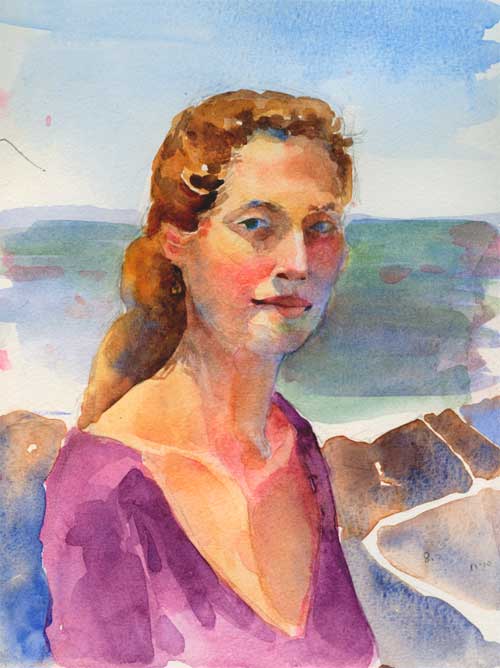
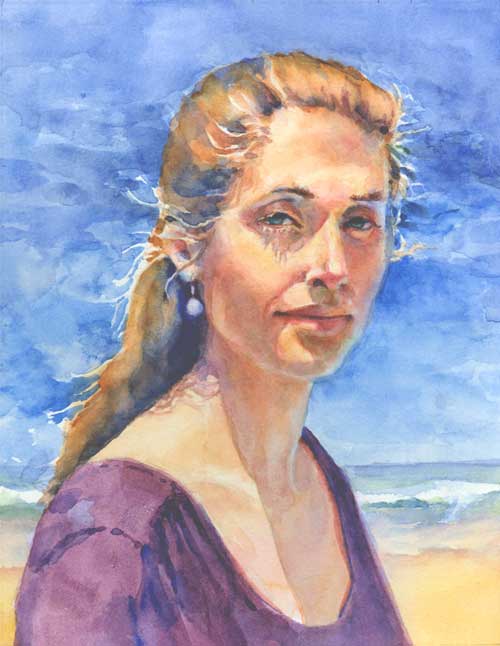
I’ve been working an image of a friend’s wife for a year. It’s eluded me, partly because the original photograph was taken with the sun overhead. A no-no; yes, I’m aware of that. But her eyelashes cast a shadow on her cheek, delicate and curved. Her hair was wisping in a light breeze. Her name is Margaret (yes, my name too!), which, according to coffee cup research, means “pearl of the sea.” The photo, although taken on the front steps of a local church, somehow made me think of the ocean, so I decided to place her on a beach.

This first painting was a color sketch, to play around with the palette and composition. The sketch looks fresh, with nice, clear colors (my favorite part is the blue and green in the shadowed side of her face) and easy brush strokes, but it was just a very quick drawing.

watercolor painting
Sketch for “Margaret”
Watercolor on paper


This is the second version, a small painting: only 8.5″ x 11″. Whatever it was that had caught my attention eluded me in this painting, although in retrospect, I like the placement of the horizon the best in this version.

watercolor painting
Margaret 1
8.5″ x 11″ Watercolor on Arches #300
© Margaret Sloan 2014


This is the current painting, larger, with more finish. From the beginning the drawing was off, asI didn’t take a lot of time with it. (I grabbed it off the drawing board to take to Open Studios so I could paint while I hung out in my booth.) That little bit of wonkiness in the drawing magnified to large proportions when I started adding paint, and I had to repaint the eyes—a couple times—before they looked like eyes that belonged together on the same face. (Lots of gentle scrubbing with an ancient Series Seven sable removed the eyes.) Note to self: Nail the drawing before applying paint.

Watercolor Painting
Margaret M.
11″ x 14″ Watercolor on Arches 300#
© Margaret Sloan 2014

I think I’ll let this last one sit in the flat file for a while, then take it out and see what can be done. Or I might repaint it again someday!


I’m interested to know what you think. Let me know in the comments field.

Open Studio Profile: Karen Olsen

Today you’ll be able to visit the 5 artists profiled at Mockingbirds at midnight. I do hope you’ll come let us delight you with our offerings!

The last artist interview for Silicon Valley Open Studios is with Karen Olsen. Karen paints beautiful landscapes in oil and watercolor, and her career in graphic design is evident in the strong designs and bold shapes she uses for her paintings.

Late Light at Grand Canyon Watercolor © 2014 Karen Olsen
Late Light at Grand Canyon
18″ x 24″ watercolor on Arches
© 2014 Karen Olsen

Describe your artistic journey
I was one of those kids who drew from the time I could hold a pencil, but my mother, who was very talented but had an unfortunate career path as an artist, encouraged me to pursue anything except art.  In my early twenties, I learned to paint in watercolor, and I dabbled in it between feedings of my newborn daughter, but still with little serious intent.  My life took an unexpected turn after that, and I was on my own, needing to make a living.  I eventually landed in the graphic design field, and for 25 years I have made my living in it.  Another life surprise recently brought me back to painting, and I now consider that I have a dual career as both designer and fine artist.

Where has art taken you in life?
I think my previous answer covers this…

Gnarled Tree at Canyon Rim Watercolor © 2014 Karen Olsen
Gnarled Tree at Canyon Rim
12″ x 16″ watercolor on Arches
© 2014 Karen Olsen

What do you think about when you begin painting?
First thought: “I wonder whether I can pull this one off??!!”

Yes, that’s sort of a joke.  But in a way it’s not at all.  Each blank sheet of paper or canvas is the beginning of a new adventure.  I may be trying a new brush, a new color, a new technique I want to experiment with, or a type of subject I haven’t done before.  Or maybe a subject I’ve done but want to see if I do better.  If it’s plein air, it’s new and unknown every single time!  Weather, changing light, curious onlookers, even bugs make for interesting challenges when painting outdoors.  So…to answer the question—I try to assess the environment I’m in and what I want to achieve, then try to figure out how to go about it.

Runner at Papohaku Beach, Molokai Oil © 2014 Karen Olsen
Runner at Papohaku Beach, Molokai
32″ x 40″ oil on canvas
© 2014 Karen Olsen

Tell me about one of your favorite paintings or drawings that you’ve made. Why is it your favorite?
Gee, I guess I’d have to select one of my Hawaiian or Grand Canyon subjects.  They are my favorites because of the joyful personal experiences that went into their creation, and which I hope are passed along through the eyes and into the hearts of the people who see them.

If you could ask one question of an artist you admire, who would it be, and what would you ask?
This isn’t an easy one.  I’ll let you pick…I can’t.  🙂

to Anders Zorn: “Your stunningly beautiful watercolor painting Sommarnöje (Summer pleasure) is so evocative, and so…well…Swedish!  It’s one of my favorites.  How long did it take you to make it?”

to Monet and friends I’d ask: “Hey, can I come out and paint with you guys one of these days?  I’ll bring a picnic…”

to Georgia O’Keeffe I probably wouldn’t ask anything.  I’d just tell her, “I could look at these paintings forever…except after a while, they make me DIZZY!”

and to Leonardo: “Who is that lady?”

You can see more of Karen’s work at  www.karenolsenfineart.com

Karen Olsen will be exhibiting May 10-11 at 1471 Hollidale Court, Los Altos, CA 94024 and May 17-18 at  247 Velarde, Mountain View.

How to begin a painting


Study for painting 3" x 5" watercolor painting
Study for painting
 I’ve started the drawing for this painting. Six hours into the drawing and I feel like it’s just beginning to emerge from a mush of pencilscratchings. But I dreamed the colors, and couldn’t wait to get them onto paper. 

Painting is a very slow process for me. I’m not a slap dash painter; I dream, plan, draw, make more drawings, prepare my references, compose the image, draw the image, stew and chew my cuticles, draw some more, then finally start to paint. In a world of instant gratification, I’m a total throwback.

But when, at his workshop last week, Ted Nuttall told me to keep working on my drawing for the whole of the first day, my heart kind of grinched around in my chest. I’d already spent a lot of time on that drawing, but hey, I was paying the man to help me with my life’s work.  I kept at the drawing, all day, and eventually, I really looked at it.  And there was a sorting, as if things were sliding into place. I found a multitude of drawing mistakes that would have plagued me once I began to paint; fixing those mistakes felt really good, like scratching an itch in the deep part of my heart. The painting eventually became Strength. It has a certain clearness, a crispness that I really like. It makes music in my head.

There are days, though,  when I have to simply let go and paint. If you paint, you know what I mean: You need to feel the water love the brush, and the brush kiss the paper with paint . That’s the time for color  studies.

These next two studes are for a painting my Dad has requested. It’s a small black and white photo of my mom he’s had in his wallet for nearly 60 years (can it be that long since they were so young, beautiful, and full of early romance?).

Study for painting 5" x 3" watercolor study
Study for painting
5″ x 3″ watercolor study


It’s interesting how the composition and editing of the background changes the story. What stories do you see?

Study for painting 5" x 3" watercolor study
Study for painting
5″ x 3″ watercolor study

Farm memories

Although I grew up in the city, I come from farming people. I grew up with so many stories of the farm, the family, and the various chickens, goats, and cows, that I sometimes feel I lived alongside my ancestors.

I’ve certainly romaticized their lives, although I know that it was a hard life; subsistence living is never easy. But I’ve heard their stories, told with a slight bitterness towards the privations, but mostly washed by a greater love of their lives. It makes me wonder if today, in our lives of relative ease, are we really happier?

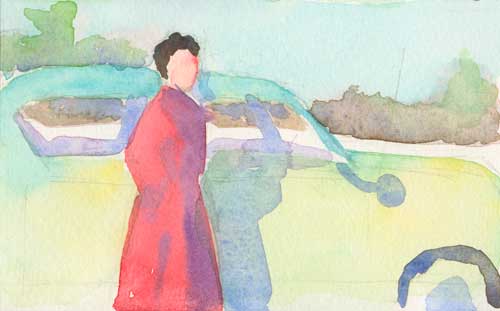
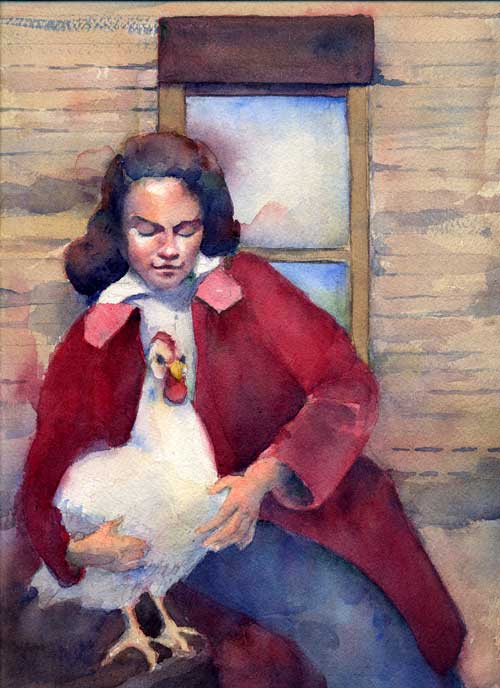
Her Favorite Red Coat
Watercolor © 2011 Margaret Sloan

This is a small painting: 9″ x 12″ on Arches cold press. Yes, it’s from a photo-a black and white photo at that. Right now I’m enjoying working from black and white photos. They give me greater freedom in color choices and combinations. Unchained from the tyranny of the camera’s red-blue-green, I can make my own statements. (Of course, now that the painting has been fed back into the camera and computer, I can see errors that will need fixing, mostly edges that need softening.)

That little girl is all grown up now, and that chicken long emigrated to chicken heaven (grasshoppers and freshly sprouted gardens abound!). Some painters gripe about painters who paint from photos. “Why paint it if you can take a photo of it?” they ask. But without this dusty photo, I could not have made this sweet painting, and this little girl would have been lost.

Are you a painter? What do you think about using photos?

Teatro Zinzanni

Mat Plendl of Teatro Zinzanni

It was one of the best Christmas gifts ever, a family outing to Teatro Zinzanni in San Francisco. The  tag line is “Love, Chaos, Dinner.” And it’s true.

It’s like dinner theatre/circus. Every act is spot on, funny when it’s supposed to be funny, amazing when it’s supposed to amaze, and always entertaining. All this and they feed you too!

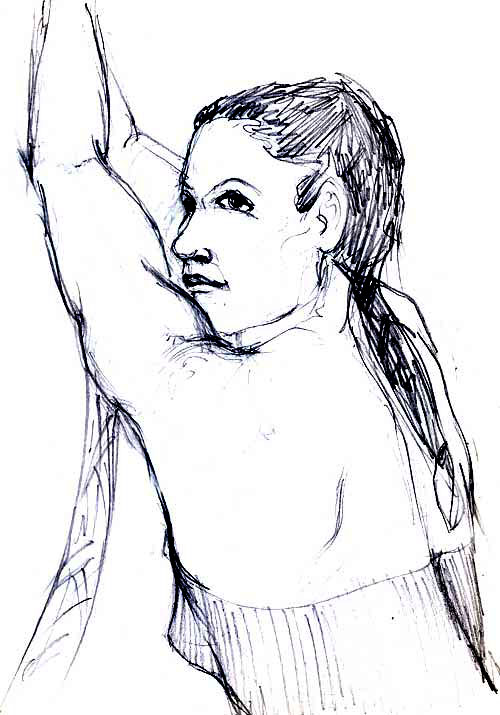
Marina Luna

There was juggling, trapeze, singing, dancing, clowns, even hula hooping. All the artists were phenomenal. The professionalism, energy, and grace with which they performed was amazing. It was so enchanting and fast paced that I didn’t have time to do any sketching, so I had to sketch from memory when I came home.

My favorite act was Marina Luna, an aerial artist who has a terrific dance on the rope. I would love to sit and draw her as she worked on the ropes, and would love to get her to model for a portrait.

If I were younger, beautiful, and talented, I’d run away and join a circus.

The Great Dickens Christmas Fair

We kicked off the Christmas season with the Great Dickens Christmas Fair Sunday. It was delightful and entertaining as usual. Dickens and the Victorians practically invented my idea of Christmas, and I love the play-acting.

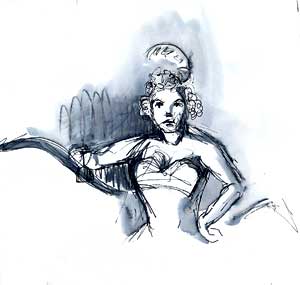
This year I went prepared to sketch with a Tombow dual brush pen, a Niji waterbrush, and several Staedtler pigment liners. I used the same 7″ x 7″ hard-bound Daler Rowney I used last year for my first foray into public sketching. I have to admit I still haven’t finished that journal, and besides, I thought it a proper and fitting way to round out the year.

I decided that I’d do at least 10 pages of sketching. I counted journal pages, and put a big number 10 on the tenth page so I’d know I’d reached my quota of sketching for the day.

And I did it.  Some of my pages aren’t anything I’d want to show anyone, but oddly, the least successful as sketches have the most possibilities for future projects. I’ll blog about the completed projects later.

Sketches I will show you

Polka at Fezziwig’s Dance Party

Fezziwig’s Dance Party was as fun as always. In fact, it was more fun this year because the players asked us to dance, and then they taught us to waltz.

Waltzing with someone who knows how to do it is an experience verging on the sublime, and I recommend you run right out and find someone to teach you. In fact, any of the old-style dances are barrels of fun, and I think everyone should try them. Fortunately, the Bay Area has a lot going on. Try the Period Events & Entertainments Re-Creation Society  (Peers) website. They sponsor scads of events, and their links page gives even more info on other local and national period reinactments and events.

Irish Step Dancer

The Siamsa le Cheile dancers put on a terrific exhibition of traditional and modern-style Irish, Scottish, and Cape Breton dancing. After all these years of being involved in the music and dance, this stuff still makes my heart stand up like a 4-year old kid and whirl around till it’s dizzy.

The Dark Garden window displays seem like a perfect spot to draw, since the models hold their creative and cute poses very well, and let’s face it, just about everybody looks better in a corset. Unfortunately, the windows are also a perfect photo-op, so there’s a lot of jockeying for position with photographers. Also, people do love to look over your shoulder and comment on your drawing. Maybe some year, when I’m more confident sketching in public,  I’ll get a hoop skirt, set up my easel, and become a part of the show.

Year of the portrait

Unfinished self-portrait

Each fourth-year student at the atelier chooses a thesis that they work on in and out of class. My area of focus is portraits. Because one of the things I’d like to be doing is drawing portraits. Ppeople fascinate and  confound me, and compel me to try to understand them. And drawing them helps me do that.

In college a million years ago I studied theatre, which is really the study of humanity, magnified by over-the-top drama, stage makeup, and masks. Theatre, and the people attracted it, can be a risky business. It can be quite painful. So one year I gave up theatre to study horticulture.

I did that because—aside from being obsessed with plants—I found that studying the sciences of botany and soils had a certain kind of safe roundness in which I could wrap myself. There were no lumpy inconsistencies and thorny disputes of the kind that make humanity a hard garment to wear. And so for years I immersed myself in the study of horticulture.

During that time I had a dog.  She was a great dog, but she didn’t really know she was a dog. She’d really never been around many dogs. Then we moved into a house where there were two other dogs. Much to her surprise and delight, my dog discovered her canine heritage. And she loved being a dog. So much that for a few months, she would barely speak to me. She just hung out with her two biggest, bestest doggie buddies.

Like that long ago dog of mine, about a decade ago I suddenly found myself  in a place full of people. It was hard going at first. But slowly I’ve discovered that I am, indeed, a human, and that other humans are fascinating. Maybe I like being human again.

And so  I’ve come back around to studying humans. Don’t get me wrong. I still love the green world, and seek refuge among forests, meadows, and gardens when the human world gets to be too much (and it does, believe me, it does). But I’m learning to deal with the humanity of the world.

And I find that drawing helps me figure people out. That’s a plus. And when I’m drawing a portrait, I can sometimes connect with the person I’m drawing in a very deep, intuitive way. I really like that.

And so, I’ll be drawing a lot of portraits, and studying the where’s, why’s, and who-to-fores of portrait drawing, along with the study of all my other fractured interests. I’ll share what I learn here on this blog.

The practice of music and art

Pastel pencil on colored paper

This is a small drawing I made of my friend Cyndy. It’s from a photo taken as she was sitting around a campfire, playing tunes with a group of musicians.

I know Cyndy’s present teacher. He’s told me that she’s the kind of student a teacher loves to have. She really thinks about the music she plays, and she makes him think about it too. And she practices!

She’s passionate about her fiddle in the way most of us are passionate about a new romantic partner. But, come to think about it, I know a lot of musicians who are married to their instrument, and playing music is simply part of their everyday experience. I also know artists who feel the same way about their art. (I’m torn between the two. Do I play tunes, or do I draw? Tough question, that.)

Sometimes playing music or making art becomes a stale thing, or a stressful thing, fraught with needs and cravings that block the joy of our passions. But if we really think about what we’re doing, and lose ourselves in the process, suddenly the work becomes play, and we amaze ourselves at our success.

Shannon Heaton, one of my favorite Irish flute players, has a terrific blog at Whistle and Drum called The Inner Game of Irish Music about practicing the music. She’s talking about Irish music, but she could be talking about drawing, painting, old time music, classical music, dancing, or even just plain-old, everyday work.