I worked on the image from my St. Stephen’s day post, and made another, more solid watercolor sketch. I don’t have a real wren to draw, so I had to cobble together an imaginary wren from an identification book and several online photographs.
When I lived in Mexico, a little wren lived in the trees next to my house. Every day at about 2:30 she would come in through the always-open kitchen door, make a circuit of the living room (she loved the indoor garden), and after about 30 minutes she would exit through the living room door. She was quite unafraid of me and the dog, and after I caught her killing a scorpion by beating it to death on the metal window bar, I always graciously bade her welcome into my house.
Unfortunately I didn’t draw so much then, so I lost my chance to sketch that little bird. I shall have to figure out how to invite a wren to my home in California.
Some of the funniest entertainment at the Great Dickens Christmas Fair is in the Victoria & Albert Bijou Music Hall. This year they’re performing the Mikado in an hour, and it will make you laugh.
It’s like a send up of a Victorian Thespian Society putting on community theater in their bathrobes. Most of the voices are Gilbert & Sullivan worthy. Yum-yum can hit those high notes and be heard in the next county. Nanki-poo has a smooth tenor. But even if the actors don’t have an operatic voice, they are still fun to watch. Ko-Ko, the Lord High Executioner was very fun to watch as the actor (what are these player’s names anyway? Is there no cast list anywhere?) played a slightly nerdish Victorian banker-type who’d been cast into the role because he was just really funny. And the Mikado is as pompous as any businessman playing an emperor might be.
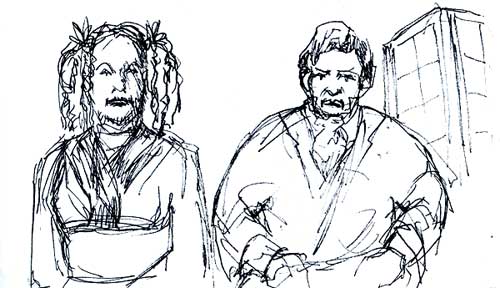
The Mikado and Ko-Ko, the Lord High Executioner
Plus, the play was a great sketching situation, as I could get a grip on what each actor looked like and have plenty of time to do gesture drawings as they posed and sang.
If you think this blog might be of comfort to someone, please share it
We kicked off the Christmas season with the Great Dickens Christmas Fair Sunday. It was delightful and entertaining as usual. Dickens and the Victorians practically invented my idea of Christmas, and I love the play-acting.
This year I went prepared to sketch with a Tombow dual brush pen, a Niji waterbrush, and several Staedtler pigment liners. I used the same 7″ x 7″ hard-bound Daler Rowney I used last year for my first foray into public sketching. I have to admit I still haven’t finished that journal, and besides, I thought it a proper and fitting way to round out the year.
I decided that I’d do at least 10 pages of sketching. I counted journal pages, and put a big number 10 on the tenth page so I’d know I’d reached my quota of sketching for the day.
And I did it. Some of my pages aren’t anything I’d want to show anyone, but oddly, the least successful as sketches have the most possibilities for future projects. I’ll blog about the completed projects later.
Sketches I will show you
Polka at Fezziwig’s Dance Party
Fezziwig’s Dance Party was as fun as always. In fact, it was more fun this year because the players asked us to dance, and then they taught us to waltz.
Waltzing with someone who knows how to do it is an experience verging on the sublime, and I recommend you run right out and find someone to teach you. In fact, any of the old-style dances are barrels of fun, and I think everyone should try them. Fortunately, the Bay Area has a lot going on. Try the Period Events & Entertainments Re-Creation Society (Peers) website. They sponsor scads of events, and their links page gives even more info on other local and national period reinactments and events.
Irish Step Dancer
The Siamsa le Cheile dancers put on a terrific exhibition of traditional and modern-style Irish, Scottish, and Cape Breton dancing. After all these years of being involved in the music and dance, this stuff still makes my heart stand up like a 4-year old kid and whirl around till it’s dizzy.
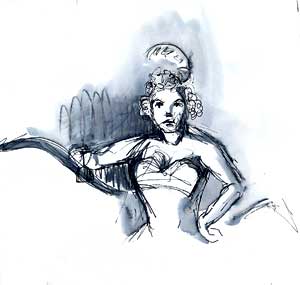
The Dark Garden window displays seem like a perfect spot to draw, since the models hold their creative and cute poses very well, and let’s face it, just about everybody looks better in a corset. Unfortunately, the windows are also a perfect photo-op, so there’s a lot of jockeying for position with photographers. Also, people do love to look over your shoulder and comment on your drawing. Maybe some year, when I’m more confident sketching in public, I’ll get a hoop skirt, set up my easel, and become a part of the show.
If you think this blog might be of comfort to someone, please share it
Each fourth-year student at the atelier chooses a thesis that they work on in and out of class. My area of focus is portraits. Because one of the things I’d like to be doing is drawing portraits. Ppeople fascinate and confound me, and compel me to try to understand them. And drawing them helps me do that.
In college a million years ago I studied theatre, which is really the study of humanity, magnified by over-the-top drama, stage makeup, and masks. Theatre, and the people attracted it, can be a risky business. It can be quite painful. So one year I gave up theatre to study horticulture.
I did that because—aside from being obsessed with plants—I found that studying the sciences of botany and soils had a certain kind of safe roundness in which I could wrap myself. There were no lumpy inconsistencies and thorny disputes of the kind that make humanity a hard garment to wear. And so for years I immersed myself in the study of horticulture.
During that time I had a dog. She was a great dog, but she didn’t really know she was a dog. She’d really never been around many dogs. Then we moved into a house where there were two other dogs. Much to her surprise and delight, my dog discovered her canine heritage. And she loved being a dog. So much that for a few months, she would barely speak to me. She just hung out with her two biggest, bestest doggie buddies.
Like that long ago dog of mine, about a decade ago I suddenly found myself in a place full of people. It was hard going at first. But slowly I’ve discovered that I am, indeed, a human, and that other humans are fascinating. Maybe I like being human again.
And so I’ve come back around to studying humans. Don’t get me wrong. I still love the green world, and seek refuge among forests, meadows, and gardens when the human world gets to be too much (and it does, believe me, it does). But I’m learning to deal with the humanity of the world.
And I find that drawing helps me figure people out. That’s a plus. And when I’m drawing a portrait, I can sometimes connect with the person I’m drawing in a very deep, intuitive way. I really like that.
And so, I’ll be drawing a lot of portraits, and studying the where’s, why’s, and who-to-fores of portrait drawing, along with the study of all my other fractured interests. I’ll share what I learn here on this blog.
If you think this blog might be of comfort to someone, please share it
Last Saturday we went to see the show Into Pergamon by Rob Anderson (my teacher at the atelier). The show centers around a collection of drawings he did of the Great Frieze of the Pergamon altar that’s now in Berlin.
This is great stuff! His work is subtle, seemingly delicate at first, the charcoal like feather marks on the paper. But the longer you look at it, the more you see the strength and internal integrity of it. It comes into focus suddenly and forcefully, and simple charcoal and chalk drawings on brown handmade paper come alive with the clash of giants and gods at battle.
In his bio, it says, “He [Rob] did not in a moment of inspiration walk into his studio to spill out these skillful drawings in a fit of artistic passion. It didn’t take him a day to complete these works, nor did it take several days, or even weeks, but months of tedious and arduous work.”
It struck me that the time he took to make these drawings is almost as powerful as the drawings themselves. In our instant-society, where we expect everything to get done in less time than it takes to cook Uncle Ben’s minute rice, this kind of focus and dedication is rare.
And it makes me wonder if the new direction fine art will take will be back towards craftsmanship, back towards thought, and planning, and effort.
There is a movement, to be sure, of artists who want to study realism, but the big guns, the critics and columnists, the editors and galleries, don’t seem to value this, calling it a “populist movement.”
“Sheer draftsmanship,” they sneer.
But draftsmanship coupled with artistic vision…doesn’t that put a drawing or painting squarely back in to the realm of fine art? It becomes something that is valued not just for the thing itself, but the thought, dreams, and desires, and the time that went into the making.
Into Pergamon is at Ohlone College in Fremont until February 6, 2010. Give yourself plenty of time to see it.
If you think this blog might be of comfort to someone, please share it
Just a few more photos of costumes. The level and detail of the costumes just amazed me. Wish I had more photos, but there are tons more photos from other people here.
A Happy Couple.Wonder if she lets him wear his rocket pack in the house?
This guy even assumed the sorry-my-darling-but-duty-calls aura worn by any daring officer of world adventure.
And, of course, your’s truly in a new bustier/shirtcoat/dressy thingy. Never felt so lovely in all my old life!
At the Abney Park part of the Seattle SteamCon concert, I had an odd, disconnected moment when three beautifully proper Edwardian ladies threw off their jackets and started boogying across the floor.
My niece loves Abney Park. The band is edging towards something I’d like to listen to. But I’m put off by the karaoke-style drum track—guess I’m just old fashioned and want a drummer that I can swoon over. Captain Robert whapping on a djembe is not the same as a guy on a kit.
However, their show is wonderful. I love watching them. The costumes are wonderful, the stage business interesting, and sometimes they have a belly dancer! I’m just not so into listening to them. But that could change. I’ll keep trying.
I’ve been trying hard to like Steampunk music. Honestly, I have. I’ve listened to most of the jukebox at Sepiachord.com. I’ve sampled some of the Steampunk bands at LastFM.com. (ok, Circus Contraption’s cut Come to the Circus comes close to being interesting, and Clare Fader’s throwback Caberet Noir is compelling), but I’m still not sold on the style.
The underlying story/fantasy behind Steampunk is a future that never was, full of cool clothing, sprockets and gears, wheels, and mechanical engines. It’s theatre, pure theatre.
Airships powered by magical steam ply the skies. Horse-drawn buggies plod along next to whizzing locomotives. Science thrusts satin-skirted ladies (full of buxom adventure) into the arms of mad scientists. Gentlemen (and women) adventurers explore new worlds; they study new species of plants, animals, and people.
Steampunk is a place where people can have wings.
My favorite part of the whole convention (besides the costumes) was the “radio show” put on by the folks at Studio Foglio, publishing house for and creators of the online comic, Girl Genius. What fun that was! It was sort of a reader’s theater. I love radio shows, but this was even more fun to see the folks doing the lines. What a bunch of hams. .
If you think this blog might be of comfort to someone, please share it
The virgin looks great, but who told the chancellor this haircut was a good idea?
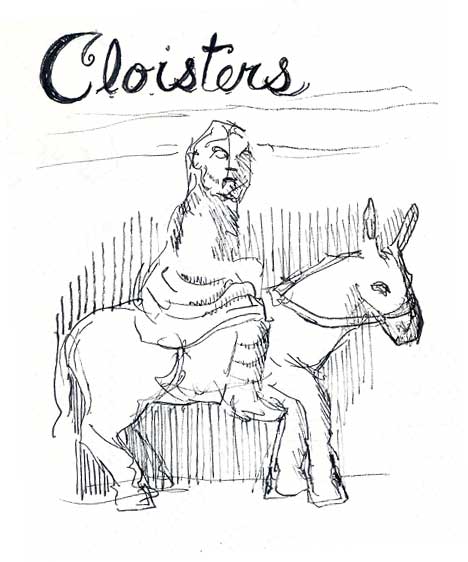
I am afflicted with art attention drift. After years of loving 19th-century realism, suddenly, after a first visit to the cloisters in New York City, I’ve become enamored of Medieval art. And not the later stuff, when artists were working out the rules of perspective and the craft of realism and coming up with beautiful renditions of the Virgin and baby Jesus blessing some guy with a weird haircut.
No, I like the early work, the cartoony figures, the lack of perspective, and the patterns. Lots of patterns. Because if they couldn’t draw a figure worth a damn, at least they could make beautiful patterns, compulsively covering church walls and painted parchment with animals, people, flowers, leaves, stalks, and bibs and bobs and swirling loop de loops.
James Gurney says this is called Horror vacui, the fear of open space. I don’t know if folks in the middle ages were particularly fearful of open spaces; I’m thinking it might have been more a function of some rich guy saying, “hey, Duke Weligsburdof in the duchy next door has half a wall that’s got paintings all over it. Be cool to have one of those too. I’ve got an empty castle wall here, and the son of the serf in cottage #5 is a pretty good painter. Let’s fill this wall with pictures so it’s even more chock-a-block full of weird creatures and lovely maidens than Weli’s wall. Then we’ll have a dinner party, and we can all look at it. That’ll make Weli green with envy.”
It was a sure-fire way to impress the guests. In those days, painted, carved, or cast images were rare; there was little to look at other than the pile of garbage outside the south castle window. And church services were no doubt interminably long with that guy with the funny haircut droning on and on and on in Latin. All those intricate portals and tapestries, the crenelated baptismal fonts, the fancy work and bible stories in stone must have been like television for the Medieval man or woman, entertaining their brains while fueling them with stories and propaganda.
Today we are awash with images. We’ve got so many images, so much clutter (in the 21st century, society at large is suffering from horror vacui) that it’s a sign of wealth to have spacious houses empty of all but some uncomfortable furniture and an ugly rug. But nearly every household in America has a television. Sometimes every room in an American house contains a television.
And I suppose, like the complicated designs of Medieval art, television fills a vacuum in folks’ lives.
If you think this blog might be of comfort to someone, please share it







 Mockingbirds at midnight