Drawing the portrait: week one and two

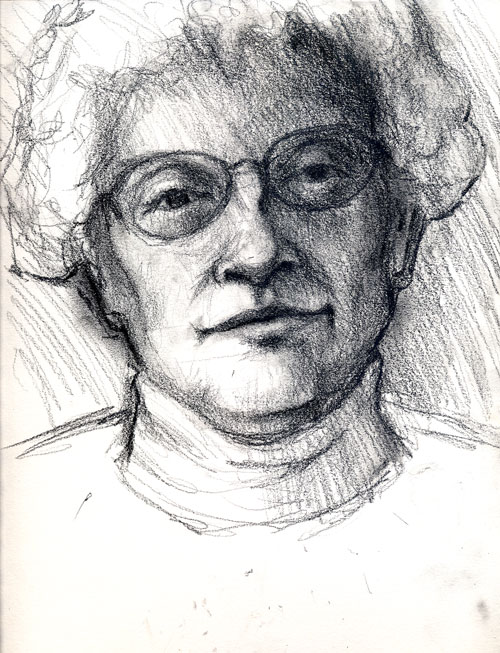
The portrait class (I told you about it last week) taught by Felicia Forte has been going well. Felicia is a lovely teacher; her classes are low key and she encourages students gently, without condescension or brittleness. Felicia does wonderful charcoal work; her drawings have the most beautiful soft but strong marks. They have an integrity that I’m striving to create in my own work. They hold together, you know?

Here are some things I’ve learned:

  • Make fewer lines and make them well. No scritchy-scratchy searching lines. Observe correctly and make confident, correct marks.
  • Draw the big shadow shapes first. Don’t go for detail right away. (And why, oh why, do I have to relearn this repeatedly? Will this ever become something I do automatically? Or will it always be my weak point, my charcoal smudged Achilles’ heel?)
  • Keep the shading simple. Use strokes that all flow in one direction so that blocked in masses don’t become confusing and distracting.
  • Think about design as you work. This is especially true for short poses during which we make four 5-minute drawings, all on the same page. This is probably the hardest lesson for me to learn; it requires not just observation and motor skills, but also really thinking and planning ahead.
  • Draw! The biggest, most important lesson of them all. Draw all the time. Then draw some more. Always  with an active, curious mind.

Winter of the portrait

Graphite portrait of a good friend as she told me stories of her life on the farm.

I love drawing and painting people. It’s a passion that runs contrary to my introverted character, but there you have it. Our brains don’t always behave in completely logical fashion.

The thing I love most about portrait painting is that I get to touch a subject’s stories. I touch those their tales with my ears and with my paintbrush. Above all else, I love story.

Last year was my Year of the Portrait, and I see no problem with 2011 being Year of the Portrait Part II. Wednesday I start a portrait drawing class with Felicia Forte, a teacher new to me. I am nervous, a bit (meeting new people is always out of my comfort zone), but looking forward to it.

Dream Time at New Year

I don’t like to make New Year resolutions. For me, setting goals at the end of the Christmas holidays is an exercise doomed to failure. I’ve been on break, for heaven’s sake. For the last two weeks in December, the day job  was whittled down to giggly celebrations, vacation time, and three-day weekends. Visiting with family  and general laziness all ’round.

So I’m really in no position to decide on a regime of resolutions to follow in the year to come. Because when life returns to it’s normal race, I’ll fall behind on any resolutions I made during downtime.

I guess my only resolution is to keep to the usual goals: Draw. Paint. Try not to let life unhinge my self-discipline. (These goals never change.)

Instead, I dream on New Year Day. And this year, the biggest dream of all is to somehow have a painting studio. I do all my work in my living room right now. As you can see in the photo, it’s cramped, crowded, and a wreck. I have to clean it up on Sundays, so we can live in it the rest of the week. Some weeks it never gets tidied at all.

I’ve been told, put your dreams out to the Universe. Let It know what you want. So I’m going to do that, and put it out to the blogosphere. You never know what might happen.

What I wish for:

A garage, a room, a shack, near my home (this is important, because otherwise I’d probably never go to the studio).

It needs to be something that I can afford and be able to lock up when I’m not there. It should have electricity, heat, and light (Oh Universe, would a north facing window be too much to ask?). Big enough to have work table, easel, and a model stand.

There. The wish is out there. Does the Universe read blogs?

Christmas eclipse

I’m dragging this morning, because I had to stay up (wa-a-ay) past my bedtime to watch the lunar eclipse. It was the first eclipse on the solstice in nearly 400 years, and that’s got to be portentous.

I didn’t think we’d be able to see it through the storm that’s been drenching the Bay Area. But at 11 the storm abated, and the clouds thinned. The moon flitted like a shy bird behind the blue-white skeins of stratus.

We sat in the backyard with the damp wind tugging at our hair, and watched the bright silver disk get eaten by the shadow of the earth. She turned dusky orange as scraps of clouds blew across her face. Wintery Orion and Gemini, growing more brilliant as the moon dulled, stood sentinel around her, Orion with his head towards her, and the twins, Castor and Pollux, facing away. She seemed well guarded in her moment of weakness.

A plane flew between the moon and a cloud, and the jet’s shadow was projected across the scrim of cloud, looking like a giant child’s toy.

Then the storm returned, and clouds hid the moon’s face as she regained her silvery self. Tonight she’ll rise at about 5:30, unencumbered by our shadow.

Happy Solstice.

What do your holiday parties look like?

1867-1917-NewYearReaIrvin
Cartoon by Rea Irvin for "Life" magazine, ink over graphite underdrawing. Via reproduction online at Library of Congress website
Thanksgiving last night; the first party of the holiday season. And it was a blast.

Yes, we ate the required phenomenal amounts of turkey, carbo-loaded until our pancreases (pancrea?) screamed, and foundered on vegan chili and pumpkin pie. And while good food is always the center around which all great parties are built, what happened after the food fest was what made the party a blast.

It started with the mathematician and I playing some tunes. Normally, when we play tunes, people gravitate away, into the other room. “Oh, we’re listening,” they say, but they’re really not. The fiddle and whistle are loud, and make conversation difficult. Folks would rather gab.

But last night the other guests actually sat in the same room with us while we played! In between tunes, my dad and the host traded bad jokes about the Irish (we play traditional Irish music. These jokes go with that territory)

Boldly, we asked if someone wanted to sing a song. Someone did! A lovely piece.

Then, we asked, did someone else want a go?

The host didn’t bake a ham for that party; she didn’t have to. The room was full of hams!

The host’s sister and boyfriend dragged out a lap dulcimer and a ukulele and we sang Amazing Grace. A guest told a poem.The dulcimer and ukulele played Greensleeves. Someone told another joke.

It was fun, people! Nobody turned up their noses and sniffed. Rather, nearly everyone participated in some way; everyone had some sort of party piece that they could contribute.

That was a perfect party, as far as I’m concerned. No canned music, no artificial conversations, just folks sitting around, trading turns and entertaining the rest of the gathering, bringing their own selves to the center, then cycling out to allow the next song, poem, or joke.


More owls

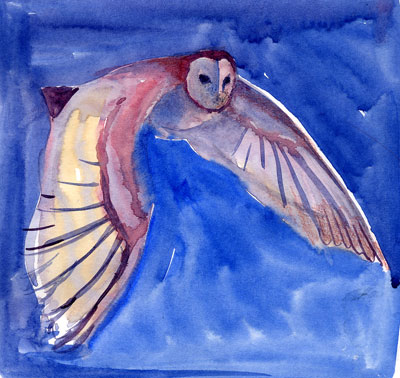
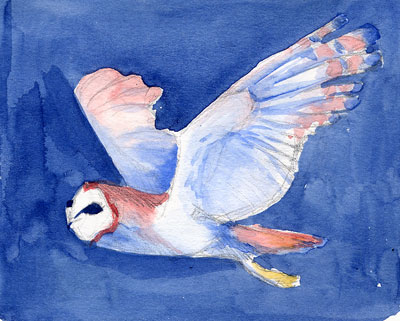
Sometimes, you know, life makes me feel a little earth-bound. Painting helps take me away, if only in my sketchbook. Again, we have some more owls.

Feathered journey

The wanderings of this blog are often paths of odd connections sparked by one simple beautiful thing.

For instance, how did I decide  to write about owls in my previous post?

It started with a beautiful image by Jude Hill. I love that image, and in order to internalize it, I “interpreted” her stitched image with watercolors. Since the original image is not mine, I can’t share my interpretation with you.

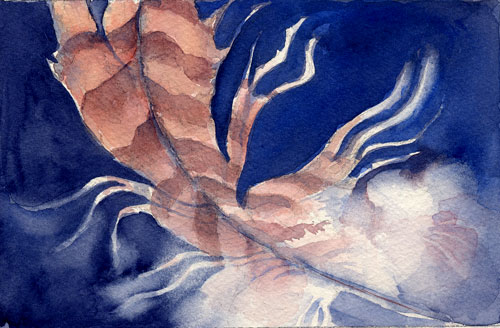
But while painting that image, I remembered some feathers (I think they are from a barn owl) I found in the Sierra. So I dragged them out to make a painting of them (the fluffy part—called the after feather!—was really hard to paint. Or not paint, as the case may be). While working,  I suddenly remembered the barn owls I’d seen in the middle of Sili Valley and knew I had to tell you about it. And I  had to draw some owls.

Now my sketchbook is filled with feathers and owls, and such moonlit dreams that I have on these dark autumn nights.

Barn owls

Barn owl
Pastel sketch by M. Sloan

It was late. Downtown. And a pale shadow soared silently overhead.

It was only the flash of unfurled white wings that caught our attention. We looked up just in time to see an owl landing on a parapet of city hall.

We heard small papery cries. Then, in another flash, the owl sped away. After a bit, two small faces looked down at us, as curious about us as we were about them.

They were baby barn owls, probably the most human looking of all birds. Right then and there I fell in love with them.

ARKive video - Barn owl in flight

Barn owls haven’t always been loved. People have believed (still believe!) all sorts of malicious things about owls: they’re harbingers of death, witches, and bad weather. Barn owls have screetchy voices that creep people out. They look like ghosts flying around in the dark. So we humans have hunted and persecuted them over the years.  We build cities over their roaming grounds. Like other animals that aren’t human, they’ve been in decline.

But they eat prodigious amounts of rats and squirrels. They’re good critters to have around. (I don’t know about your town, but in ours, we could sure use some help with rodent control.)

And clearly, barn owls will live in a mixed suburban setting (we’ve got lots of trees, and open space and green belts flanking the megalopolis).  But the birds need nesting places. I would love to put up an owl box in my garden.

Barn owls won’t steal your babies, your money, or your soul (I’m not so sure about chickens, though. Some say yes, some say no. Does anyone know for sure?). According to The Owl Pages, “the Inuit see the Owl as a source of guidance and help.” If you have to believe something about owls, believe this Inuit tale. And believe that barn owls are incredible creatures to see as they ghost their way through the night.

Other owl box sites:

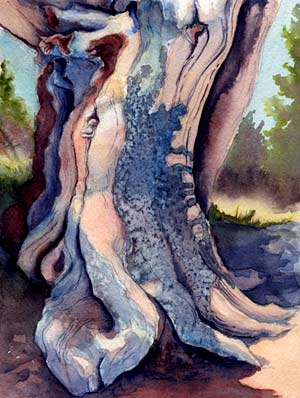
Bristlecone Pine

Bristlecone Pine
Watercolor by Margaret Sloan

This summer I got to meet the bristlecone pines of Great Basin National Park in Nevada. They live precariously above 10,000 feet between rock and sky. The oldest have been there on the mountain for thousands of years. Some have only a thin strip of bark sheltering a living cambial layer; only that bit of xylem and phloem spirals up the dead part of the trunk to the branches that are still alive.

The trees clasp the rock, seeking out the little bit of soil they find there. They stretch branches of tight, bunchy needles to the sun. I thought they seemed as if they were a conduit between the planet and the sky. When the wind whistles through the short green needles, surely the mountain can feel the branches shiver through the wiry, grasping tree roots.

I fancied the trees spoke to me in long, slow, booming voices. I can’t tell you what they said. Perhaps they just let me know they exist, and that they knew I exist. I know this sounds all Tolkieny and Entish, but when faced with these weathered Methuselahs in the thin air above 10,000 feet, a person thinks these things.

Blogger  Susan Miller posted this quote from  In the Global Forest by Canadian botanist Diana Beresford-Kroeger:

“If we go into the forest, we enter a cathedral of creation that we cannot fully understand and that we should not touch. If we go into the forest, we’re blind, deaf and dumb.  We’re blind because trees have perfected the photo-reception of sunlight while we haven’t. We’re deaf because we can’t hear the long sound waves of the movement of trees. We’re dumb because today’s best chemists cannot make some of the chemicals produced by trees. Simply put, we should never forget that as a species, we’re all connected through trees.”

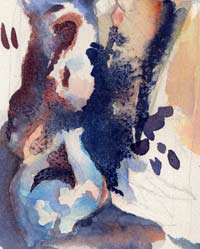
I only made 4 studies for the painting at the top of the post. Once I started the final piece, the painting pretty much just fell out of the paintbrush onto the paper.