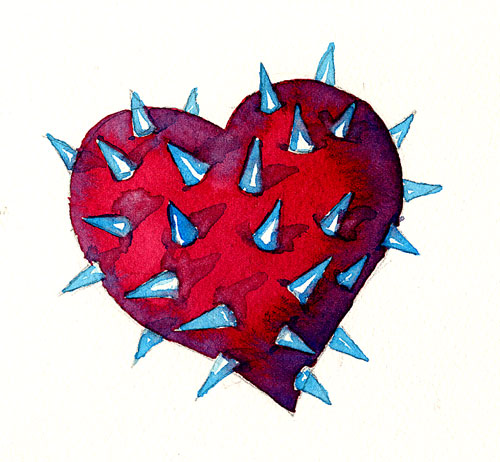
The martyred heart

No me toques

It’s nearly Valentine’s Day, a holiday named after some poor martyred early Christian. We don’t even really know who he was. Or maybe there were even more Valentines than just one. We don’t know much about them either. There’s a lot of rumor and supposition.

Safe to say, there wasn’t much romance in their martyrdom.

The Anti-Valentine Countdown

A whole heart can't hide the cracked shadow

Valentine’s day. Not my favorite holiday. But not my least favorite either. (That would have to be New Year’s Eve, when I feel forced by social custom to be jolly, giddy, and go out and have mindless fun. Eh.)

Normally I just sort of ignore the holiday. It’s hard to make romance fit a schedule; it either happens or it doesn’t.

Perhaps you, dear reader, are not a fan of hearts and flowers fun either. Or perhaps you have reason to dislike this holiday. So to you I give the gift of 7 days of anti-Valentine’s illustrations. One per day. I hope you enjoy them.

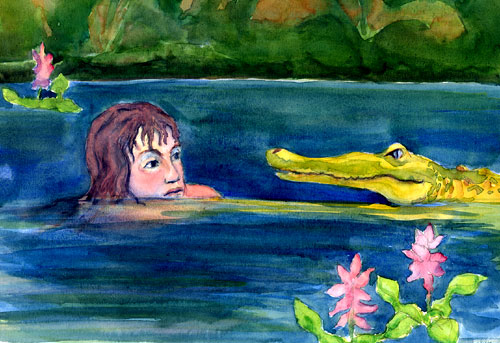
Swimming with crocodiles

After my last post, I was compelled to paint this picture. And I’m also compelled to admit in the spirit of pure honesty, I’ve never really done an Esther Williams-type swim with crocodiles. It was more like, while I was lolling in warm salty water, I heard a muchacho say, “hey, señorita, don’t go swimming in there. There might be crocodiles. ” And then I heard gales of laughter. And one afternoon I swam in a lake where, later that night, I would go hunting crocodiles. Or maybe we were hunting alligators. I’m not sure. At night, in the liquid black water, I could see shining eyes of some large critters.  But the only thing we  caught was the last round of beer at a local cantina.

But the illusion of danger was still there. And there’s something about that type of risk that makes a person feel free.

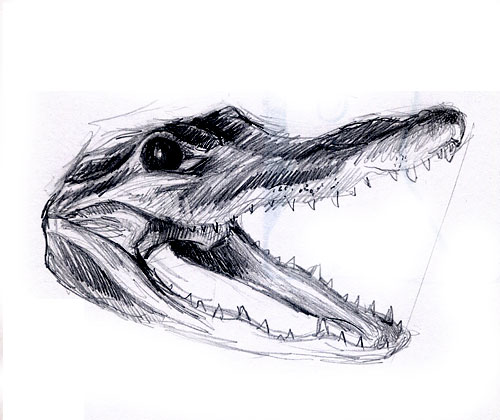
I have floated through cathedrals of mangrove roots among clouds of seahorses, I’ve snorkled over forests of coral and scared a baby barracuda. But those toothier denizens of the agua?  We’ve never come face to face. But I’ve flirted from a distance.

The eyes have it

Ricë Freeman-Zachary, at Notes from the Voodoo Cafe posted the Nadine Stair poem. You know, the one in which she talks about what she’d do if she could live her life over. She’d make more mistakes, be sillier, eat ice cream.

Hmm, well, I was one of those people who decided at an early age to live differently. I climbed mountains, swam rivers (with crocodiles!), and ate a lot ice cream. I didn’t live sanely for the first half of my life. Yeah, it was fun. Yeah, it made me what I am today: A person with a lot of unusual experiences, great memories. The problem was, I didn’t really apply myself to anything but experiencing. So now, well, there’s a lot I do without.  So for the last 10 years I’ve been doing the sane thing, with a raincoat and hotwater bottle, trying to make a parachute with which my misspent youth can land more softly into old age.

Sort of.

Problem is,  I can’t seem to shake the need to live creatively. I can’t shake the obsessive need to draw and paint, to tell stories, to sing and play music, even if it means I don’t study something useful, like accounting or database design. Sometimes I get discouraged, and vow to stop all that watercolor and charcoal activity. Pack away the flute and whistle.
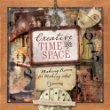
But then I read books like Ricë’s book, Creative Time and Space; Making Room for Making Art. It gets me going again, makes me realize that there is a place in the world for people like me, and that sometimes some of us can earn a living. It’s like a little jet pack, boosting me to create every time I dip into it.

And I’m trying hard to live creatively, even while I’m wearing a raincoat and lugging around that hot water bottle.  I often get to climb, if not a mountain, at least a hill. And I occasionally eat ice cream.

But I have given up the crocodiles. For a while. At least until I’ve got some sort of parachute patched together. Then who knows where I’ll land.

A better wren, a better rider

I worked on the image from my St. Stephen’s day post, and made another, more solid watercolor sketch. I don’t have a real wren to draw, so I had to cobble together an imaginary wren from an identification book and several online photographs.

When I lived in Mexico, a little wren lived in the trees next to my house. Every day at about 2:30 she would come in through the always-open kitchen door, make a circuit of the living room (she loved the indoor garden), and after about 30 minutes she would exit through the living room door. She was quite unafraid of me and the dog, and after I caught her killing a scorpion by beating it to death on the metal window bar, I always graciously bade her welcome into my house.

Unfortunately I didn’t draw so much then, so I lost my chance to sketch that little bird. I shall have to figure out how to invite a wren to my home in California.

Debbi Kaspari, at Drawing the Motmot, has several blogs on drawing birds. Two of my favorite pages: 5 Steps to Better Bird Drawing and How to Sneak Up on Your Subject. Now if I can just get a little wren to move into my backyard…

Reynard’s accordion

Reynard's accordion 2009 Margaret Sloan Watercolor
Reynard’s accordion
© 2009 Margaret Sloan Watercolor

The accordion has gotten a bad rap in this country, thanks to cheesy lounge lizard music and guys in glittery suits. But there are other sides to this instrument, facets that do not include champagne bubbles and Lady of Spain. Accordions have morphed into something new whenever a culture touched them.

I like accordion music, particularly music played on the button box. Particularly Irish music played on the button box (no surprise there), although I’ll take a good French Canadian reel too. English country music on the button box sounds great. And don’t forget accordion is a staple in  Cajun music.

It makes sense to me that a fox should play the accordion. And the fellow in this painting reminds me of a fox.

Raynard the fox was, in European folklore, a trickster, a shape-shifter, a magical animal. May Day seems like a day he is in top form.

I like to think of my Raynard  attracting fluffy white rabbits with his accordion, wooing them with a rockin’ reel or a seductive waltz on dry-tuned reeds and then…well, what he does with the bunnies when he catches them is best left to your imagination. I can assure you that my Reynard doesn’t bite their little heads off, and that they’re pretty happy to have been caught.

May day Morris dancing

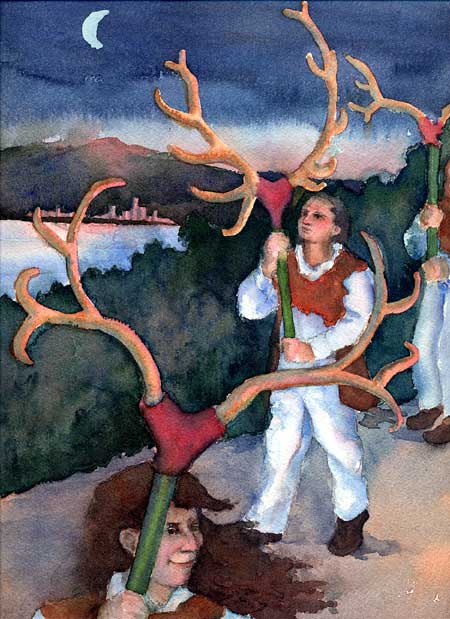
The Palo Alto Baylands before dawn on the first day in May is a chilly place, quiet except for a few startled shorebirds and the shuffling of feet. People gather in the parking lot, talking quietly between yawns. Later there will be revelry, laughter, and silliness, but right now they wait. And just before the sun comes up, men carrying deer horns emerge from the darkness to dance to a haunting tune in a minor key.

Abbots Brumley Horn Dance (Thaxted version)  Watercolor on Arches paper
Abbots Bromley Horn Dance (Thaxted version) Watercolor on Arches paper

This is Morris Dancing, an English style of folk dance that is very old. No one is quite sure how old it is, but evidently records dating back to the 1600s mention it. It’s almost died out several times—Cromwell and his puritans put a temporary halt to it, then the industrial revolution bled people from their culture and nearly killed it—but was revived in the early part of the 20th century. How ironic that it’s had another revival in this age of technology killing culture. In fact, it may be that technology has helped it grow (although some predict a decline),  and now Morris teams all over the world clash swords, shake bells, wave hankies, and dance to the music of accordions and fiddles. They dance to help the sun rise on May 1, a brilliant endeavor, and a happy one. Then, I believe, they go have some beer.

The dance I’ve painted here is the Thaxted version of the Abbots Bromley Horn Dance.  The Thaxted version is haunting, mystical. You feel like you’ve stumbled upon some primitive rite in the midst of the megalopolis. Like an ancient god will spring from the bay mud and perhaps accept  a sacrifice as the dancers make their moves. It’s deliciously chilling and meaningful.

But the Thaxted version an after-market dance. The original, still performed in Abbots Bromley after something like 800 years, is lively, fun, and a little goofy. Danced in daylight. Lot’s of bouncy tunes. To this Yank, Monty Python springs to mind. In the best possible sense, of course.

This is a study for a larger painting I have in mind. As always, I imagine I’ll paint it many times before I get it to the place I want it to be.

If you’re up before dawn on May 1, find a Morris team near you and go help them dance up the sun.

Finally! It doesn’t take this long to play the tune!

Trim the Velvet <p>Watercolor</p> <p> Copyright Margaret Sloan 2009
Trim the Velvet
Copyright Margaret Sloan 2009

This week I painted my final version of William Bajzek’s hands playing flute. I think I’ve painted about 12 versions of this; I’m happiest with this last version, although I also like the earlier version I posted in February.

I’m calling it Trim the Velvet, one of my favorite Irish tunes. It’s a tune that falls beautifully on the flute, and one that William plays really well. You can hear sound samples of William playing Irish music with his wife, Angeline, in their duo called Castlerock. Unfortunately, they haven’t any sound samples of Trim the Velvet on their website. They should.

12 versions of the same painting. That’s a pretty compulsive thing to do. But I made about every mistake a person can make in those 12 paintings. Sometimes I made pretty awful color decisions (and sometimes no decisions at all). I struggled to create soft edges. I roared into the painting and impatiently splashed dark values onto the paper too soon. I didn’t pay attention to the paint.

These are the things I learned: Painting a watercolor is a lot like starting a relationship. It’s best to be delicate in the beginning, leaving room for the big decisions that you’ll have to make later on. Plan well. Make clear choices. Use a light touch. Be happy with what the painting wants to be.

The end of art?

Puppet Goddess <p> Watercolor Copyright Margaret Sloan 2009
Puppet Mistress Watercolor

This painting started out as a meditation on three young women I know who are entering their college years at what may be the worst economic time in recent history. They are all artists, although in different arenas, and they all want to pursue a life in the arts. I have no doubt about the talent of these three young women. It bubbles out of them in everything they do; they are incredibly creative, innately talented. They simply glow.

But all is doom and gloom in the world these days, and bad news begs the question: Is this the end of art? The end of being able to make a living from your art? Will my  young friends find a world where they can profit from their lights?

Of course I worry that the storms of reality may derail their (and my) dreams of making it as artists. So this painting is a charm for them (and for me). We’re all hiding under our umbrellas right now, but really, we should be looking around, letting the storm entertain and inform us, and making better art in response.

If the silver lining to this economic train wreck is brought by a half-naked Amazon making marionettes tap dance on our heads, so much the better!

BTW: There’s a good op-ed piece from the New York Times (The Boom Is Over. Long Live the Art!) about the effects of the bum economy on that rarefied world where artists hawking pickled sharks and embalmed calves become high-end darlings of people with more money than God. It’s an interesting read, if just for the historical value of seeing how the last few downturns in the economy affected that otherworldy land, and that, for the health of art, this downturn might not be a bad thing.