We all need to get a Flying Pig

Blogger  Ricë Freeman-Zachary, at the Voodoo Lounge, once again kicked me into gear, right before a long weekend, with her post about flying pigs. If you’re an artist having trouble getting to work, I suggest you read that post. Read it now.

On that long weekend away from my day job, I had lots of time to paint and draw. Sure, I could have spent the whole long weekend watching movies, or reading chick-lit fiction, or surfing the internet (and I did actually do some of that).

But for most of the weekend, I heeded Ricë’s flying pig, the one that said, “It’s your life. You choose,” and I sat at my little drawing table and painted.

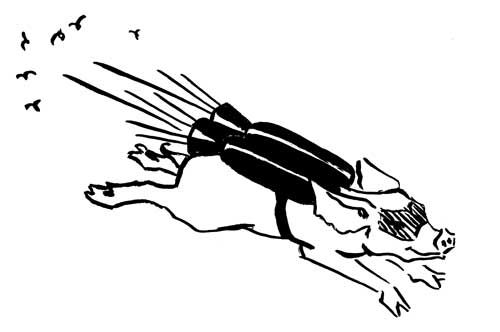
One of the things I made was the silly comic at the end of this post (you can click on it to make it bigger). I admit to having loved comics when I was a kid; I still love them, although they’re of more grown up fare now, and usually I loftily call them graphic novels. I’ve had ideas for them rolling around in my brain for some time, but had a dozen reasons why I couldn’t do it.

Bless this blogger Ricë. I don’t know her from beans. I’ll probably never meet her. But I read her blog every morning, loved her book Creative Time and Space. Sometimes, along with making me laugh so hard I snort coffee out of my nose, she inspires me to get to work. Such is the power of the internet.

Some pig.


Return of the prodigal blogger

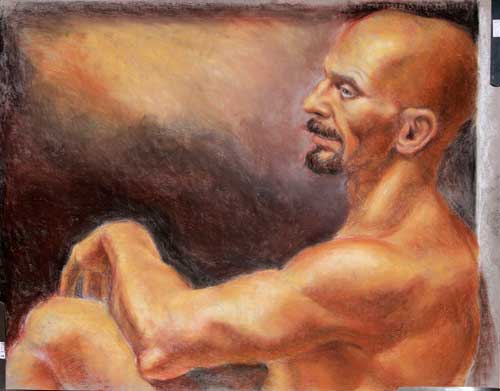
Joe Pastel on Canson Mi-Tientes paper. I'm not yet finished with this. I have pages and pages of notes from Christian and Rob. Corrections like: make the background distinct from the foreground, dull down the "heavenly light" in the background, get rid of Joe's "mohawk." And lots more things to work on. Whew!

I’ve been letting this blog slide the last couple months, as I’ve been busy with other projects, plus a camping trip to Nevada.

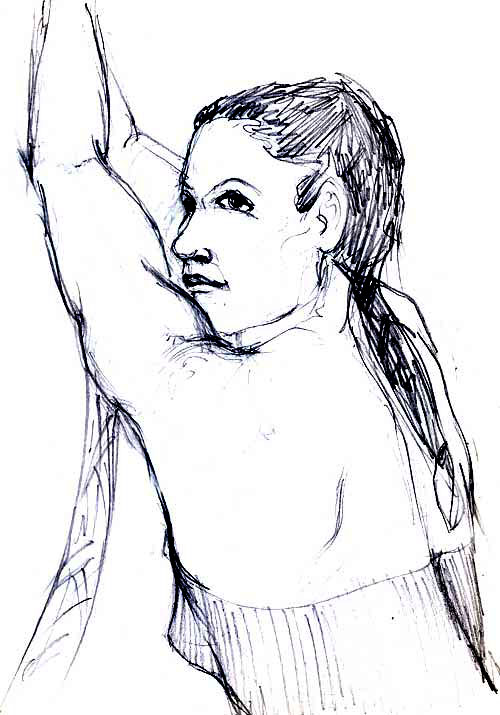
I’ve been trying to finish up my projects from my fourth year at the Atelier (At the top of this post, you can see the last portrait I made in June), and then, just when the school year was finishing and I thought I’d have some time to rest, Christian Fagerlund (the teacher who’d taken over the last few classes at the Atelier while the usual teacher, Rob Anderson was away), offered a portrait painting workshop—6 people, 8 classes, twice a week—during the month of July.

Christian is a wonderful painter, and a brilliant teacher (I’ve been so lucky to have such wonderful teachers: Rob, David, and now Christian). Taking his class has been worth the exhaustion of driving to the East Bay twice a week during rush hour traffic. I’ve learned so much; I can feel my brain fizzing and buzzing like it’s full of 7-Up.

Now I’m taking a much-needed break from classes, and will practice what I’ve learned. That means discipline to work at home the same number of hours that I worked in classes (plus those two extra hours I spent driving to Oakland!).

I also want to get back into the swing of blogging again. I wish someone would give me a push, but alas, in the blogging world, you really have to learn to swing yourself.

Two drawings

In The Art Spirit, Robert Henri says, “The most vital things in the look of a face or of a landscape endure only for a moment. Work should be done from memory. The memory is of the vital movement.”

Often, when setting up a long pose, I see the moment I want to capture right away; sometimes I have to watch the model for a while, even talk a little with him or her, to find what I’m looking for. And then, after the long days of model and artist assuming the same position, the pose loses that crystalline moment that interested me to begin with. I must remember to continually restate that first found emotion, that vitality of personality that captured my eye and intellect.

Gesture drawings are good for capturing initial emotions and impressions. The two drawings connected to this post were started each as 10-minute drawings. My goal when I made the sketches was to choose a composition that clarified the spirit of the pose and then get down as much information as I could while the models were there so that I could finish the sketches at home.

Things suffered: perspective, proportion, hands, foreshortening. But in general, I feel like I remembered the feelings—and the narratives—I had in my head when I composed the drawings. I wonder, what narratives do you see in these two paintings?

Better places to be

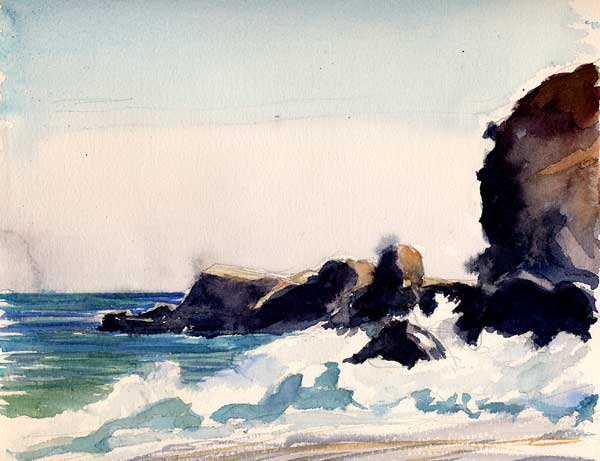
Año Nuevo Beach

Today I woke up, still tired, and slightly depressed. The day ahead looks long and boring, and while that’s usually a good thing (it means no tremendous drama), sometimes I think my life is getting a little too boring.

I also woke up thinking about my favorite blog, Into the Hermitage, by artist Rima, who is a working artist in England. She used to live in a wonderful wheeled house, and blogged about her adventures. Now she lives in a wonderful English village, all thatchy and thick white walls. I hopped over to her site and found that she had posted about a successful selling at a wonderful fair. Good news from a wonderful artist.

We anglophiles tend to fantasize about the British Isles, filling our dreams with romantic images such as the ones Rima posts in her blog.

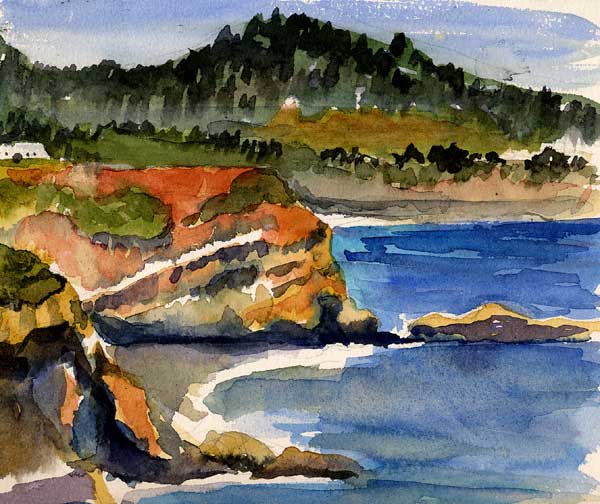
I posted these paintings, made last summer on a wonderful wild day on the coast, to remind myself (and any other Californians who are dreaming of other worlds) of the fantasy of our lives here on the California coast. Año Nuevo is only a short drive away, easily accessible. It’s not as medieval and thatchy as Britain, but it’s wild and beachy.

Año Nuevo Headlands

Art and maths

Addendum: Someone recently contact me to ask about this video, and I realized that I hadn’t attributed it! Shame on me. So I went looking, and all I could find was that it was posted by someone named Aelithou. Unfortunately, his website is parked, so I can’t tell you any more about him. Aelithou, could you please raise your hand?

Back on the art and math problem, I found a story about Carla Farsi, an artist and a mathematician. She created a course at the University of Colorado in Boulder for non-math students, using visual arts to teach math. I would love to have taken that course. Math has always been a nightmare for me, but 9 years with my own personal mathematician, who has impeccable taste in materials for thought, has made me see that math could be a beautiful discipline, if one could only understand it.

And I think the divide between art and math wasn’t always so great. Certainly during the renaissance, artists were trying to figure out arty things like perspective by using mathematics.

I know, art is supposed to be about feeling and emotion, but I wonder if we’ve let so much of our own personal feelings and emotions creep into our personal art that much of it has become opaque to other people. Math is about communicating ideas, about solving problems. Really, is art so very different?

Art and math

According to Kenneth Clark, in his book The Nude: A study in Ideal Form, the arts meant something deeper to the Greeks than mere decoration (although they had plenty of clearly commercialized vase paintings and sculptures available for their mass market). Sculpture was a philosophy; the classical proportional canon was based on geometry. A certain kind of mathematics infused the best of Greek art and gave it a cool, otherworldly beauty. A kind of beauty that is not found today in the ugliness that gets often gets passed off as art.

Somewhere along the line, mathematics and art got separated into opposing camps. And the saddest thing is that art and math (and science too) are so separated in school. A friend of mine has a kid that goes to a high-rent day care and nursery school. At that school they have an “art” room. Of course, I realize it’s practical; kids can be messy as they like in there, and it keeps the rest of the school clean.

But I think it’s sad to segregate the arts like that. Making art becomes something precious rather than part of the everyday warp and weft of life. And I also think it’s sad that there’s no “math” room. And even sadder that math, art, and science are considered separate studies and would have to be in different rooms.

Kids say, “I hate math, I hate science. I’m going to be an artist.” (I said it too. Shame on me.) As if there is a natural chasm between those disciplines. Now that I’m grown up and my brain has finally grown in, I don’t think there has to be such a rift between disciplines. Lately my brain has been hungering for, of all things, math. Go figure.

Cristóbal Vila, at Etérea Studios in Spain has bridged that gulf with this fabulous short film. It’s beautiful even if you don’t have a mathematics background. My mathematician loves this piece, and has explained the math behind it, which makes it even more extraordinarily beautiful. Enjoy.


The short long pose


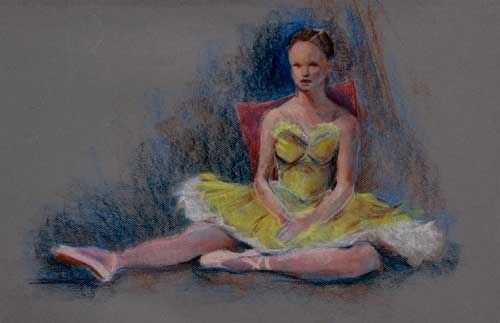
I dropped in on Linda Corbett’s life drawing class last week. I was at the Pacific Art League for a portrait class, but it had been canceled and Linda said, “You’re welcome to stay for my class. We have a ballerina for the model tonight.” And on cue, a beautiful young woman strolled in, a tutu under one arm.

Good teacher. She knows what kind of lure will catch a student.

The drawing I’ve posted above is a “long” pose—two 20-minute sets and two 15s. That’s not much time for me; I’m used to much longer poses at the Atelier. I have clocked in 20 to 30 hours on one pose. I haven’t drawn from short poses much in the last couple years.

It meant I had to manage my time more rigidly so that I could bring the entire drawing up to some small amount of finish by the end of the evening. I allowed myself only the first 20 minutes for the block in, 10 minutes into the second pose to check measurements and make any adjustments, then the remaining time to build up the form with pastel color.

That was an exciting exercise. At the time it felt like drawing like the wind. But now I can see all the flaws in execution. It felt good to draw that way, but I traded emotion for precision.

On the other hand, this sketch above was done in about 2 minutes as the model was tying on her toe shoes. Although the proportions are off, the sketch still has an energy and integrity lacking in the twenty minute sketch. Weird how that works. Sometimes a really fast sketch will capture the model better than a longer pose.

I decided to attend the rest of the class—4 classes in all—and concentrate on pastel portraits. I’m interested to see what happens when I only have one 20-minute pose to catch a likeness.


Teatro Zinzanni

Mat Plendl of Teatro Zinzanni

It was one of the best Christmas gifts ever, a family outing to Teatro Zinzanni in San Francisco. The  tag line is “Love, Chaos, Dinner.” And it’s true.

It’s like dinner theatre/circus. Every act is spot on, funny when it’s supposed to be funny, amazing when it’s supposed to amaze, and always entertaining. All this and they feed you too!

Marina Luna

There was juggling, trapeze, singing, dancing, clowns, even hula hooping. All the artists were phenomenal. The professionalism, energy, and grace with which they performed was amazing. It was so enchanting and fast paced that I didn’t have time to do any sketching, so I had to sketch from memory when I came home.

My favorite act was Marina Luna, an aerial artist who has a terrific dance on the rope. I would love to sit and draw her as she worked on the ropes, and would love to get her to model for a portrait.

If I were younger, beautiful, and talented, I’d run away and join a circus.

Year of the portrait

Unfinished self-portrait

Each fourth-year student at the atelier chooses a thesis that they work on in and out of class. My area of focus is portraits. Because one of the things I’d like to be doing is drawing portraits. Ppeople fascinate and  confound me, and compel me to try to understand them. And drawing them helps me do that.

In college a million years ago I studied theatre, which is really the study of humanity, magnified by over-the-top drama, stage makeup, and masks. Theatre, and the people attracted it, can be a risky business. It can be quite painful. So one year I gave up theatre to study horticulture.

I did that because—aside from being obsessed with plants—I found that studying the sciences of botany and soils had a certain kind of safe roundness in which I could wrap myself. There were no lumpy inconsistencies and thorny disputes of the kind that make humanity a hard garment to wear. And so for years I immersed myself in the study of horticulture.

During that time I had a dog.  She was a great dog, but she didn’t really know she was a dog. She’d really never been around many dogs. Then we moved into a house where there were two other dogs. Much to her surprise and delight, my dog discovered her canine heritage. And she loved being a dog. So much that for a few months, she would barely speak to me. She just hung out with her two biggest, bestest doggie buddies.

Like that long ago dog of mine, about a decade ago I suddenly found myself  in a place full of people. It was hard going at first. But slowly I’ve discovered that I am, indeed, a human, and that other humans are fascinating. Maybe I like being human again.

And so  I’ve come back around to studying humans. Don’t get me wrong. I still love the green world, and seek refuge among forests, meadows, and gardens when the human world gets to be too much (and it does, believe me, it does). But I’m learning to deal with the humanity of the world.

And I find that drawing helps me figure people out. That’s a plus. And when I’m drawing a portrait, I can sometimes connect with the person I’m drawing in a very deep, intuitive way. I really like that.

And so, I’ll be drawing a lot of portraits, and studying the where’s, why’s, and who-to-fores of portrait drawing, along with the study of all my other fractured interests. I’ll share what I learn here on this blog.