Last week we were off to Death Valley with a group of friends! Painting! Hiking! More painting!
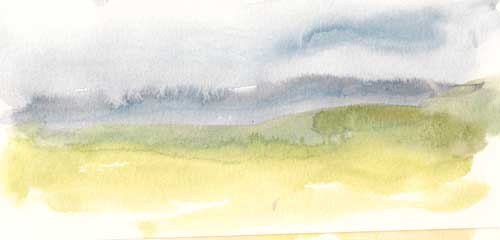
It’s a long trip to DV. Eleven hours for us, stopping often to drain our radiators, stretch creaky backs, eat, and just generally look around. I can paint a little on the road (the fiddler does the driving), but the scenery moves too fast for an even partially realized landscape. There’s only enough time for quick color sketches.
———————————————————–
Quick color sketches in watercolor on Aquabee Super Deluxe Sketch Book paper. This paper is not sized as well as it used to be so the colors don’t sit as nicely on the paper as they do on Arches 300 lb. hot press. But for quick studies in the car, it’s enough.
I also filled in some pages of color blocks in my color journal.
My color journal is a Daler & Rowney Cachet watercolor journal. Again, it’s adequate, but the paint is not as vibrant or well behaved on this paper. When I’ve filled up this journal, I think I will make one bound with binder rings of my favorite Arches hot press.
My tiny pocket palette has a mysterious collection of pigments; I don’t remember what I was thinking when I poured the paint but there are decidedly too many oranges in this palette. Most of my mixtures from the pocket palette end up being built around Mayan blue and transparent orange, with Hooker’s green and a yellow (lemon or aureolin) as secondary colors.
Anyone who likes to paint on the road really should take a look at the book A Pocketful of Watercolors: Philip Enquist. It’s a little book full of little watercolor sketches that shows just how evocative such simplicity can be.
If you think this blog might be of comfort to someone, please share it
Portrait of a fiddler (but not my fiddler), done in a Canson sketch book with a Pigma Micron pen.
Music is an essential part of my life. You all know what that means. I almost never play much music anymore.
People are funny that way; the things that mean the most to us often take a back seat to everything else. And despite the fact that the fiddler and I love to play music, (in fact, playing traditional Irish music is the oldest, strongest part of our relationship) we are both scheduled to the hilt with non-musical tasks, and so we don’t often have a day devoted to tunes. To break this trend, we decided to make last Sunday a music day.
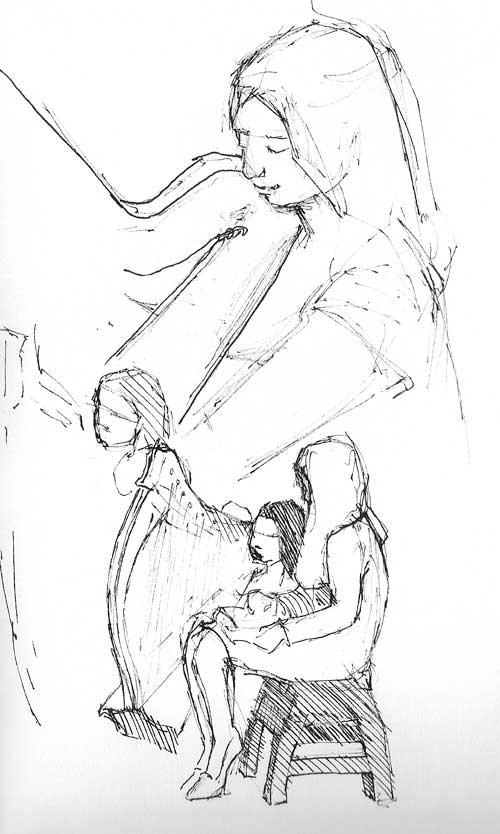
I’ve never seen so many harps in one place! Pixie harps, celtic harps, concert harps, wire strung harps. The music was lovely, the church was beautiful, with lots of milky winter ocean light pouring through etched-glass windows. Perfect for drawing, but the sanctuary was crowded, and I was, of course, struck with extreme shyness. Someone might look at me! Oh! The Horror! But I dredged up some grit, got out my journal and sketched while the musicians played. If anyone watched me, I didn’t know about it. I listened to the music and drew. It was like a little bit of heaven.
If you click on this sketch, you’ll be able to see a blurry bit on the fiddler’s chin (also not my fiddler) where my pennywhistle dripped moisture as I played a tune over the half finished drawing. Although the pen was a Pigma Micron, and supposedly waterproof, I guess it’s not immune to pennywhistle drool.
Afterwards we stopped at The Poet & The Patriot Pub for the last bit of the Irish session. It was brilliant fun, and once again I forced myself to open the journal and draw (mostly while the other musicians played tunes I didn’t know). No one even payed attention; they were intent on their jigs and reels. And that was the most lovely thing of all.
If you think this blog might be of comfort to someone, please share it
Finding time for reflection on the past year is difficult, smack dab in the middle of several projects I’d like to finish before the week is out. But after reading Rose Welty’s lovely New Year’s post, I thought I’d take a stab at casting a backwards glance over 2011, and peering forward into 2012.
Here’s what I accomplished in the last year:
Entered and won an art competition
Had my first solo gallery show
Painted. A lot
I admit, I’m not good at marking time over the long haul. The concept of time, longer than a few hours, gets away from me. The past, even just a few weeks ago, seems like it happened in another lifetime. As for the future? I never quite believe that next year (heck, tomorrow) will actually show up, hat in hand, at my doorstep and demand to be let into the house. I realize this grasshoppery attitude probably bodes ill for my little-old-lady future, so occasionally I do try to plan.
My goals for next year:
Make an artist website
Blog more often
Make it possible for people to buy my art
Enter a few art competitions
Apply for a residency.
But my main goal? Paint. A lot. Which may supersede all the other goals. Because painting is what makes the long year worth the heavy slog.
I want to say thank you to my readers for reading my posts and commenting. I love to hear from you; a comment from you makes me smile all day. And I want to give you something in return.
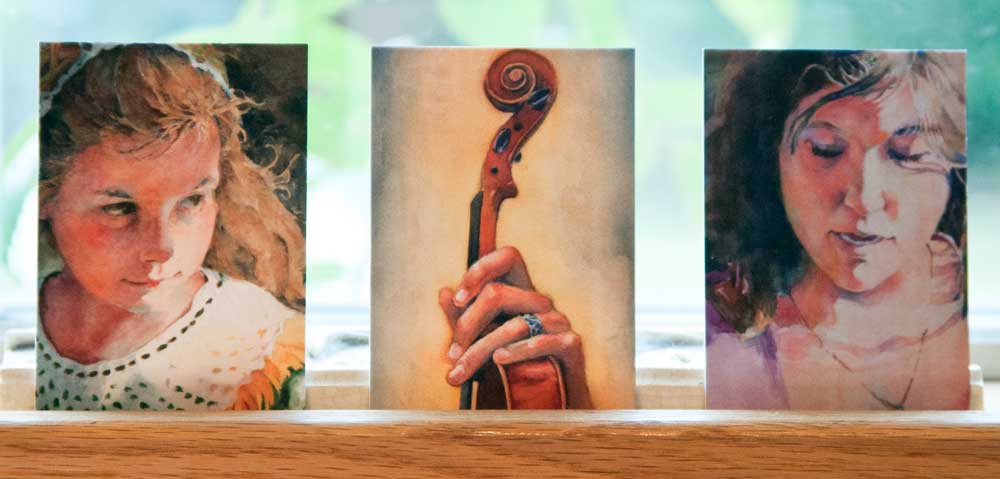
I recently had business cards made at moo.com. These cards are slightly bigger than most normal business cards (they’re 2.15″ x 3.30″, which, as it turns out, is the size of a credit card), and very pretty. Totally suited to framing in a tiny frame. There are three styles, as you can see in the picture above.
To the first 6 commentors to this post, I will send you two sets of business cards (that’s 6 cards, two of each style). One set for you to keep and one set for you to give away.
Of course, after you comment, you’ll have to email me your postal address so I can mail them to you. Don’t put your postal address in the comment section!
You can email me at mockingbirdatmidnight *AT* gmail.com.
If you think this blog might be of comfort to someone, please share it
As the visual artist part of a collaboration for Hungry for Yiddish; a Mitzvah Project (organized by fabulous singer Heather Klein), I was honored to be included with musical artists Heather, Anthony Russell, and the Saul Goodman’s Klezmer Orkestar.
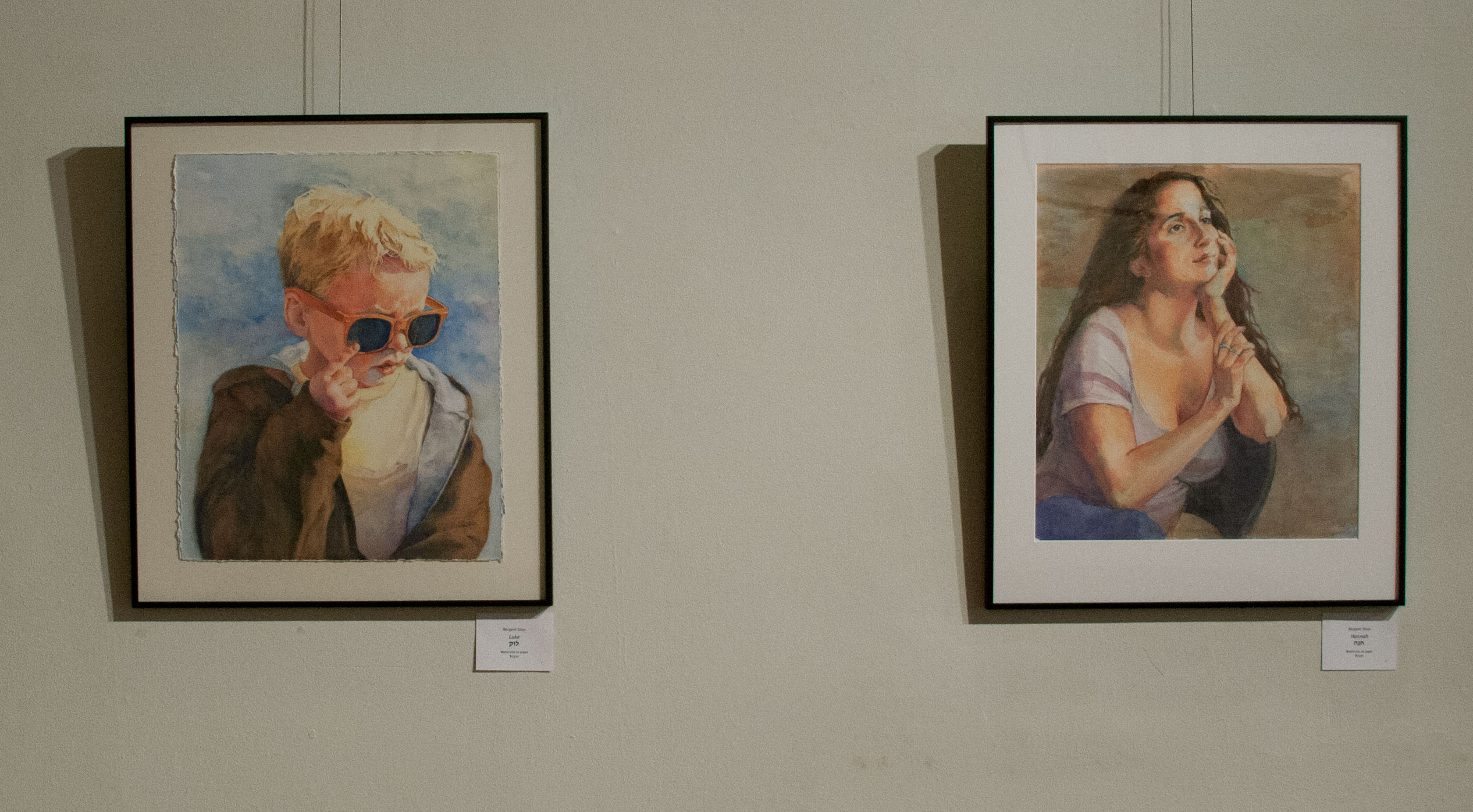
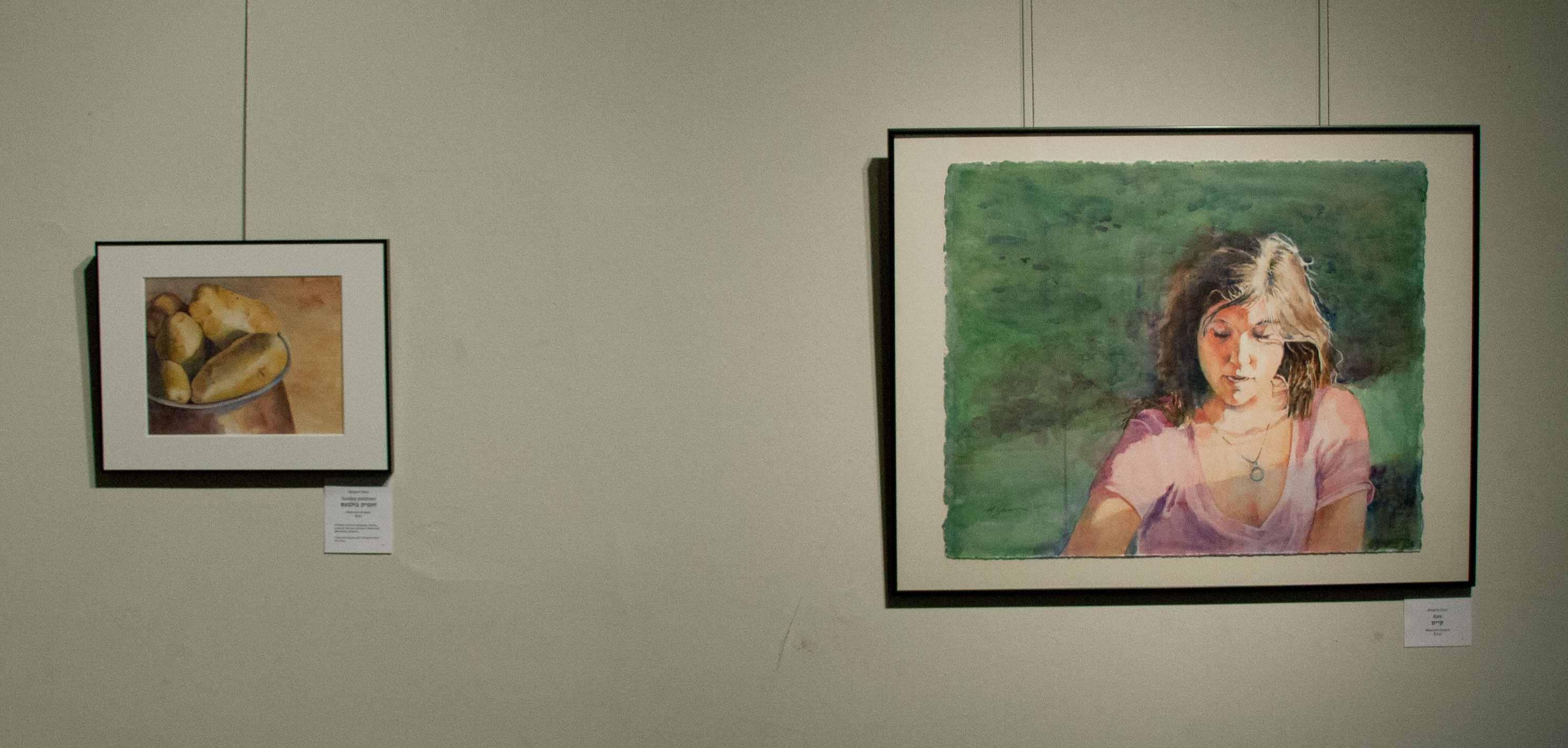
It was so wonderful to see 13 of my paintings hung on the gallery walls of the Subterranean Arthouse in Berkeley.
My fiddler said, “I live with these images while you’re painting them, and they’re alive, but I’ve never seen them have so much presence as they had when they were all on the gallery walls.”
Normally I paint, finish, and file my paintings in the flat file. If they get framed, they are briefly displayed on a dining room chair, then they’re off to their new home. It was amazing to see that on the gallery walls the portraits came to life in a way they never do in my dining room.
The painting above at left is, yes, a bowl of potatoes. Since this show was about feeding people (a benefit for the Berkeley Food Pantry) I thought a few paintings of potatoes would be appropriate. After all, potatoes have fed the world for over 500 centuries, haven’t they?
Many thanks to Nicole Rodriguez and Katherine MacElhiney of the Subterranean Arthouse for helping hang the show, and especially to Katherine, who, despite a dreadful cold, stayed around after we hung the show so that a friend of mine could come in the afternoon and view the paintings.
And this is me with the painting Desert Rat. I am not normally a smiley kind of person, but on seeing all my paintings looking back at me, I couldn’t stop beaming.
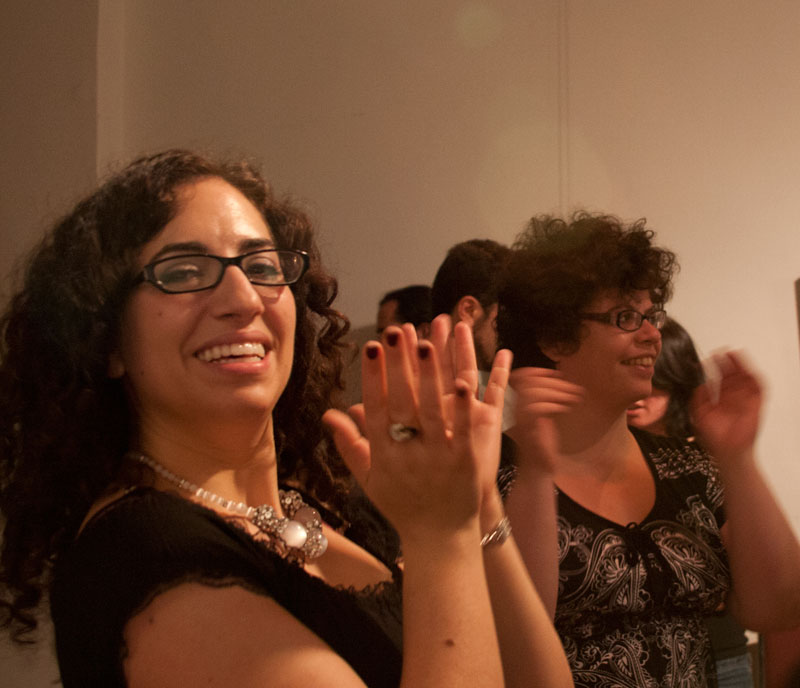
But it wasn’t all paintings and portraits. We heard Heather and Anthony (both magnificent performers) sing, and then we danced to joyous Klezmer music.
The dancing was led by dance teacher Bruce Bierman.
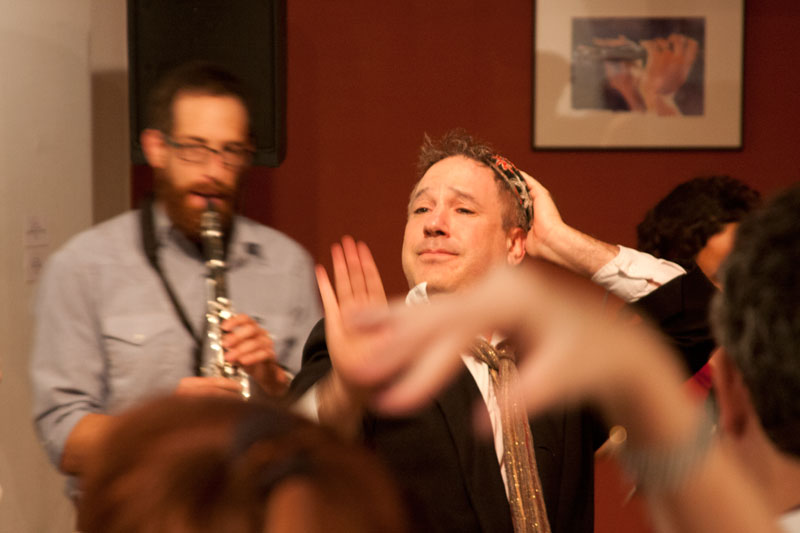
The band was terrific! In the photo below, blazing through a tune, are Jim Rebhan on keyboard accordion, Illana Sherer on violin, and Dave Rosenfeld on mandolin. Also in the band was Gerry Tenney on guitar and voice, Stu Brotman on poyk (a bass drum), and Aharon Bolsta on snare drum.
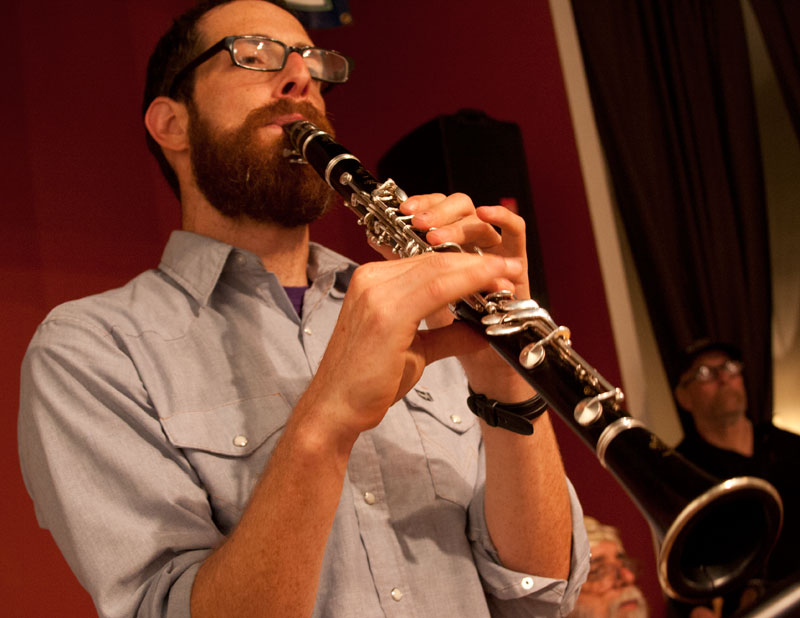
And show curator and clarinet player, Mike Perlmutter.
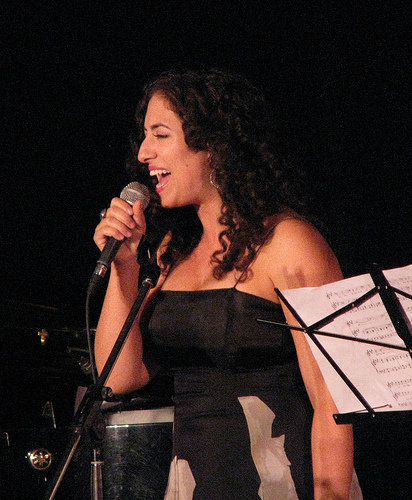
Thanks to Heather (on left, below) for organizing this wonderful evening!
A sheynem dank!
If you think this blog might be of comfort to someone, please share it
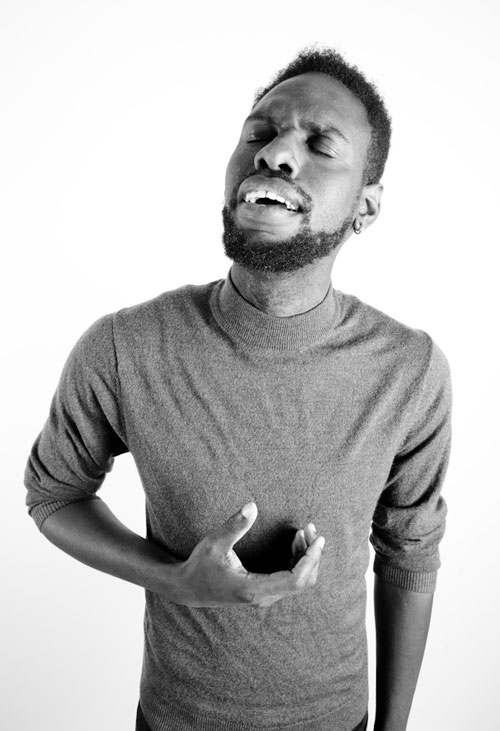
The first time I played a recording of Anthony Russell singing a Yiddish song, it was as if thunder rolled through the house. His rich bass voice wraps itself around a song and makes it rattle the windows. I’m very pleased to be involved in the Hungry for Yiddish: a Mitzvah Project with him, and I’m looking forward to hearing him sing in person.
1. How do you know Heather? How did you get involved in this project?
I actually met Heather earlier this year at her “Yiddishe Meydlekh” concert for YIVO in New York. We both attended KlezKanada in Quebec this past summer, and by chance, my partner got a job in the SF Bay Area, where I’m originally from and where Heather lives. So, as soon as I got back from Canada and somewhat settled in California, I met with Heather to figure out what the Bay Area had to offer a Yiddish singer. She said, “Well, I have this program I did last year called ‘Hungry for Yiddish‘,” and the rest, soon, will be history…
2. Tell me a little bit about the songs you’ll be singing at the Hungry for Yiddish event. What are they about?
Yiddish songs are always so complicated, which is why I love them! So I’ll make an attempt. In “Akhris Hayomim“, a young boy describes to his grandfather the wonders of the world to come; in “Der Gemore Nign“, a student in kheder (a traditional elementary school teaching the basics of Judaism and Hebrew) misses his family; in “Lekoved dem Heylikn Shabbes“, a Chasid literally asks his rebbe, “Where’s the beef?”, and in “O Ir Kleyne Likhtelekh“, the lights of a menorah stir memories of the Jewish past and questions about the future.
3. Sometimes language can really influence a piece of music. How do you feel Yiddish shapes a song or a tune?
Having sung in English, Spanish, Italian, French, German, Hungarian, Japanese and Hebrew over the past fifteen years or so, I have found Yiddish to be an unparalleled language for expression. It strikes me as a language that lands softly on the ears (thanks to its vowels and certain “closed” consonants), yet is well-accented with consonant combinations full of descriptive character. Songs in a Yiddish are much the same, possessing a plaintive quality accented with wit, pain, humor and character.
3. You say on your Facebook page that not only were you able to understand a Yiddish speaker, but he could understand you. Impressive! How long have you been studying Yiddish? What kind of personal meaning does Yiddish have for you?
I’ve only been singing in Yiddish for a little less than a year, and my study of the language has been solely for the purpose of improving my understanding and interpretation of my repertoire. For the past few months I’ve been hobbling along by myself through Sheva Zucker’s Yiddish textbook for beginners, but I can tell you upfront I’m a much, much better listener in Yiddish than a speaker.
What I told the Yiddish speaker was my own original well-rehearsed joke about my lack of ability: “Ikh keyn nit redn gantz gut Yiddish; aber, ikh red a besser Yiddish vi alle mentshn in der khumesh,” or “I don’t speak Yiddish very well, but I speak it better than anyone in the Bible.” He laughed for a good long time, and what’s language if you can’t do that?
In contrast to the monumental advent of Hebrew as a language in recent history, Yiddish—for me—is a language that best describes the Jewish experience in the world, in all of its unusual beauty, longing, ambiguity, mystery and quiet, subtle triumph.
4. What is your favorite Yiddish word or phrase?
In the song “Lekoved dem Heylikn Shabbes“, a worried Chasid during Shabbes dinner tells his rebbe, “Rebbe! There’s no challah! There’s no fish! There’s no meat!”, to which the rebbe answers, “‘S’vet zayn!“—”There will be!” Let me tell you, on many levels, I’m saying ” ‘S’vet zayn!” all the time.
If you think this blog might be of comfort to someone, please share it
I’ve always been mad for trains. I was born in the wrong century, long past the age of long-distance train travel. I know, unless you were as wealthy as a god, it was uncomfortable, crowded, slow, dirty, hot in the summer and cold in the winter. But still, it was a way to travel West, to see the world, to leave behind an old life and start a new one.
You can see, I’ve built up a lot of romance about train travel. My heart always leaps when I hear our local train blow its whistle.
Unfortunately, commuter train has been all I’ve been able to do (and I still love it!), except for joy rides on the Niles Canyon Railway.
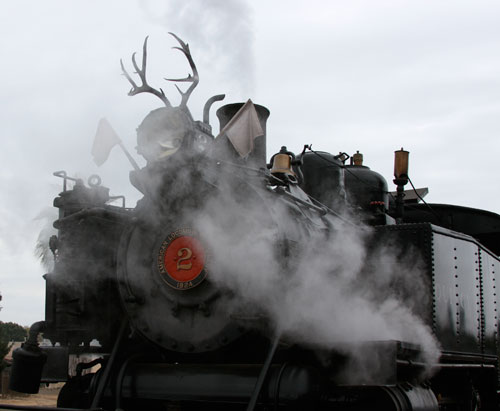
Niles Canyon steam train, my favorite of their collection.
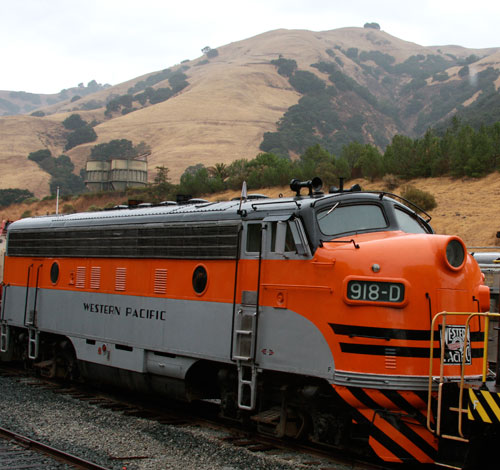
Another Niles Canyon Railway train. I’m not sure if this one ever leaves the yard. More’s the pity if it doesn’t.
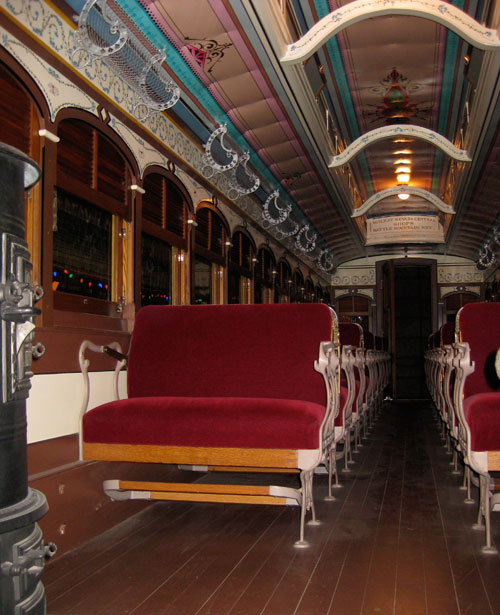
Then there is the California State Railroad Museum, one of my favorite museums in all the United States. Below are interior shots of train on display.
And who doesn’t love dials and faucet handles and thing-a-ma-bobs? At the museum, one of the docents told me that there’s practically no man left alive who knows the purposes of all the dials in the old locomotives.
Someday I’ll do a trip on Amtrak , in a private berth please, on the Empire Builder. I sometimes fantasize about hopping a box car—when I was a little kid, I remember a period when I planned on growing up to be a railroad bum—but I know it must remain a fantasy.
So it’s no surprise that I collect train songs. Yesterday Fiona Ritchie played the Poozies singing a song (in exquisite harmony) about trains, and starting over. So many of us, older and wiser yet still young in our hearts and minds, have been deemed by corporatocracy and the world to be redundantly over-the-hill (never mind that there are currently 4 U.S. senators in their 80s that refuse to retire). We are re-starting lives, or even just trying to continue living. This song is for us, I think, and I’m sending this out to my friends and readers who are feeling a little left behind.
If you think this blog might be of comfort to someone, please share it
I met Heather Klein in our Yiddish class, where we learned the bulbes (potato) song, and she told of teaching it to a group of friends. She sang a few bars of a Yiddish song, and I soon became the owner of her latest CD, Shifreles Portret: A Yiddish Art Song Project. It’s been in heavy rotation on the cd player ever since.
Heather, who is classically trained, brings a richness of voice and emotional connection to stories of loved ones lost to war; of a fiddle player greeted in heaven by his friends; dancing women; and praying bubbes (grandmothers). Heather is the third leg of the Inextinguishable Trio (special guest Ilana Sherer on violin and Alla Gladysheva on piano), a group devoted to performing lesser-known to newly composed pieces in Yiddish, Hebrew, and Ladino. In keeping with the Yiddish tradition, they also perform musical theatre as well.
When she asked me to display my paintings at her annual Hungry for Yiddish; a Mitzvah Project, I was honored, and of course said yes! She graciously agreed to talk a bit about the project, her music, and her love of Yiddish.
1. How did Hungry for Yiddish; a Mitzvah Project get started?
Five years ago I lost a special person in my life to suicide. He was a chef in San Francisco, and did not make a lot of money, but he loved to feed people. Wherever we went he would give whatever he had to people on the streets that were hungry or even just asking for money, and I admired him for being selfless. When I lost him to suicide, I realized that I wanted to give something back in whatever way I could. So I decided to give through music. I started a concert benefit during the colder months when it is harder to find food or warmth. It’s called Hungry for Yiddish; A Mitzvah Project. The proceeds from admission are given to the local food bank, and my friend’s spirit of giving is remembered.
2. Tell me little bit about the songs you’ll be singing at the event.
I pick songs based on the visual artwork on display at the concert. The art this year consists of portraits of people. Every portrait has a story to tell, so I’m performing songs that let you get a glimpse at the persons character. Those include songs about a Gypsy, a grandfather, a street kid and a young woman looking for love.
3. The material you choose is haunting and yet so joyous.
Most Yiddish music sounds sad because it’s played in darker keys and the lyrics are not always uplifting. You’ve got to remember that many of these songs were written by people who lived in oppressed, violently anti-Semitic places. But they stayed hopeful that things would get better, and the songs reflect that.
4. What is your favorite Yiddish word or phrase?
“Mit rekhtn fus.” Another way of saying good luck. Literally meaning “with the right foot.” It was the first Yiddish phrase I was taught before I performed with other Yiddish singers.
My work will be gracing the walls of the Subterranean Arthouse in Berkeley on December 13. I hope it will provide inspiration for these wonderful musicians, and joy to all the folks in attendance. For the next couple posts, I’ll be interviewing two of the singers in the show, founder Heather Klein and Anthony Russell. So come back to learn more about the project!
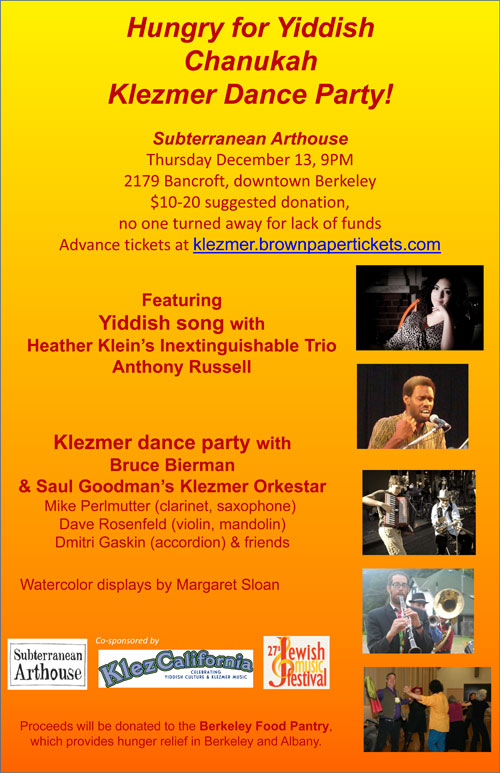
Click on the poster to order tickets.
If you think this blog might be of comfort to someone, please share it











 Mockingbirds at midnight