Farm memories

Although I grew up in the city, I come from farming people. I grew up with so many stories of the farm, the family, and the various chickens, goats, and cows, that I sometimes feel I lived alongside my ancestors.

I’ve certainly romaticized their lives, although I know that it was a hard life; subsistence living is never easy. But I’ve heard their stories, told with a slight bitterness towards the privations, but mostly washed by a greater love of their lives. It makes me wonder if today, in our lives of relative ease, are we really happier?
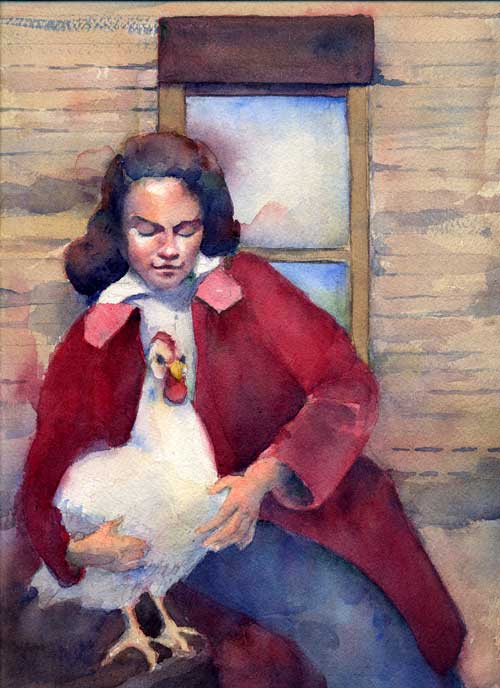
Her Favorite Red Coat
Watercolor © 2011 Margaret Sloan

This is a small painting: 9″ x 12″ on Arches cold press. Yes, it’s from a photo-a black and white photo at that. Right now I’m enjoying working from black and white photos. They give me greater freedom in color choices and combinations. Unchained from the tyranny of the camera’s red-blue-green, I can make my own statements. (Of course, now that the painting has been fed back into the camera and computer, I can see errors that will need fixing, mostly edges that need softening.)

That little girl is all grown up now, and that chicken long emigrated to chicken heaven (grasshoppers and freshly sprouted gardens abound!). Some painters gripe about painters who paint from photos. “Why paint it if you can take a photo of it?” they ask. But without this dusty photo, I could not have made this sweet painting, and this little girl would have been lost.

Are you a painter? What do you think about using photos?
Watercolor breakthrough

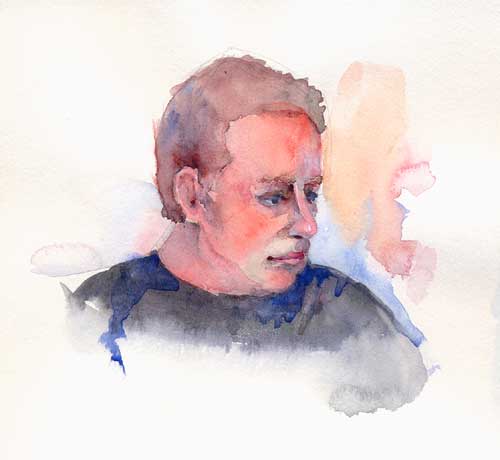
Watercolor by Margaret Sloan 2011

I painted the above piece in my journal after attending a Ted Nuttall demo (and while deep in Felicia Forte‘s portrait drawing workshop). Mr. Nuttall is the watercolor artist du jour, and since he teaches what seems to be an exhausting series of workshops across the country, I’m seeing more and more copies of his style in watercolorlandia.

And with good reason. He paints big, he goes outside of the lines, and his color choices are fabulous. His paintings are deliciously loose and free (although he spends much time planning and controlling his process.)

One of things I haven’t liked about my paintings is that they are overly tight. This thumbnail painting you see above,  was painted when I was fresh from Mr. Nuttall’s demo, I drew this man (I was watching some movie, but I don’t remember who the guy is), and painted it in the style of Mr. Nuttall. It’s not a very big painting, but I really like it.

While I don’t want to be a Ted Nuttall-clone, I do want my paintings to have a more free appearance. Which means I must break all kinds of old habits.

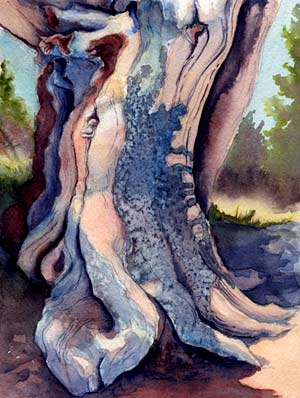
Bristlecone Pine

Bristlecone Pine
Watercolor by Margaret Sloan

This summer I got to meet the bristlecone pines of Great Basin National Park in Nevada. They live precariously above 10,000 feet between rock and sky. The oldest have been there on the mountain for thousands of years. Some have only a thin strip of bark sheltering a living cambial layer; only that bit of xylem and phloem spirals up the dead part of the trunk to the branches that are still alive.

The trees clasp the rock, seeking out the little bit of soil they find there. They stretch branches of tight, bunchy needles to the sun. I thought they seemed as if they were a conduit between the planet and the sky. When the wind whistles through the short green needles, surely the mountain can feel the branches shiver through the wiry, grasping tree roots.

I fancied the trees spoke to me in long, slow, booming voices. I can’t tell you what they said. Perhaps they just let me know they exist, and that they knew I exist. I know this sounds all Tolkieny and Entish, but when faced with these weathered Methuselahs in the thin air above 10,000 feet, a person thinks these things.

Blogger  Susan Miller posted this quote from  In the Global Forest by Canadian botanist Diana Beresford-Kroeger:

“If we go into the forest, we enter a cathedral of creation that we cannot fully understand and that we should not touch. If we go into the forest, we’re blind, deaf and dumb.  We’re blind because trees have perfected the photo-reception of sunlight while we haven’t. We’re deaf because we can’t hear the long sound waves of the movement of trees. We’re dumb because today’s best chemists cannot make some of the chemicals produced by trees. Simply put, we should never forget that as a species, we’re all connected through trees.”

I only made 4 studies for the painting at the top of the post. Once I started the final piece, the painting pretty much just fell out of the paintbrush onto the paper.


Better places to be

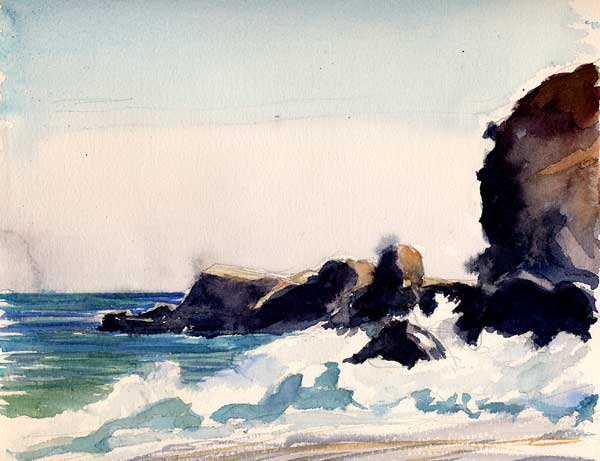
Año Nuevo Beach

Today I woke up, still tired, and slightly depressed. The day ahead looks long and boring, and while that’s usually a good thing (it means no tremendous drama), sometimes I think my life is getting a little too boring.

I also woke up thinking about my favorite blog, Into the Hermitage, by artist Rima, who is a working artist in England. She used to live in a wonderful wheeled house, and blogged about her adventures. Now she lives in a wonderful English village, all thatchy and thick white walls. I hopped over to her site and found that she had posted about a successful selling at a wonderful fair. Good news from a wonderful artist.

We anglophiles tend to fantasize about the British Isles, filling our dreams with romantic images such as the ones Rima posts in her blog.

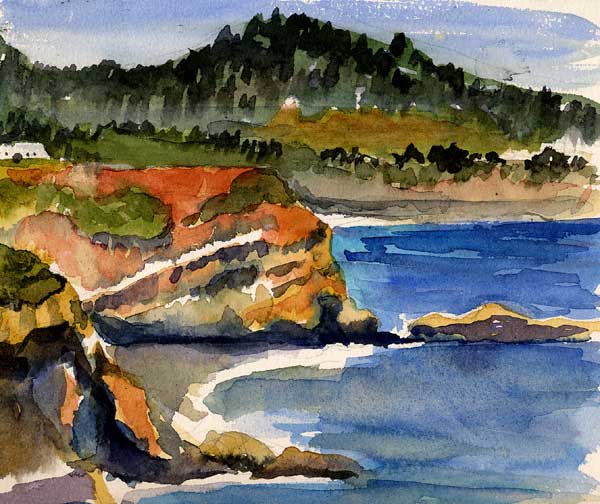
I posted these paintings, made last summer on a wonderful wild day on the coast, to remind myself (and any other Californians who are dreaming of other worlds) of the fantasy of our lives here on the California coast. Año Nuevo is only a short drive away, easily accessible. It’s not as medieval and thatchy as Britain, but it’s wild and beachy.

Año Nuevo Headlands

Happy Anti-Valentine’s Day

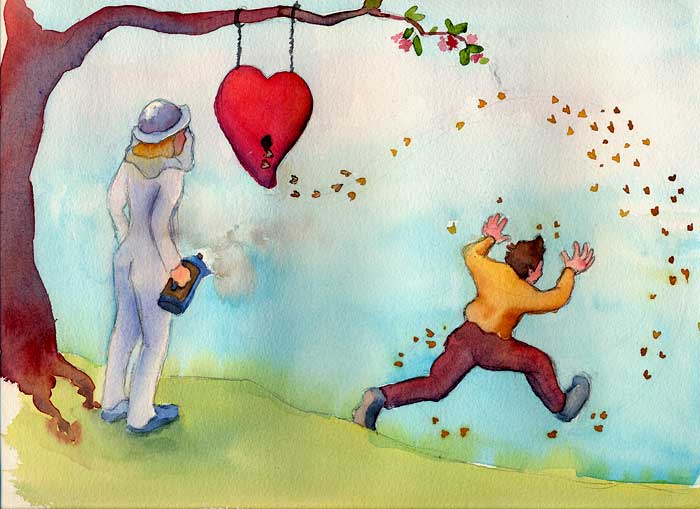
Beekeepers and the bees who love them

This post was meant to commemorate a better holiday than V-Day. That would be St. Modomnac’s Day. But that was yesterday (February 13), and I’m a day late.

Anyway.

St. Modomnac is credited with bringing bees to Ireland, when they kept following him about. I’m all for anybody bringing bees anywhere. And since bees are often credited with being able to scope out mean nasty people, I think they’d make a good warning for a girl. If your bees don’t like your guy, then I’d say he’s not the Valentine for you. (I’d trust bees intuition over that of my dog or cat, because they pretty much liked anyone who would pet them.)

And lest anyone out there should think this post is in anyway autobiographical, let me hasten to say that there is a bouquet of roses on my kitchen table, and a pot of tea sweetened with honey that I’m going to share right now. And yes, he’s been out to my bees and passed the bee test.

Cookin’ up love

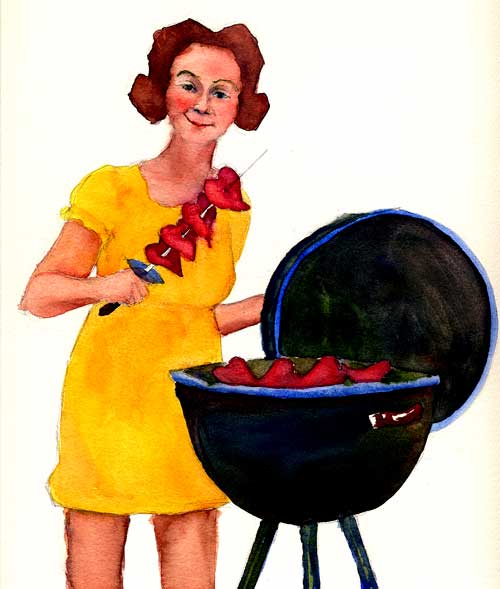
What to do with all those heart’s you’ve collected this year? Why not make Cupid’s Flaming Hearts this Valentine’s Day? The recipe sounds yummy, and would make a perfect dish for Valentine’s eve. (Okay, so really it’s made with chicken hearts.)

Plus, the illustrations by this blog’s author, Pierre A Lamielle, are wonderful.

Unrequited love

Unrequited love. That’s a hard topic. We’ve all suffered, one way or the other. Google “unrequited love” and it turns up over a million hits. Mostly for the sort of site that offers cliche advice about how to recover from unrequited love. The kind of advice that’s been around forever. We read it in Seventeen Magazine when we were first learning about love, we’ve read it in Cosmopolitan as we grew into love. Our mother’s and friends imparted it, and now we find ourselves mouthing the same phrases. The kind of advice that boils down to one phrase: Get over it.

Easier said than done, isn’t it? (One aside-Do men’s magazines ramble on about this disability? Do men suffer from unrequited love? Sure they do. They just don’t talk about it.) So I’m not going to give you any advice on how to recover if you’re suffering. There’s plenty of advice out there. I’m just going to give you a couple of nice literary blogs to take your mind off the pain of loving someone you can’t have.

At See Michelle Read, guest blogger Aimee of My Fluttering Heart reminds us of a greater type of unfulfulled love, the type of love for which all hope is dashed by circumstances. And Simone Ogilvie (a romance author courting the publishing industry—another type of unrequited love that I hope she can turn around) at The Romantic Query Letter and the Happy-Ever-After gives us a nice short post about the pain of unrequited love.

About that unrequited publishing love thing. If you suffer from it, and you write, you might try Help! I Need a Publisher!

Foxy hearts

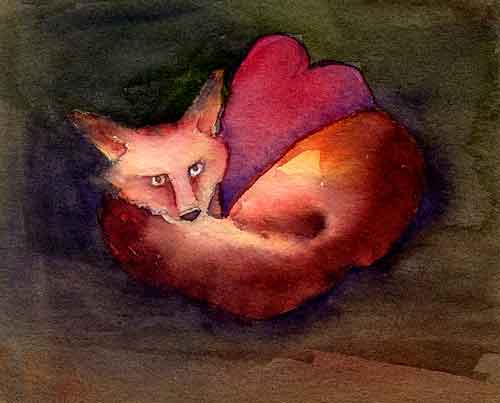
Some people think that the Roman festival Lupercalia (wolf-festival) was the beginning of Valentine’s Day. Wikipedia says that Lupercalia was celebrated on February 15 in ancient Rome. It was to “avert evil spirits and purify the city, releasing health and fertility.

Fertility. Ladies, we know what that means. Doing the dirty on a schedule.

The Catholic church came along and outlawed Lupercalia. In true high church fashion, they  co-opted the feast, the cleansing, the purity, and the fertility. They gave us Valentine’s day. Still sex on a schedule, but at least we get chocolate.

Deflated love

Yeah, you know the drill. Eventually the gas in that big balloon of love starts to leak out. So you eat lots of chocolate. It doesn’t put the gas back in the balloon, but at least it gives you that lovey-dovey high.

Or does it? Supposedly it releases the chemical Phenylethylalanine (whisper that to your lover and see what it gets you) in your brain, leading to the giddy goofy feelings of first falling in love. But unfortunately, they say that the levels aren’t high enough to really do anything to us. They say that the levels aren’t high enough to act as an aphrodisiac.

But I say, if that See’s candy you’re eating is not making your heart pound, you’re not eating enough. Tell said lover you want a box of truffles and a box of P-nut crunch.