How to draw figures by drawing a stick man

StickmanWalkingYou drew them when you were a child: stick people that lept, danced, fought, or just stood around in the landscape of your childhood art. And if you learn how to draw them again, they’ll help you enormously when you are sketching in public places.


Things to look for when drawing a stick man

  • Angle for position Pay attention to the angle of the head, shoulders, and the hips. I often draw those lines first, lightly, to help me capture the pose. I also make quick lines for the angles of the feet so that I know how they are positioned and if I have time, I add the knees and elbows using little circles. Getting these landmarks down on paper will help you remember the position of your subject, even after they’ve moved. Everything after that becomes a connect-the-dots game.
  • Measure! Stick your pencil out and verify that your brain is really seeing what’s there. I can’t stress that enough. You don’t have to get too detailed; if you’re rapidly sketching kids on a soccer field, or people in a park, you don’t have time for a lot of measurements. I look for the vertical halfway point and mark that quickly so I can go on to the torso. When I draw the torso, I eyeball the center line so that I can get the right perspective.
  • Torso comes first My life drawing teacher, Rob Anderson, used to say, “if you can draw the torso correctly, you can hang the rest of the body from it.” I always try to get the torso and hips first; they are the structure. All the rest is decoration. If you add lobes to represent the rib cage, it can help you see the center line.
  • Draw cubicley Think of the upper body as a box with two lobes (the ribs). The tummy is a soft ball; how much of that do you see? The pelvis/hips can be a tube, although some people use a box for the hips. I like using a butterfly shaped tube because I can see how the ball of the tummy fits into the pelvis area.
  • Transparent thinking Try to imaging the shoulder blades on the back, which will give you the correct position of the arms. Draw your stickman as though he were a ghost so you can see your construction lines.


Stickman2

Once you have the stickman posed correctly, you can start adding flesh to him. In the figure below, I drew him in black ink, then built his form up using blue lines. When I’m sketching in the field, I draw the construction lines lightly, and often don’t erase them when I’m finished because they can make the figure more solid and dimensional. They are also great for later reference when I’m trying to construct a new drawing, because all this public sketching, besides being fun, is fodder for future work. Stickmanslouching

Drawing exercise Get thee to a public place and draw the people in it. Concentrate on drawing only stickmen. Afterwards at home, draw other stickmen (from your imagination) interacting with the first drawings. Challenge yourself by drawing them in overlapping positions, some farther away, some closer to the picture plane. Then let me know how it goes. I’d love to see your drawing.

Sketching musical hands while they’re playing guitar

Sketch of Beppe Gambetta
Sketch of Beppe Gambetta while he played lightning fast flat-pick guitar licks.

Yesterday I had the pleasure of seeing flat-pick guitar player Beppe Gambetta in concert. It was a small venue, and I was fortunate to sit right up front, thanks to friends who arrived early. I was so stunned by Mr. Gambetta’s playing that I couldn’t even think of drawing for the first half of the concert. But of course I had a sketch book (It was the 11″ x 14″ Cachet,  far too large for unobtrusive concert drawing. Reminder to self: bring something smaller to concerts.). I swallowed my sketching-in-public shame during the second half of the concert and drew (still amazed and enchanted) while Gambetta played.

You can’t draw musicians without drawing their hands, yet hands are so difficult to draw. And the hands of a musician are always moving (Gambetta’s left hand sometimes blurs against the neck of the guitar). But I’ve found that even a mass of lines can lead me to a better understanding of the subject. And when I draw something I have a better understanding of the whole thing, music included.

Sketch of hand
First sketch of guitar player’s left hand

The first time I drew Gambetta’s hand, I tried to record the position of the fingers and knuckles, and the angle of his hand as it wrapped around the neck of the guitar. I imagined the fingers as little boxes, with tops, bottoms, and sides, to help me figure out the planes of each digit.

But it’s not easy; since his hands are always moving, I had to devise a way to make a gesture drawing that was accurate. First, I listened a bit to understand the structure of the tune. Then I chose a chord that he made often. Since I could anticipate when he’d return to that chord, I was ready to draw when he got there, and I quickly sketched as he played with his hand in that position.


Sketch of hand
Second sketch of guitar player’s left hand

In my second attempt, I wanted to smooth out the lines and make the drawing less about boxes and more about fingers. I was also trying to figure out the position of his hand and how the fingers attached to it.

Sketch of hand
Final sketch of guitar player’s left hand

Later, I studied my sketches and made the drawing above. It’s neater, and shows each finger and the hand position as it wraps around the guitar. It doesn’t show the passion that Gambetta puts into his chord hand; the initial scribble at the top of the post does a better job at that. But this is work that needs to be done; it will eventually make my initial sketches better.

The more an artist learns about a subject, the more force they can bring to even little things like a quick sketch. It’s all about observing, paying close attention, and then attempting to show what you’re feeling with pen and paper, brush and paint. What better way to live a life?

And here are some YouTube videos of Beppe Gambetta.

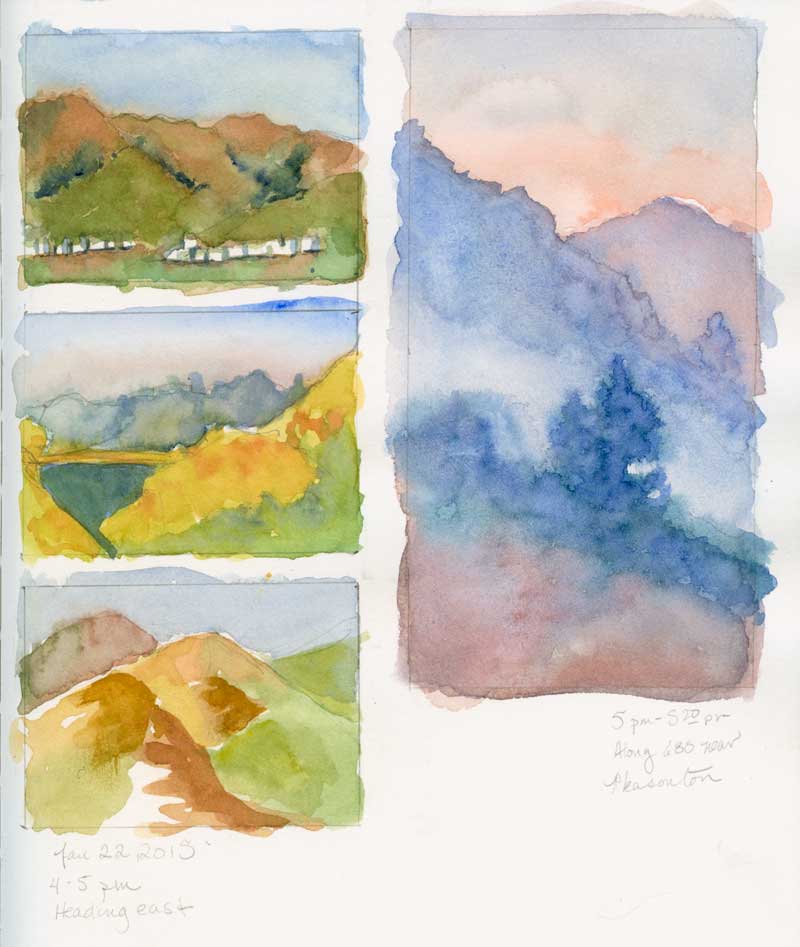
30-in-30: Going east at dusk, watercolor in hand

Jan22_LandscapeJournalJan21_LandscapesThese are what my car-journal pages look like. The smaller rectangles are 2.5 inches by 3.5 inches, and the vertical rectangles are whatever size my little heart desires.

We don’t travel much, so I don’t always remember what colors are in my little travel palette. It helps to make a little swatch palette before I begin (that’s why there are twelve color swatches all in a row on the page at top).

Interstate 680 through Pleasanton at dusk

Sketching Thanksgiving portraits

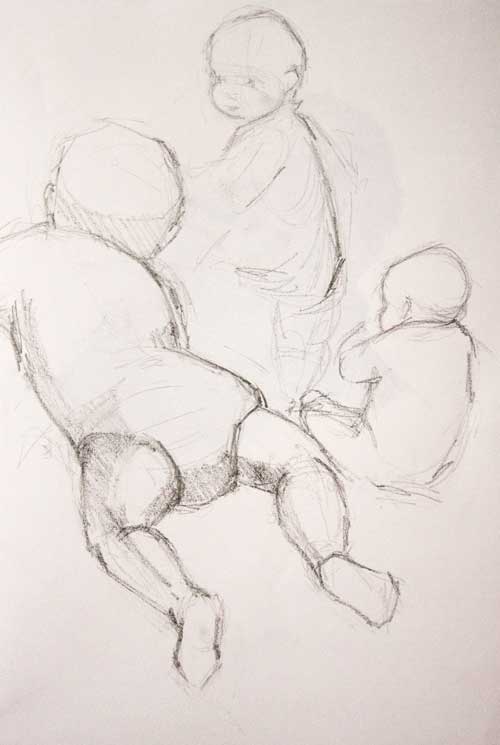
Graphite sketches
Graphite sketches

We had a house chockablock full of people over the holidays, and I finally unpacked my sketchbooks and had a few moments to scribble a few lines. Babies are hard to draw. Their proportions are unrelated to the proportions of adults, and they squirm and wriggle so much that it’s hard to capture a pose. These were the best I could do, as I could only draw until our li’l bit wanted cuddling.

Blockin-graphite sketch
Block in graphite sketch

A seated adult brother made a much easier target. You can see that I’ve  blocked in the head using straight lines. Even when drawing curves, it’s much easier to begin with straight lines. They are more accurate than a curve. You can always smooth them out later.

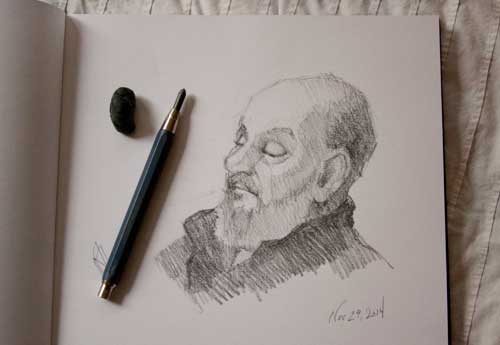
Graphite sketch
Graphite sketch

I’ve been trying to draw my brother for years. For some reason, catching his likeness is hard for me to do. Perhaps I know his face too well. Perhaps he won’t sit still long enough (these sketches were done while he was engrossed in a book).

The pencil is some kind of clutch pencil, a thing that’s like a mechanical pencil, only with a fat lead. I like it, but I’d be happier with it if I sharpened it. But since I can’t find any of the multiple sandpaper blocks I’ve bought for this purpose, and I’m unwilling to buy more, I’ll have to use it like it is until I unpack more boxes in the studio.

Drawing babies

Sketch of baby
Graphite, red and white chalk, Strathmore 400 Series Toned Sketch Journal, Warm Tan paper

Sunday our power went out for the whole day, so that meant no computers, no internet, none of the electronic time-wasters we’re all so used to. Even my phone lost its charge, so I was cut off from the 4g network I usually live on.

How did we pass the time?! Well, we went with some friends to a local park and had a little picnic. While we were there, I tried to sketch their new-born daughter. Babies are hard to draw, especially newborns. They lack the bone structure that an artist can use as landmarks when drawing. Their faces are all out-of-whack, proportion-wise. And even asleep, babies don’t really want to hold a long pose.

There are a lot of babies in my life right now (being of grandmotherly age—meh—I find that my younger friends are filling up their lives—and mine—with babies). So I hope to study this baby-sketching more closely.

sketch of baby
Graphite, Strathomre 400 Series Toned Sketch Journal, Warm Tan

This is an idea of a baby, not drawn from life but from what I remember and what I suppose a baby should look like. Small face, big head. I never thought I’d want to spend a lot of time with the youngest set!

Recommendation: I’m really liking the Strathmore 400 Series Toned Sketch Journal. The paper has a nice feel, the brown color doesn’t reflect sunlight and blind me when sketching outdoors, and I love the luxurious feeling of the faux-leather binding.

Painting against time

clarinet player
Klezmer musician sketch
8.5″ x 12″
Watercolor on Arches #140 cold press
© 2014 Margaret Sloan

I tend to paint slowly. I spend hours getting the drawing right before I move to color. Then I paint deliberately, thinking about each stroke. Sometimes I think too much,  standing in front of the easel, brush in hand, looking and daubing.

Eventually I start feeling trapped, like some old hen pecking away in a chicken coop. I’m afraid to move from my comfort zone because I’ve got too much invested in a particular painting. Yet, with no forays out of the barnyard into the woods, well, where is the exploration? Where is the learning? Where is the joy? All I’m doing is laying eggs.

But I want to fly.

Perversely, sometimes limits can free an artist from gravity. Rather than spend hours on a painting, I decided to give myself some parameters: half hour for the drawing and an hour for the painting. I wanted to see what I could accomplish in a short period of time.

What a great exercise! It forced me to think in terms of big shapes, clear color and correct value. I let go of trying to have a “finished” product and made choices quickly. And I was quite surprised at how instinctive painting has become.

Most valuable tool in this exercise: The kitchen timer.

At cliff edge with a sketchbook

Bean Hollow
Looking out over Bean Hollow State Beach.

Yesterday while plein air painting on the cliff overlooking Bean Hollow State Beach, I watched legions of families troop down to the pebbly beach. Every so often kids would stop and politely ask if they might look at my painting; My goodness, yes!

A small boy sat at the edge of the cliff next to me, a packet of colored pens and a sketchbook in hand.

“Yes,” he said quietly, “I think this will do nicely.” And he opened his sketchbook, ready to draw.

But those cliffs are slippery; it’s best to be careful on the California coast. Absorbed in the view, the little boy leaned forward, and in a scraping of dust and sand he slid down the cliff to the beach below. (Don’t worry. The cliff face is shallow, the surface smooth from generations of kids zooming down on their bottoms, and the sand and pebbles below make the landing soft and delightfully scrunchy.)

He never dropped his art supplies. He stood, brushed himself off and gazed out to sea. Then he turned and ran up the stairs, around my easel, and, still grasping pens and sketchbook, slid down the cliff again.

Gentle painters and sketchers, take a lesson from this small boy. Even though life might send you sliding down a cliff, never let go of your sketchbook!

Breaking waves
Waves at Bean Hollow.
Breaking waves
Waves at sunset after a beautiful day.

Painting from a fast sketch


The holiday bazaar last Saturday was lovely, with beautiful artwork and Irish music provided by my own fiddler and our friends from the Irish music community (if there’s any reason—other than sheer joy—to learn to play Irish music, old time, or any folk music, it would be the wonderful groups of friends you’ll make doing so).

The day started a bit slowly, so I took the opportunity from my seat inside the circle of musicians (in between firing off the tunes I knew on the whistle) to sketch the dulcimer player with the intention of later making a painting solely from my sketch after the dulcimer player left to go to another gig.

Sometimes I can’t take photos for reference. Sometimes I just don’t want a camera intruding on the moment. And I like the practice of trying to find a painting from my initial sketch.


pencil sketch
Quick pencil sketch

I payed particular attention to these elements as I gathered information for a painting:

  1. The shapes of the features that made a likeness. She has strong features, making it easier to draw them.
  2. The shapes of the shadow forms. There wasn’t a clear single-light source, so I had to choose the shadows as best I could to show form.
  3. Lost and found edges. Frankly, I was pressed for time, so I didn’t give as much thought to edges as I should have.
  4. Color notes. Okay, in all honesty, I didn’t make any color notes on anything other than her hair and her jacket. But I should have. They would have noted things like skin color in the highlights, midtones, and shadows, room color, light quality. Next time!

I had about half an hour (give or take a tune or two) to make this sketch, so some areas, like the far eye and hairline, were left a bit hazy.  These omissions would later bite me in the butt as I tried to recreate this sketch in color.

Then, while the hall bustled around me with holiday shoppers, I painted.

Watercolor painting
Watercolor painting using pencil sketch as resource

After a day of painting between customers, I ended up with a sort of half sketched painting that was almost a likeness, but not quite.

The prevailing wisdom about watercolor is that you can’t erase it. Nonsense! While you can never get down to the beautiful pristine paper again, you can certainly lift much of the color. I didn’t like the purply-red I’d put in her hair, so when I got home, I scrubbed it off with a toothbrush and a spray of water. Then I let it dry completely and repainted.

The mouth also didn’t match the sketch, and so lost much of her character, so I lifted the paint using an old sable brush (I don’t know why this is, but nothing lifts watercolor as well as sable), let it dry, redrew it, and repainted it. The nose got a little surgery and lost its bottom edge. I adjusted the angle of the far cheek and the perspective of the eyes.

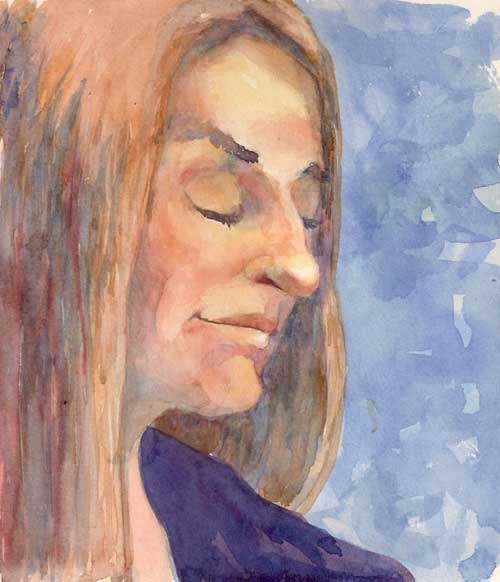
watercolor
Watercolor from fast sketch

This almost captures the likeness of the dulcimer player, and I’m pretty pleased to have done it without a photo-aid. To be fair, I’ve known her for years, so that when my brush drove past the likeness, I knew I’d arrived.

Brendan Behan in ArtGraf black carbon

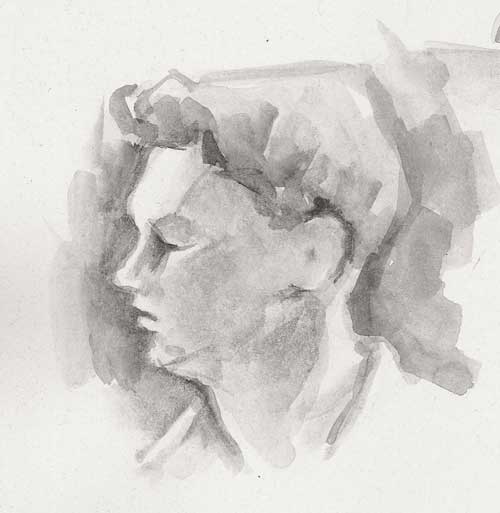
BrendanBehanYoung

Shawn Hatosy as Brendan Behan

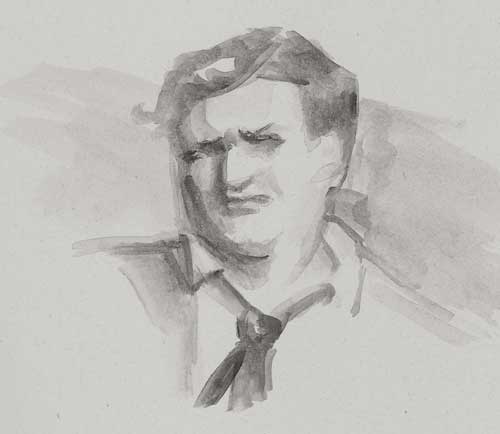
Saturday night I watched Borstal Boy, a romanced version of the early life of Irish patriot, playwright and poet, Brendan Behan. Mr. Behan was a man of letters—he wrote in English and in Irish—who unfortunately died quite young from the drink. He was the public face of the stereotypical Irishman, as well as typifying a whole generation of artists:  brilliant star and stumbling, mumbling drunk. He once described himself as a drunk with a writing problem.

BrendanBehanBrendan Behan as Brendan Behan

The above painting is from a Youtube video here, where Mr. Behan sings the Auld Triangle.

These were painted using my new toy, an ArtGraf black carbon block. It’s a neat little block of water soluble carbon with which you can draw on wet or dry paper, or just rub a wet brush across the block for shades of gray. It’s an easy and clean way to practice brush work while watching television, so long as you don’t kick over your pot of water. The paper is my new favorite, cheap cover stock from the copy store.

José Emídio paints with the tailor shape of ArtGraf in the video below. Beautiful!