Art and maths

Addendum: Someone recently contact me to ask about this video, and I realized that I hadn’t attributed it! Shame on me. So I went looking, and all I could find was that it was posted by someone named Aelithou. Unfortunately, his website is parked, so I can’t tell you any more about him. Aelithou, could you please raise your hand?

Back on the art and math problem, I found a story about Carla Farsi, an artist and a mathematician. She created a course at the University of Colorado in Boulder for non-math students, using visual arts to teach math. I would love to have taken that course. Math has always been a nightmare for me, but 9 years with my own personal mathematician, who has impeccable taste in materials for thought, has made me see that math could be a beautiful discipline, if one could only understand it.

And I think the divide between art and math wasn’t always so great. Certainly during the renaissance, artists were trying to figure out arty things like perspective by using mathematics.

I know, art is supposed to be about feeling and emotion, but I wonder if we’ve let so much of our own personal feelings and emotions creep into our personal art that much of it has become opaque to other people. Math is about communicating ideas, about solving problems. Really, is art so very different?

Portrait on the clock

Pastel sketch 8.5" x 11"

I started this painting when I was all buzzed from a video by Alicia Sotherland, a portrait artist I quite like. Likeness eluded me for this drawing from a photo. I find it much easier to get a likeness from life. But, after all, I wasn’t trying for likeness.

I had budgeted one hour (which expanded to two) to get as far as I could, and as close as I could to a likeness. But my main goal was to  force my hand and brain to believe that it is okay to have light values in the lit area of the face and dark values  in the shadowed area of the face (I’m always surprised that this is such a difficult concept for my brain to believe). And I was to  use color values for those lights and shadows rather than monochromatic values. You can’t see it in the scan, but the highlight on the nose is cool—a light blue.


Art and math

According to Kenneth Clark, in his book The Nude: A study in Ideal Form, the arts meant something deeper to the Greeks than mere decoration (although they had plenty of clearly commercialized vase paintings and sculptures available for their mass market). Sculpture was a philosophy; the classical proportional canon was based on geometry. A certain kind of mathematics infused the best of Greek art and gave it a cool, otherworldly beauty. A kind of beauty that is not found today in the ugliness that gets often gets passed off as art.

Somewhere along the line, mathematics and art got separated into opposing camps. And the saddest thing is that art and math (and science too) are so separated in school. A friend of mine has a kid that goes to a high-rent day care and nursery school. At that school they have an “art” room. Of course, I realize it’s practical; kids can be messy as they like in there, and it keeps the rest of the school clean.

But I think it’s sad to segregate the arts like that. Making art becomes something precious rather than part of the everyday warp and weft of life. And I also think it’s sad that there’s no “math” room. And even sadder that math, art, and science are considered separate studies and would have to be in different rooms.

Kids say, “I hate math, I hate science. I’m going to be an artist.” (I said it too. Shame on me.) As if there is a natural chasm between those disciplines. Now that I’m grown up and my brain has finally grown in, I don’t think there has to be such a rift between disciplines. Lately my brain has been hungering for, of all things, math. Go figure.

Cristóbal Vila, at Etérea Studios in Spain has bridged that gulf with this fabulous short film. It’s beautiful even if you don’t have a mathematics background. My mathematician loves this piece, and has explained the math behind it, which makes it even more extraordinarily beautiful. Enjoy.


Life drawing: freedom within structure


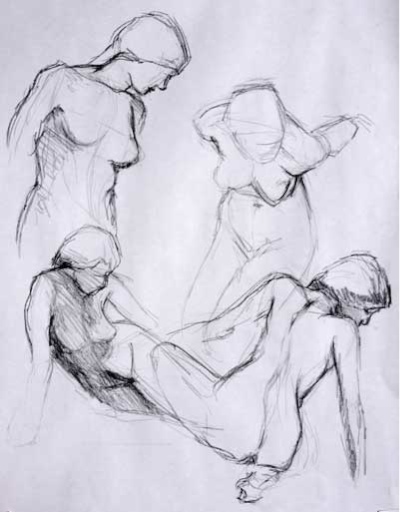
This is one of my favorite drawings from last week—a series of 2-minute poses—simply because I was able to control placement of the figures on the page. I was able to do it in a somewhat organized and pleasing fashion. And I was able to do get this information down fast. 2 minutes a sketch.

I could not have done this four years ago. In fact, a year ago I could not have controlled my drawing this much. Over the last year I’ve taken another leap in abilities.

I’ve been studying life drawing at the atelier for nearly four years. I’ve been focusing very hard on proportions, angles, measurements, and it’s only recently that I’ve been able to exert some kind of discipline over my errant and mindless drawing arm. (Sometimes I wonder, does this left hand even belong to me? My brain tells it to do something and like a spoiled puppy, my hand widdles charcoal all over the drawing even while my brain is chasing after it with a rolled up newspaper yelling NO! NO! NO!)

In open drawing classes (not at the atelier, because there we strive for proportion) I see a lot of people who just draw as they feel. It’s an experiential gig for them; they’re drawing to feel good, because, let’s face it, drawing feels good.

I’ve noticed that some folks have the kind of brain that allows them to see the model clearly and they are able to naturally get the information down on paper in proportion. But others struggle to see and don’t know what they are doing wrong. They often quit drawing in frustration. I was like that four years ago. My drawings were floundering attempts at something I could barely visualize, let alone realize. So I found the atelier and have been working hard ever since.

Rïce Freeman-Zachary, at Notes from the Voodoo Café has an interesting but maddening post (although with Rïce it could more correctly be called a rant) on being the thing you want to be. Among other things, she says:

“If you want to be it, you do it. And if you want to do it—if you really love it, and it’s what you want to do with your one single life—then you do it the best you can. You study, and you practice.

And, I want to add, practice with a purpose. Because here’s the thing. After four years of obsessively measuring angles, proportions, and anatomy, these days, when I do let myself go and draw as I feel, the feelings have some way to be expressed. I’ve got a vocabulary now, and my drawings can shout or whisper, laugh or cry. The errant drawing arm is beginning to behave like a well-trained appendage. My brain is happy.


Gaining knowledge in the intimate presence

I’m reading Robert Henri’s The Art Spirit. He says, “I think it is safe to say that the kind of seeing and kind of thinking done by one who works with the model always before him is entirely different from the kind of seeing and thinking done by one who is about to lose the presence of the model and will have to continue his work from the knowledge he gained in the intimate presence.”

He thought that the latter artist worked with more mental activity; the artist always “studies for information.”

I drew this portrait with this quote in mind, and in 60 minutes (3 20-minute sets) I got enough information down that I think I can bring it further along without the model. I also had my color chart with me, but in the hurry of trying to capture her likeness, I wasn’t able to make good color choices. I can see that I need more oranges and reds to make the flesh look less “dead.”


The short long pose


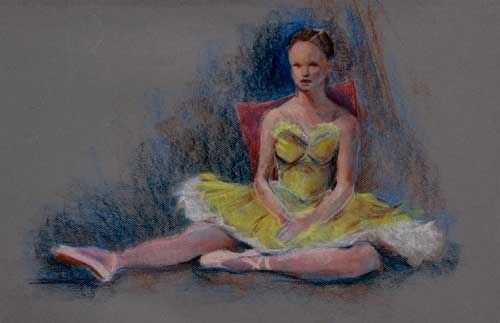
I dropped in on Linda Corbett’s life drawing class last week. I was at the Pacific Art League for a portrait class, but it had been canceled and Linda said, “You’re welcome to stay for my class. We have a ballerina for the model tonight.” And on cue, a beautiful young woman strolled in, a tutu under one arm.

Good teacher. She knows what kind of lure will catch a student.

The drawing I’ve posted above is a “long” pose—two 20-minute sets and two 15s. That’s not much time for me; I’m used to much longer poses at the Atelier. I have clocked in 20 to 30 hours on one pose. I haven’t drawn from short poses much in the last couple years.

It meant I had to manage my time more rigidly so that I could bring the entire drawing up to some small amount of finish by the end of the evening. I allowed myself only the first 20 minutes for the block in, 10 minutes into the second pose to check measurements and make any adjustments, then the remaining time to build up the form with pastel color.

That was an exciting exercise. At the time it felt like drawing like the wind. But now I can see all the flaws in execution. It felt good to draw that way, but I traded emotion for precision.

On the other hand, this sketch above was done in about 2 minutes as the model was tying on her toe shoes. Although the proportions are off, the sketch still has an energy and integrity lacking in the twenty minute sketch. Weird how that works. Sometimes a really fast sketch will capture the model better than a longer pose.

I decided to attend the rest of the class—4 classes in all—and concentrate on pastel portraits. I’m interested to see what happens when I only have one 20-minute pose to catch a likeness.


A new road map

I’ve been studying Kenneth Clark’s The Nude : A Study in Ideal Form at the Atelier. I am not well versed in art history, so a lot of what Clark says goes zooming over my head into the stratosphere. I spend as much time scouring the internet to find information about the artists Clark mentions as I do reading the darn book.

It’s a tough book to crack. Clark’s language is flowery and dense, and often his statements reference deep-seated cultural assumptions that irritate me. Celestial and vegetable venus indeed. But this tiny bit of study of my artistic heritage (a heritage artists all share) has made me think about what I’m trying to do and say with my own work. About what it might mean to reference older traditions and cultures. And how those cultures are reflected in the prism of the art of our modern world.

Sue Smith at Ancient Artist writes, “Because we live in our own time, when the modernism driven by the critic-influenced 60’s led to a period of post-modernism that commercialized the idea of art nearly out of existence, we are now seeing a rudderless homogenization of ideas. Of catch phrases characterized by ambiguity. Perhaps we have lost the idea of what constitutes art.”

It seems to me that by knowing what went before—knowing and understanding our artistic genealogy—we artists can use it to inform their own art. We can transform the styles, methods, and means into something that speaks to people today. We can hope to create new ideas of what constitutes art (multiple ideas, because people like as many styles of art as they like styles of pie). And the most important of those ideas will be as solid, strong, and long lasting for our time as the idea of sculptural morality was for Polykleitos or the idea of simplifying the female form was for Matisse.


Klezmer Festival!

I was lucky enough to have a front row seat and plenty of light, so out came the sketchbook. How much happier could I be than to listen to amazing music while drawing the amazing musicians making said music?

Last night we heard the trio Veretski Pass play their Klezmer Shul, a beautiful piece of music that combines Jewish sacred and secular music of Eastern Europe (and maybe some “co-territorial” music from other cultures).

In a talk with the audience after, the fiddler Cookie Segelstien (oh, alright, she’s a violinist, if you want to reference her work in the classical world. As if being an amazing Klezmer fiddler isn’t enough) told us that there used to be, a long time ago, special shuls (houses of worship) dedicated to specific tradesmen. There were shuls for builders, and tailors, and, they think, there were shuls for musicians. Cookie said, “we asked the question, in that light, what kind of music would Klezmer musicians jam on?”

The music was terrific. It was haunting, and joyful, and all the things you’d expect from three amazingly gifted musicians mining the very roots of their musical souls. The Klezmer Shul is what happens when classically trained musicans cross over into folk music and create something new and wonderful.

I loved what I heard last night, but it was more academically inclined (not that this is a bad thing, mind you). It’s just that the kind of music in the clip below makes my heart dance. This video clip is pure Klezmer.

I’m hoping we’ll have some of this music in the house soon. My own fiddler has been away these last two days, attending Klezmer workshops at the KlezCalifornia yiddish Culture Festival at Congregation Etz Chayim in Palo Alto. I would have loved to join in the fun, but I just can’t take on another hobby right now. But I’m hoping he brings home some tunes.


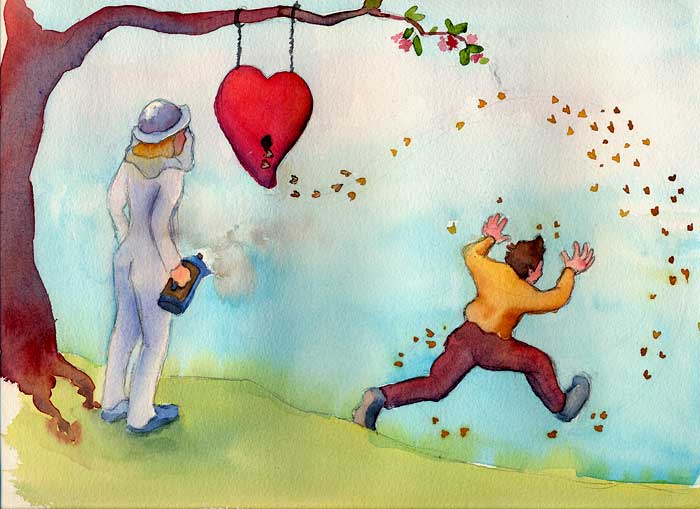
Happy Anti-Valentine’s Day

Beekeepers and the bees who love them

This post was meant to commemorate a better holiday than V-Day. That would be St. Modomnac’s Day. But that was yesterday (February 13), and I’m a day late.

Anyway.

St. Modomnac is credited with bringing bees to Ireland, when they kept following him about. I’m all for anybody bringing bees anywhere. And since bees are often credited with being able to scope out mean nasty people, I think they’d make a good warning for a girl. If your bees don’t like your guy, then I’d say he’s not the Valentine for you. (I’d trust bees intuition over that of my dog or cat, because they pretty much liked anyone who would pet them.)

And lest anyone out there should think this post is in anyway autobiographical, let me hasten to say that there is a bouquet of roses on my kitchen table, and a pot of tea sweetened with honey that I’m going to share right now. And yes, he’s been out to my bees and passed the bee test.