Open Studio Profile: Karen Olsen

Today you’ll be able to visit the 5 artists profiled at Mockingbirds at midnight. I do hope you’ll come let us delight you with our offerings!

The last artist interview for Silicon Valley Open Studios is with Karen Olsen. Karen paints beautiful landscapes in oil and watercolor, and her career in graphic design is evident in the strong designs and bold shapes she uses for her paintings.

Late Light at Grand Canyon Watercolor © 2014 Karen Olsen
Late Light at Grand Canyon
18″ x 24″ watercolor on Arches
© 2014 Karen Olsen

Describe your artistic journey
I was one of those kids who drew from the time I could hold a pencil, but my mother, who was very talented but had an unfortunate career path as an artist, encouraged me to pursue anything except art.  In my early twenties, I learned to paint in watercolor, and I dabbled in it between feedings of my newborn daughter, but still with little serious intent.  My life took an unexpected turn after that, and I was on my own, needing to make a living.  I eventually landed in the graphic design field, and for 25 years I have made my living in it.  Another life surprise recently brought me back to painting, and I now consider that I have a dual career as both designer and fine artist.

Where has art taken you in life?
I think my previous answer covers this…

Gnarled Tree at Canyon Rim Watercolor © 2014 Karen Olsen
Gnarled Tree at Canyon Rim
12″ x 16″ watercolor on Arches
© 2014 Karen Olsen

What do you think about when you begin painting?
First thought: “I wonder whether I can pull this one off??!!”

Yes, that’s sort of a joke.  But in a way it’s not at all.  Each blank sheet of paper or canvas is the beginning of a new adventure.  I may be trying a new brush, a new color, a new technique I want to experiment with, or a type of subject I haven’t done before.  Or maybe a subject I’ve done but want to see if I do better.  If it’s plein air, it’s new and unknown every single time!  Weather, changing light, curious onlookers, even bugs make for interesting challenges when painting outdoors.  So…to answer the question—I try to assess the environment I’m in and what I want to achieve, then try to figure out how to go about it.
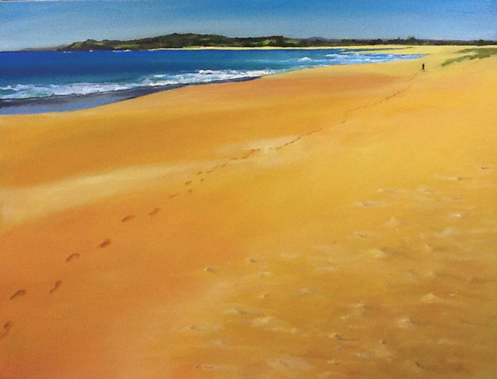
Runner at Papohaku Beach, Molokai Oil © 2014 Karen Olsen
Runner at Papohaku Beach, Molokai
32″ x 40″ oil on canvas
© 2014 Karen Olsen

Tell me about one of your favorite paintings or drawings that you’ve made. Why is it your favorite?
Gee, I guess I’d have to select one of my Hawaiian or Grand Canyon subjects.  They are my favorites because of the joyful personal experiences that went into their creation, and which I hope are passed along through the eyes and into the hearts of the people who see them.

If you could ask one question of an artist you admire, who would it be, and what would you ask?
This isn’t an easy one.  I’ll let you pick…I can’t.  🙂

to Anders Zorn: “Your stunningly beautiful watercolor painting Sommarnöje (Summer pleasure) is so evocative, and so…well…Swedish!  It’s one of my favorites.  How long did it take you to make it?”

to Monet and friends I’d ask: “Hey, can I come out and paint with you guys one of these days?  I’ll bring a picnic…”

to Georgia O’Keeffe I probably wouldn’t ask anything.  I’d just tell her, “I could look at these paintings forever…except after a while, they make me DIZZY!”

and to Leonardo: “Who is that lady?”

You can see more of Karen’s work at  www.karenolsenfineart.com

Karen Olsen will be exhibiting May 10-11 at 1471 Hollidale Court, Los Altos, CA 94024 and May 17-18 at  247 Velarde, Mountain View.
New work for Open Studios

One of the things I learned last weekend at Silicon Valley Open Studios was that I needed more work to display.

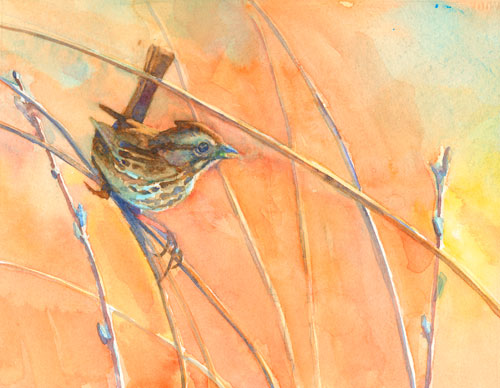
So this week I’ve been painting: Birds!

I’m a portrait painter. I seriously love painting people, but the few animal paintings I had at open studios were the most popular (read: sales.) So this week I combed through my photos and painted a few birds.

Painting of sparrow
Sparrow
8″ x 10″ watercolor on Arches 300#
© 2014 Margaret Sloan

And you know what? It turns out I love painting birds. Who knew?

Sparrow detail
Sparrow detail (It has a bug in its mouth)

Now, can anyone tell me what kind of little speckled bird this is?


I hope you’ll come to our open studios this weekend (maybe you’ll buy a bird for Mother’s day!) I’ll be at 1471 Hollidale Court, Los Altos, CA 94024

How to begin a painting


Study for painting 3" x 5" watercolor painting
Study for painting
 I’ve started the drawing for this painting. Six hours into the drawing and I feel like it’s just beginning to emerge from a mush of pencilscratchings. But I dreamed the colors, and couldn’t wait to get them onto paper. 

Painting is a very slow process for me. I’m not a slap dash painter; I dream, plan, draw, make more drawings, prepare my references, compose the image, draw the image, stew and chew my cuticles, draw some more, then finally start to paint. In a world of instant gratification, I’m a total throwback.

But when, at his workshop last week, Ted Nuttall told me to keep working on my drawing for the whole of the first day, my heart kind of grinched around in my chest. I’d already spent a lot of time on that drawing, but hey, I was paying the man to help me with my life’s work.  I kept at the drawing, all day, and eventually, I really looked at it.  And there was a sorting, as if things were sliding into place. I found a multitude of drawing mistakes that would have plagued me once I began to paint; fixing those mistakes felt really good, like scratching an itch in the deep part of my heart. The painting eventually became Strength. It has a certain clearness, a crispness that I really like. It makes music in my head.

There are days, though,  when I have to simply let go and paint. If you paint, you know what I mean: You need to feel the water love the brush, and the brush kiss the paper with paint . That’s the time for color  studies.

These next two studes are for a painting my Dad has requested. It’s a small black and white photo of my mom he’s had in his wallet for nearly 60 years (can it be that long since they were so young, beautiful, and full of early romance?).

Study for painting 5" x 3" watercolor study
Study for painting
5″ x 3″ watercolor study


It’s interesting how the composition and editing of the background changes the story. What stories do you see?

Study for painting 5" x 3" watercolor study
Study for painting
5″ x 3″ watercolor study

Watercolor portrait: Strength

Strength Watercolor on Arches #300 © 2014 Margaret Sloan
Strength
Watercolor on Arches #300
© 2014 Margaret Sloan


My thought while I painted this portrait at Ted Nuttall’s workshop at Kowana Valley Folk School and Lodge was “strength despite frailty.” This is of my mom. She’s been very ill through out the last year, but she still is strong enough to make dinner, work in the garden, and boss us all around. She’s also quite beautiful, and was pretty nice about posing for about 500 photographs for me.

I’m thinking that I maybe made another breakthrough at the workshop. I hope so. I’m liking what I’m doing. What a delightful week that was!

If you go back to this post, you can see the tiny abstract paintings that I found in this larger work. Can you tell where they were?

But now it’s back to getting ready for Open Studios. The first weekend is May 3 and 4!

Things learned and a few abstractions

Abstract 1
Abstract 1

Last week I lived beyond cell phone and internet reach as I  attended a week long workshop taught by watercolorist Ted Nuttall. As I expected, I learned so much (yes, the back of my head blew off a couple times!). Let me share just a few of the most important concepts I took away from this wonderful experience..

1. Slow down. No, I mean s-l-o-w d-o-w-n. I spent a lot of time thinking about my next brush stroke. Where should it go? What color should it be? How would it react with the other colors already on the paper? When I finally acted, it was with intention rather than panicked splashiness.

Abstract 2
Abstract 2

2. Think abstractly. This was probably the single most important concept I tried to internalize. I’ve been unhappy with my work lately, finding it a bit flat, and lacking the broken color and fine edges that make my head ring with internal music. By concentrating on making each small passage its own tiny abstract painting, (that of course, relates to the whole image) I was able to add interest and visual variety to otherwise flat passages.

Abstract 3
Abstract 3

3. Think color. I tend to get stuck in one single color: orangey-red flesh tone. But that’s not what a person looks like. Skin tones are made up of many different hues and chromas. By varying color, saturation, and value, the painting is not only more exciting, but more like life. So I went (a little) crazy with color, using combinations I don’t normally choose.

Abstract 4
Abstract 4

4. Be uncomfortable. I made a decision that every brush stroke I put down would make me uncomfortable. I not only walked a watercolor tight rope, but I bounced a bit on the artistic high wire.  Sometimes my brushstrokes set me teetering and wheeling, but after a bit of nail biting (and whining), I regained my balance and continued  painting. You know what? Those seemingly near disasters turned out to be the best parts of the painting.

My workshop painting is still not quite finished, so I’ll not post it yet, but I’ve cropped a few of the tiny abstract paintings that make up the whole. I find them quite lovely all by themselves.

Of into the wild blue yonder

This week I’m off to a Ted Nuttall workshop at Kowana Valley Folk School. The last time I attended one of his workshops, it was a sea change for me. I know I shouldn’t apply expectations, but I’m hoping for another big jump during this workshop. We shall see.

I like to have goals, though. They focus me and keep me from straying off along a thousand different paths. I’ve been thinking a lot about my goals for this workshop.

  1. There is tightness—a constriction—about my work that I’d like to loosen. It’s the seeming freedom in Ted’s work that I admire, although he told us at the last workshop that every dib and daub of paint is placed carefully and deliberately. But I think it must be a freedom in his way of thinking that allows for those spot-on “sloppy dots.”
  2. I also admire his color sensibility, and although I’m not sure how someone can teach that in a week, I’m hoping to gain some insights.

I know that I need to keep myself open to whatever knowledge blows my way. Sometimes it’s the errant zephyrs of knowledge that make the most impact. But I’m going to try to follow my path as best I can.


Fears and art and the fear of failure

“Sometimes you just have to jump out the window and grow wings on the way down.” –Ray Bradbury

In less than a month, I’ll be selling my paintings and prints at Silicon Valley Open Studios. I’ve been preparing. I’ve been painting. I’ve been printing. I think I have a nice body of work to show. Everybody in my life, from the fiddler to my day-job boss and colleagues, has been excited and supportive.

And yet…

The first day of Open Studios, May 3, is my own personal “Follow your Fear Day.”

There are days when I’m nearly paralyzed by fear of the Open Studios experience. Fear of selling my work, fear of meeting the public, fear of competing with other artists.

There’s nothing new about these fears nor are they my fears alone. The Skinny Artist has a post that does a good job describing the 5 fears that can destroy an artist, and I have to admit, I suffer from all of them.

What, exactly am I afraid of? Well, it’s sort of a nebulous, nameless fear that involves people sneering at me, total failure, and a recurring nightmare of showing up at prom in curlers and pajamas. So let me break these things down and try to dispel them, if not for you, than at least for me.

Failure is a state of mind

Michael Jordan famously said, “I accept failure…I can’t accept not trying.” But my wonderful fiddler puts it another way:

“There are no failures, only experiments for gathering data in order to learn.”

I can do that. I like science, and although I’m not a scientist, I appreciate the scientific method. So I’m trying to be a dispassionate observer as I work towards May 3. I tell myself, I’m simply gathering data. I’m taking notes on the whole process of setting up a tent, sitting with my work displayed, and meeting people. Watching people’s reactions, learning from other artists, practicing my talking skills.  Since, like many artists, I’m shy, meeting and greeting people is the hardest thing for me to do. What will people think?

Who cares what other people think?

Let’s be real here. I do. You do. We all care what our fellow humans think about us; it’s part of the pack mentality. We want to be accepted into the tribe because that’s where our safety rests. And if we don’t belong to the troupe we see coming over the hill,, well, that group of folks may be hostile.

Except I know that most people aren’t hostile. Most people wish others well. And I’m not sure I should care about the ones who don’t wish me well.

Art is a personal choice, and people may not like what I do. That’s fine. That’s got to be fine, because I only can paint like Margaret Sloan (me!) paints. And wherever I am in my particular artistic journey, that’s where I am.

“And then I discovered I was at the dance wearing my pajamas!”

Yes, I’m afraid of forgetting something, of being caught out, of looking stupid. A friend once said to me, “Don’t be afraid of the future. Be prepared for it.” And so I’m spending all my free time getting ready for Open Studios. And when I have those embarrassing dreams, well they’re my dreams; I’m dream-hiring the band Pink Martini to play  “Tempo Perdido” while I shake it like there’s no tomorrow. Because damn it, I look pretty good in my pajamas.

Biting back at the tyranny of perfectionism

Frustrated artist
Portrait of the artist seeking perfection
Watercolor on Yupo

Blogger Drew at the Skinny Artist recently posted about the perils and paralysis of perfectionism. The kind of perfectionism that keeps painters from painting, writers from writing, and musicians from musicking. You probably have felt it: the need to make sure everything is just so before beginning, working on, or finishing a piece of work. It can be a problem for creatives. It can keep us from accomplishing our goals, telling our stories, meeting deadlines, and making our dreams come true.

I know, I know, it’s hard to let go of the tyranny of perfectionism. I work at freeing myself from it constantly. But it’s possible to break those chains. Here 8 simple bullet point items that work for me.

1. Just start. Fear of failure can derail my creative train before it ever gets out of the station. But come on. It’s art, not mass transportation; if I go off the artistic tracks, nobody dies. Truly. So I chug ahead by doing something. Anything. I copy a Bargue plate; study how to draw a particular body part (right now I’m doing knees); make some color charts; even—when I’m least inspired—drag a brush or pen across a piece of paper just to make some marks. It often sparks an idea and stokes that creative choo-choo.
2. Do a lot of work. Everyday. With plenty of work going on, I don’t end up hunched over one painting hissing “my precioussss”. I’ve got other fish to fry. If a particular painting isn’t working, I move on to something else for a while.
3. Make a mistake early in the process. I work in watercolor, and we all know how hard it can be to correct an errant  . Rather than live in fear that I’ll ruin my perfect piece, I often deliberately make a mistake, just to get it over with so I can paint in peace.
4. Forge ahead and find those mistakes. As an artist, I’m an explorer. I’m seeking the fountain of eternal personal vision, but along the way I’m sure get stuck in the bog of bad brushstrokes, or lost in the desert of dumb ideas. My job is to find those places too; while slogging through them, I’m also mapping them. Who knows? There might be something there I’ll need in the future.
5. When the inner critic starts blathering, change the station. Sometimes there’s a reason to listen to that gremlin, but usually there’s not. When mine starts to cackle in glee at a mistake, I shut him out by thinking of my past teachers, and imagining that they’re standing at my shoulder helping me out of a sticky situation (fortunately I’ve only ever had wonderful, supportive teachers).
6. Let it go. Take a breath. Turn the work to the wall. Go eat some cookies. When you come back to the work, you might discover the fix for any mistakes that have been bugging you. Or you might just discover that you are, in fact, finished, and ready to take what you’ve learned from this work on to the next.
7. Embrace rejection. I once asked a magazine editor friend how she dealt with the constant rejection of her ideas at story meetings. She laughed. “Ideas are cheap. I come up with a hundred of them everyday. Most of them get rejected; I don’t take it personally.” So, go back to #2 in this list. Or move on to #8.
8. Did I say work? Yeah. Work some more. Sleep. Then get back to work. Over the years I’ve noticed that many of the successful artists I admire don’t really have time for existential angst over perfectionism. They don’t have time to, well, spend a lot of time obsessing. Painters pick up the brush and paint; writers sit down at the computer and write. My fiddler takes up his fiddle and plays. There might be angst contained in the process, and they always try to do their best, but the work? It gets done.

**Disclaimer: Understand that I’m just whistling in the dark here. But the thin tune I’m singing can bolster my courage and gumption to get over that fear of failure. Because really, the game may be a foot, but still, it’s all in the mind. 

Get to work.

Painting against time

clarinet player
Klezmer musician sketch
8.5″ x 12″
Watercolor on Arches #140 cold press
© 2014 Margaret Sloan

I tend to paint slowly. I spend hours getting the drawing right before I move to color. Then I paint deliberately, thinking about each stroke. Sometimes I think too much,  standing in front of the easel, brush in hand, looking and daubing.

Eventually I start feeling trapped, like some old hen pecking away in a chicken coop. I’m afraid to move from my comfort zone because I’ve got too much invested in a particular painting. Yet, with no forays out of the barnyard into the woods, well, where is the exploration? Where is the learning? Where is the joy? All I’m doing is laying eggs.

But I want to fly.

Perversely, sometimes limits can free an artist from gravity. Rather than spend hours on a painting, I decided to give myself some parameters: half hour for the drawing and an hour for the painting. I wanted to see what I could accomplish in a short period of time.

What a great exercise! It forced me to think in terms of big shapes, clear color and correct value. I let go of trying to have a “finished” product and made choices quickly. And I was quite surprised at how instinctive painting has become.

Most valuable tool in this exercise: The kitchen timer.