How to paint teeth in watercolor

I normally don’t paint portraits of smiling people. It just doesn’t have the weight of a more sober pose. And it’s darned difficult to pull off. If not well done, teeth tend to get all snaggly in a painting.

But for a recent portrait, I completely agreed with the client that, for a variety of reasons, a smiling portrait was the best possible choice.

I ALWAYS make a study (or two or three) before embarking on a painting. Since the smiling mouth presented the most difficult challenge, I did a small version of that. And for once in my painting/blogging life, I had the presence of mind to have my camera out and take photos of the process to share on this blog. So here we go. How to paint teeth in watercolor.

Start with a line drawing

Line drawing of teeth
Line drawing

For a portrait, I always start with a detailed line drawing. This is the most time-consuming stage, as this is where I do much of my thinking and planning. Here are some of the things  I think about:

  • Shapes and the rhythms of those shapes (getting the shape of the teeth is most important, but I don’t worry about all the details. I concentrate on the general outline.)
  • Lost and found edges
  • Value and color within the shapes

It’s kind of like mapping a journey and getting an overall picture in my  head of where I want to go, because I find that in watercolor, if I don’t know where I’m going, I’ll never get anywhere.

Adding the first light wash

On the day I met with the subject, I made some color studies. Using these studies for reference,  I lay in the first light wash, keeping the warmest colors and lightest values in the lit areas of the portrait, and the cooler and darker values in the shadows.

I don’t preserve a lot of whites on my paper. They seem too harsh once I get the darkest values down. I like to have a light value tone to begin with, and preserve that through out the process.

To make this first wash soft and flowy, I make sure I have plenty of pure color mixed up with lots of water on my palette, ready to go so there’s no chance for the wash to dry into a hard edge.
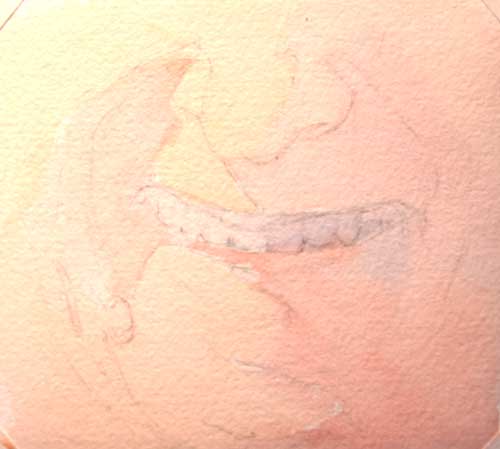
First light wash in watercolor
First light wash: Computer screens don’t give accurate color. This wash is about 3 steps lighter in value, and not as red.

Ack! It looks like Jabba the Hut! That’s why the next step is so important.

First dark values

The picture below is better, isn’t it? The dark green defines his face and neck. Whew.

Adding dark values
Adding dark values

I start adding color to build the forms and I start adding in the first of my darkest values. I use a dark red in the mouth, painting carefully around the teeth to preserve their shape. The red looks terrifically bright (it’s a little frightening at this stage!), but I know that I’m going to tone that down later with a blue or violet wash. A warm color like red or orange is a way to bring glowing light into the shadows.

Building form

Building form
Building form

I keep building form, continuing to think of hue, value, and those pesky edges. I love to paint into the shadows.  Forms in the mass shadow also have temperature, hue, and value.

Continuing to build form
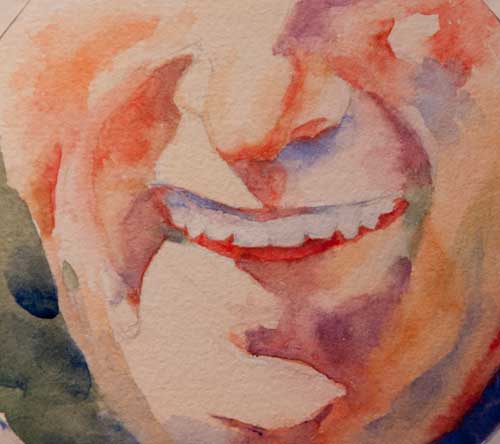
Building form using darker values

If you deconstruct the face, you’ll find that it’s really a collection of spheres and cylinders. As I’m painting, I’m thinking about those shapes rather than thinking of the painting as a face.

I know this looks rather alarming, but I’ll keep adding light washes, and eventually it will come together.

Final image

Final Image
(Not-so) Final Image

Many layers of transparent paint, and a final light wash of ultramarine blue, it will come together—or not. The use of blue and violet on the lips was a mistake. It looks like Grampa Munster‘s smile. So I’ll leave this tutorial with a bit of a cliff hanger. Can I repair it? Stay tuned for the next episode of The Watercolorist in Fix-it Mode!

 Linkage:

Big time portrait painter John Howard Sanden has a good essay on the question of the smile.

How to draw a sphere

Preparing for a watercolor painting

I’m planning a large painting—a full sheet of watercolor paper—of a figure. As eager as I am to start slopping paint around on such a large space, I know I”ll be happier if I first paint some smaller studies. I often make lots of studies before beginning a painting; with watercolor, it helps to know where you’re going.

Watercolor sketch of coat
Watercolor sketch of coat 8″ x 10″

The painting is based around an old coat of my mother’s. My grandmother made it in the 50s, and as a testament to my mother’s care and thoughtfulness with her things,  the coat is still like new. Getting the right red-orange color is difficult. It’s an unusual shade of red.

Watercolor figure sketch
Figure sketch in watercolor 10″ x 8″

I got my niece to pose for me in the garden and I sketched, took photos, and made color studies. She’s a lovely young woman and I wish she would be my model always, but sitting still for so long made her feet fall asleep. It’s hard work to be a model.

Watercolor painting of a young woman's face
Watercolor portrait study 7″ x 5″

This is much larger than it will be in the painting, but I couldn’t resist painting a close-up of her face.

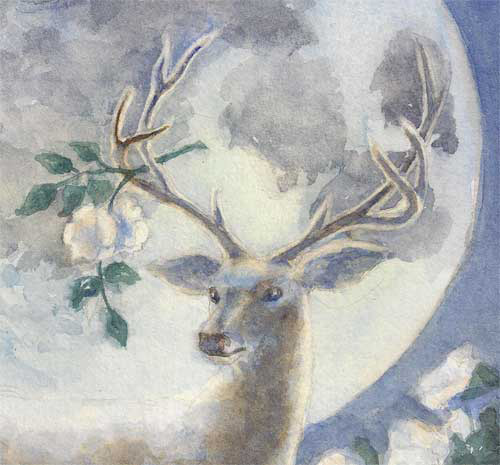
The supermoon brings the deer to the roses

White deer in roses
Hart in the roses

Watercolor on paper
© Margaret Sloan 2013

July’s supermoon kept me awake for the third time this year, and my wakeful night inspired this watercolor sketch for a painting of a hart in the roses. In North America, the full moon of July is known as the full buck moon, when deer have antlers (some say the antlers are still in velvet. Any readers out there know for sure?)

I’ve been a gardener for many years, and I don’t find deer as thrilling as an un-gardened person. But a hart  in the roses, edged silver by the supermoon is a magical image. The hart (especially the white hart) is a mystical being in many cultures. A white stag led Arthur and his knights on hopeful quests, brought Hungarians to their homeland, gave Frenchmen pain from unrequited love, and made  Native American brides beautiful on their wedding day. The white hart even became the Christ in some Christian countries. And it was the white stag the children hunted in the first Narnia Chronicle that led them back through the wardrobe into their own non-magical world.

I live in an urban area, where deer are few and far between. So if I saw one in the garden, I think I would have to follow it. Until that time, all I can do is follow it with my brush and paint. It will have to be enough.

WhiteHartcloseup

For more about the hart in mythology, you might try these sites:

Terri Windling’s Wonderful Blog, Myth and Moor
Protect the White Deer
The Sacred Hart Moot
The White Deer

The goddess and her cat

Note: For the first time ever, I’m offering paintings for sale online. These paintings, to be specific. You can find them on Etsy.

This series of paintings popped into my head one night as I sketched in pre-sleep drowsiness, having just finished Neil Gaiman’s American Gods.

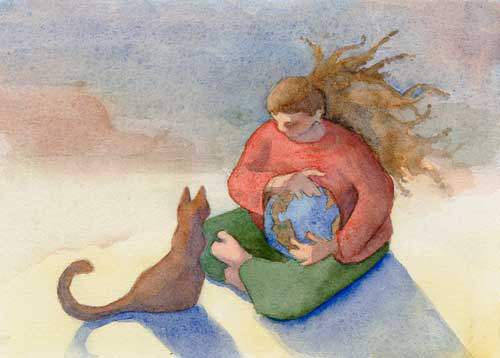
The liturgy at the congregation where we celebrate the High Holy days does not give G*d a gender, or rather, the gender is floating, sometimes male, sometimes female, sometimes nothing. So I have chosen to portray the earth’s protector as a feminine entity, a Goddess, if you will, in comfy clothes (she’s a goddess; she can wear sweat pants if she wants!), with a cat (you can make the cat a symbol of something if you want. But really, it’s just a cat. And isn’t being a cat enough?)

Earth Mother Protects

 Earth Mother #1: Protecting
7″x 5″
© Margaret Sloan 2013
Watercolor on paper
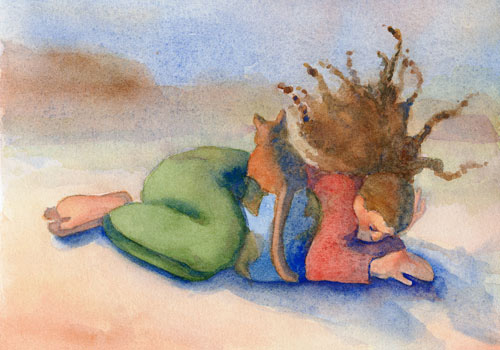
Earth Mother Sleeps Earth Mother #2: Dreaming
7″x 5″
© Margaret Sloan 2013
Watercolor on paper

Earth Mother Plays

Earth Mother #3: Playing
5″ x 6.5
© Margaret Sloan 2013
Watercolor on paper

My Etsy shop, in case you don’t like to click is: etsy.com/shop/MargaretSloanArt


Rapid Painting

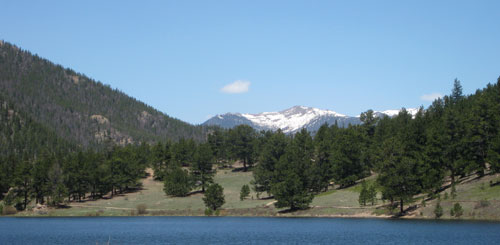
Lilly Lake near Estes Park, Colorado

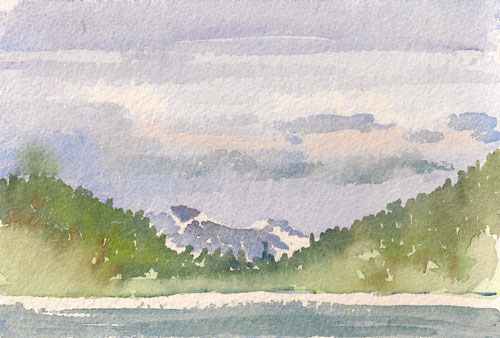
On a recent trip to Colorado, I painted at Lily Lake near Estes Park.

I’ve been trying to loosen up my watercolor landscapes; normally I make a tight pencil drawing on the paper before I start applying water and pigment. But I’m not liking the results. The image is too tight,  much like a cartoon.

Watercolor landscape painter Jonathan Pitts advises starting out with a 5-minute sketch before launching into a longer painting. In 5 minutes there’s only so much you can do. You have to rely on simple shapes, colors, and brush strokes.

At Lily Lake, I couldn’t quite restrict myself to 5 minutes. I gave myself a 15 minute time limit for an initial sketch on a 3.5″ x 5″ piece of watercolor paper, set the timer, and painted.

LilyLake_15MinutesLily Lake
15 minute study
Watercolor 

Next I worked for a couple of hours on a larger piece of paper. It was late afternoon, and the light and sky was changing every few minutes.

LilyLake_2hours

Lily Lake
2 hour study
Watercolor

I like the quick study much better. Making quick decisions forces me to work rapidly in bold patterns and simple color. Such “thin-slicing” is not my normal state of affairs; I usually mull things over until they are thoroughly mushed and muddy. I’m searching for clarity in many things. Funny that it should sometime come as a result of flash decisions.

Grass moon

Grass Moon
Grass Moon

We’re just coming off the April full moon (last night, gleaming through the slats in the blinds, she woke me; though waning gibbous, she still left me breathless) . Her names are hopeful: the Pink Moon; the Full Sprouting-Grass Moon; the Egg Moon; the Full Fish Moon.

Here in the Bay Area I think she’s best called the Grass Moon. It’s a name that celebrates the luxurious growth of plants reveling in moisture at the end of our short damp winter.

This is a painting from Russian Ridge (right now one of my favorite places in the Bay). On the day I painted this, the marine layer (aka fog) covered the mountains, hugging the ridge in the drippy embrace of the not-too-distant ocean. The grass raved viridian, turquoise, and shining wet jade green around this little outcropping of rocks.

In just a few weeks the grass will yellow and turn white-gold in the California sun. Even now the poverty grass is silvering, turning the color of a new moon.

In praise of privet

Privet
© Margaret Sloan 2012
Watercolor 

Two weeks ago, shaky and hollow feeling, I came home from hospital to our un-airconditioned house (really, it’s just an uninsulated box sitting in the sun). Our house, besides being horrendously hot during warm summer afternoons, is not really set up for relaxing (except in the bedroom, the hottest room in the house). We’re set up for working. Or eating. Because working and eating? Those are pretty much our main activities. The living room is my studio. The extra bedroom an office. We don’t do much lounging.

But after 4 days flat on my back in hospital (No food! No ice cream!), I couldn’t work. I needed a place to rest.

We’re lucky to have a backyard. And in the backyard beginning at about 1 p.m., there is a lounge chair that just fits in a small wedge of shade cast by a privet tree.

Normally I hate privet. It’s weedy. It sprouts in every inch of the garden. Sprouts that, at 5 inches tall,  require a shovel to extricate them from the center of my favorite perennials and shrubs.

Because of a miscommunication with the mow-blow-and-go lawncare service, this privet, once a semi-tamed shrub in a mixed hedge, went without pruning for so long that it has now become a tree. For many years I’ve threatened to cut it down. And now I’m glad the chainsaw never touched it.

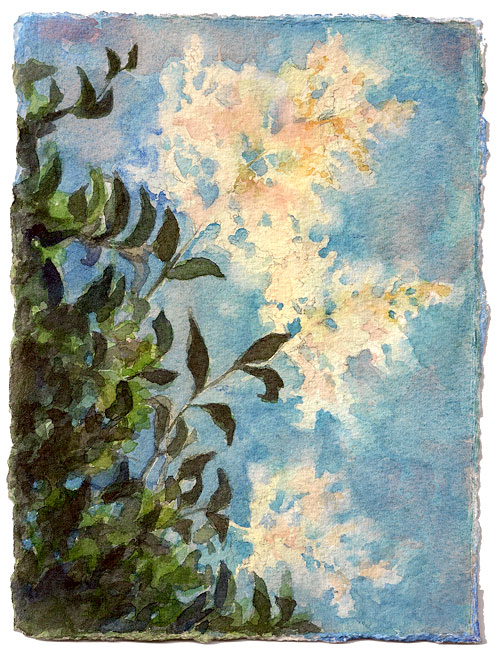
Because for two days after coming home from the hospital, I rested in that pool of privet shade and watched the white blossoms against the blue sky. The fresh smell of the flowers helped clear the nasty hospital and medication odors from my nose, and the sound of insects buzzing through the flowers lulled me into much needed sleep.

Yes, I know. All those lovely flowers will become blue-black seeds that will create a veritable privet lawn in the garden, and I’ll be cursing the privet soon enough. But for now, I sing, grateful and loud, in praise of the privet tree.

Best in show

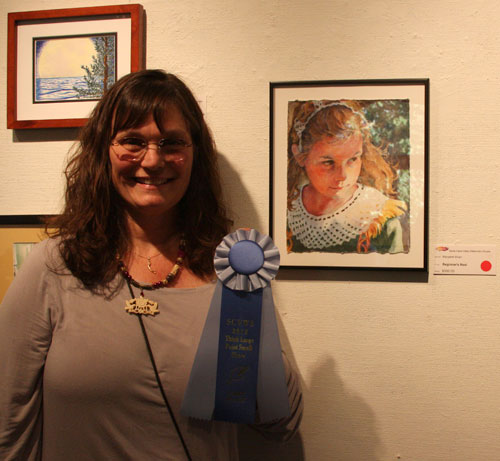
I was thrilled to win first prize at the Santa Clara Watercolor Society show “Think Large…Paint Small.” Really thrilled.

And see the red dot? Someone bought it–A friend who does Irish step dancing.

I couldn’t stop smiling.

Think Large…Paint Small

Sorry, I have to do a little more crowing. My painting was included on the poster! (click here to enlarge the image).

The opening is Friday, July 6, 5:30-8 p.m. in the Norton Gallery  (That’s the small but beautiful upstairs gallery) at the Pacific Art League in Palo Alto. It would be great to see you there; you’ll know me because I’m the one who will be beaming with smiles.