30-in 30: Painting an egg in watercolor

Egg 1 Watercolor on Arches #300 hot press
Egg 1
Watercolor on Arches #300 hot press

After the complexity of painting an antler in my new shadowbox, I thought that it might be easier to so something simpler, less complex.

It turns out that painting an egg is harder than you’d think. Yes, I’ll try painting an egg another day (maybe not tomorrow). Really seeing that blanquillo—that little white one—is a challenge.  Really seeing the colors and values and figuring out how to portray them in paint flummoxed me.

Despair. I should just study accounting (actually, I am).

While I was slopping away at this egg painting, getting more and more frustrated, I was listening to NPR’s new podcast, Inivisibilia. The story of Martin Pistorius, locked in his mind and unable to communicate at all, sort of slammed my psyche up against the wall. If you haven’t listened to this show, go straight there, right now, and listen to Locked-in Man (click here)  Then come back and let’s talk.

Sometimes living the artist life is frightening and frustrating, and full of mistakes, wrong turns, and dissatisfaction. My mind is constantly scolding me for choices I’ve made, big and little, and telling me horror stories about the past, present, and future. Sometimes I get locked in to my own fears, and they’re all I can hear. It gets in the way.

The story of Martin was a little like a thunderbolt in my brain. Imagine living so locked in, so completely out of your own control, with the sound in your head of your mother’s words: “I wish you’d die.” Not just living with those words, but unable to talk back, to cry, to fight. Then imagine coming to the realization that those words came from a place of deep compassion from your momma’s heart, and forgiving her for those hard harsh words. Good heavens.

Martin let his thoughts float by, examined them without getting torn up by them, and built his own inner life. Very Zen, and very hard to do. But it seems like it would be so worth it to be able to do that. I see the necessity. Now I need to figure out the methods.

I’d love to hear from you. Reader, if you’ve figured out how to “let it go,” share it with us in the comment section.



30-in30: Painting a quick watercolor portrait

Portrait of Lee Watercolor in 500 Series Mixed Media Hardbound Art Journal
Portrait of Lee
Watercolor in 500 Series Mixed Media Hardbound Art Journal

People often ask if I paint portraits from life. Yes, I do, and I prefer it actually. But no one wants to sit still for that as many hours as it takes me to paint a portrait.

But as part of my 30 in 30 challenge (30 days of painting for at least an hour a day from life only), I persuaded a visiting friend to sit for me for about 2 hours. We were listening to my fiddler and her banjo-player have some major old-time tunes, and she was itching to dance (she’s an avid and talented dancer). Between the wiggles and the occasional clogging break, I managed to get this quick portrait of her.

By the way, if you’re looking for a journal that will take watercolor, I suggest the Strathmore 500 Series Mixed Media Hardbound Art Journal. It will take several sloppy washes and a lot of pigment with only a minimal amount of buckling. And the image doesn’t bleed through to the other side too much, which makes it useful for journaling. And the binding is a sort of fake leathery-looking material, so it feels a bit rich and special, which we all need sometimes.


You can hear the music here:


Long time crush

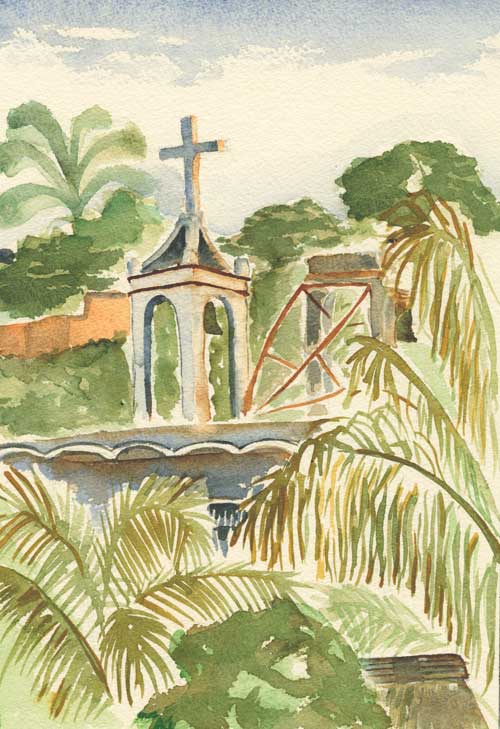
painting of church
A watercolor done many years ago of a half-built church

I’ve been absent from the blogosphere lately because we are in the process of moving (or thinking about moving, or taking about moving. We are not fast people. We move slowly).

Part of the process of moving is, of course, going through years of accumulated detritus, sifting out what to keep and what to save. It’s a little like an archeological dig, exposing layers of life that have been buried in boxes for nearly 2 decades.

The painting that heads this blog was done when, many years and lives ago, and sweating in tropical heat, I was just discovering that I needed to be a painter. I had always drawn, painted, created, but I was also attempting a writing career in those days. I was carving my time into chunks so that I could do both— write and paint—plus upkeep our lives in a foreign land.

I happened to read Annie Dillard’s The Writing Life. In it she describes making a pen drawing of the view she had through her window. Then one day she shut the blinds.

“Then, by lamplight, I taped my drawing to the closed blind. There, on the drawing, was the window’s view….If I wanted a sense of the world, I could look at the stylized outline drawing. If I had possessed the skill, I would have painted, directly on the slats of the lower blind, in meticulous color, a tromp l’oil mural view of all that the blinds hid. Instead, I wrote it.”

This passage was a watershed moment. I realized that by focusing on writing, I was penciling the wrong paper; I needed to paint, and to paint realistically, because I needed to see the world. I needed that connection of observing the world closely, granularly, carefully. I needed to create the picture in the window, not write it.  Painting was where my stories could live.

Need is such a weak word to describe the yearning, the almost sick-with-desire crush I felt for painting, that I feel even now. I still write (yeah, this blog), and I enjoy the (rare) feel of stones falling clop-clop-clop when I craft a particularly elegant sentence. But my true love, that moves with me from place to place, after nearly 20 years?

Brush and paint.

Watercolor painting
One of my first landscape paintings done from a sketch I’d made onsite.


Wednesday WIP: Little Pink Skull

Here’s a little tutorial.

There is a little school near our house where they often have events, complete with performances for the kids. One day they had dancers in full feathered Aztec regalia rattling their cowrie-shelled legs and swirling burning incense over the playground.

So dramatic! And I caught a beautiful image of a woman dancer that I really wanted to paint.

You might remember this was one of my initial color studies:

Study for painting 3" x 5" watercolor painting This study is for a drawing I'm working on. Six hours into the drawing and I feel like it's just starting to emerge from a mush of pencil scratchings. But I dreamed the colors, and couldn't wait to get them onto paper.
Study for painting
3″ x 5″ watercolor painting
This study is for a drawing I’m working on. Six hours into the drawing and I feel like it’s just starting to emerge from a mush of pencil scratchings. But I dreamed the colors, and couldn’t wait to get them onto paper.

This was the finished detailed drawing. How many hours in this drawing? I’m not sure I could tell you. Time folds when I’m concentrating.

pencil drawing
Pencil drawing for watercolor painting

I paint on Arches 300# paper, a stiff, cardboard like stock, so I don’t have to stretch it. I use push pins to hold it to a board. Sometimes it curls while painting, but I can flatten it after I’m done.

pencil drawing
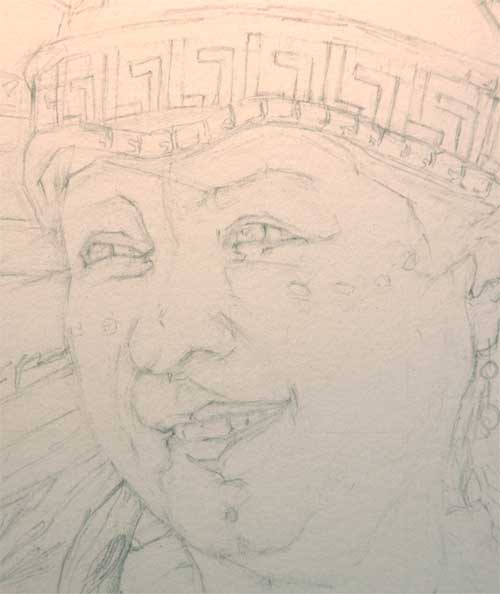
Close up of pencil drawing

As I draw, I’m not only trying to find the likeness, but I’m also thinking about the painting. Watercolor (the way I paint) takes planning, and the underdrawing is my page of notes. Where will I use lost edges? Hard edges? And those difficult in-between edges that can often describe form so beautifully? How will I apply the paint? What brush strokes will I use?

When I finally believe I’m happy with the drawing (I always reach that point too soon. I’ve got to learn to keep working even after I think I’m finished.), I start adding light washes.

beginning painting
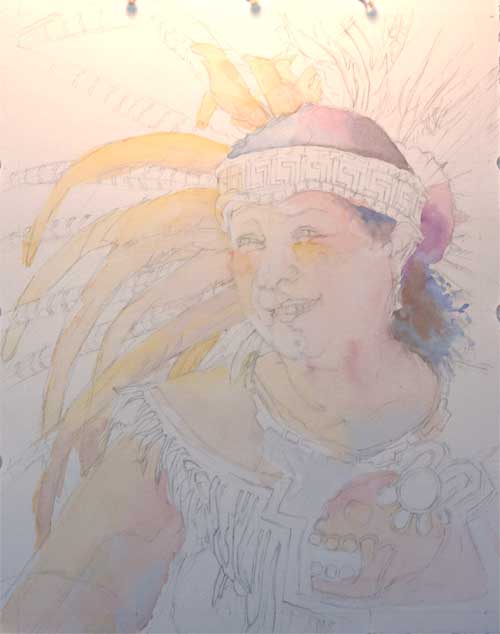
Light washes over pencil drawing

The first light washes establish the color temperature of my painting as well as the values. I like a lot of pigment on my paper, so I know that I’m going to cover  much of these beginning strokes with more paint. But these light washes are the  foundation onto which I build ever-deepening color. After this, it’s all about layering.

Painting of Aztec dancer
Little Pink Skull (unfinished)
Watercolor on Arches 300# paper
© Margaret Sloan 2014

I’m sorry that I got caught up in painting and didn’t make more process photos. This is unfinished; I am still working out the feathers in the head dress, and feel like I need to go a little deeper in value on parts of her face. Plus all the fiddly bits of the costume need to be fiddled with.

As careful as I was to get my drawing right, I still ended up glossing over complicated passages like the feathers in her headdress. Small drawing mistakes and fuzzy thinking magnify when you add paint, and I’ve had to scrub out those darn feathers a couple times to get the values and shapes to fall where I want them. I’m still messing with them.

When I’m finished, I’ll have a little dance of my own!


Multiple studies

I’ve been known to paint a single image many times, trying to “get it right.” (The painting “Trim the Velvet” I painted at least 12 times before I was happy with the results.)

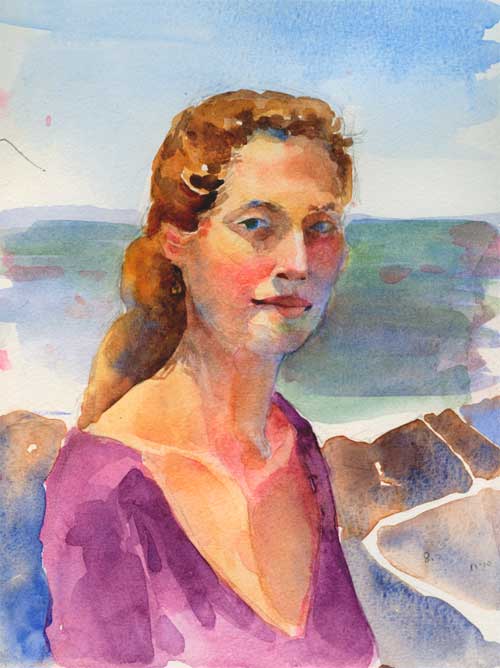
I’ve been working an image of a friend’s wife for a year. It’s eluded me, partly because the original photograph was taken with the sun overhead. A no-no; yes, I’m aware of that. But her eyelashes cast a shadow on her cheek, delicate and curved. Her hair was wisping in a light breeze. Her name is Margaret (yes, my name too!), which, according to coffee cup research, means “pearl of the sea.” The photo, although taken on the front steps of a local church, somehow made me think of the ocean, so I decided to place her on a beach.

This first painting was a color sketch, to play around with the palette and composition. The sketch looks fresh, with nice, clear colors (my favorite part is the blue and green in the shadowed side of her face) and easy brush strokes, but it was just a very quick drawing.

watercolor painting
Sketch for “Margaret”
Watercolor on paper


This is the second version, a small painting: only 8.5″ x 11″. Whatever it was that had caught my attention eluded me in this painting, although in retrospect, I like the placement of the horizon the best in this version.

watercolor painting
Margaret 1
8.5″ x 11″ Watercolor on Arches #300
© Margaret Sloan 2014


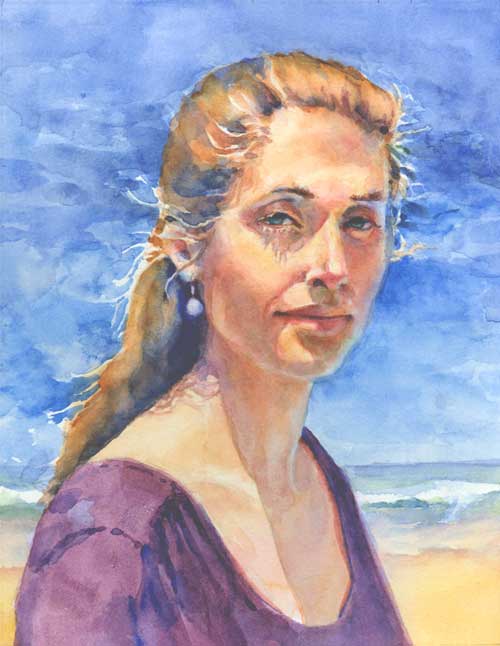
This is the current painting, larger, with more finish. From the beginning the drawing was off, asI didn’t take a lot of time with it. (I grabbed it off the drawing board to take to Open Studios so I could paint while I hung out in my booth.) That little bit of wonkiness in the drawing magnified to large proportions when I started adding paint, and I had to repaint the eyes—a couple times—before they looked like eyes that belonged together on the same face. (Lots of gentle scrubbing with an ancient Series Seven sable removed the eyes.) Note to self: Nail the drawing before applying paint.

Watercolor Painting
Margaret M.
11″ x 14″ Watercolor on Arches 300#
© Margaret Sloan 2014

I think I’ll let this last one sit in the flat file for a while, then take it out and see what can be done. Or I might repaint it again someday!


I’m interested to know what you think. Let me know in the comments field.

New work for Open Studios

One of the things I learned last weekend at Silicon Valley Open Studios was that I needed more work to display.

So this week I’ve been painting: Birds!

I’m a portrait painter. I seriously love painting people, but the few animal paintings I had at open studios were the most popular (read: sales.) So this week I combed through my photos and painted a few birds.

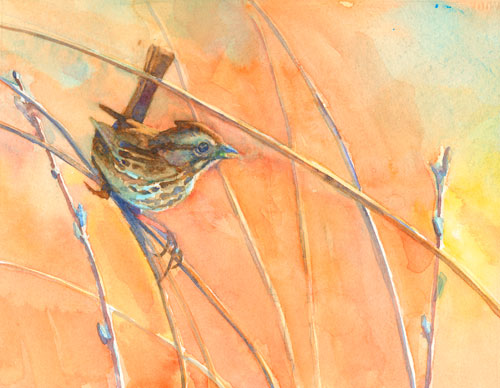
Painting of sparrow
Sparrow
8″ x 10″ watercolor on Arches 300#
© 2014 Margaret Sloan

And you know what? It turns out I love painting birds. Who knew?

Sparrow detail
Sparrow detail (It has a bug in its mouth)

Now, can anyone tell me what kind of little speckled bird this is?


I hope you’ll come to our open studios this weekend (maybe you’ll buy a bird for Mother’s day!) I’ll be at 1471 Hollidale Court, Los Altos, CA 94024

How to begin a painting


Study for painting 3" x 5" watercolor painting
Study for painting
 I’ve started the drawing for this painting. Six hours into the drawing and I feel like it’s just beginning to emerge from a mush of pencilscratchings. But I dreamed the colors, and couldn’t wait to get them onto paper. 

Painting is a very slow process for me. I’m not a slap dash painter; I dream, plan, draw, make more drawings, prepare my references, compose the image, draw the image, stew and chew my cuticles, draw some more, then finally start to paint. In a world of instant gratification, I’m a total throwback.

But when, at his workshop last week, Ted Nuttall told me to keep working on my drawing for the whole of the first day, my heart kind of grinched around in my chest. I’d already spent a lot of time on that drawing, but hey, I was paying the man to help me with my life’s work.  I kept at the drawing, all day, and eventually, I really looked at it.  And there was a sorting, as if things were sliding into place. I found a multitude of drawing mistakes that would have plagued me once I began to paint; fixing those mistakes felt really good, like scratching an itch in the deep part of my heart. The painting eventually became Strength. It has a certain clearness, a crispness that I really like. It makes music in my head.

There are days, though,  when I have to simply let go and paint. If you paint, you know what I mean: You need to feel the water love the brush, and the brush kiss the paper with paint . That’s the time for color  studies.

These next two studes are for a painting my Dad has requested. It’s a small black and white photo of my mom he’s had in his wallet for nearly 60 years (can it be that long since they were so young, beautiful, and full of early romance?).

Study for painting 5" x 3" watercolor study
Study for painting
5″ x 3″ watercolor study


It’s interesting how the composition and editing of the background changes the story. What stories do you see?

Study for painting 5" x 3" watercolor study
Study for painting
5″ x 3″ watercolor study

Watercolor portrait: Strength

Strength Watercolor on Arches #300 © 2014 Margaret Sloan
Strength
Watercolor on Arches #300
© 2014 Margaret Sloan


My thought while I painted this portrait at Ted Nuttall’s workshop at Kowana Valley Folk School and Lodge was “strength despite frailty.” This is of my mom. She’s been very ill through out the last year, but she still is strong enough to make dinner, work in the garden, and boss us all around. She’s also quite beautiful, and was pretty nice about posing for about 500 photographs for me.

I’m thinking that I maybe made another breakthrough at the workshop. I hope so. I’m liking what I’m doing. What a delightful week that was!

If you go back to this post, you can see the tiny abstract paintings that I found in this larger work. Can you tell where they were?

But now it’s back to getting ready for Open Studios. The first weekend is May 3 and 4!

Things learned and a few abstractions

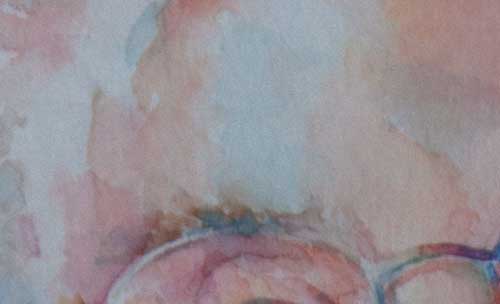
Abstract 1
Abstract 1

Last week I lived beyond cell phone and internet reach as I  attended a week long workshop taught by watercolorist Ted Nuttall. As I expected, I learned so much (yes, the back of my head blew off a couple times!). Let me share just a few of the most important concepts I took away from this wonderful experience..

1. Slow down. No, I mean s-l-o-w d-o-w-n. I spent a lot of time thinking about my next brush stroke. Where should it go? What color should it be? How would it react with the other colors already on the paper? When I finally acted, it was with intention rather than panicked splashiness.

Abstract 2
Abstract 2

2. Think abstractly. This was probably the single most important concept I tried to internalize. I’ve been unhappy with my work lately, finding it a bit flat, and lacking the broken color and fine edges that make my head ring with internal music. By concentrating on making each small passage its own tiny abstract painting, (that of course, relates to the whole image) I was able to add interest and visual variety to otherwise flat passages.

Abstract 3
Abstract 3

3. Think color. I tend to get stuck in one single color: orangey-red flesh tone. But that’s not what a person looks like. Skin tones are made up of many different hues and chromas. By varying color, saturation, and value, the painting is not only more exciting, but more like life. So I went (a little) crazy with color, using combinations I don’t normally choose.

Abstract 4
Abstract 4

4. Be uncomfortable. I made a decision that every brush stroke I put down would make me uncomfortable. I not only walked a watercolor tight rope, but I bounced a bit on the artistic high wire.  Sometimes my brushstrokes set me teetering and wheeling, but after a bit of nail biting (and whining), I regained my balance and continued  painting. You know what? Those seemingly near disasters turned out to be the best parts of the painting.

My workshop painting is still not quite finished, so I’ll not post it yet, but I’ve cropped a few of the tiny abstract paintings that make up the whole. I find them quite lovely all by themselves.