Spring is officially here. Freshly laden with promise, sex, and the promise of sex; the season of flowers and babies has sproinged to life in the Northern Hemisphere. The maiden, full and fertile, drives mythology of the vernal equinox.
Spring is so closely identified with the maiden that we still tell the ancient myths about her: Stories of beautiful Persephone, emerging each spring from her winter home in Hades to touch the landscape with life; Myths of Ēostra, dawn goddess of ancient Britain, who so tickled St. Bede’s fancy that he attributed Easter festivals to remnants of her ancient cult. And songs of huntress Artemis, notching arrows to her bow, echo across the centuries to create Katniss Everdeen and her fight against the evil capitol of Panem.
We love the myth of the springtime maiden. Perhaps because we are in love with youth. But one of the unavoidable truths of life is that, unless death preempts it, we are all going to age.
The crone often represents aging, the waning of the moon. Winter. She occupies a cold place in our cultural mythologies. We scare children (and adults) with stories of crones feeding princesses with poison apples, Baba Yaga beating the air with her pestle, fashion-forward heiresses making coats from puppies.
This is wrong. We need new stories. Tales that recognize the duality of spring and winter, and the worth of both ends of our lives.
Spring Crone Watercolor on Arches #140 hot press
If you think this blog might be of comfort to someone, please share it
I am a sucker for themed dress-up events like the Sonora Celtic Faire. I love the Irish tunes rippling through the fairgrounds, with the occasional Scottish strathspey straining to be heard. My heart beats hard to the pulsing Celtoid drums of bands like The Wicked Tinkers; my eyes mist over at ballads sung by the venerable harp-and-fiddle band Golden Bough; I make my fiddler swing me in the aisles to the raging reels of Molly’s Revenge.
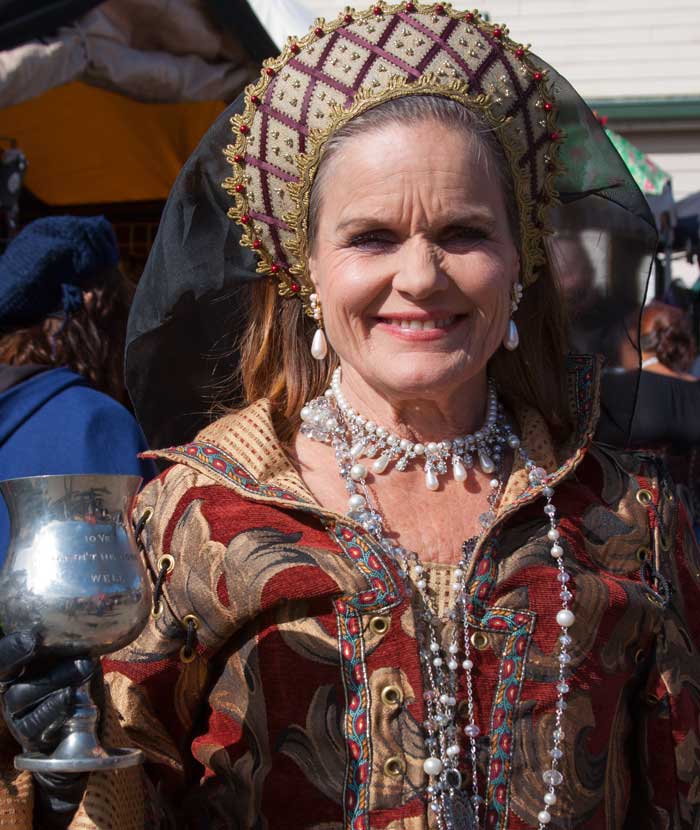
I cheer at the anachronistic (and questionably Celtic) crash-and-bash heavy armor battles and charging horses carrying jousting knights. I admire the long sword-wielding solders in their swoon-worthy uniforms and leg-revealing hose. I shiver with a thrill of awe at the costumed players pretending to be royalty.
I even salivate at faux-Dickensian food like bangers and mash, and turkey legs bigger than your head. Who doesn’t want to gnaw greasy meat off a bone held like a cudgel in the hand?
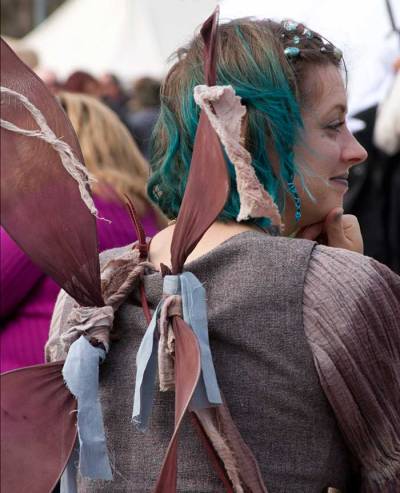
Wings at the Sonora Celtic Faire
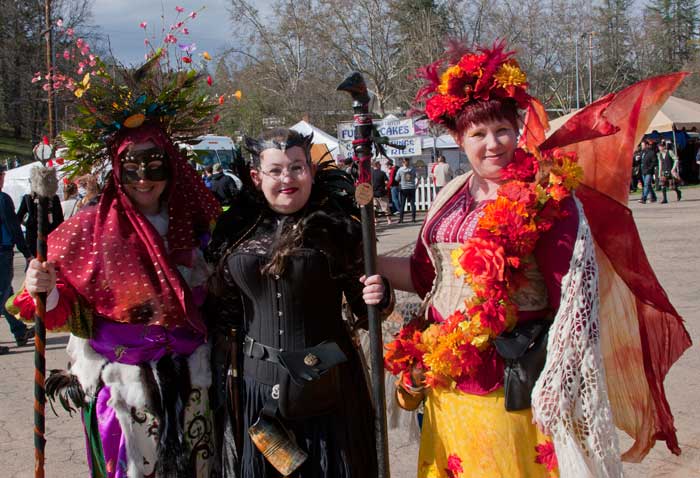
But what I like best are the costumes.
Three sprites at the Sonora Celtic Faire
I’m a nerd that way. I’m flabbergasted at the creativity of those clever enough to make intricate costumes. Most of the cosplay isn’t historically accurate, but what it lacks in research, it more than makes up for it with creativity and fun.
Goat people on stilts
I mean, the goat people were just awesome.
Knights in shining (and dented) armor waiting to do battle
The knights who bang on each other with wooden swords seem to take their competitions seriously.
Knight jousting
The jousting ring was not so serious, with a lot of crowd pleasing banter and only a short display joust. But still, charging Percherons! Guys bashing each other with staves! More, please!
Young lads sword fighting-Don’t try this at school!
Everywhere boys fought mock battles with swords—toy and real. Even in these modern times, video games flicker dimly when compared to the romance of actually smacking each other with sticks. Real time, real bruises.
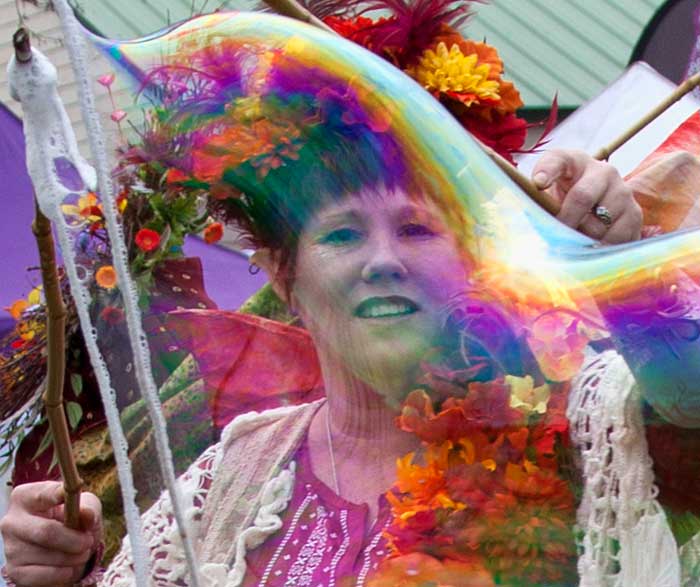
Bubbles at the Celtic Faire
Originally I thought I would bring my sketchbook and draw, but the fun of photography won me over, and I captured many images that will grace my easel in the future.
Queen for a day
As much as I love to draw, I mostly kept my sketchbook in my bag. There was too much going on. The camera allows me to capture ephemeral moments, like this young man well seated on his mount.
Young knight and his ride
At the end of the day, exhausted, I sat still long enough to dig out my sketchbook and draw while I enjoyed the traditional Irish music of my friends’ band, Cooking with Turf.
Did you know that today is International Bagpipe Day? The Bagpipe Society in Britain has deemed it so, and exhorts you to “go out and play your pipes – anywhere, anyhow to anyone!” Perhaps you’ll hear someone playing pipes today; I think it’s a sign of luck to come.
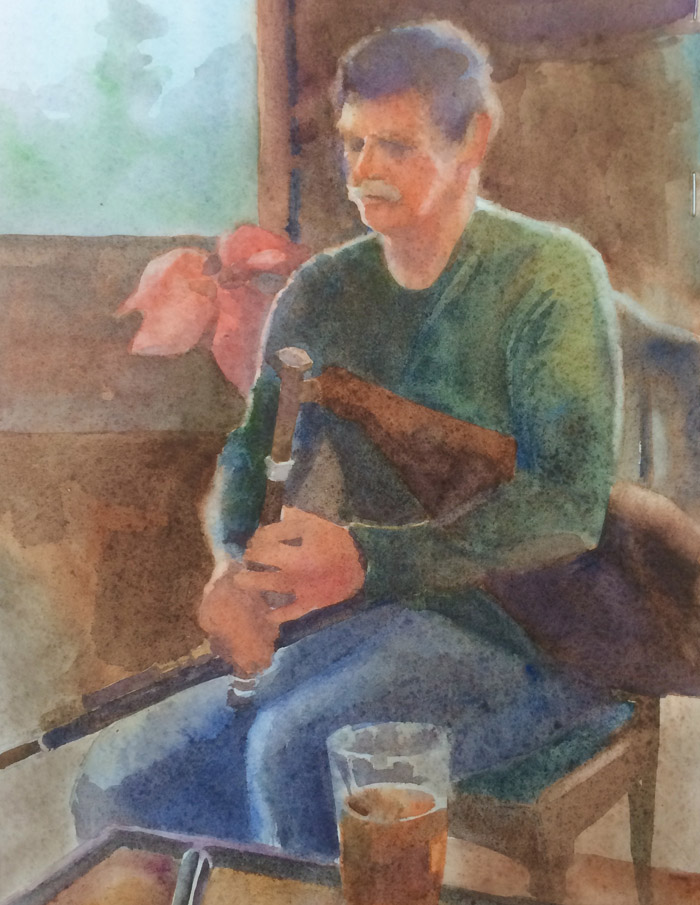
Bagpipes, the ultimate in balky reed instruments, are traditional throughout the world. My favorite are the Irish Uilleann pipes, which are the kind of pipes my friend Mike is playing in the painting above.
To avoid sounding like a punter, pronounce the word “illin,” which is Irish for elbow. They’re played by pumping a bellows with one elbow to fill the air sack, which is squeezed by the other elbow to force air through the reed to make the squawking sound pipers describe as music. Get it? Elbow pipes.
Follow International Bagpipe Day at the society’s Facebook page:
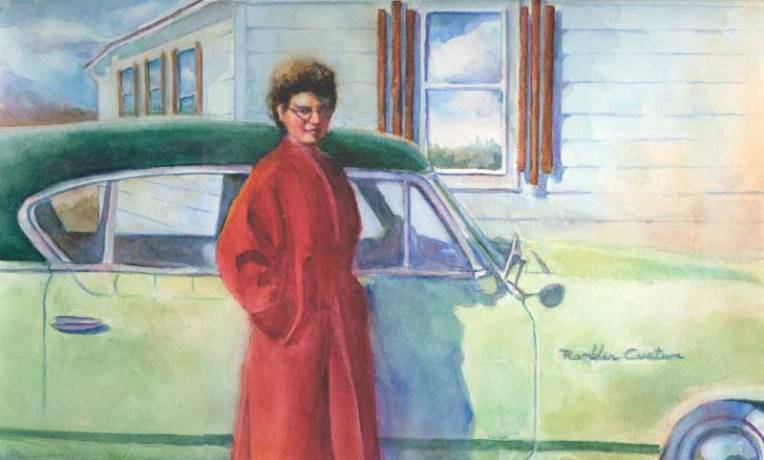
The painting above is of my mom with her brand new car in 1956, that she bought with her own money earned from working a professional job. (For 60 years, my dad carried in his wallet the black and white photo I used to make this painting)
She told me that when I was a baby, she was passed over for a promotion—even though the boss admitted she was better qualified for the job—because he had to give it to a man, even though that man was less qualified. After all, he had a family to feed. My mom was supporting us at that time while my dad went to school. She asked the boss man, “what about my family?” Perhaps because I was a girl-child, I didn’t need to eat much?
My mom is one of my heroes. I can only hope to ever measure up to her intelligence, compassion, dedication, and love.
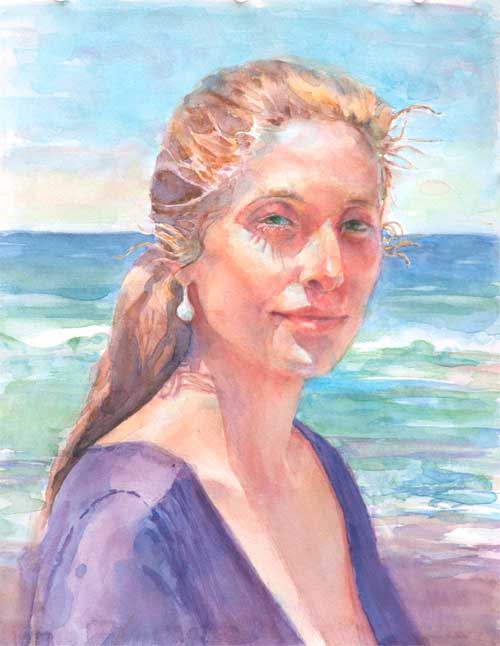
The above painting is of Margaret, the wife of a very fine painter. She and her husband told me that she helped put him through art school by being a model. She helps run the half of his business that doesn’t involve painting, and is raising their young children. When I painted this picture, I kept thinking of her as the heart of their family, as well as the heart of the sea.
She still models for him.
Figure sketch in watercolor
This is my beautiful niece. I convinced her to pose for me one warm summer day. She was very young; I wanted to capture that fear of being a young woman setting out in the strange and sometimes frightening world. 5 years later, she’s planning a wander year, still a little anxious, but bravely planning her journeys. I worry about her. I know that the world is not always kind to young women, and yet, I want her to make her way with bravery and joy.
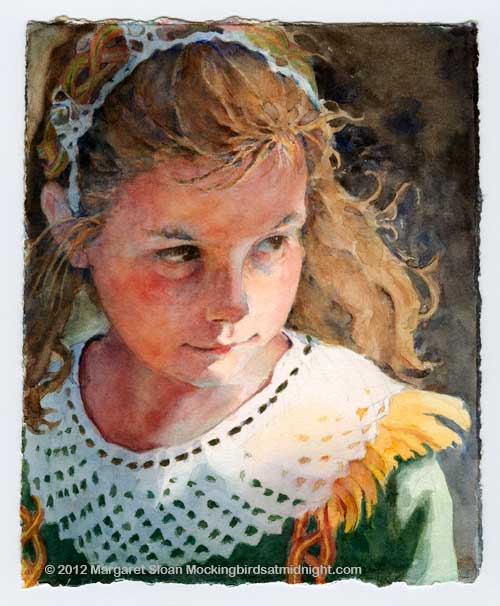
This little girl was at her first stepdancing exhibition. She was about 6 years old, and the only beginner to dance at the show. But she bravely marched out and danced her sevens and one-two-threes by herself, soloing on the edge of a world that holds promise as well as dread. I hope that she dances through a world that gives her a chance.
To all women still turning the wheel, I salute us. To the men who love us, I salute you too. It’s sometimes a hard wheel to turn; let’s work together on making it revolve.
If you think this blog might be of comfort to someone, please share it
When a friend lobbed a few critical words at my life drawing skills (something I work hard at and am proud of), all my self-puffery deflated like a sat-upon whoopee cushion.
We all know the sting of criticism. And artists—sensitive lot that we are—tend to become derailed by the smallest hint that our work is not up to snuff.
The criticism came from an artist I respect immensely, so it stung especially hard. I was ready to crawl into a hole, learn Microsoft Office and reemerge as an office lady. Why would I even think I could be an artist?
I’ve seen a lot of talented people give up their love because of a few off-the-cuff critical words.
But I can’t do that. Because to not paint; to not draw; to not tell stories? That really hurts. If criticism is like being stuck with a hat pin, not working at my art is like being eviscerated with a dagger.
Yes, really.
So I’ve developed 5 ways to deal with criticism. They aren’t foolproof, but they do help keep me from sinking into despair.
1. Consider the source. Did a yayhoo in a beer hat just say my painting sucks, then shows me a watercolor his great-grandmother did of two Labrador retrievers in a pond?
Wait, what? Those are ducks?
Unless he then tells me he’s a professor at a prestigious art school, and then goes on to offer me a free detailed critique of my work, I smile, hand his phone back to him, and go on painting. Everyone’s entitled to an opinion.
If, while sipping his beer, my hypothetical art professor goes over my languishing painting and tells me where I’ve gone wrong. I listen. And here’s where the last three bits of advice on my list come to play.
2. Don’t take it personally. I am an artist, but my art isn’t me. The art I’ve made in the past just shows the road I’ve been traveling. Sometimes that road is rocky and I stumble on a rough track, sometimes it’s smooth and I zoom like a sports car. But that journey doesn’t define me; I like to think that it’s the potential art I might make that defines me.
3. Consider the criticism. This is hard. Because it hurts a little to admit to myself that my carefully crafted work is never going to make it into the Guggenheim, even as outsider art. It hurts a lot to find that my peers think my art sucks.
But I force myself to take the criticism in my hand and examine from all sides. Is any of it valid? If so, what bits can I keep and learn from and what bits can I put in a mental drawer and forget about for now? And if it’s not valid, I file it away in my mind anyway, because it could be that I’m just not quite ready to hear it.
4. Consider your options. If the criticism is valid, what steps do I take to make my art better? Do I need to learn more about composition? Do I need to learn more about color theory to clarify muddy color? Do I need to work with another media for a while to loosen my arm?
My art is about communication, and if I’m not doing a good job of that, what will it take to improve my skills?
5. Keep working. Like a traveler on a pilgrimage, I keep putting one (metaphorical) foot in front of the other. Art (and life) is sometimes a slow trudge, and I’m learning to take help from even hostile territory.
The fiddler tells a story about his martial arts teacher, who said, “People ask me how I got so good at martial arts. I got so good because I got beat up a lot.”
Because even when criticism is meant to draw blood, you can learn something about the battle.
Addendum: Wow, I want to thank those of you who read this column and then came to my defense! That means a lot to me.
But really, I was not fishing for anything. I was trying to talk about the hurt feelings that artists all have at some time. I honestly wanted to share how I deal with those hurt feelings, in hopes that it might help others in the same situation.
Keep on creating, whatever you do! And if you have any tactics you use to survive and benefit from criticism, share it in the comments section.
If you think this blog might be of comfort to someone, please share it
A square-yard of watercolor calm while the storm rages just outside the window.
Big storm last week in the mountains. Winds howling through the trees, sounding like freight trains bearing down on us. Trees dancing and shaking like things possessed.
I sat down to work on a painting. Painting calms me; I have to be still inside to hear what the watercolors are saying.
At 7:45 the lights went out.
In the mountains, when the lights go out during a storm, it’s dark as hell, if hell is dark and winds screams on the wild hunt over the ridge and through the treetops. The house rattled and windblown branches cracked against the siding, smacked against the windows. In the dark I heard the fiddler in his upstairs office aerie play tunes in a minor key, and the wind wailed in harmony. The interval sounded like the Devil’s chord.
The big trees on the windward side of our house swung and swayed; in the dark I couldn’t tell if the venerable cedar that leans towards our house was about to give way to the push of the wind, lose its footing and crash through the roof. The fiddler asked, should we build a fire in the fireplace? I prevaricated; if the tree went through the roof into the living room, it could catch the house on fire.
I love that we live in a house that’s like a tree house. I love the soft gray-green light that comes through the branches of the pine outside the window. I love my view over the forest and the baby cedars sprouting on the hillside below. I’m eye to eye with flickers and nuthatches; I watch tiny gray birds flock and flutter through the trees as I eat breakfast.
But being in the trees is a precarious position. Every season brings new pleasures, but also new worries.
John Muir used to climb tall Sierra trees and ride out big storms in the rocking branches at the crown. I’m too chicken to do that. Instead, I groped about and found my penny whistle to add my trilling keen to the fiddlers wail, while the wind augmented the fourth and chased across the mountains.
In the morning: The holy blue light of snow, melting in soft blip-blips. Water on the windows, branches on the ground, but the trees still stand.
Actually, one tree did go down, a small snag killed by bark beetles and destined for the chainsaw anyway. It didn’t hurt anything, thank goodness.
If you think this blog might be of comfort to someone, please share it
Snow and water 10″ x 8″ Watercolor on Arches 300# hot press
On Superbowl Sunday I visited Calaveras Big Trees State Park to interview photographer Susan Conner. She shoots landscapes that tell the story of a quiet earth that often seems to be waiting for something.
“Dress warm,” she warned me. “It will be cold.”
That meant lots of layers, and as I drove past drifts of snow on the highway, I was glad for the long underwear, double shirts, down vest, and Sherpa cap.
But as we sat at a sunny picnic table, the air was warm, the sun burnt our winter-pale faces. We had to speak loudly to be heard over the sound of running water.
I get such a charge out of talking about art with creators, especially when they’re as open and talkative as Susan. As we chatted, we began to strip: first gloves, then the down vest, the jacket, the hat, until in the end we were wearing just jeans and shirts. I don’t know about Susan, but I was wishing I could lose the long underwear.
I wanted Susan to take me on a mini photo shoot. I’m deeply interested in how others work. I always wonder, how do they get from point A to point B, C, and beyond.
Susan hunts for photographs nearly everyday. Things catch her eye, and she starts shooting. She says sometimes she just knows a photo will be great, and other times she doesn’t see the composition until she gets home and looks at the photo on her computer.
We crunched through melting snow as she shot random things: water trickling down a redwood stump, burls in an old tree. On the north side of the forest, the snow, rather than melting, turned to ice at the edge of the big meadow.
A boardwalk crisscrossed the fen to protect the delicate ecosystem from trampling human feet; it was covered in slick humps of iced-over snow. “Too dangerous,” Susan said, and we turned back to the sunny side of the meadow.
There, sparkling in the touch of the sun, streams and rivulets of snowmelt ran through last year’s curled and matted grass. From this approach the boardwalk was dry, and we ventured over the meadow.
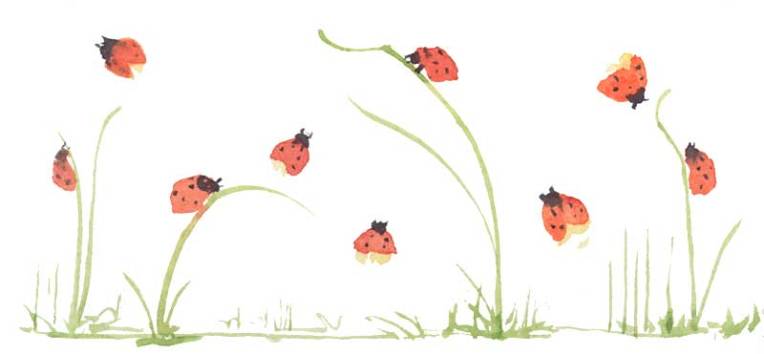
Suddenly the air was filled with a swarm of flying bugs. Thousands of glowing wings whirred in clouds; on the ground we saw bazillions of ladybugs. There were so many that the ground appeared to be moving. They climbed anything vertical and clung to sticks and stems.
Ladybugs hibernate together in clumps during winter, emerging in the first warm days of spring to eat and mate. “It’s too early,” Susan said, as everyone has said when I tell them this story. They should still be hibernating in February. But ladybugs don’t have calendars, and the sun was telling them to wake up.
We laughed and laughed while ladybugs whirred around us. Susan clicked off a dozen or more shots into the air, trying to capture the floating, glowing insects. Then she jumped to the boggy ground and began composing shots of the clumps of the orange and red bugs that had not yet flown. I stood watching, back to the sun, and later Susan had to brush the bugs off my sweater; they had clumped together in the warmth on my back.
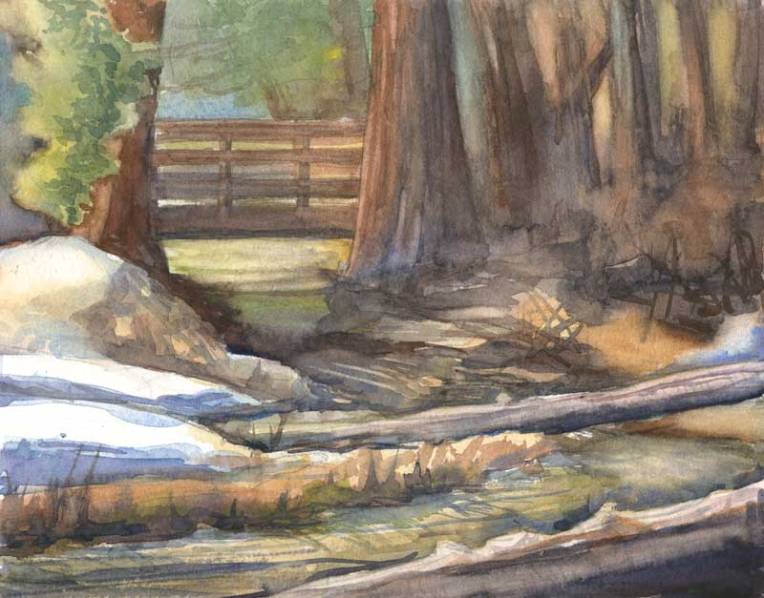
After our walk in the woods, Susan went off to photograph more ladybugs and I dragged out my easel and paint box. I painted the watercolor at the top of this post, trying to capture the feeling and the colors of the day.
For a landscape photographer, for a landscape painter, for a writer, for anyone who creates, I think the trick to inspiration is simply showing up. You never know what will happen when you step outdoors. You could find icy snow on your favorite path, but if you turn around and go a different direction, you could find yourself in a cloud of flying ladybugs.
You can see Susan Conner’s gorgeous work at her website, www.susanseye.com
If you think this blog might be of comfort to someone, please share it
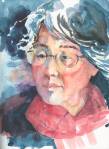
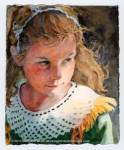
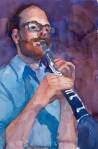
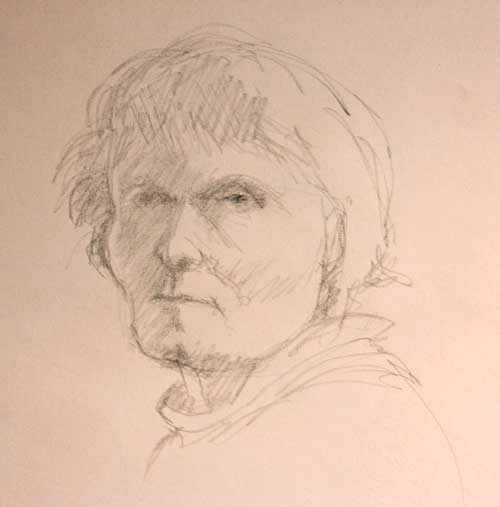
I am currently accepting portrait commissions. I’d love to create a memory for you of a loved one, an event, or an emotional time. See the gallery at the bottom of the post for some of my favorite portrait creations, then contact me at mockingbirdatmidnight_ at _gmail . com to find out how you can commission a watercolor portrait.
I love drawing portraits more than anything else. It’s odd that I would, as I’m not a gregarious person. As introverts go, I’m pretty high on the “I vant to be alone” scale.
But that doesn’t mean I don’t yearn for human connections. It’s just that, rather than partying in a big, loud group, I prefer an intimate cuppa (plenty of milk and sugar, please!) with one or two close friends, sitting in the sun or in front of a cozy fire, trading tales, hearing their stories of their lives and loves.
Painting a portrait is like sitting down with someone and having a nice chat, even if I’m working from a photograph. I often imagine I can hear them speaking to me. In fact, I often fancy the portrait as a conversation I’m having with the person, the paint, and the paper.
My favorite portraits come from sitting down and letting the person talk. Their stories become part of the portrait, and help bring it to life, full of their spirit and soul.
Former Metropolitan Museum of Art director Thomas Hoving shot a video of Andrew Wyeth painting his portrait. In it, Hoving is blabbing away while Wyeth chuckles, nods, and makes “I’m listening” noises, paintbrush moving the whole time. Hoving said that Wyeth told him to talk during the two sessions during which he drew the portrait. Wyeth reportedly said, “I must have animation.”
You can see that video here. It’s not long, and it’s very amusing.
It’s the most wonderful feeling in the world when you manage to draw a portrait that captures not only the likeness of a person but something of their inner life as well.
In the best of portraits there’s a synergy between artist and model that flows as easily as liquid, and creates something as beautiful and memorable as a life expressed in pigment, water, and paper.
Last Thursday I hosted a drawing session at my house. It was so much fun that I can’t wait to host another one. It was a great group of artists, all confident in their own hand, and strong with their own vision. I’d like to show you some of their work.
Drawing by Sue Smith
I could watch Sue Smith draw all day long. She has such a delicate touch of charcoal to paper, yet a strength of form and line; her hand moves like it’s dancing when she draws.
Drawing by Sarah Switek
Sarah is also a sculptor, and I think that her knowledge of all dimensions of a form gave this drawing substance even though it’s drawn primarily with an energetic line and just a little shading.
I envy George’s ability to draw with such expressive marks. His drawings are always spare and minimal, but the lines are loose and free. And he makes it look so easy. Drat you, Geo (not really).
You can see his work, and his wonderful videos here: www.gadurkee.com
Drawing by Margaret Sloan
And mine…
If you think this blog might be of comfort to someone, please share it















 Mockingbirds at midnight