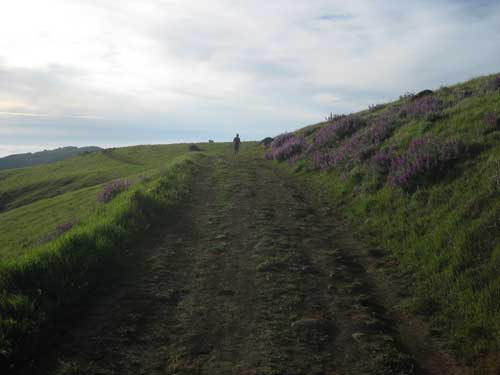
It was a rare weekday afternoon that I was able to spend painting at Russian Ridge, just before a late spring storm. Last weekend I realized this little patch of lupine was about ready to pop into full bloom, and if I wanted to paint them in their full glory, I’d have to get out there soon. Wildflowers fade fast.
Such is the life of a plein air painter. Time and flowers wait for no man or woman, and I wanted to capture the feeling I got on this trail that a person could step from the edge of the lupine-purple earth into the glowing sky.
I love these hazy days with lots of high clouds in the sky. We don’t get enough clouds in the Bay Area. And soon we’ll have the eternal sunshine of the spotless California summer, with no cover from the sun for months and months. But for now, we’ve got clouds a-plenty.
Of course, we’ll always have the fog rolling over the ridgelines, even on most summer evenings.
If you think this blog might be of comfort to someone, please share it
Last week we were off to Death Valley with a group of friends! Painting! Hiking! More painting!
It’s a long trip to DV. Eleven hours for us, stopping often to drain our radiators, stretch creaky backs, eat, and just generally look around. I can paint a little on the road (the fiddler does the driving), but the scenery moves too fast for an even partially realized landscape. There’s only enough time for quick color sketches.
———————————————————–
Quick color sketches in watercolor on Aquabee Super Deluxe Sketch Book paper. This paper is not sized as well as it used to be so the colors don’t sit as nicely on the paper as they do on Arches 300 lb. hot press. But for quick studies in the car, it’s enough.
I also filled in some pages of color blocks in my color journal.
My color journal is a Daler & Rowney Cachet watercolor journal. Again, it’s adequate, but the paint is not as vibrant or well behaved on this paper. When I’ve filled up this journal, I think I will make one bound with binder rings of my favorite Arches hot press.
My tiny pocket palette has a mysterious collection of pigments; I don’t remember what I was thinking when I poured the paint but there are decidedly too many oranges in this palette. Most of my mixtures from the pocket palette end up being built around Mayan blue and transparent orange, with Hooker’s green and a yellow (lemon or aureolin) as secondary colors.
Anyone who likes to paint on the road really should take a look at the book A Pocketful of Watercolors: Philip Enquist. It’s a little book full of little watercolor sketches that shows just how evocative such simplicity can be.
If you think this blog might be of comfort to someone, please share it
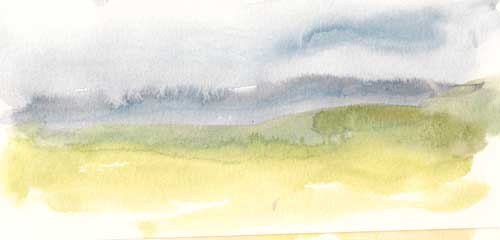
This painting captures a fleeting hour of a Northern California morning on Windy Hill. The South Bay stretched gloriously at our feet, but I blinkered my eyes and found a less dramatic scene: the last of the morning fog drifting over a little hill. It was the kind of hill that I might have climbed when I was a child, peering in squirrel holes and looking for foxes.
These days I’m finding greater success in painting small slices of the view, in making the landscape more intimate. Limiting the painting to this small view made seeing the composition and the values easier. I was able to wrap my head around the color shifts, and win more arguments with the paint than I lost.
Maybe that’s the kind of person I am right now; my present tense has gotten smaller, more confined to small views. Once-upon-a-time I took epic (seeming to me) journeys, traveling across desert horizons and through mountains of rainforests. But now I stay home mostly, in the place where I was raised.
My friend Cynthia Brannvall (an artist whose wonderful work taps into some larger, softer universal landscape) wrote to me, “One of the things that I find so beautiful about your work are the little, beautiful moments of everyday life…in this day and age when we are assaulted with stimulation and virtual realities, I find the little and ordinary gestures of real life to be more and more precious.”
I guess for me, small is comfortable. I like the up-close view, the things seen at trailside. I find value in landscapes that are familiar to children, in the possibilities of squirrel holes, foxes, and little white clouds.
If you think this blog might be of comfort to someone, please share it
The fiddler and main computer guy of the house finally convinced me to back up my computer, so I’m trying out the mythical cloud storage route. Now my trusty little laptop is occupied with the upload that never ends, and I’m reduced to the fiddler’s old machine that, a few months ago, came out on the wrong side of a tussle with a cup of coffee. Not all the keys work all of the time. I don’t hold that against it, but it does make it hard to type.
I’m feeling better from the walk-in-the-park-from-heck surgery, and am back to the day job and doing some painting. Paul Fox’s Habit Building forum really helped me get back into a groove. I know I’m establishing a habit of taking out the sketchbook or paints in the evening, even if I’m a wee bit too tired to do much actual drawing or painting. But without much work, I don’t write many blogs
But I have been enjoying the blogs of others. Painter Keven McEvoy has written a lovely sweet blog about the Four Ages of Man and the power of a portrait. James Gurney has a link to a neat old movie about Hollywood matte painter Peter Ellenshaw. Sue Favinger Smith (who is really a terrific landscape painter) talks about the importance of learning to draw, and offers links to several sites with photos of models for you to draw. And Matthew D. Innis has gifted the blogosphere with a look at the paintings of Michael Klein (both are painters of a quality to which I can only aspire).
If you think this blog might be of comfort to someone, please share it
My band has been preparing for a gig. We recorded a tune, and when I listened to it, I was horrified to hear a tempo as ragged and floppy as an old stuffed bunny.
I play Irish flute, specifically dance music. I love the rolling beat, the pulse of the tune lifting and driving dancers through the set. The beat needs to be crisp and perfect to move the dancers.
But that what wasn’t what I was hearing in our recording.
So I’ve spent the last week practicing with a metronome, first lilting the tune in time with the flashing red LED, then trying to match my flute playing to that maddening strobe.
It’s amazing how that little pulsing light seems to slow down and speed up as I play a tune. At first I thought there was something wrong with the metronome, but of course, there’s nothing wrong with the electronics; it’s my playing that’s uneven. But gradually I’ve managed to tame my out-of-control tempo, and the tunes sound all the better for it.
Painting isn’t like playing a flute, but visual arts don’t exist outside of tempo. I think that paintings have their own internal tunes. My favorite paintings are those that make my brain feel like I’m seeing music. Sorolla paintings play tunes to me. Zorns are full of music. Sargent is something like a symphony. Surprisingly (because I prefer realistic work) Paul Klee paintings are like small pipes and fiddles.
I find that external noise while I paint influences a painting’s tempo. My most successful paintings are done in silence, when I really listen to the painting and pay close attention to the pulse that each passage requires. I listen carefully to hear fast strokes that are well conceived; slow shapes of color placed just exactly where they need to be; staccato or slurred edges; the pacing of high and low values. I’m always asking myself, how do I encourage the viewer to dance through a painting?
When I paint, there’s no steady tick-tock of a metronome, other than the drum of my blood and the deep sound a painting makes when it’s making my heart dance. Only if my heart is shouting “house Maggie, mind the dresser!” will I have a chance to let others hear that internal music.
If you think this blog might be of comfort to someone, please share it
The first place I went in Chicago was the Art Institute. That was the first stop on our trip; I really didn’t care what else I saw in that big city. The art museum was my “it” stop.
People have asked me (rhetorically, of course) how many hours can you stand to be in a museum? I snort. I can stand in front of one painting for at least an hour! Sheesh! How can you stand to leave an art museum!
My family went along with my obsession, but they began to look a bit gray after 4 hours of wandering through illustration, folk art, modern art, and impressionism.
And then I discovered gallery 273, the room that held works by John Singer Sargent. Hearing my squeals of excitement, husband and step-daughter sighed, collapsed on a bench, and whispered to each other until they fell into art-induced comas. I wallowed in the paintings.
The Chicago Institute of art allows only pencil and paper in the museum, so I copied this painting (after Sargent’s Madame Paul Escudier) in graphite on BFK Rives, making notes about the color and value. That night in our B&B, I sat at one of the fussy little Victorian-style tables and added gouache paints to the drawing. The Rives takes gouache very well.
The design in this painting was so powerful. I love the little shapes of the lighted windows behind the heavy dark curtains and the figure. She seems to be trapped by those curtains. If you squint your eyes, she becomes a part of them, the dark value of her skirts forming another bar against the bright daylight behind her.
We also saw the play Ethan Frome, and the ticket stub as well as the theme of the play seemed to fit nicely on this page of Victoriana.
If you think this blog might be of comfort to someone, please share it






 Mockingbirds at midnight