Sketching bears and tigers at the PAWS Ark 2000 animal sanctuary

Animals at PAWS Watercolor in Stilman & Birn Zeta Series
Animals at PAWS
Watercolor in Stilman & Birn Zeta Series

I was recently selected to be an exhibiting artist in the project  AnimalScapes of the Sierra Nevada Foothills. This show, a tri-county project of the Calaveras County Arts Council, Tuolumne County Arts Alliance and the Amador County Arts Council, will include over 50 artists and makers. We artists will be creating pieces—paintings, pottery, photos, sculptures, even poetry—that depict animals in the Sierra Foothills, and our works will travel around the three counties in an exhibition to be displayed in 2016.

A part of AnimalScapes, we chosen artists were gifted with a trip to PAWS, an organization whose mission is “….the protection of performing animals, to providing sanctuary to abused, abandoned and retired captive wildlife, to enforcing the best standards of care for all captive wildlife, to the preservation of wild species and their habitat and to promoting public education about captive wildlife issues.

Touring the PAWS sanctuary in Calaveras County is a coveted trip. They don’t open to the public often, and when they do, it’s usually for  expensive fundraisers that many artists could never afford. I was indeed lucky.

Bears
Bear sketches at PAWS
Watercolor in Stilman & Birn Zeta Series Sketchbook

There’s a reason the sanctuary is off-limits to most people. The president of the organization, Ed Stewart, showed us around the sanctuary, and introduced us to many of the animals, and told us the stories of their lives before they were rescued. “Most of these animals have been places where they can’t get away from people,” Stewart said. Frankly, these animals have suffered so much at the hands of humans that they should never have to see us again.
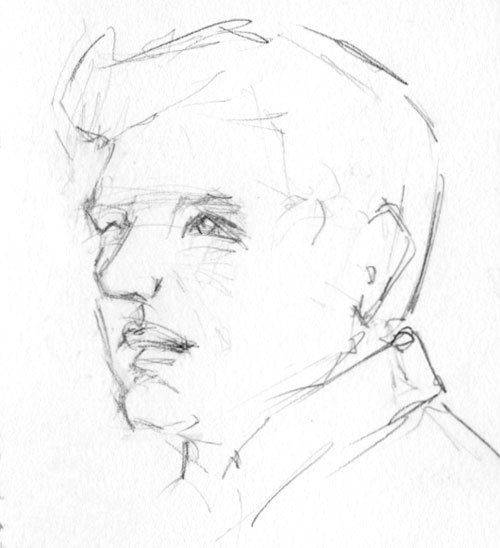
President of PAWS, Ed Stewart

Stewart told stories that make your blood run cold: a bear cub sold at a flea market as a birthday gift for a 4-year-old, then chained, starving, in the back yard for years. Grizzlies and black bears bred to create hybrids, then kept in small cages at roadside attractions. On and on and on. And not in some crazy ignorant poverty-stricken country either; but right here in the United States. I don’t understand. Why on earth do people do things like this?
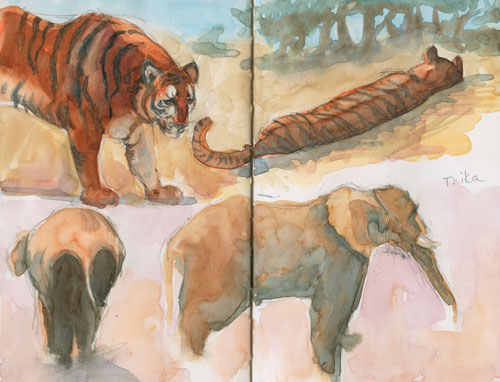
Tigers and elephants at PAWS Watercolor in Stilman & Birn Zeta Series
Tigers and elephants at PAWS
Watercolor in Stilman & Birn Zeta Series

But as horribly as these animals have been treated by humans, they appear to have learned to accept the folks at PAWS, or at least have unlearned some of their fear and hatred. When we crept up to the bear enclosures, the bears, expecting food,  came down to see what was up. We were admonished to be very quiet; no worries there. I was so stunned and in awe of being so near a bear that I could hardly talk at all.

There were two tigers that we could see in an enclosure (The sanctuary rescued 39 big cats in 2003. Meet them here.) One slept with its back to us the whole time we were there. Another padded out, looked at us in what seemed to be disgust, and disappeared from view. Stewart said that this was much better than when the tigers first came to the sanctuary. Rescued from an abusive tiger breeder, they hated humans when they first arrived. The two tigers we saw didn’t seem to be happy about us gawping at them, but at least they weren’t scaling the fence to get at us.

I know that the sanctuary isn’t the same as a jungle or veld or forest where animals can roam at will. But there are fewer and fewer of those places left on our small planet as the human population grows exponentially. And the Sanctuary is a place where at least a small number of being hurt by humans can live out their lives in peace and safety.

Next: Elephants at PAWS

Here’s a vid of the tigers at PAWS

The link below is live. Click on it to go to the PAWS website.

Performing Animal Welfare Society

AnimalScapes blog posts

Drawing animals for AnimalScapes

Sketching bears and tigers at the PAWS Ark 2000 animal sanctuary
Elephants at PAWS

Drawing animals for AnimalScapes

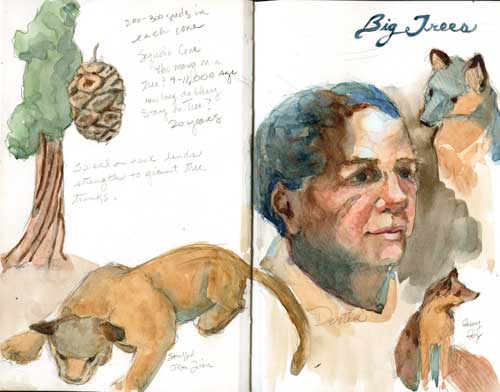
Spread from AnimalScapes sketchbook at California Big Trees State Park Stilman& Birn Zeta Series Sketchbook
Spread from AnimalScapes sketchbook at California Big Trees State Park
Stilman& Birn Zeta Series Sketchbook


Hoo! I made the grade and was selected to be an exhibiting artist in the project  AnimalScapes of the Sierra Nevada Foothills. This show, a tri-county project of the Calaveras County Arts Council, Tuolumne County Arts Alliance, and the Amador County Arts Council, will include over 50 artists and makers. We artists will be creating pieces—paintings, pottery, photos, sculptures, even poetry—that depict animals in the Sierra Foothills, and our works will travel around the three counties in an exhibition to be displayed in 2016.

There are many good things about this show. It will raise awareness of the animals that live in the Sierra Nevada Foothills, and publicize animal welfare organizations working in the Foothill communities. I hope that it will increase the human will to protect and care for the other species that live in the area.

But one of the best things about being a part of this show?  There were two field trips. I love a field trip. (Yeah, selfish. I know.)

For our first foray we piled into a big yellow school bus and spent a long day rambling around Calaveras and Alpine Counties. It was great to leave the isolation of the studio and meet other local artists (my people!).

First stop was the New Melones Lake Visitor Center & Museum, where rangers led us on a short hike and we spotted an osprey roosting in a tree. The ranger said it was probably a fledgling from last summer’s clutch of chicks raised in the osprey nest built near the center.

Stuffed coyote in pouncing pose at New Melones Lake Visitor Center & Museum Stilman& Birn Zeta Series Sketchbook
Stuffed coyote in pouncing pose at New Melones Lake Visitor Center & Museum
Stilman& Birn Zeta Series Sketchbook

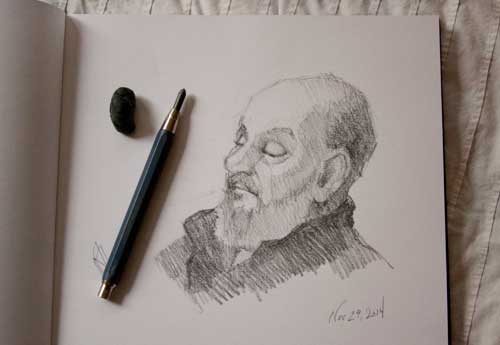
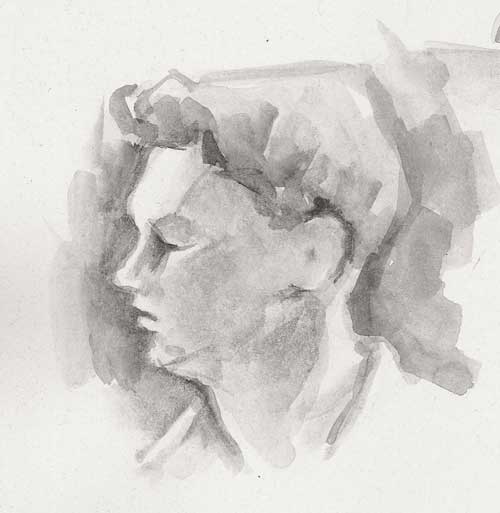
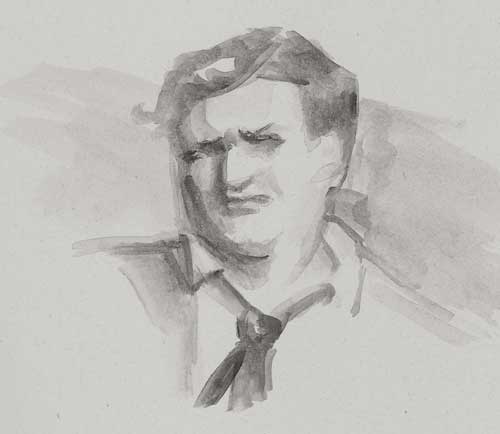
At Calaveras Big Trees State Park we had a short tour of the redwoods, led by volunteer docent Dexter. Dexter gave a good tour, and even better, had a great face for sketching. (That’s the illustration at the top of this post.)

This trip was like sketching heaven for me, and my pencil was busy the entire time. I tried to catch as much visual information as I could. Since the theme of this show is animals, I spent time drawing the taxidermy specimens in the visitor centers. Sketching stuffed animals isn’t as fun as drawing live beasts, but on the bright side, I could really concentrate on understanding perspective, proportions and forms.

I’m slowly adding color to the sketches, as there was no time for dragging out watercolors during either tour. It’s been a great way to experiment with the paint, as I’ve scanned the original pencil sketches to preserve them. With the sketches safely stored on my computer, I feel like I can take some chances with the paint.

AnimalScapes blog posts

Drawing animals for AnimalScapes

Sketching bears and tigers at the PAWS Ark 2000 animal sanctuary

Elephants at PAWS

Drawing in the Outer Aisle

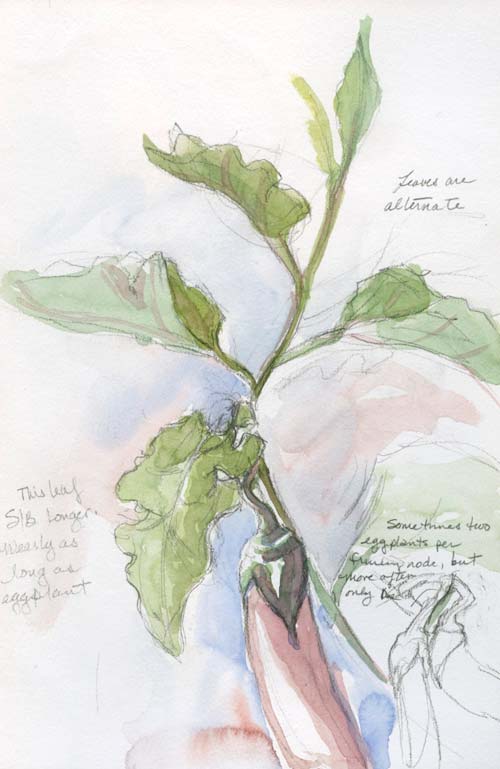
Paintings of eggplant
Asian eggplant sketches
Graphite and watercolor in Stillman & Birn Delta Series sketchbook

A freelance illustrator often has to scramble to find source material for illustration gigs that fall from the sky. My last task—drawing three kinds of garlic growing at the end of their life cycles—had me calling a friend on Nantucket and pleading with her to take photos of a winter-retarded stand of late-blooming hardneck garlic in her gardens.

The photos were helpful, but there’s nothing like drawing from life for accuracy and understanding. As I struggled to make visual sense from the distortion of photography, I realized that I need to create a library of plants drawn from life that I can use as guides for future jobs. But how? I don’t have room (or water) for a garden of my own, plus our little yard is a crossroads for every animal that lives in these mountains. (I haven’t seen any bears yet. But you know if I did, I’d  be frantically drawing them while they chased me down the hill.)

I realized I’d have to find a garden or a farm at which to draw.

And fortunately, I discovered a small one-day-a-week farmstand of ultra-local vegetables called the Outer Aisle Farmstand. The produce is so local that most of it is grown less then 5 miles away from the store on a small 2-acre farm in the mountains.

A few days later, I was sitting cross-legged in the loamy soil of Taylor Mountain Gardens, sketching a light purple Asian eggplant. Owners Christine and Eric Taylor had just given me a tour of their lovely slice of organic paradise, and introduced me to at least 4 kinds of eggplant growing in lush, thick rows.  Eggplant heaven.

A farm of this kind—small, intimate, and worked by humans who love the land—is a sort of a sacred space. The earth is so lovingly cared for, the plants grown so well, and everything is managed with respect and foresight, that the farm seems almost radiant. It’s an honor to be allowed to make portraits of their plants. Stay tuned.

Christine and Eric, along with partner/chef Jimmy own Outer Aisle Farm to Table Restaurant in Murphys, California. Try their summer barbecue on Thursday nights, or enjoy fine dining Friday and Saturday. They source everything themselves and feature only what’s in season. If you live too far away, you can try their eggplant recipes at home.

Paintings of eggplant
Asian eggplant sketches
Graphite and watercolor in Stillman & Birn Delta Series sketchbook

How to draw figures by drawing a stick man

StickmanWalkingYou drew them when you were a child: stick people that lept, danced, fought, or just stood around in the landscape of your childhood art. And if you learn how to draw them again, they’ll help you enormously when you are sketching in public places.


Things to look for when drawing a stick man

  • Angle for position Pay attention to the angle of the head, shoulders, and the hips. I often draw those lines first, lightly, to help me capture the pose. I also make quick lines for the angles of the feet so that I know how they are positioned and if I have time, I add the knees and elbows using little circles. Getting these landmarks down on paper will help you remember the position of your subject, even after they’ve moved. Everything after that becomes a connect-the-dots game.
  • Measure! Stick your pencil out and verify that your brain is really seeing what’s there. I can’t stress that enough. You don’t have to get too detailed; if you’re rapidly sketching kids on a soccer field, or people in a park, you don’t have time for a lot of measurements. I look for the vertical halfway point and mark that quickly so I can go on to the torso. When I draw the torso, I eyeball the center line so that I can get the right perspective.
  • Torso comes first My life drawing teacher, Rob Anderson, used to say, “if you can draw the torso correctly, you can hang the rest of the body from it.” I always try to get the torso and hips first; they are the structure. All the rest is decoration. If you add lobes to represent the rib cage, it can help you see the center line.
  • Draw cubicley Think of the upper body as a box with two lobes (the ribs). The tummy is a soft ball; how much of that do you see? The pelvis/hips can be a tube, although some people use a box for the hips. I like using a butterfly shaped tube because I can see how the ball of the tummy fits into the pelvis area.
  • Transparent thinking Try to imaging the shoulder blades on the back, which will give you the correct position of the arms. Draw your stickman as though he were a ghost so you can see your construction lines.


Stickman2

Once you have the stickman posed correctly, you can start adding flesh to him. In the figure below, I drew him in black ink, then built his form up using blue lines. When I’m sketching in the field, I draw the construction lines lightly, and often don’t erase them when I’m finished because they can make the figure more solid and dimensional. They are also great for later reference when I’m trying to construct a new drawing, because all this public sketching, besides being fun, is fodder for future work. Stickmanslouching

Drawing exercise Get thee to a public place and draw the people in it. Concentrate on drawing only stickmen. Afterwards at home, draw other stickmen (from your imagination) interacting with the first drawings. Challenge yourself by drawing them in overlapping positions, some farther away, some closer to the picture plane. Then let me know how it goes. I’d love to see your drawing.

Sketching Thanksgiving portraits

Graphite sketches
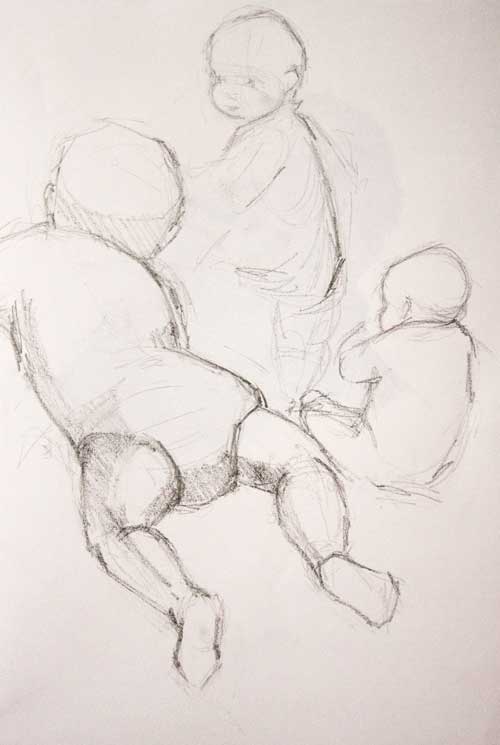
Graphite sketches

We had a house chockablock full of people over the holidays, and I finally unpacked my sketchbooks and had a few moments to scribble a few lines. Babies are hard to draw. Their proportions are unrelated to the proportions of adults, and they squirm and wriggle so much that it’s hard to capture a pose. These were the best I could do, as I could only draw until our li’l bit wanted cuddling.

Blockin-graphite sketch
Block in graphite sketch

A seated adult brother made a much easier target. You can see that I’ve  blocked in the head using straight lines. Even when drawing curves, it’s much easier to begin with straight lines. They are more accurate than a curve. You can always smooth them out later.

Graphite sketch
Graphite sketch

I’ve been trying to draw my brother for years. For some reason, catching his likeness is hard for me to do. Perhaps I know his face too well. Perhaps he won’t sit still long enough (these sketches were done while he was engrossed in a book).

The pencil is some kind of clutch pencil, a thing that’s like a mechanical pencil, only with a fat lead. I like it, but I’d be happier with it if I sharpened it. But since I can’t find any of the multiple sandpaper blocks I’ve bought for this purpose, and I’m unwilling to buy more, I’ll have to use it like it is until I unpack more boxes in the studio.

Painting against time

clarinet player
Klezmer musician sketch
8.5″ x 12″
Watercolor on Arches #140 cold press
© 2014 Margaret Sloan

I tend to paint slowly. I spend hours getting the drawing right before I move to color. Then I paint deliberately, thinking about each stroke. Sometimes I think too much,  standing in front of the easel, brush in hand, looking and daubing.

Eventually I start feeling trapped, like some old hen pecking away in a chicken coop. I’m afraid to move from my comfort zone because I’ve got too much invested in a particular painting. Yet, with no forays out of the barnyard into the woods, well, where is the exploration? Where is the learning? Where is the joy? All I’m doing is laying eggs.

But I want to fly.

Perversely, sometimes limits can free an artist from gravity. Rather than spend hours on a painting, I decided to give myself some parameters: half hour for the drawing and an hour for the painting. I wanted to see what I could accomplish in a short period of time.

What a great exercise! It forced me to think in terms of big shapes, clear color and correct value. I let go of trying to have a “finished” product and made choices quickly. And I was quite surprised at how instinctive painting has become.

Most valuable tool in this exercise: The kitchen timer.

Painting from a fast sketch


The holiday bazaar last Saturday was lovely, with beautiful artwork and Irish music provided by my own fiddler and our friends from the Irish music community (if there’s any reason—other than sheer joy—to learn to play Irish music, old time, or any folk music, it would be the wonderful groups of friends you’ll make doing so).

The day started a bit slowly, so I took the opportunity from my seat inside the circle of musicians (in between firing off the tunes I knew on the whistle) to sketch the dulcimer player with the intention of later making a painting solely from my sketch after the dulcimer player left to go to another gig.

Sometimes I can’t take photos for reference. Sometimes I just don’t want a camera intruding on the moment. And I like the practice of trying to find a painting from my initial sketch.


pencil sketch
Quick pencil sketch

I payed particular attention to these elements as I gathered information for a painting:

  1. The shapes of the features that made a likeness. She has strong features, making it easier to draw them.
  2. The shapes of the shadow forms. There wasn’t a clear single-light source, so I had to choose the shadows as best I could to show form.
  3. Lost and found edges. Frankly, I was pressed for time, so I didn’t give as much thought to edges as I should have.
  4. Color notes. Okay, in all honesty, I didn’t make any color notes on anything other than her hair and her jacket. But I should have. They would have noted things like skin color in the highlights, midtones, and shadows, room color, light quality. Next time!

I had about half an hour (give or take a tune or two) to make this sketch, so some areas, like the far eye and hairline, were left a bit hazy.  These omissions would later bite me in the butt as I tried to recreate this sketch in color.

Then, while the hall bustled around me with holiday shoppers, I painted.

Watercolor painting
Watercolor painting using pencil sketch as resource

After a day of painting between customers, I ended up with a sort of half sketched painting that was almost a likeness, but not quite.

The prevailing wisdom about watercolor is that you can’t erase it. Nonsense! While you can never get down to the beautiful pristine paper again, you can certainly lift much of the color. I didn’t like the purply-red I’d put in her hair, so when I got home, I scrubbed it off with a toothbrush and a spray of water. Then I let it dry completely and repainted.

The mouth also didn’t match the sketch, and so lost much of her character, so I lifted the paint using an old sable brush (I don’t know why this is, but nothing lifts watercolor as well as sable), let it dry, redrew it, and repainted it. The nose got a little surgery and lost its bottom edge. I adjusted the angle of the far cheek and the perspective of the eyes.

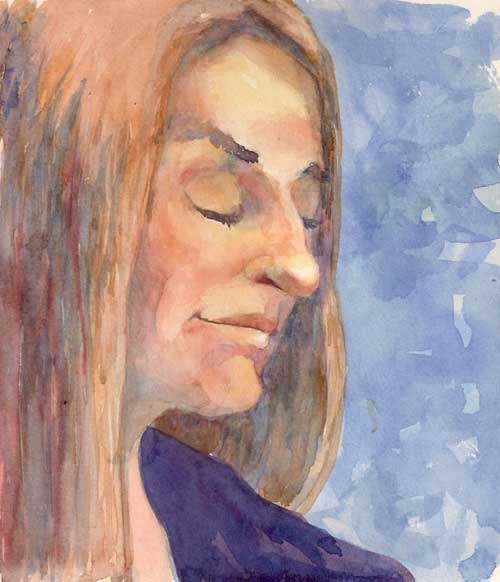
watercolor
Watercolor from fast sketch

This almost captures the likeness of the dulcimer player, and I’m pretty pleased to have done it without a photo-aid. To be fair, I’ve known her for years, so that when my brush drove past the likeness, I knew I’d arrived.

Brendan Behan in ArtGraf black carbon

BrendanBehanYoung

Shawn Hatosy as Brendan Behan

Saturday night I watched Borstal Boy, a romanced version of the early life of Irish patriot, playwright and poet, Brendan Behan. Mr. Behan was a man of letters—he wrote in English and in Irish—who unfortunately died quite young from the drink. He was the public face of the stereotypical Irishman, as well as typifying a whole generation of artists:  brilliant star and stumbling, mumbling drunk. He once described himself as a drunk with a writing problem.

BrendanBehanBrendan Behan as Brendan Behan

The above painting is from a Youtube video here, where Mr. Behan sings the Auld Triangle.

These were painted using my new toy, an ArtGraf black carbon block. It’s a neat little block of water soluble carbon with which you can draw on wet or dry paper, or just rub a wet brush across the block for shades of gray. It’s an easy and clean way to practice brush work while watching television, so long as you don’t kick over your pot of water. The paper is my new favorite, cheap cover stock from the copy store.

José Emídio paints with the tailor shape of ArtGraf in the video below. Beautiful!

Figures under water

After reading Sue Smith’s blog at Ancient Artists about pushing your art to the next level, I felt I needed to challenge myself. So, watercolor backpack in hand, and a stack of failed paintings (the backs of the paper still pristine, ready for work) under my arm, I headed to a local life drawing session to try my hand at sketching with water and paint.

I was in a kerfuffle from the first moments, adrift without the guiding compass of charcoal pencils and kneaded eraser.  And painting at the session was completely different from painting at home. Normally I stand at my easel and work on a vertical surface; at the session, I sat at a table, paper propped on my backpack.

1-minute watercolor war zone

Right away, my body rebelled against sitting. My neck and back ached, my hands stung, and my butt fell into a pins-and-needle coma. The process of painting like that was awful.

I floundered during the first 20-minute set of 1-minute poses, completely rudderless and out of control. I thrashed about with brush, paper, paint, water, making a mess.

The quick gesture paintings looked like a war zone. Body parts were disconnected. Chaotic limbs and runny torsos bled across the page. The figures turned into misshapen blobs of color.

During the break in poses, I screwed up my courage and asked if it would bother anyone if I stood. Talking to people! Asking for something! That was a breakthrough in itself, overcoming my  little mouse-self that doesn’t like to make a fuss in public.

You know what? Nobody cared. So I stood.

That helped. The next set of 2-minute poses made me much happier. I began to make friends again with my paintbrush, and like any good friend, my trusty Kolinsky sable helped me to see in a new way. It taught me to look for the large shapes, forms, and shadow patterns.

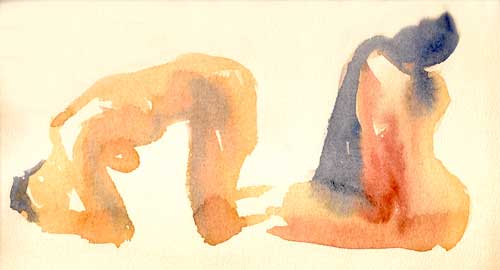
2-minute watercolor sketches

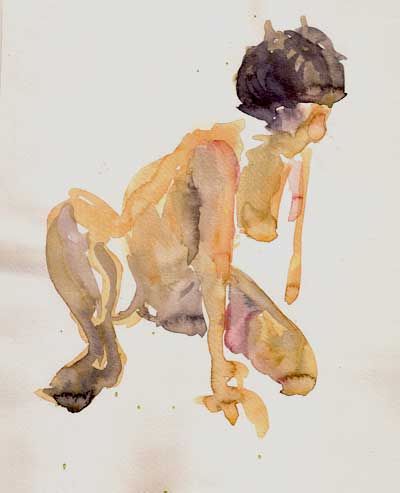
The 5-minute poses came along a bit better . The one below is my favorite. The horns on her helmet-hair were accidental, but I love them. Watercolor warrior woman!

5-minute watercolor sketch

At 10-minutes I thought that I could give myself a few graphite guidelines to help me control where I put the paint. And that is where I lost the energy of the previous paintings.

10-minute watercolor sketch

Below you can see the final 20-minute pose. Except for the extraordinarily long arm, it’s a pretty correct representation of the model’s position. But that’s about it.  It has lost some of the wonderful freedom of the quick sketches.

20-minute watercolor sketch

Somewhere  between loss of control and total control there are pictures to be made. The challenge is to navigate to that tricky space.