Landscape painting vs. landscape walking

Pinnacles National Park

Rocks at Bear Gulch Resevoir, Pinnacles National Park
Watercolor

7.5″ x 9.5″
© 2013 by Margaret Sloan

I am still reading—and recommend—The Old Ways: A Journey on Foot by Robert MacFarlane. MacFarlane is a walker; he experiences the landscape through his feet, even walking barefoot through several pages. He travels at shanks-mare pace, slow enough to notice things as he walks over mountain, bog, or desert, passing landmarks, pathways, and people. Fair enough. Good writing has to keep moving to get anywhere.

I’m enjoying this book, as I’ve always loved walking, and fantasize regularly about a walkabout of my own. But since I’ve started landscape painting, my relationship with the landscape has changed.

As a landscape painter, I don’t so much move through a landscape as move into it. I build a temporary studio with tripod, pochade box, and backpack full of supplies and sandwiches (this army travels on her stomach). And there I stand at the easel, brush in hand, watching the landscape move around me.
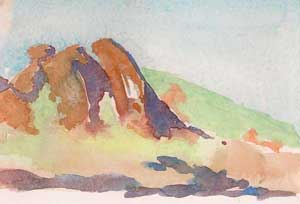
Pinnacles National Park
Small watercolor sketch at Pinnacles National Park

Wind crackles through grass, and cloud shadows ripple and dimple the surface of the hills. Tides ebb and flow, birds fly by, eyeing my sack of sandwiches, and people stop, chat, then continue their own walk. When you stand still on the earth, the landscape moves like a flood around you, driven by the solar-storm of the sun as it rockets overhead.

Pinnacles National Park
Small watercolor sketch at Pinnacles National Park

And that is the landscape painter’s challenge, isn’t it? To try to capture a scene, to freeze a feeling, a smell or a taste of a moment that is constantly zooming past, on towards the next moment. The land is never, ever going to hold a pose long enough for me to capture a perfect likeness. In the field, all I can hope for are impressions: an idea of color, a gesture of form. In the studio, I can rely only on memory (and perhaps photographs).

Although I’m not walking across the land when I paint, I am making a slow sort of progress in tracking the world. I’m learning to notice things I don’t see when walking. Sometimes standing still is the best way to move.

“You do not need to leave your room. Remain sitting at your table and listen. Do not even listen, simply wait, be quiet, still and solitary. The world will freely offer itself to you to be unmasked, it has no choice, it will roll in ecstasy at your feet.” —Franz Kafka

Here’s a lecture by MacFarlane. It’s long, so get a cup of tea, pull out your sketchbook, and draw while you listen.

A Halloween sketch and a scary story

Painting
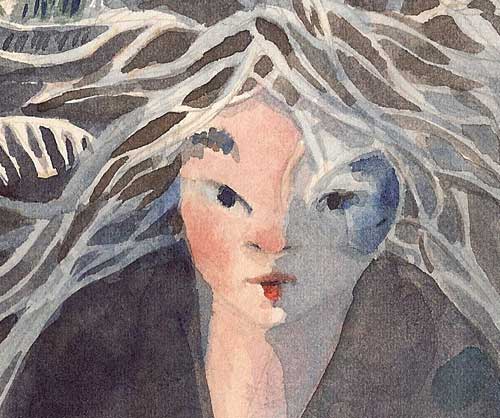
Watercolor painting after Reeling for the Empire by Karen Russell

Happy Halloween!

This is a watercolor sketch I made  while  listening to an audio version of Reeling for the Empire by Karen Russell (it’s part of her recent collection of short stories, Vampires in the Lemon Grove.) It’s one of the creepiest stories I’ve heard in ages, and I suggest you make a Samhain trip to your local bookstore (I hope you still have a local bookstore) and find this book, if only for this story.  I loved all of the stories, but this is the one that made my skin go all goose-fleshy, and so this makes it a perfect tale to read on Halloween.

I’ll not tell you what it’s about—there are plenty of spoilers in cyberspace—but I really think that, if you like unusual, odd and sometimes creepy stories, you’re going to like this book.

Painting of girl
Detail: Kitsune

Young girls in peril…

Silkworm moth
Detail: Silkworm moth

And bugs.

What could be scarier?


What does the landscape know of the painter?

Painting of hills
Oil sketch of bay and hills. 8″ x 10″

In The Old Ways: A Journey on Foot , Robert MacFarlane says:

“For some time now it has seemed to me that the two questions we should ask of any strong landscape are these: Firstly, what do I know when I am in this place that I can know nowhere else. And then, vainly, what does this place know of me that I cannot know of myself?”

As a landscape painter, I felt particularly pierced by this quote. I rolled it around in my head as I painted in Alviso Marina County Park this weekend. I recounted to myself what I knew of this landscape: it used to be rural and isolated from the hustle of Silicon Valley. It was, quite literally, the site of a dump, but now, with the invasion of tech dollars, it’s got that beginning shine of gentrification-creep.

But it hasn’t all been siliconized yet. The town and park are on the wild southern edge of the Bay, and across the water you can see the Diablo range. The tide was in, and the bay glowed sky blue in the slanting afternoon light. The color of the hills reddened as the sun burned through the late autumn haze and I scrambled to adjust my colors and capture the sweetness of the evening.

Every landscape I paint makes me know of myself that I do not paint enough; that I desire more than I can accomplish in the time allotted to me; and that I love being outside more than just about anything (except for playing music and painting). And when I paint in urban-edge areas, I learn, over and over again, that the earth, even while brutalized by humans, remains steadfast.

But does that landscape know anything of me? What does it even mean that the place might know of me something I cannot know of myself? Does it mean what I should know from the humans who come over to “meet a painter?” Or does it mean some sort of Gaia-like sentience on the part of the landscape, the dried mud that powders around my feet, the weeds that jump into my socks as I wade through them, the hills and water that stand silently in my view?

I don’t know. But I think for a while it will become my painting mantra, an addition to the usual litany of: is this the right color, right value, right chroma, and right stroke?

More about Alviso http://www.metroactive.com/papers/metro/08.20.98/cover/alviso-9833.html

Night terrors and books

I was a fairly brave child during daylight hours, but the sleeping little-girl me often ran through dream woods chased by half-seen threats and shadowy monsters.   (No, I was not an abused child, but I did have a propensity for watching The Twilight Zone and reading scary books.)

Girl running from monsters in the Woods

One night, while running from dream monsters, I chanced upon a boat floating in a dream river. I jumped into the boat and cast off from shore.  The boat floated across the river, leaving behind the snarling night creatures (who evidently didn’t swim).

Escaping by boat

The little boat landed on the shore of an island. I followed a muddy path and found a house with its windows glowing and door ajar. In that weird way of dreams, I knew I was welcome. I crept in and found a house full of books.

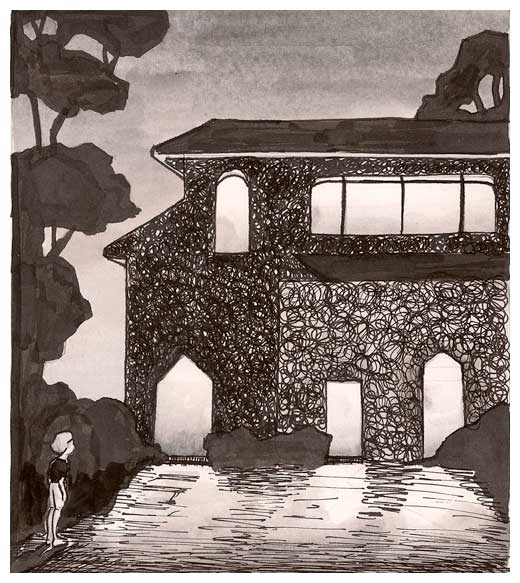
Lighted house beckons in the dark

In the heart of the house was a comfy armchair in front of a fireplace made up with a perfect fire. A floor lamp cast a pool of light over the chair. And I knew I was home, and a happy home at that. I was in a place where no monsters could get me as I curled up in the chair and opened the nearest book.

Girl reading by fireplace

After that dream, I learned to control my own night journeys, often making them into movies by directing them. It’s amusing to see the frustration of a slobbering slagrothlockeling (made up dream monster name) when you make him do the 12th take because he wasn’t believable enough. I got some good performances out of my dream beasts; however, I almost always was victorious in our dream battles.

I still love books, and my dream house has become my real-life house (okay, not so nice as in my drawing). I still feel safest surrounded by stacks of  books, comforted by the smell of paper and ink, the whisperings of the printed word. And this is why it’s been so hard to weed my “library” for our upcoming move. But I’m doing it.

If you’ve got time (about 25 minutes) you can watch an episode (about a book worm!) of The Twilight Zone here, but I’m warning you, most frightening of all, there are commercials (and they’re not well placed either).

Oz

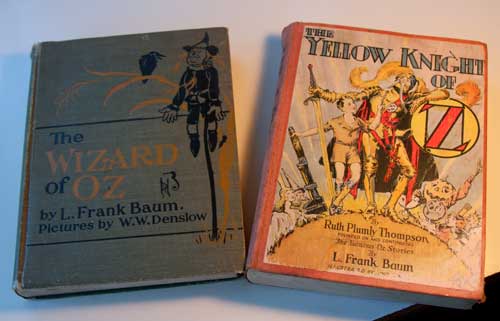
OzBooks

Okay, so the Wizard of Oz is a cliché classic. Everyone loves it, don’t they?

The childish me had mixed feelings about the Wizard of Oz. I liked the story, but this particular 1903 edition (the one on the left in the photo above), gave me a bit of the creeps. (Yes, it was probably from a library sale. Seriously, in the 60s you could buy wonderful old books by the grocery bag for 50 cents.) While today I recognize the brilliance of the W. W. Denslow illustrations, when I was 9 they  gave me a slight chill. Well, actually, they still make me slightly uneasy.

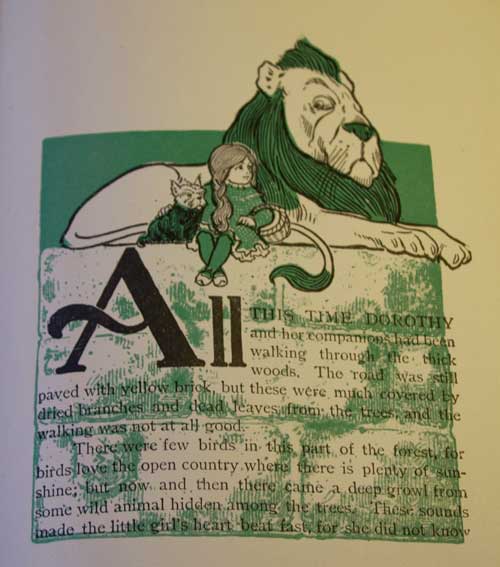
Oz_LionandDorothy

I think that the idea of “cute” was different at the beginning of the twentieth century. While Dorothy looks sweet in her thick, half-done braids (a hair-style I, with a fashionable 60s pixie-style foisted upon me by my overworked mother, could never aspire to), Toto looks a trifle dangerous. Maybe more dangerous than the lion.

Oz_Tinman

The tin man looks friendly enough in this plate. For a guy with an axe.

OZ_Scarecrow

The scarecrow’s head got all lumpy and pokey when the wizard filled his head with pins and needles. Childish takeaway? Brains are sharp and pointy, and maybe painful.

Oz_Witch

And the witch had braids! Three of them. And decidedly bad fashion sense; no wonder she wanted Dorothy’s shoes.

This is a beautifully printed book, and it’s amazing to think of quality that lasted 100 years through repeated readings.  For some reason I didn’t mark up this book, probably because I was afraid of the illustrations.

The other book on the right, (in the top photo) I did mark up. I colored away in it. Boo on me. But it’s not nearly as commanding as the 1903 book. Maybe I liked it better, or got it when I was younger. It was a gift from a family friend, a woman who was moving and cleaning out her possessions. I think it had been her book, and possibly her mother’s before that.

Caveat: This may look like a valuable book, but it’s not. I got all excited when I Googled it, and saw the price on a first edition. But this is not a first edition. Not even a second edition. Not even a first printing of a third edition. It’s not worth much more than a dinner at a fancy restaurant (without the wine). My childhood is worth ever so much more than that. So I’m keeping this beautiful, slightly creepy book, and the other one too.

Bondage I’ll keep

The good news is, we finally found a place to live. The bad? We’re purging ourselves of possessions so we’ll fit, light as feathered birds, into our new, much smaller digs.

To help with the agony of jettisoning, I tell myself to remember that possessions are bondage, but I’m mostly tossing books (because aside from art supplies, that’s mostly what I have). And it’s hard to get rid of books. Some I can not bring myself to pitch into the rough ocean of the library sale.

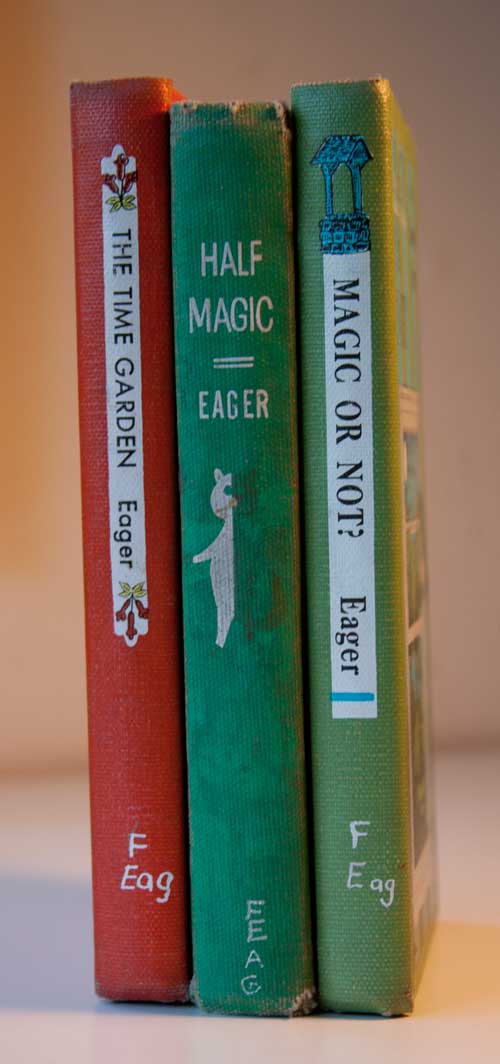
Edward Eager was my favorite author when I was a child, and I still love these silly books. You can buy them yet today, but not with the magical hardcovers I read (and coveted) as a child.

EagerBooks

These aren’t valuable books. They’re library discards, complete with the checkout card in the little pocket in the front cover. But, dated from the 1950s, they have the original illustrations by N.M. Bodecker , worn covers from years of childish love, and dog-eared pages to mark where someone was called to dinner or to do their homework.

HalfMagic

Half Magic was one of my favorites, full of silly maths and puns. The children in the book find a token that grants them exactly half their wish, so they always have to wish for twice as much. They eventually figure this out, but their math is often bad, and magic is fickle; wishes don’t always turn out exactly as they had been envisioned.

My most favorite Eager book was Magic by the Lake, full of watery goofiness, mermaids, pirates, and talking turtles. But that particular library discard has been lost into the mists of time, lent to nieces and never returned. Maybe someday it will heed my wishing and return to my bookshelves.

Caveat: These books were written in the 1950s, and so contain images and language that some might find offensive today. If you’re easily offended or have a particular politically-correct bone to pick, please don’t read these books, or if you do, please don’t complain to me about it, as I’ve made my peace with it and still love Edward Eager’s books.

A new road map

I’ve been studying Kenneth Clark’s The Nude : A Study in Ideal Form at the Atelier. I am not well versed in art history, so a lot of what Clark says goes zooming over my head into the stratosphere. I spend as much time scouring the internet to find information about the artists Clark mentions as I do reading the darn book.

It’s a tough book to crack. Clark’s language is flowery and dense, and often his statements reference deep-seated cultural assumptions that irritate me. Celestial and vegetable venus indeed. But this tiny bit of study of my artistic heritage (a heritage artists all share) has made me think about what I’m trying to do and say with my own work. About what it might mean to reference older traditions and cultures. And how those cultures are reflected in the prism of the art of our modern world.

Sue Smith at Ancient Artist writes, “Because we live in our own time, when the modernism driven by the critic-influenced 60’s led to a period of post-modernism that commercialized the idea of art nearly out of existence, we are now seeing a rudderless homogenization of ideas. Of catch phrases characterized by ambiguity. Perhaps we have lost the idea of what constitutes art.”

It seems to me that by knowing what went before—knowing and understanding our artistic genealogy—we artists can use it to inform their own art. We can transform the styles, methods, and means into something that speaks to people today. We can hope to create new ideas of what constitutes art (multiple ideas, because people like as many styles of art as they like styles of pie). And the most important of those ideas will be as solid, strong, and long lasting for our time as the idea of sculptural morality was for Polykleitos or the idea of simplifying the female form was for Matisse.