Drawing animals for AnimalScapes

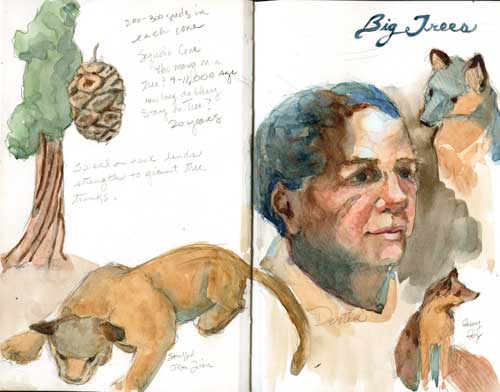
Spread from AnimalScapes sketchbook at California Big Trees State Park Stilman& Birn Zeta Series Sketchbook
Spread from AnimalScapes sketchbook at California Big Trees State Park
Stilman& Birn Zeta Series Sketchbook


Hoo! I made the grade and was selected to be an exhibiting artist in the project  AnimalScapes of the Sierra Nevada Foothills. This show, a tri-county project of the Calaveras County Arts Council, Tuolumne County Arts Alliance, and the Amador County Arts Council, will include over 50 artists and makers. We artists will be creating pieces—paintings, pottery, photos, sculptures, even poetry—that depict animals in the Sierra Foothills, and our works will travel around the three counties in an exhibition to be displayed in 2016.

There are many good things about this show. It will raise awareness of the animals that live in the Sierra Nevada Foothills, and publicize animal welfare organizations working in the Foothill communities. I hope that it will increase the human will to protect and care for the other species that live in the area.

But one of the best things about being a part of this show?  There were two field trips. I love a field trip. (Yeah, selfish. I know.)

For our first foray we piled into a big yellow school bus and spent a long day rambling around Calaveras and Alpine Counties. It was great to leave the isolation of the studio and meet other local artists (my people!).

First stop was the New Melones Lake Visitor Center & Museum, where rangers led us on a short hike and we spotted an osprey roosting in a tree. The ranger said it was probably a fledgling from last summer’s clutch of chicks raised in the osprey nest built near the center.

Stuffed coyote in pouncing pose at New Melones Lake Visitor Center & Museum Stilman& Birn Zeta Series Sketchbook
Stuffed coyote in pouncing pose at New Melones Lake Visitor Center & Museum
Stilman& Birn Zeta Series Sketchbook

At Calaveras Big Trees State Park we had a short tour of the redwoods, led by volunteer docent Dexter. Dexter gave a good tour, and even better, had a great face for sketching. (That’s the illustration at the top of this post.)

This trip was like sketching heaven for me, and my pencil was busy the entire time. I tried to catch as much visual information as I could. Since the theme of this show is animals, I spent time drawing the taxidermy specimens in the visitor centers. Sketching stuffed animals isn’t as fun as drawing live beasts, but on the bright side, I could really concentrate on understanding perspective, proportions and forms.

I’m slowly adding color to the sketches, as there was no time for dragging out watercolors during either tour. It’s been a great way to experiment with the paint, as I’ve scanned the original pencil sketches to preserve them. With the sketches safely stored on my computer, I feel like I can take some chances with the paint.

AnimalScapes blog posts

Drawing animals for AnimalScapes

Sketching bears and tigers at the PAWS Ark 2000 animal sanctuary

Elephants at PAWS

Rain frog

Amulets_FrogThe Mayans have a serious froggy called Uo. The rain caller. It’s a fat plop of a frog that burrows in mud. (Read about the Uo here)

When I lived in Mexico, we often made our evening paseo near a long-abandoned hotel; during the rainy season the frogs  who lived in the drippy jungle and roofless building chorused like something out of One Hundred Years of Solitude.  I’m not sure if the Uo makes its home on the Pacific coast of Mexico, but every time it was going to rain, the ranas that lived in the overgrown hotel garden sang like the feverish lovers they were.

Here in the drought-dusty Sierra, we have been crying for rain. And the day before the big California-walloper storm hit, I heard a few tree frogs singing. Not many, but their small voices rang out like oracles.

It’s been a long while since I’ve heard froggy voices of any kind.  They all but disappeared from Silicon Valley decades ago. The Sierra frogs I heard heralded a good soaking rain, and I made the above picture to honor them as the rain bucketed down last night, and to ease my anxiety about flooding, mudslides, and all the other horror stories from the National Weather Service.

I needn’t have worried about rain. Because right now? It’s snowing.

Snow


Mockingbirds in the morning

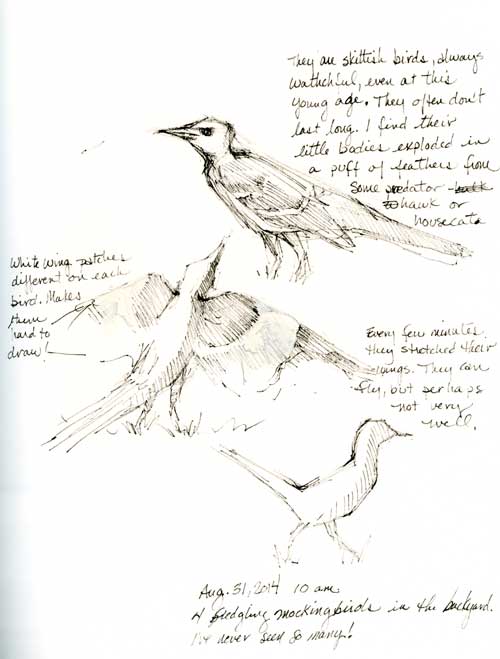
This morning I woke to find four newly fledged mockingbirds on my lawn. They were gawky, still scruffy with baby down, and clumsy as they fluttered from lawn to lawn chair. Regularly they stretched out their little wings as if exercising them for their next big flight.

Sketch of mockingbirds
Sketch of baby mockingbirds; Pigma Micron pen in Strathmore mixed media journal. Click on the image to see a larger vision.

This is the first time I’ve been able to sketch in a while, as house hunting and moving has taken over my life. Hopefully that will soon be over, because for everyday I spent not sketching, painting, or drawing, I feel my skills atrophy.

I’m going to miss my mockingbirds when we move. I don’t think that they live where I’m going. But I think I’ll keep the name of this blog, because I’ll always know that somewhere, mockingbirds are yodeling the night away.

New work for Open Studios

One of the things I learned last weekend at Silicon Valley Open Studios was that I needed more work to display.

So this week I’ve been painting: Birds!

I’m a portrait painter. I seriously love painting people, but the few animal paintings I had at open studios were the most popular (read: sales.) So this week I combed through my photos and painted a few birds.

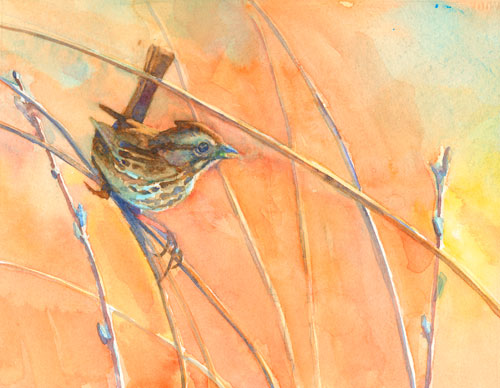
Painting of sparrow
Sparrow
8″ x 10″ watercolor on Arches 300#
© 2014 Margaret Sloan

And you know what? It turns out I love painting birds. Who knew?

Sparrow detail
Sparrow detail (It has a bug in its mouth)

Now, can anyone tell me what kind of little speckled bird this is?


I hope you’ll come to our open studios this weekend (maybe you’ll buy a bird for Mother’s day!) I’ll be at 1471 Hollidale Court, Los Altos, CA 94024

Mockingbirds at midnight

Mockingbird
Mockingbird 1
Pencil sketch

Last week I heard a mockingbird singing in the wee hours for the first time this year. I’ve been seeing them sitting in the overgrown apple tree in my backyard (I think they’re year-round residents in the Bay),  but I hadn’t yet been awakened by their midnight battle arias.

I love the songs of mockingbirds although I know they’re just the yells of  horny males. They’re endlessly entertaining; I try to figure out what they’re mimicking. Sometimes I whistle a tune to them (I’ve been trying to teach them Sail Away Ladies since forever). Once, back in the first days of the now ever-present cell phone, I heard one singing the then-standard ringtone.

When I was young (just as this sixth mass extinction began in earnest) mockingbirds lived up and down our street, and their repertoires included stanzas from all the seemingly thousands of songbirds that nested in the eaves and trees and foundation plantings of suburbia. Sadly, these days the mockingbirds mostly sing songs of squirrels, crows, sparrows, and noises I can’t identify. But they still make me happy to hear them doing musical battle in the middle of the night.

Mockingbirds
Mockingbirds 2
Pencil sketch

The supermoon brings the deer to the roses

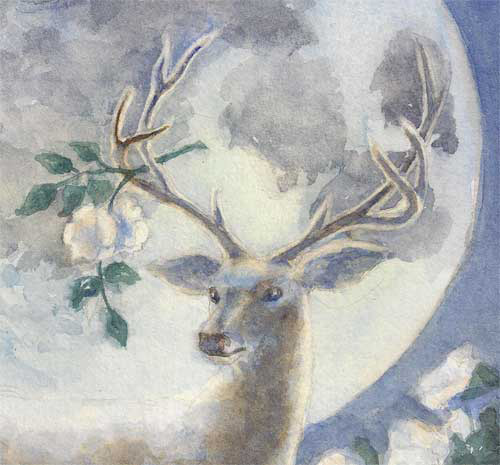
White deer in roses
Hart in the roses

Watercolor on paper
© Margaret Sloan 2013

July’s supermoon kept me awake for the third time this year, and my wakeful night inspired this watercolor sketch for a painting of a hart in the roses. In North America, the full moon of July is known as the full buck moon, when deer have antlers (some say the antlers are still in velvet. Any readers out there know for sure?)

I’ve been a gardener for many years, and I don’t find deer as thrilling as an un-gardened person. But a hart  in the roses, edged silver by the supermoon is a magical image. The hart (especially the white hart) is a mystical being in many cultures. A white stag led Arthur and his knights on hopeful quests, brought Hungarians to their homeland, gave Frenchmen pain from unrequited love, and made  Native American brides beautiful on their wedding day. The white hart even became the Christ in some Christian countries. And it was the white stag the children hunted in the first Narnia Chronicle that led them back through the wardrobe into their own non-magical world.

I live in an urban area, where deer are few and far between. So if I saw one in the garden, I think I would have to follow it. Until that time, all I can do is follow it with my brush and paint. It will have to be enough.

WhiteHartcloseup

For more about the hart in mythology, you might try these sites:

Terri Windling’s Wonderful Blog, Myth and Moor
Protect the White Deer
The Sacred Hart Moot
The White Deer

The goddess and her cat

Note: For the first time ever, I’m offering paintings for sale online. These paintings, to be specific. You can find them on Etsy.

This series of paintings popped into my head one night as I sketched in pre-sleep drowsiness, having just finished Neil Gaiman’s American Gods.

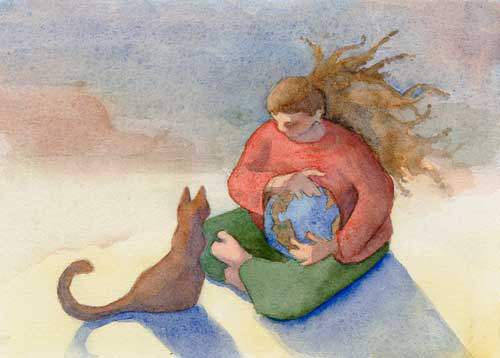
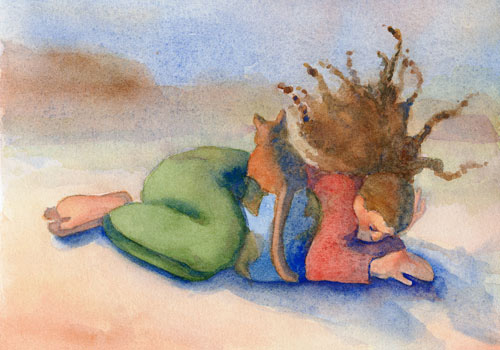
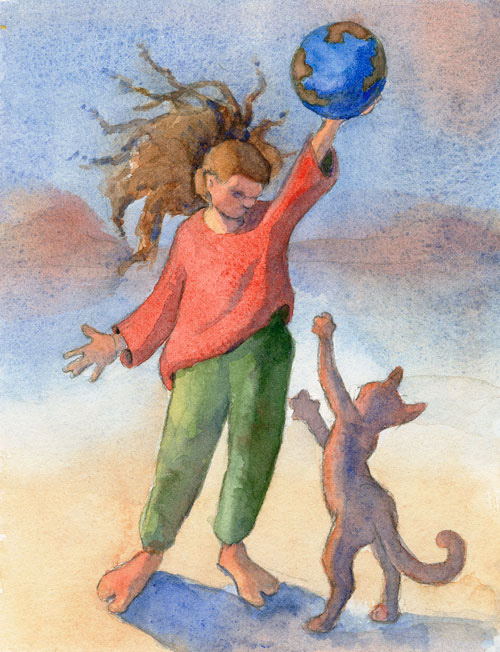
The liturgy at the congregation where we celebrate the High Holy days does not give G*d a gender, or rather, the gender is floating, sometimes male, sometimes female, sometimes nothing. So I have chosen to portray the earth’s protector as a feminine entity, a Goddess, if you will, in comfy clothes (she’s a goddess; she can wear sweat pants if she wants!), with a cat (you can make the cat a symbol of something if you want. But really, it’s just a cat. And isn’t being a cat enough?)

Earth Mother Protects

 Earth Mother #1: Protecting
7″x 5″
© Margaret Sloan 2013
Watercolor on paper
Earth Mother Sleeps Earth Mother #2: Dreaming
7″x 5″
© Margaret Sloan 2013
Watercolor on paper

Earth Mother Plays

Earth Mother #3: Playing
5″ x 6.5
© Margaret Sloan 2013
Watercolor on paper

My Etsy shop, in case you don’t like to click is: etsy.com/shop/MargaretSloanArt


Cedar waxwings in the garden

CedarWaxwing
Graphite sketch of cedar waxwing in the garden

Last summer the privet tree in the backyard bloomed shamelessly. All winter it’s been covered in dark blue berries, and I’ve been threatening to cut the tree down before the berries fall and create a privet thicket in my garden.

Once again, inertia and lack of time served me well, for the berries must have reached the peak of ripeness on Thursday and Friday.  On those two days (and those two days only), an enormous flock of cedar waxwing flew through the garden and breakfasted on the berries until nearly all the fruit was stripped from the tree. But today, on Sunday? Only the mockingbird sings while two bluejays eye each other salaciously.

I made this sketch at the kitchen window on Thursday, binoculars in hand, while I was waiting for my morning tea water to boil.

Edges


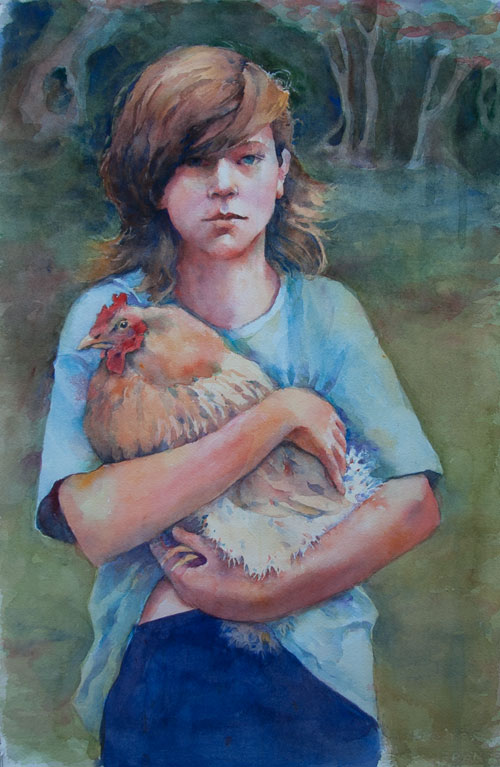
Boy with Chicken

Watercolor
Copyright 2011 Margaret Sloan

I met this young boy at Hidden Villa one late afternoon. He was with his family, looking at the chickens. Suddenly he scooped up one of the hens and cradled her in his arms. She didn’t seem to mind.  I asked if I might take a photo of him. He nodded silently, so I snapped a few photos. I wish I knew who he was so I could give him and his folks a copy of this.

I made this painting after taking Ted Nuttall’s watercolor workshop. If you compare it to the painting of the fiddler that I finished before the workshop, I think you’ll see a lot changes and improvements. At least, I can see them.

In past paintings, I’ve worried the paint to death. I’ve tried to make every transition smooth, and ended up making everything is bland, and even, and lifeless. Ted’s workshop made me finally see that what was missing were edges (although other art teachers have preached edges to me, I evidently wasn’t ready to hear that painting gospel). When I did paint edges, they were too abrupt, unsubtle, unsophisticated.

Edges are important. They give a painting movement and life, tell the story, sing the song. Hard edges can describe a fold, a crease, or the boundary of a cast shadow. Soft edges show a rounded structure, a form shadow, or a distant horizon. Between the nounage of hard and soft edges, there is a whole visual dialect—a spectrum—of edges that make a painting speak with nuance and grace.

When I think about edges in a painting, I’m always reminded that in nature, the edges of eco-systems are the places where life is most abundant. And now, when I paint, I’ve been trying to remember that edges are ok; they are, in fact, necessary to the life of the painting. Edges are where things happen.


Face—Detail of Boy with Chicken

Feathers—Detail of Boy with Chicken