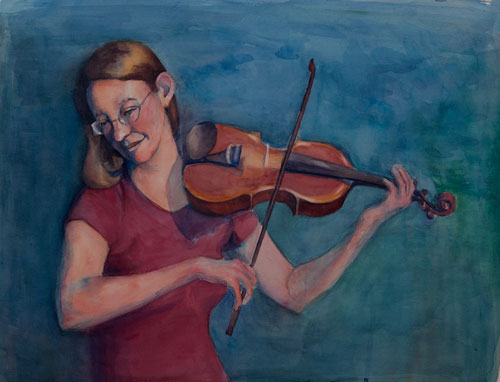
Fiddle player

This portrait is on Arches print paper. I inherited this beautiful paper from a friend whose father was an artist. He’d passed a long time ago, and when they finally cleared out his workshop, they found a stack of this lovely paper that probably dates back to the 60’s. Isn’t that an artist’s fantasy—to find beautiful, antique paper from a time when craftsmanship still ruled the day?

I love to draw on this paper, and small sizes worked okay with watercolor. But this painting is big—a full sheet of paper, 22X30—and there were some issues.

Paper for letterpress printing has less sizing than watercolor paper, which makes the press paper lovely and soft, but without the sizing to protect it, the paper sucks up the paint. Plus,  even though I stretched it and stapled it firmly onto a board, when the paper got wet, it got all floppy like a wet cotton sheet. But it dries nice and flat. The painting is still on it’s stretcher board, and I may rework it a bit.

This was painted before I took the Ted Nuttall workshop. I now refer to this as my BT (before Ted) style. Next post, I”ll show you my AT (after Ted) style. Very different.

More about sizing

http://www.arts-in-company.com/paper/additives/sizing.html

http://www.trueart.info/sizing.htm

More about paper

http://www.handprint.com/HP/WCL/paper1.html

Color theory #2

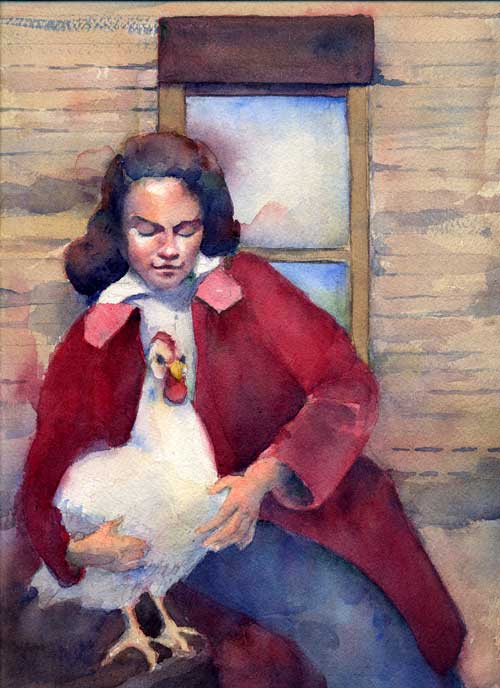
The Henny Penny in this post  was painted using an analogous color scheme. That is, all the hues came from the same corner of the color wheel. Transparent pyrrol orange, quinacridone red, and perylene maroon (all Daniel Smith watercolors). Not exactly analogous, but pretty close.

The analogous colors are interesting to work with. When mixed, they often increase in intensity. I used the perylene maroon, a dark value, dusky pigment to try to tone things down a bit.

The trouble with the analagous palette in watercolors is that, unless you use black paint, which I don’t, the paints will often not create as dark a value as you might need. They are inherently incapable of making a dark dark. So to make the eye dark enough, I had to mix in a touch of sap green to the violet. It made a nice dark eye. Too dark, I see now. I need to add a little highlight.

Farm memories

Although I grew up in the city, I come from farming people. I grew up with so many stories of the farm, the family, and the various chickens, goats, and cows, that I sometimes feel I lived alongside my ancestors.

I’ve certainly romaticized their lives, although I know that it was a hard life; subsistence living is never easy. But I’ve heard their stories, told with a slight bitterness towards the privations, but mostly washed by a greater love of their lives. It makes me wonder if today, in our lives of relative ease, are we really happier?

Her Favorite Red Coat
Watercolor © 2011 Margaret Sloan

This is a small painting: 9″ x 12″ on Arches cold press. Yes, it’s from a photo-a black and white photo at that. Right now I’m enjoying working from black and white photos. They give me greater freedom in color choices and combinations. Unchained from the tyranny of the camera’s red-blue-green, I can make my own statements. (Of course, now that the painting has been fed back into the camera and computer, I can see errors that will need fixing, mostly edges that need softening.)

That little girl is all grown up now, and that chicken long emigrated to chicken heaven (grasshoppers and freshly sprouted gardens abound!). Some painters gripe about painters who paint from photos. “Why paint it if you can take a photo of it?” they ask. But without this dusty photo, I could not have made this sweet painting, and this little girl would have been lost.

Are you a painter? What do you think about using photos?