Kathleen Dunphy Workshop: I’ve painted with chiggers and lived to tell the tale

Sketching
Kathleen and Vicky sketching before class

This week I am recovering from last weekend’s plein air-excesses at a Kathleen Dunphy workshop. Kathleen paints wonderful landscapes. I’ve admired them for a long time, and like most workshop attendees, I hoped she could transmit (directly into my head, thank you very much) a bit of the magic she uses to weave her paint-on-canvas spells.

But learning to paint isn’t as simple as sticking your head in a pensieve. Plein air skills are gained by—and you knew this already—long hours behind the brush, direct study, and hard hard work.

Plus, plein air painting is not a picnic in the park. The weather was hot. There were chiggers. There was wind. There was the siren-song of wineries that we had to ignore. The standing joke among workshop attendees: If painting is so relaxing, why am I so stressed?

BestBrella
Patty under her creation, the BestBrella. They really work well!

However, it wasn’t all stress. There was lots of learning. Here are 7 valuable lessons that came home with me.

1. Squint It helps you see the values.

2. Apply the paint thinly I never realized this. I am first and foremost a watercolorist; the gloppiness (and messiness) of oil paint has always confounded me. After half an hour in the field, my canvas, clothes, face, hands, and hair are smeared every color of mud. But Kathleen begins a painting by applying a thin layer of paint—it looks like she’s drawing a charcoal sketch—and only builds the paint thickness as she approaches the finish. Woah! Control!

3. Squint Because values!

4. Narrow down the range  Everything—value, chroma, and color—lives much closer together in space than I understood. When painting, it’s better to stay near to the center than migrate to the extremes (kind of like life, huh?). For practice I’m going to spend a lot of time mixing paint in the middle of the octave.

5. Squint That hill on the horizon is not that dark.

6. Oil paint is not watercolor paint  As a watercolorist, I work like a stone mason, carving my darker values from the lights. But oil painters work like potters, adding layers of lighter values on top of darker values.  It was a different way of thinking. My head was addled by trying to think like an oil painter. I had to imagine my painting in reverse, like an old film negative. I needed wine. But didn’t get any.

7. Pay attention to values Squint!

Painter
Landscape sketches (draw more, Kathleen said) and Juliana painting

Armchair travel


Girl reading by fireplace
We create rooms from our dreams. This is an image from an old post. To see the whole post, click here.

I often dream of plein air-painting trips to exotic lands. Tracing the curve of the Amur River through Mongolia. Filling the pages of a worn watercolor journal with sketches of women in cerulean blue saris or rippling grass-green áo dàis. Painting the song of a skylark as it ripples across blue Irish skies and the howl of a monkey crashing through deep Guatemalan jungles.

Those are my dreams. I would have gladly traveled like that when I was young, a happy vagabond artist sleeping in hostels and riding on trains (and I did, some, but without the artistic skill and drive—or money—of middle age).

But would I do it these days?  I am not so sure, especially when the sun warms my studio, or I curl up in our den with a book. Andrew Loomis’ Creative Illustration would be awfully heavy to carry in a back pack.

But sometimes ultramarine blue and viridian green precipitates onto the paper and glimmers like the ocean. Those are days I long to be on a cargo ship headed to Greece.

This post is in response to a prompt from WordPress University Writing 101: A Room with a View

At cliff edge with a sketchbook

Bean Hollow
Looking out over Bean Hollow State Beach.

Yesterday while plein air painting on the cliff overlooking Bean Hollow State Beach, I watched legions of families troop down to the pebbly beach. Every so often kids would stop and politely ask if they might look at my painting; My goodness, yes!

A small boy sat at the edge of the cliff next to me, a packet of colored pens and a sketchbook in hand.

“Yes,” he said quietly, “I think this will do nicely.” And he opened his sketchbook, ready to draw.

But those cliffs are slippery; it’s best to be careful on the California coast. Absorbed in the view, the little boy leaned forward, and in a scraping of dust and sand he slid down the cliff to the beach below. (Don’t worry. The cliff face is shallow, the surface smooth from generations of kids zooming down on their bottoms, and the sand and pebbles below make the landing soft and delightfully scrunchy.)

He never dropped his art supplies. He stood, brushed himself off and gazed out to sea. Then he turned and ran up the stairs, around my easel, and, still grasping pens and sketchbook, slid down the cliff again.

Gentle painters and sketchers, take a lesson from this small boy. Even though life might send you sliding down a cliff, never let go of your sketchbook!

Breaking waves
Waves at Bean Hollow.
Breaking waves
Waves at sunset after a beautiful day.

Rapid Painting

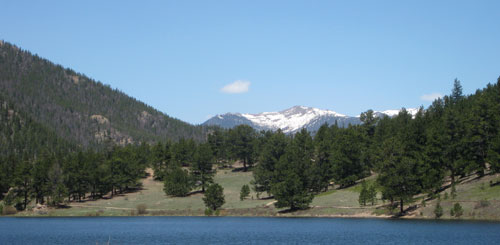
Lilly Lake near Estes Park, Colorado

On a recent trip to Colorado, I painted at Lily Lake near Estes Park.

I’ve been trying to loosen up my watercolor landscapes; normally I make a tight pencil drawing on the paper before I start applying water and pigment. But I’m not liking the results. The image is too tight,  much like a cartoon.

Watercolor landscape painter Jonathan Pitts advises starting out with a 5-minute sketch before launching into a longer painting. In 5 minutes there’s only so much you can do. You have to rely on simple shapes, colors, and brush strokes.

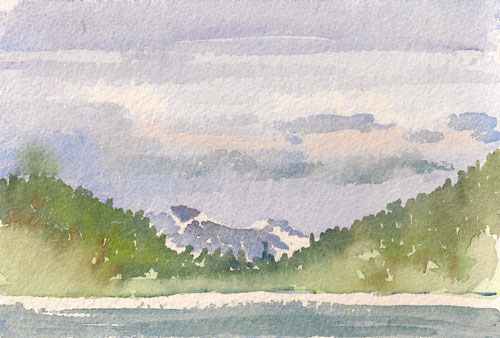
At Lily Lake, I couldn’t quite restrict myself to 5 minutes. I gave myself a 15 minute time limit for an initial sketch on a 3.5″ x 5″ piece of watercolor paper, set the timer, and painted.

LilyLake_15MinutesLily Lake
15 minute study
Watercolor 

Next I worked for a couple of hours on a larger piece of paper. It was late afternoon, and the light and sky was changing every few minutes.

LilyLake_2hours

Lily Lake
2 hour study
Watercolor

I like the quick study much better. Making quick decisions forces me to work rapidly in bold patterns and simple color. Such “thin-slicing” is not my normal state of affairs; I usually mull things over until they are thoroughly mushed and muddy. I’m searching for clarity in many things. Funny that it should sometime come as a result of flash decisions.

Painting outside: Mindego Hill

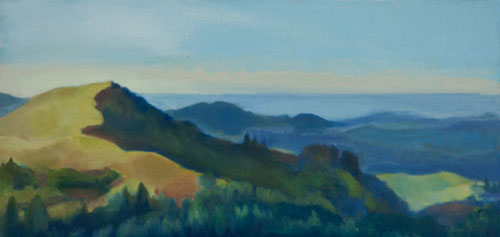
RussianRidge500pxMindego Hill #1
Oil on canvas board
© 2013 Margaret Sloan

For the last 3 Saturdays I’ve been at Russian Ridge, painting Mindego Hill. It’s an iconic view from the ridge: Mindego Hill rises over the coast range of mountain ridges rippling all the way to the sea. On a clear evening from the ridge, you can watch the sun set into the Pacific.

A few years ago, this hill was saved for all of us by the Peninsula Open Space Trust (POST) and the Midpeninsula Regional Open Space District (MROSP), organizations that have protected many acres of the Bay Area from the rampant cancer of development that afflicts the Bay. It’s rather miraculous that we have these open spaces where we can all savor the landscape that makes the Bay Area so beautiful. For many of us, getting away from the city streets is a necessity for our health and sanity.

The world is full of coincidence. (If you don’t believe me, check out This American Life’s recent show on coincidence) While I was writing this post, a young man rang to ask me to take a survey about POST and MROSP. I guess they are trying to put together a bond issue to raise some dollars. Would I be willing to pay more taxes to fund the necessary luxury of having open space available to everyone?  I’m not a fan of more taxes, but for this, I’m not sure how I could refuse.

To read about the GoMindego campaign (which was successfull in preserving the hill), as well as some history and facts about the hill, go to this newsletter: http://www.openspacetrust.org/downloads/newsletters/Landscapes-WI07.pdf