Long time crush

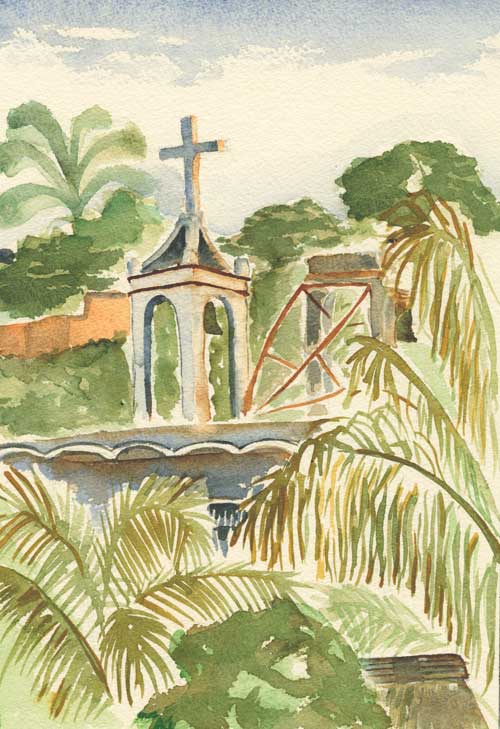
painting of church
A watercolor done many years ago of a half-built church

I’ve been absent from the blogosphere lately because we are in the process of moving (or thinking about moving, or taking about moving. We are not fast people. We move slowly).

Part of the process of moving is, of course, going through years of accumulated detritus, sifting out what to keep and what to save. It’s a little like an archeological dig, exposing layers of life that have been buried in boxes for nearly 2 decades.

The painting that heads this blog was done when, many years and lives ago, and sweating in tropical heat, I was just discovering that I needed to be a painter. I had always drawn, painted, created, but I was also attempting a writing career in those days. I was carving my time into chunks so that I could do both— write and paint—plus upkeep our lives in a foreign land.

I happened to read Annie Dillard’s The Writing Life. In it she describes making a pen drawing of the view she had through her window. Then one day she shut the blinds.

“Then, by lamplight, I taped my drawing to the closed blind. There, on the drawing, was the window’s view….If I wanted a sense of the world, I could look at the stylized outline drawing. If I had possessed the skill, I would have painted, directly on the slats of the lower blind, in meticulous color, a tromp l’oil mural view of all that the blinds hid. Instead, I wrote it.”

This passage was a watershed moment. I realized that by focusing on writing, I was penciling the wrong paper; I needed to paint, and to paint realistically, because I needed to see the world. I needed that connection of observing the world closely, granularly, carefully. I needed to create the picture in the window, not write it.  Painting was where my stories could live.

Need is such a weak word to describe the yearning, the almost sick-with-desire crush I felt for painting, that I feel even now. I still write (yeah, this blog), and I enjoy the (rare) feel of stones falling clop-clop-clop when I craft a particularly elegant sentence. But my true love, that moves with me from place to place, after nearly 20 years?

Brush and paint.
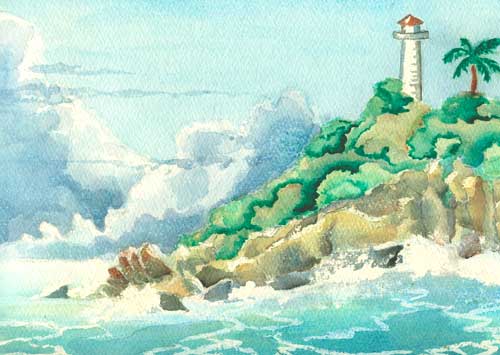
Watercolor painting
One of my first landscape paintings done from a sketch I’d made onsite.


Biting back at the tyranny of perfectionism

Frustrated artist
Portrait of the artist seeking perfection
Watercolor on Yupo

Blogger Drew at the Skinny Artist recently posted about the perils and paralysis of perfectionism. The kind of perfectionism that keeps painters from painting, writers from writing, and musicians from musicking. You probably have felt it: the need to make sure everything is just so before beginning, working on, or finishing a piece of work. It can be a problem for creatives. It can keep us from accomplishing our goals, telling our stories, meeting deadlines, and making our dreams come true.

I know, I know, it’s hard to let go of the tyranny of perfectionism. I work at freeing myself from it constantly. But it’s possible to break those chains. Here 8 simple bullet point items that work for me.

1. Just start. Fear of failure can derail my creative train before it ever gets out of the station. But come on. It’s art, not mass transportation; if I go off the artistic tracks, nobody dies. Truly. So I chug ahead by doing something. Anything. I copy a Bargue plate; study how to draw a particular body part (right now I’m doing knees); make some color charts; even—when I’m least inspired—drag a brush or pen across a piece of paper just to make some marks. It often sparks an idea and stokes that creative choo-choo.
2. Do a lot of work. Everyday. With plenty of work going on, I don’t end up hunched over one painting hissing “my precioussss”. I’ve got other fish to fry. If a particular painting isn’t working, I move on to something else for a while.
3. Make a mistake early in the process. I work in watercolor, and we all know how hard it can be to correct an errant  . Rather than live in fear that I’ll ruin my perfect piece, I often deliberately make a mistake, just to get it over with so I can paint in peace.
4. Forge ahead and find those mistakes. As an artist, I’m an explorer. I’m seeking the fountain of eternal personal vision, but along the way I’m sure get stuck in the bog of bad brushstrokes, or lost in the desert of dumb ideas. My job is to find those places too; while slogging through them, I’m also mapping them. Who knows? There might be something there I’ll need in the future.
5. When the inner critic starts blathering, change the station. Sometimes there’s a reason to listen to that gremlin, but usually there’s not. When mine starts to cackle in glee at a mistake, I shut him out by thinking of my past teachers, and imagining that they’re standing at my shoulder helping me out of a sticky situation (fortunately I’ve only ever had wonderful, supportive teachers).
6. Let it go. Take a breath. Turn the work to the wall. Go eat some cookies. When you come back to the work, you might discover the fix for any mistakes that have been bugging you. Or you might just discover that you are, in fact, finished, and ready to take what you’ve learned from this work on to the next.
7. Embrace rejection. I once asked a magazine editor friend how she dealt with the constant rejection of her ideas at story meetings. She laughed. “Ideas are cheap. I come up with a hundred of them everyday. Most of them get rejected; I don’t take it personally.” So, go back to #2 in this list. Or move on to #8.
8. Did I say work? Yeah. Work some more. Sleep. Then get back to work. Over the years I’ve noticed that many of the successful artists I admire don’t really have time for existential angst over perfectionism. They don’t have time to, well, spend a lot of time obsessing. Painters pick up the brush and paint; writers sit down at the computer and write. My fiddler takes up his fiddle and plays. There might be angst contained in the process, and they always try to do their best, but the work? It gets done.

**Disclaimer: Understand that I’m just whistling in the dark here. But the thin tune I’m singing can bolster my courage and gumption to get over that fear of failure. Because really, the game may be a foot, but still, it’s all in the mind. 

Get to work.

More on turning the wheel

Happy After-Solstice Saturday!
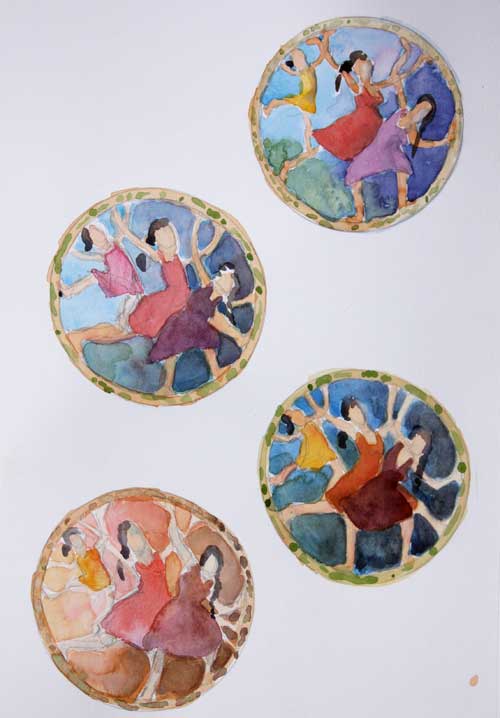
My birthday doodle has turned into a painting idea.

I like to plan my paintings, doing lots of composition sketches, and then making thumbnail color sketches. (which color combination do you like best?).

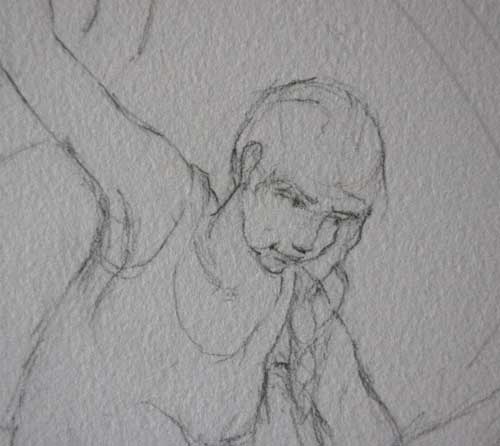
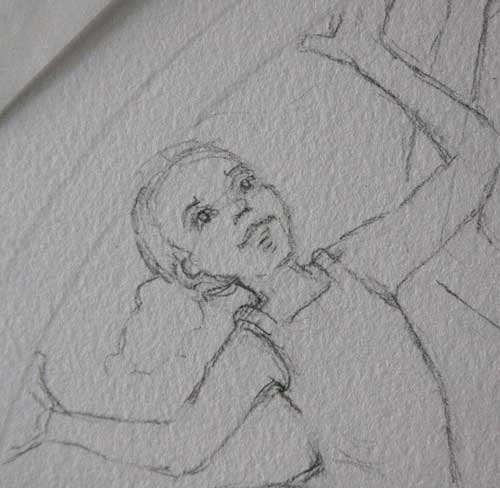
Then I spend time perfecting the drawing.

Still some work to do on the woman’s arms and torso, and some cleaning up of the face.

The little girl finally has a face.

Tomorrow I’m hoping to begin painting.

My artist friend Cynthia says that I like the planning part best; that’s the big part of my process of making art. Yes, she’s right.

I do like to plan, and not just because I’m a tad bit compulsive. I like to plan because that allows me to be more spontaneous when I get to the big painting (on the expensive paper). I like to experiment before I start, trying out many different things. In fact, I wish I had time to do more of it.

Who knows how this painting will turn out? Sometimes it’s all a crap shoot, really. Sometimes all the pre-planning in the world doesn’t make for a good painting.

My blogging friend Chris (who brilliantly identified this drawing as a mandala, before I even made that connection), at Groundswell, likes to play Mahjong at the computer. She wrote last week:

“We think we are at the end. . . that no other possibilities for movement exist. . . and then, we see one more tile, turn it over, and everything opens up, everything changes.

We can never see everything or be fully “prepared” for what’s to come. And in this Mystery is much of the joy that is life, and, of course, some of the suffering.”

Public sketching and the flame of desire

I’m relatively new to the sport of public painting, and I am sometimes surprised by people’s reactions when they watch me paint. Usually I get the standard “Oh, my mother, father, sister, brother paints. They’re really good.” But sometimes other emotions come bubbling to the surface, and I’m surprised by the intensity.

I made this pencil sketch at the museum restaurant (nothing but graphite in the museum, remember?), and that evening, while sitting in a crowded restaurant, I pulled out my gouache paints and watercolor brush and started adding paint.

The table where we sat was at  a choke point in the floor plan; it slowed traffic considerably.  The customers, intent on ordering tapas, didn’t pay much attention to my splashings, but the waiters did. They stopped briefly each time they passed our table to watch the progress of the color sketch, smiling and whispering to each other.

One young man was particularly interested. He asked several times, insistently, where and how I learned to do that. Then he asked if I taught classes.

“No, I don’t,” I answered. “But in Chicago there are tons of ateliers and schools.”

He grumped. “I tried a school for art once. There was to much book stuff for me. I don’t want to learn other people’s ideas, I want to do my own.”

¡Aye Chihuahua! Not like books? Not study other people’s ideas? That makes my mind reel about like a drunken turkey on Christmas eve.

I tried to keep my flabbergastment to myself, because I could see a flame in his eyes, and I didn’t want to extinguish it. I recognized that flame because I know that bit of fire. It burns inside your chest. It burns and it hurts, because you want to do something so much that you don’t even have words for it, you don’t know how to get there, and you’re afraid to even try.
A flame like that is easily blown out by the wrong word, a flippant remark, or indifference from another artist.

My step-daughter and I spent the rest of dinner  searching our smart phones for  Chicago ateliers and by the end of dinner, we had given him a list of ones that looked promising—schools that looked like they had solid programs in drawing and painting rather than a lot of theory and academics. At the end of the evening, we presented him with the list.

“Try these schools,” I advised. “I think they’ll teach you how to draw and paint. But I hope you look at art books. You’re studying art, so the books you’ll study are full of pictures. And that’s got to be a good thing, right?”

He hesitantly nodded, and took the scrap of journal paper I handed him and stuffed it in his wallet. I hope that strong blue flame I saw in him burns brightly enough to get him down to one of those art schools, do the work, and, yes, read some books.

Visiting Olana and the Hudson River

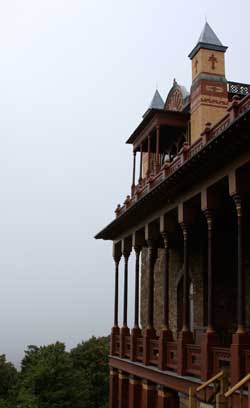
OlanaWhile in upstate New York, we managed a quick visit to Olana, the castle-like home of Frederic Edwin Church, the 19th century landscape painter.

I’ve long admired the Hudson River School of painting, a style that celebrated nature, and especially the landscapes of the New World. During the 19th century it was hot stuff, but it fell out of favor when those darned impressionists brought their pastel-colored personal impressions to the art world. Fauvism (along with modernism) has ruled the art world for the last 100 years, but I think people are rediscovering the realist painters of the past.

Church was one of the most famous of the Hudson River School, known not just for his famous iceberg paintings, he but also paintings of the dark brooding Catskill forests and luminous skies reflecting in the shining Hudson River. Alive when artists could attain rock star status, Church was a box office draw. He also came from money, and had wealth at his fingertips.  So he built a beautiful, over-ornamented home on a hill top overlooking the river valley.

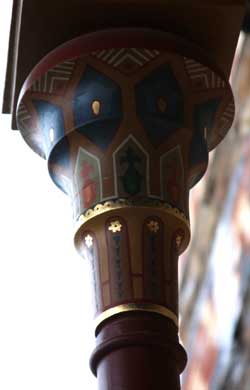
OlanaDetailOlana is a sort of homage to a Victorian-era Persian fantasy. There are Middle-Eastern motifs everywhere you look, right down to fake-Arabic script on the wall panels. Once breathtakingly colorful (Glittery silver and gold decorative painting on the door! Bright yellow drapes! Burgundy and green velvet furniture!), the colors have faded to the muted tones we associate with old photographs.

I have to admit, it’s a little like visiting the Winchester Mystery House in San Jose. It’s a bit over the top, and it’s hard to imagine people actually living and visiting amidst the ornamentation. But how prejudice against decoration are my 21st-century eyes, having been trained and honed by the naked lines and sparsity of mid-20th century modern?

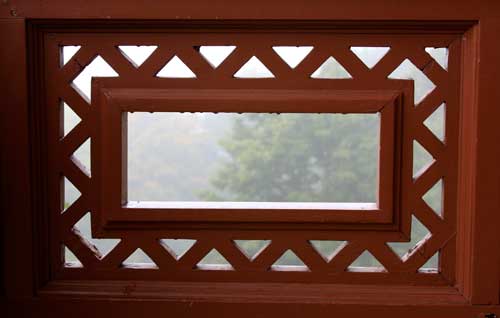
The Victorian era was all about ornamentation, and Olana is a tribute to that design ethic. But more than that, the house is a series of frames for the surrounding landscape. Church wanted the house to frame his beloved Hudson River Valley, and every window and door opens on some incredible view (Unfortunately, a storm obscured the vistas when we were there, and so we only had more intimate views). Even the ornamental balustrades frame views in miniature.

OlanaFrame

It’s something I need to learn more about, this framing of the landscape. Too often I begin drawing before I’ve properly figured out the design of the landscape I’m trying to paint. Then I am overwhelmed by the whole thing and my painting (and my mood) falls apart.

The end of art?

Puppet Goddess <p> Watercolor Copyright Margaret Sloan 2009
Puppet Mistress Watercolor

This painting started out as a meditation on three young women I know who are entering their college years at what may be the worst economic time in recent history. They are all artists, although in different arenas, and they all want to pursue a life in the arts. I have no doubt about the talent of these three young women. It bubbles out of them in everything they do; they are incredibly creative, innately talented. They simply glow.

But all is doom and gloom in the world these days, and bad news begs the question: Is this the end of art? The end of being able to make a living from your art? Will my  young friends find a world where they can profit from their lights?

Of course I worry that the storms of reality may derail their (and my) dreams of making it as artists. So this painting is a charm for them (and for me). We’re all hiding under our umbrellas right now, but really, we should be looking around, letting the storm entertain and inform us, and making better art in response.

If the silver lining to this economic train wreck is brought by a half-naked Amazon making marionettes tap dance on our heads, so much the better!

BTW: There’s a good op-ed piece from the New York Times (The Boom Is Over. Long Live the Art!) about the effects of the bum economy on that rarefied world where artists hawking pickled sharks and embalmed calves become high-end darlings of people with more money than God. It’s an interesting read, if just for the historical value of seeing how the last few downturns in the economy affected that otherworldy land, and that, for the health of art, this downturn might not be a bad thing.

Painting hands

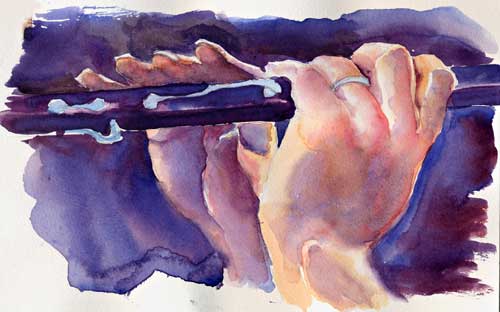
hands playing flute

These are the hands of William Bajzek, a very fine Irishflute player from County Santa Clara (that would be in California).

When you play the wooden flute, you feel the flute vibrate through your hands and the air rush up through the finger holes. A well-made flute feels nearly alive in your hands, ready to start singing at barely a breath of air. When I watch William play, it seems to me that his hands as well as his ears are listening to his flute.

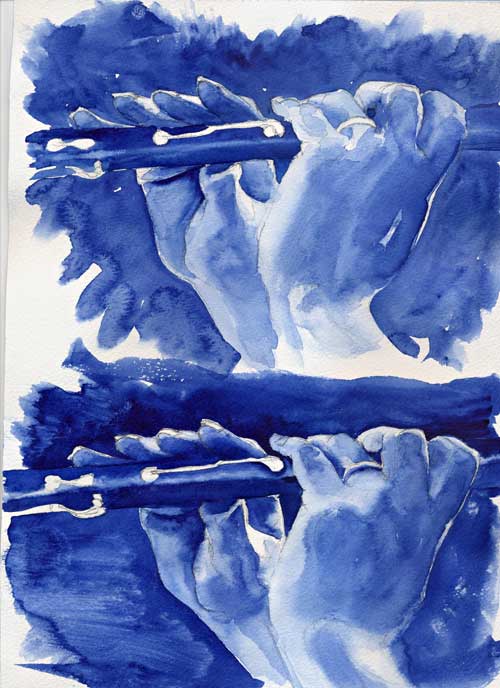
monochromaticstudyI’ve painted this image in watercolor 8 times. The first 6 paintings were one-color value studies, painted on Biggie watercolor paper, 2- up. I was trying to understand the way the values moved across the forms, and how to manipulate the paint. With watercolor especially, you need to have a plan, a framework around which to build your spontanaity, and I’m trying to figure out that plan.

I’m posting just one pair of my favorite one-color studies. I think it’s nice as one color, but I have a color piece in mind.

The first time I tried to use color was disastrous. Lesson learned: start with light value colors first, and progress to dark values. Also, be very careful with staining color, because it’s nearly impossible to remove.

I’m not entirely happy with this first color version, although it has a freshness to it. But the cheap paper buckles unattractively. And I’d like it to be a little tighter, less impressionistic, although I know that is the style in watercolor right now. Somehow I’d like to combine freshness and control in my watercolors.

If you’d like to know more about woodenflutes, you can start at woodenflute.com.