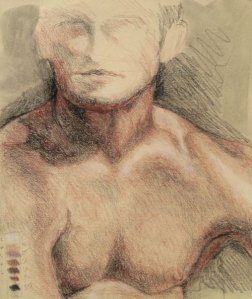
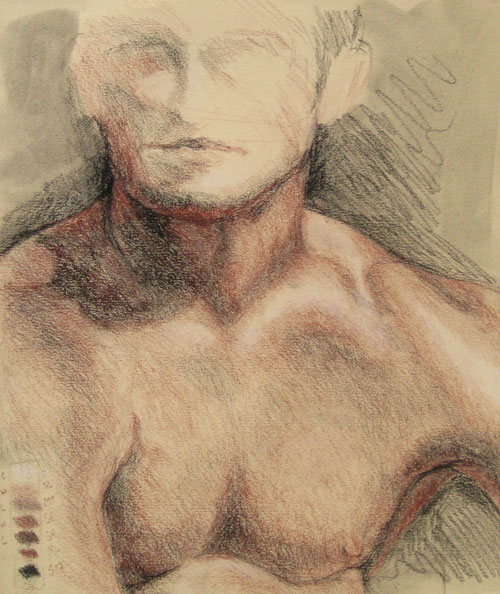
Neck study Charcoal, chalk, sanguine on toned paper
At the Atelier School of Classical Realism, we’ve graduated from using only charcoal and white chalk. We’ve added a third chalk: red-hued sanguine. Boy, what a difference! With charcoal, white chalk, sanguine, and the toned paper, we’re actually working with four colors, and it’s amazing how many variations in value and hue we can mix.
At the bottom left of the drawing above, you can see my value chart. Working out your values before you start adding tone is absolutely the way to go. It doesn’t pay to be lazy in this regard; you’ll end up either working harder in the end, or just giving up on the drawing.
This drawing was done in about 3.5 hours, and with this limited amount of time (we do lo-o-o-ng poses in this class. I’ve worked on drawings up to 15-20 hours, so 3.5 hours was brief for me) I chose to do a study of a neck because Rob had just given us a terrific lecture on how to stick the head on the torso (always an important thing!) and I wanted to try out his ideas.
The key to getting the head on right is placing the neck properly. And the key to placing the neck is to think of it as a column emerging from top of the torso.
Sounds simple, but it’s not.
If you think this blog might be of comfort to someone, please share it
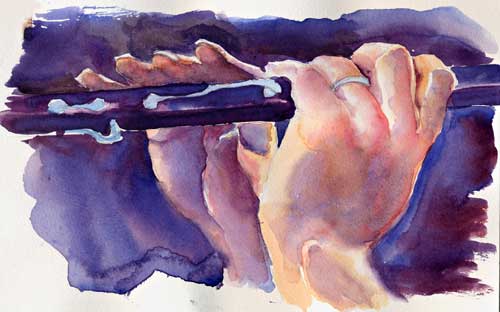
This week I painted my final version of William Bajzek’s hands playing flute. I think I’ve painted about 12 versions of this; I’m happiest with this last version, although I also like the earlier version I posted in February.
I’m calling it Trim the Velvet, one of my favorite Irish tunes. It’s a tune that falls beautifully on the flute, and one that William plays really well. You can hear sound samples of William playing Irish music with his wife, Angeline, in their duo called Castlerock. Unfortunately, they haven’t any sound samples of Trim the Velvet on their website. They should.
12 versions of the same painting. That’s a pretty compulsive thing to do. But I made about every mistake a person can make in those 12 paintings. Sometimes I made pretty awful color decisions (and sometimes no decisions at all). I struggled to create soft edges. I roared into the painting and impatiently splashed dark values onto the paper too soon. I didn’t pay attention to the paint.
These are the things I learned: Painting a watercolor is a lot like starting a relationship. It’s best to be delicate in the beginning, leaving room for the big decisions that you’ll have to make later on. Plan well. Make clear choices. Use a light touch. Be happy with what the painting wants to be.
If you think this blog might be of comfort to someone, please share it
Sketched while watching a BBC production of the Pickwick Papers
Paul Foxton at Learning-to-see, the artist behind one of my favorite blogs, has just posted that he’s had to get a day job. He’s wondering how he’s going to have enough time to paint.
I’m something of an expert at this. For three years I’ve been managing a more than full-time job, plus learning to paint. It’s tough, and slow, and frustrating. Although I truly like going to work most days (I’m lucky that I get to do creative stuff, and keep bees at my job), I often daydream about painting all day long.
But unless I suddenly win big at the lottery (hmm, I guess I should really buy a ticket one of these days) in order learn to to paint—or do any other kind of intense study and work, whether it’s writing, music, computer programming, boat building—I’ve had to make certain decisions, embrace certain strategies. Sorry if this list is a little preachy.
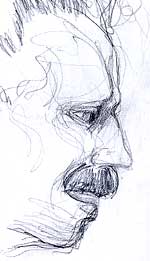
I drew this in the car. I do quick portrait gestures while I'm sitting at stoplights; great faces present themselves.
1. Realize that progress is going to be slow. If you have to work a day job to live, you just have to embrace that you’re going to move forward in small steps.
2. Keep your work close at hand. I keep a sketch pad available at all times-I draw everything, everyone, until family and friends tell me to stop. Thankfully, they’re pretty patient. I even draw in the car at stop lights. (But don’t draw in meetings at work. Bosses don’t like it.)
2. Be your own (strict) boss. I set a goal of dedicating 2o hours a week to painting, and I keep a time sheet. I list amount of time and project—and it doesn’t have to be directly handling paint. Research counts, blogging counts, sketching counts. But the time sheet keeps me honest. Keeps me from wasting time, and keeps me on a schedule. Because I can get seriously lost in “research,” and not leave enough time for painting.
3. Kill your T.V. I still have one, but it won’t make the switch happily to digital because it’s too old. Now I need to seriously disable the internet and YouTube. On the rare occasion I do watch a movie (mostly at home), I usually sketch the actors, the set design, costumes. (John Ford movies are great for learning landscape composition.)
4. Get some rest. I remind myself I’m human and need rest or all else goes to heck. During the crunch time at work, I have to lay off painting, or I’m no good for anything. During those weeks, I only work at painting 10 hours a week!
5. Be jealous of your time. What would I rather do—paint or dust the books on the bookshelf? No brainer, that. My grandmother would gasp at the amount of dust and clutter in my house.
6. Make hard choices. I’ve had to give up many of the extra-curricular activities I used to engage in. The hardest one, that’s hurt the most, has been not seeing my family as often as I’d like. My brother’s young ‘uns have grown up while I’ve been working so hard, and I’ve missed them tremendously (I’m actually not sure I should have made that sacrifice). The second hardest sacrifice has been cutting back on music, until I scarcely play anymore.
7. Accept that for most of us, anything you really want is going to be hard to achieve. Art is hard. An evening spent painting is not a way to relax; it’s work. It’s work that I have to do or face becoming twitchy, bitchy, and mighty unhappy.
Mr. Pickwick, a man who didn't have to work
If you think this blog might be of comfort to someone, please share it
This painting started out as a meditation on three young women I know who are entering their college years at what may be the worst economic time in recent history. They are all artists, although in different arenas, and they all want to pursue a life in the arts. I have no doubt about the talent of these three young women. It bubbles out of them in everything they do; they are incredibly creative, innately talented. They simply glow.
But all is doom and gloom in the world these days, and bad news begs the question: Is this the end of art? The end of being able to make a living from your art? Will my young friends find a world where they can profit from their lights?
Of course I worry that the storms of reality may derail their (and my) dreams of making it as artists. So this painting is a charm for them (and for me). We’re all hiding under our umbrellas right now, but really, we should be looking around, letting the storm entertain and inform us, and making better art in response.
If the silver lining to this economic train wreck is brought by a half-naked Amazon making marionettes tap dance on our heads, so much the better!
BTW: There’s a good op-ed piece from the New York Times (The Boom Is Over. Long Live the Art!) about the effects of the bum economy on that rarefied world where artists hawking pickled sharks and embalmed calves become high-end darlings of people with more money than God. It’s an interesting read, if just for the historical value of seeing how the last few downturns in the economy affected that otherworldy land, and that, for the health of art, this downturn might not be a bad thing.
If you think this blog might be of comfort to someone, please share it
In the third year at the atelier, Rob started teaching us different techniques which will eventually lead to color temperature theory. Leaping into technique was a little daunting, as I was still (am still!) struggling to get an accurate rendition of the figure on my paper. Rob has an exacting eye, and with his help, I’m slowly learning to see where I go wrong in the initial stages of a drawing. These days, when I’m working on a drawing, I don’t just accept the first marks that go on my paper; instead, I try to use a more critical approach. And measure, measure, measure.
After we started working on colored paper, Rob introduced the Prud’hon method. Prud’hon was a French Romantic painter who produced some amazing drawings using toned paper, charcoal, and white chalk. A brilliant Bay Area teacher, Rebecca Alzofon (who, unfortunately is no longer teaching) has a tutorial on the Prud’hon method. I rarely follow tutorials, but I did follow some of this, and found it helpful to build on what I’d learned in Rob’s class.)
There’s a lot of smudging going on with this method. Tone is put down by a series of hatch marks, which are then smudged and blended. Charcoal and chalk can be blended, or not. After you’ve built the volume and form, to accent areas, you use line—not contour line, which would go across the form, but rather, line that follows the direction of the form.
If you think this blog might be of comfort to someone, please share it
These are the hands of William Bajzek, a very fine Irishflute player from County Santa Clara (that would be in California).
When you play the wooden flute, you feel the flute vibrate through your hands and the air rush up through the finger holes. A well-made flute feels nearly alive in your hands, ready to start singing at barely a breath of air. When I watch William play, it seems to me that his hands as well as his ears are listening to his flute.
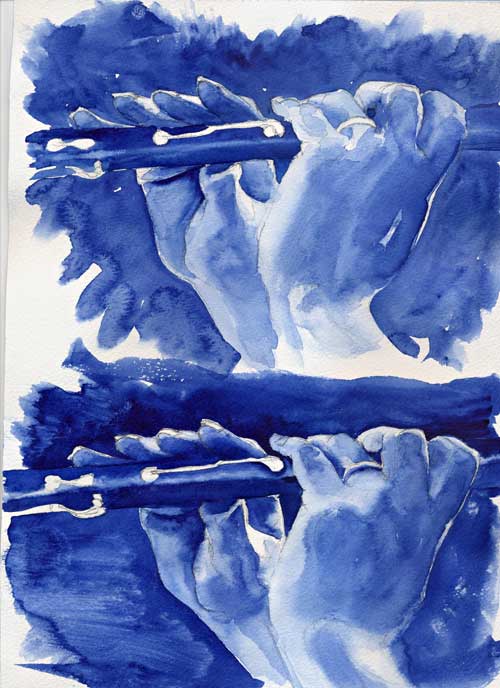
I’ve painted this image in watercolor 8 times. The first 6 paintings were one-color value studies, painted on Biggie watercolor paper, 2- up. I was trying to understand the way the values moved across the forms, and how to manipulate the paint. With watercolor especially, you need to have a plan, a framework around which to build your spontanaity, and I’m trying to figure out that plan.
I’m posting just one pair of my favorite one-color studies. I think it’s nice as one color, but I have a color piece in mind.
The first time I tried to use color was disastrous. Lesson learned: start with light value colors first, and progress to dark values. Also, be very careful with staining color, because it’s nearly impossible to remove.
I’m not entirely happy with this first color version, although it has a freshness to it. But the cheap paper buckles unattractively. And I’d like it to be a little tighter, less impressionistic, although I know that is the style in watercolor right now. Somehow I’d like to combine freshness and control in my watercolors.
If you’d like to know more about woodenflutes, you can start at woodenflute.com.
If you think this blog might be of comfort to someone, please share it





 Mockingbirds at midnight