Framing the figure

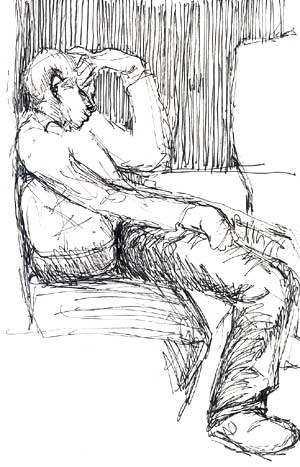
BoyonTrainThis drawing I completed after visiting the Vermeer Milkmaid exhibit at the Metropolitan Museum of Art. What luck to be in the city while the Met had a special exhibit about Vermeer. I was able to study the paintings in real time, and try to understand what made them work.

I wish I could live in that museum (I loved From the Mixed-Up Files of Mrs. Basil E. Frankweiler when I was a kid), but, alas, they will not let me. So whenever I visit New York, I spend as much time in the museum as possible, sketchbook in hand, trying to infuse my brain with master works. I don’t always understand what I’m learning while I’m at the museum, but somehow it ferments in my brain and bubbles to my conscious mind later.

One of the things that I noticed in Vermeer’s work was how he often framed the figure with geometric shapes. In A Woman Asleep, he frames the face of the young woman with a gray square. He often uses a wall hanging of a map as a geometric element that frames the subject—look at Young Woman with a Water Pitcher, Woman with a Lute, and Woman in Blue Reading a Letter. (Incidentally, if you’re interested in Vermeer, The Essential Vermeer is a terrific online resource.) But it really didn’t make a big dent in the attention I was paying to Vermeer’s color and brush technique.

But I must have filed this bit of framing arcana on top of one of the piles of information cluttering my mind, because it surfaced later that evening. After a three hour stretch at the museum, I tiredly took the train back to New Jersey where we were staying. I sat across the aisle from this young man who was trying to sleep, and took out my sketchbook to capture his lanky pose.

Suddenly I realized that it wasn’t his face (I could scarcely see it), or his figure that attracted my attention, but rather, the way he was framed by the dark of the window and the back of the seat. Light bulbs went off in my mind. This was what Vermeer was talking about when he use a shape to frame his focal point!

It’s a simple sketch, but it pleases me because it reminds me that I’ve discovered a new way of seeing.

Harmon’s Peak

Tombow brushpen and waterbrush
I drew this while Harmon's Peak sang Buffalo Gals, a song from the 19th century that's still a terrific song in the 21st century.

The best part of the Good Old Fashioned Bluegrass Festival was the jamming that took place after the amplified music stopped. There was music all night long—of course bluegrass, but also old time, blues, jazz, and a group of folks having a dance party while they played bluegrass tinged Beatles, R&B, and disco. By 1 am I was exhausted, and I drifted off to sleep under a nearly full moon, hearing banjos, fiddles, guitars, and stand-up bass in the campsite 3 spaces over. Sheer heaven.

The amount of talented folks in everyday life astounds me. People go crazy for superstars, but there’s a lot of people out there who are top-notch musicians. They might even be living next door to you!

The next morning my husband’s band, Harmon’s Peak played. They’re an old time string band, which is a different style of music, but it’s part of the roots of bluegrass. As you can see, they’re the best dressed old time band in the Bay Area.

Harmon's Peak
Harmon's Peak

The long pose in a fast world

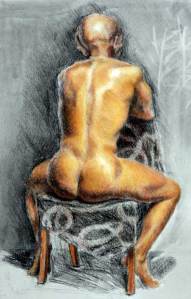
SeatedLongPose
Pastel pencils, charcoal, chalk on toned paper

This pose, drawn at the Atelier School of Classical Realism in Oakland, took about 10 hours. I still have a few hours left (without the model) to “finish” the picture.

It’s very difficult to find a long-pose life drawing session that I’m able to attend the Bay Area. Most evening life drawing session poses max out at 20 minutes; a pose that lasts many hours, like the pose I drew here, seems to interest few evening artists. In our hyper-cyberspaced out world, even artists rush around like roadrunners on amphetamines.

And this style of drawing is unpopular these days. In my head I hear an art teacher I know saying, “your drawing is too fussy, too lifeless.” And on some levels I would have to agree with him. But during the course of this long pose I learned so much about color, form, proportion. It gives me a foundation for the next long pose, and hopefully that one will look  more free and less precious, because of the long pose, and not despite it.

Quick color temperature

Pastel and chalk on toned paper

This year at the atelier I learned modeling using color temperature—we used a limited palette of 4 earth-toned pastel pencils, charcoal and white chalk, and toned paper to create form and shadow.

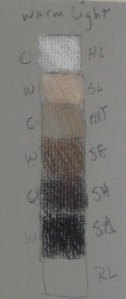
This method is about intellectualizing your drawing. It’s about making a conscious plan rather than just grabbing a color and hoping it will work. We drew value scales in color to denote the color temperature of highlight, strong light, midtones and shadows, paying close attention to warm and cool color temperature and where it was placed in the scale. This is agony for me. I don’t do it well. Scales suck.

Since I am also a musician, I know the value of scales. I think of them as athletic training, like the drills that prepare the football player for that winning 100-yard dash. Playing scales prepare the musician for a blindingly brilliant set. Playing the actual notes become muscle memory, the body goes on automatic pilot and the musician’s  intuitive brain is free to choose the music she hears in her head.

I figure it must be the same for the style of painting I’m yearning to do. Once I’ve internalized color temperature theory, I’ll be more able to make intuitive choices that are based on logic.  That’s when I think true creativity can emerge.

Value chart for warm light

So I drew value scales religiously for each of my drawings this year. They helped. It’s surprising how far astray you can go from your original values over the course of a long pose. I leaned heavily on those value scales to re-orient myself and to overcome frustration. I know I frequently muttered things like, “strong light is cool. Cool, dammit!”

But on the last day of class this year I decided to whip out a drawing using the color temperature principles without agonizing over a value scale. The drawings at the top of the post were of ten minute poses each on toned paper. I did have to write the color temperatures down so I could remember which shadow was cool, which highlight was warm, but I didn’t need to draw a value scale. I was pleased that the concept is beginning to integrate into the way I choose color.

The big stretch

elephantSometimes trying to be an artist is a big stretch.

The music in your bones

Watercolor color study

Last night after the session wound up, after the last Irish jig and reel danced out across the floor, after the last polka whirled by and the last hornpipe bobbed out for the night, after the flutes were swabbed  clean and the fiddles wrapped and stowed in their cases., we musicians fell to talking a bit about Irish music.

We talked about how we came to this old and eccentric style of music in this land of pop melody and commercial jingles. Nearly every person at that party came into the music during a crisis in their life (many of us, it seemed, found it while ending a bad relationship). We found solace in the music, friendship in our instrument. “When I feel down or troubled,” C. said, “I tell it to my fiddle.”

How well I know that type of long conversation with my flute.

Not everyone who comes to Irish music is an emotional refugee looking for comfort. Some are lucky enough to have been born into the music, and wise enough to continue playing their legacy. Others just enjoy the intellectual exercise of learning stacks of tunes. And most of us love the camaraderie and community that comes from playing this music with others.

But I’d wager that for lots of musicians, the music is more importantly a place of comfort and safety. The familiar tunes are like favorite stories  we tell ourselves when we’re happy, scared, bored, or sad.

No matter our level of competence, just to sit quietly by ourselves and play this music is to have a relationship with the tunes and with our instruments that is as deep and serious as our relationships with our spouses, our children, our parents.  I guess because ultimately, it’s a relationship with ourselves.

Late at night we dream of mice

Symbols in the wee small hours
Dreaming of mice
© 2009 Margaret Sloan
Graphite

I watched a lot of b-grade horror flicks when I was a kid. My dad loved Creature Features, and he and I would stay up late together watching the old movies. We didn’t agree on much else in those days, but we both loved Dracula.

The thing the mouse is pulling is a symbol. It appeared in a dream that woke me very early one morning. I’m well acquainted with the small hours of the morning; I’ve never slept soundly, and I wake often. Not because I want to, but because anxiety drives me from the mattress  to the drawing table. It’s a perfect setting for a monster movie scene.

I imagine this frantic mouse is bringing light to a corner of an old stone kitchen. Christopher Lee has just commanded, “Light, quickly! She’s fainted.” The beautiful ingenue is slumped gracefully into a carved wooden chair. The mouse sits up,  chittering in worry while dreadful shadows leap across the kitchen walls. They assume shapes we can only just recognize. She wakes, screams, then faints again. A window bangs open. The candle is extinguished by a damp wind.

Cut to a commercial.

Study of a flute player

Girl playing flute Graphite value study
Girl playing flute
© 2009 Margaret Sloan
Graphite value study

I met this lovely young woman at Friday Harbor Irish Music Camp. She had a boxwood flute that had bent as it aged, but it sounded lovely.

One day while we were in class, the rain and snow stopped, the sky cleared, and the sun streamed through the windows. Sitting in a shaft of sunlight, the young woman glowed as she practiced her tune. I snapped a photo quickly. There was no time to fool around if I wanted to capture the naturalness in her posture. Youth is a time of great beauty, but also great self consciousness.

I’ve come to understand the importance of doing value studies before beginning a painting. Steve Curl, my watercolor teacher, told me that when I was designing the value study I shouldn’t focus on the details. Instead, he said, look for the large shapes of light and dark; I did, and it made all the difference.

I’ve already practiced painting hands playing the flute, so I should be in good shape for her hands.

Reynard’s accordion

Reynard's accordion 2009 Margaret Sloan Watercolor
Reynard’s accordion
© 2009 Margaret Sloan Watercolor

The accordion has gotten a bad rap in this country, thanks to cheesy lounge lizard music and guys in glittery suits. But there are other sides to this instrument, facets that do not include champagne bubbles and Lady of Spain. Accordions have morphed into something new whenever a culture touched them.

I like accordion music, particularly music played on the button box. Particularly Irish music played on the button box (no surprise there), although I’ll take a good French Canadian reel too. English country music on the button box sounds great. And don’t forget accordion is a staple in  Cajun music.

It makes sense to me that a fox should play the accordion. And the fellow in this painting reminds me of a fox.

Raynard the fox was, in European folklore, a trickster, a shape-shifter, a magical animal. May Day seems like a day he is in top form.

I like to think of my Raynard  attracting fluffy white rabbits with his accordion, wooing them with a rockin’ reel or a seductive waltz on dry-tuned reeds and then…well, what he does with the bunnies when he catches them is best left to your imagination. I can assure you that my Reynard doesn’t bite their little heads off, and that they’re pretty happy to have been caught.