


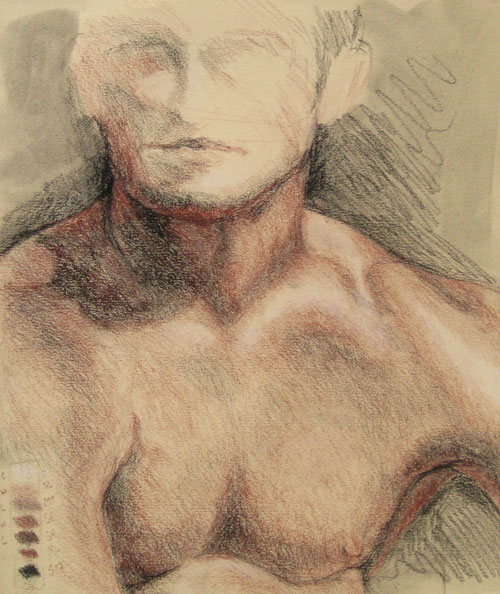
This year at the atelier I learned modeling using color temperature—we used a limited palette of 4 earth-toned pastel pencils, charcoal and white chalk, and toned paper to create form and shadow.
This method is about intellectualizing your drawing. It’s about making a conscious plan rather than just grabbing a color and hoping it will work. We drew value scales in color to denote the color temperature of highlight, strong light, midtones and shadows, paying close attention to warm and cool color temperature and where it was placed in the scale. This is agony for me. I don’t do it well. Scales suck.
Since I am also a musician, I know the value of scales. I think of them as athletic training, like the drills that prepare the football player for that winning 100-yard dash. Playing scales prepare the musician for a blindingly brilliant set. Playing the actual notes become muscle memory, the body goes on automatic pilot and the musician’s intuitive brain is free to choose the music she hears in her head.
I figure it must be the same for the style of painting I’m yearning to do. Once I’ve internalized color temperature theory, I’ll be more able to make intuitive choices that are based on logic. That’s when I think true creativity can emerge.
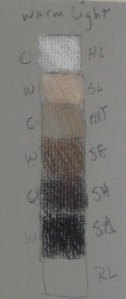
So I drew value scales religiously for each of my drawings this year. They helped. It’s surprising how far astray you can go from your original values over the course of a long pose. I leaned heavily on those value scales to re-orient myself and to overcome frustration. I know I frequently muttered things like, “strong light is cool. Cool, dammit!”
But on the last day of class this year I decided to whip out a drawing using the color temperature principles without agonizing over a value scale. The drawings at the top of the post were of ten minute poses each on toned paper. I did have to write the color temperatures down so I could remember which shadow was cool, which highlight was warm, but I didn’t need to draw a value scale. I was pleased that the concept is beginning to integrate into the way I choose color.
 Mockingbirds at midnight