

Just a little animation from the new Motion app that’s all the rage. The fiddler voices the lion.
Elephants at PAWS
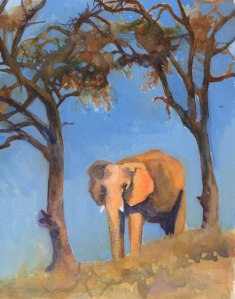
Watercolor and gouache on Arches #300 hot press
I was recently selected to be an exhibiting artist in the project AnimalScapes of the Sierra Nevada Foothills. This show, a tri-county project of the Calaveras County Arts Council, Tuolumne County Arts Alliance and the Amador County Arts Council, will include over 50 artists and makers. We artists will be creating pieces—paintings, pottery, photos, sculptures, even poetry—that depict animals in the Sierra Foothills, and our works will travel around the three counties in an exhibition to be displayed in 2016.
Thika the elephant stood on the hill looking down at us. PAWS president Ed Stewart said, “if I called her, she’d probably come down. But it’s such a beautiful scene, let’s leave her there.” Indeed. Thika was posing like a movie star between two old oak trees, and the cameras of the AnimalScapes artists clicked and whirred. I took lots of photos, and I sketched fiercely.
PAWS, the Performing Animal Welfare Society, is home to 8 elephants. The property in Calaveras County, fittingly called Ark 2000, has enough land that the huge animals can roam on mountainsides, splash in pools, and live out their lives as close to wildness as they could possibly come in the Central Sierra Foothills.
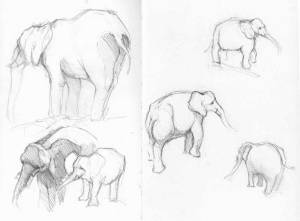
I have to admit that I’ve always had a thing for elephants, ever since watching the documentary The African Elephant when I was a kid. It seems to me that they are as conscious as we pretend to be; their complicated familial relationships, their obvious understanding of death and life, and their clear but ponderous intelligence makes me believe they are a sentient species. And we are destroying them.
Some of the elephants at PAWS had been mistreated in their former working lives, or were stolen from their mothers as little babies. Some witnessed elephants killing elephants; possibly some witnessed humans killing their mothers. It’s a wonder that the animals at PAWS have been able to overcome their past traumas to form attachments with the humans that care for them. There are a trio of Africans who throw stones at cars, but other elephants we met were just as curious about us as we were about them.

Watercolor in Stilman & Birn Zeta Series Sketchbook
We got to meet Nicholas personally. He rumbled low as his keeper showed us how they had convinced Nicholas to open his mouth for dental inspection, or show them the bottom of his ottoman-sized feet. I don’t like to use the word trained. Really what they’ve done is learned how to communicate with the animals, and they’ve done it in a way that doesn’t involve pain or punishment. If these animals consent to a dental examination, or present their ottoman-sized feet for a checkup, it’s because they want to. Not because someone is stabbing them with a bullhook.
I couldn’t stop sketching. I could have drawn Nicholas all day long as he snuffled through a pile of bran meal on the floor and purred his elephant growl.
Drawing portraits in person always brings me closer to my subject, and drawing Nicholas was no different. I could feel an intelligence there, a being that knew who he was and who accepted that a small female animal was observing him while he observed her.

AnimalScapes blog posts
Drawing animals for AnimalScapes
Sketching bears and tigers at the PAWS Ark 2000 animal sanctuary
Elephants at PAWS
Dia de los Muertos (after the fact)
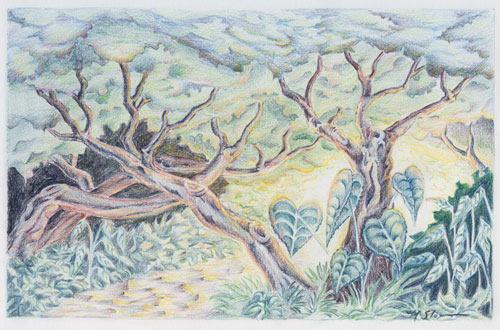

Color pencil on paper
I’m writing an art column for our local newspaper’s lifestyle tabloid, the Sierra Lodestar, and my first story appeared in last week’s edition.
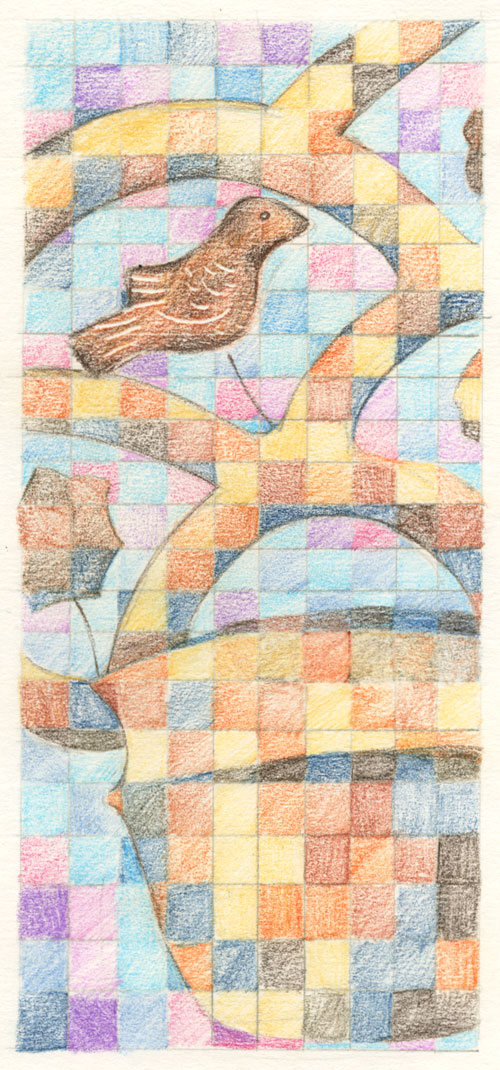
Color pencil
It’s about the ofrendas, or altars, that appear during Día de los Muertos. In Murphys, the Day of the Dead has become a popular celebration, and since it’s one of my favorite holidays, I wanted to transmit some of the beauty and meaning of the rituals of creating ofrendas for the dead.
I lived in a small tourist town in coastal Oaxaca in the 1990s, just before the narcotraficantes made Mexico a nightmarish place. Our town catered mostly to surfers and budget travelers, and Mexicans who appreciated small and real rather than huge and glitzy. During the off-season there were a few ex-pats who lived there year-round, and a small community of fishermen, farmers, service people, and shop keepers. Everyone knew everyone else; it was a lovely place to live.
In those days, the season that spanned the end of October and the beginning of November was a traveler’s secret (I don’t know what it’s like now). It wasn’t crowded. The rains had ended, for the most part, and the weather was cooler than it had been since May. The pulsating greens of the rainy season were fading to olive and gold, and there was a softness to the heat. It’s what autumn is like in the tropics.
For the week leading up to November 1 and 2, when it is believed that the veil that separates the living from the dead, people (yes, living ones) began building ofrendas, or altars, in businesses and homes. The altars, made to honor the spirits of the dead who are able to return home for the first two days of November, were crowded with things like balls of chocolate, cigars, alcohol, toys, candles, mirrors, bread, and marigolds woven into wreaths and chains, or arranged in bouquets of orange and yellow. I never fully understood which items were for the departed (but returning souls), and which items were for the saints that rather spookily had come through the now gauzy curtain between this world and the next.
The article will be up on the Enterprise website for a few more weeks (clickable link below). I hope you’ll take time to read it.
Sketching bears and tigers at the PAWS Ark 2000 animal sanctuary

Watercolor in Stilman & Birn Zeta Series
I was recently selected to be an exhibiting artist in the project AnimalScapes of the Sierra Nevada Foothills. This show, a tri-county project of the Calaveras County Arts Council, Tuolumne County Arts Alliance and the Amador County Arts Council, will include over 50 artists and makers. We artists will be creating pieces—paintings, pottery, photos, sculptures, even poetry—that depict animals in the Sierra Foothills, and our works will travel around the three counties in an exhibition to be displayed in 2016.
A part of AnimalScapes, we chosen artists were gifted with a trip to PAWS, an organization whose mission is “….the protection of performing animals, to providing sanctuary to abused, abandoned and retired captive wildlife, to enforcing the best standards of care for all captive wildlife, to the preservation of wild species and their habitat and to promoting public education about captive wildlife issues.”
Touring the PAWS sanctuary in Calaveras County is a coveted trip. They don’t open to the public often, and when they do, it’s usually for expensive fundraisers that many artists could never afford. I was indeed lucky.

Watercolor in Stilman & Birn Zeta Series Sketchbook
There’s a reason the sanctuary is off-limits to most people. The president of the organization, Ed Stewart, showed us around the sanctuary, and introduced us to many of the animals, and told us the stories of their lives before they were rescued. “Most of these animals have been places where they can’t get away from people,” Stewart said. Frankly, these animals have suffered so much at the hands of humans that they should never have to see us again.
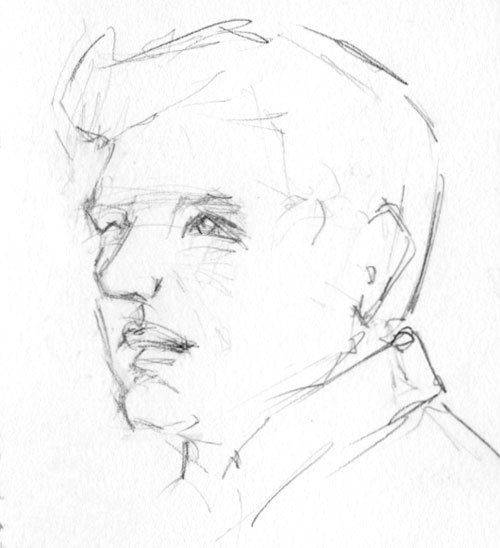
Stewart told stories that make your blood run cold: a bear cub sold at a flea market as a birthday gift for a 4-year-old, then chained, starving, in the back yard for years. Grizzlies and black bears bred to create hybrids, then kept in small cages at roadside attractions. On and on and on. And not in some crazy ignorant poverty-stricken country either; but right here in the United States. I don’t understand. Why on earth do people do things like this?
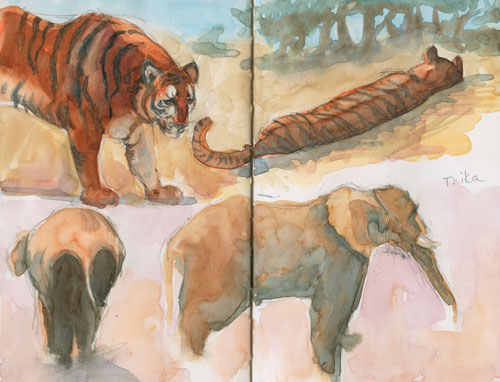
Watercolor in Stilman & Birn Zeta Series
But as horribly as these animals have been treated by humans, they appear to have learned to accept the folks at PAWS, or at least have unlearned some of their fear and hatred. When we crept up to the bear enclosures, the bears, expecting food, came down to see what was up. We were admonished to be very quiet; no worries there. I was so stunned and in awe of being so near a bear that I could hardly talk at all.
There were two tigers that we could see in an enclosure (The sanctuary rescued 39 big cats in 2003. Meet them here.) One slept with its back to us the whole time we were there. Another padded out, looked at us in what seemed to be disgust, and disappeared from view. Stewart said that this was much better than when the tigers first came to the sanctuary. Rescued from an abusive tiger breeder, they hated humans when they first arrived. The two tigers we saw didn’t seem to be happy about us gawping at them, but at least they weren’t scaling the fence to get at us.
I know that the sanctuary isn’t the same as a jungle or veld or forest where animals can roam at will. But there are fewer and fewer of those places left on our small planet as the human population grows exponentially. And the Sanctuary is a place where at least a small number of being hurt by humans can live out their lives in peace and safety.
Next: Elephants at PAWS
Here’s a vid of the tigers at PAWS
The link below is live. Click on it to go to the PAWS website.

AnimalScapes blog posts
Drawing animals for AnimalScapes
Sketching bears and tigers at the PAWS Ark 2000 animal sanctuary
Drawing animals for AnimalScapes
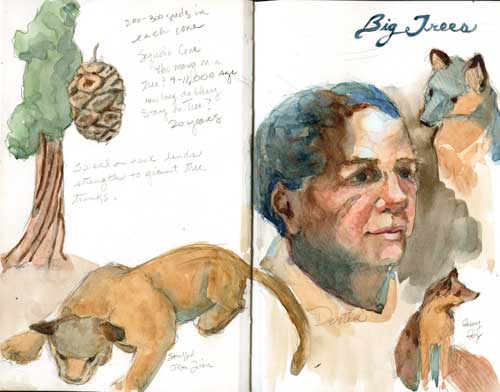
Stilman& Birn Zeta Series Sketchbook
Hoo! I made the grade and was selected to be an exhibiting artist in the project AnimalScapes of the Sierra Nevada Foothills. This show, a tri-county project of the Calaveras County Arts Council, Tuolumne County Arts Alliance, and the Amador County Arts Council, will include over 50 artists and makers. We artists will be creating pieces—paintings, pottery, photos, sculptures, even poetry—that depict animals in the Sierra Foothills, and our works will travel around the three counties in an exhibition to be displayed in 2016.
There are many good things about this show. It will raise awareness of the animals that live in the Sierra Nevada Foothills, and publicize animal welfare organizations working in the Foothill communities. I hope that it will increase the human will to protect and care for the other species that live in the area.
But one of the best things about being a part of this show? There were two field trips. I love a field trip. (Yeah, selfish. I know.)
For our first foray we piled into a big yellow school bus and spent a long day rambling around Calaveras and Alpine Counties. It was great to leave the isolation of the studio and meet other local artists (my people!).
First stop was the New Melones Lake Visitor Center & Museum, where rangers led us on a short hike and we spotted an osprey roosting in a tree. The ranger said it was probably a fledgling from last summer’s clutch of chicks raised in the osprey nest built near the center.

Stilman& Birn Zeta Series Sketchbook
At Calaveras Big Trees State Park we had a short tour of the redwoods, led by volunteer docent Dexter. Dexter gave a good tour, and even better, had a great face for sketching. (That’s the illustration at the top of this post.)
This trip was like sketching heaven for me, and my pencil was busy the entire time. I tried to catch as much visual information as I could. Since the theme of this show is animals, I spent time drawing the taxidermy specimens in the visitor centers. Sketching stuffed animals isn’t as fun as drawing live beasts, but on the bright side, I could really concentrate on understanding perspective, proportions and forms.
I’m slowly adding color to the sketches, as there was no time for dragging out watercolors during either tour. It’s been a great way to experiment with the paint, as I’ve scanned the original pencil sketches to preserve them. With the sketches safely stored on my computer, I feel like I can take some chances with the paint.
AnimalScapes blog posts
Drawing animals for AnimalScapes
Sketching bears and tigers at the PAWS Ark 2000 animal sanctuary
Hot peppers on a cool morning in Calaveras
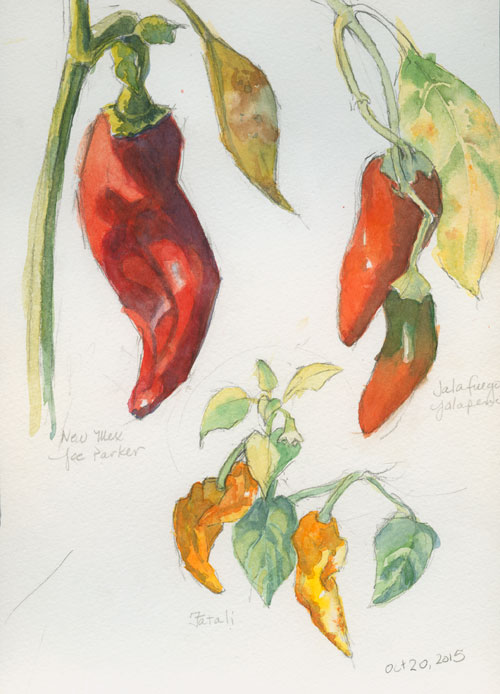
Watercolor sketch in Cachet watercolor sketch book
Tuesday I drew peppers at Taylor Mountain Gardens (Read about why I am drawing at this farm here). With the (slightly) cooler temperatures of fall, the farm is fairly glowing in the sun. It’s rapidly becoming one of my favorite places to paint.
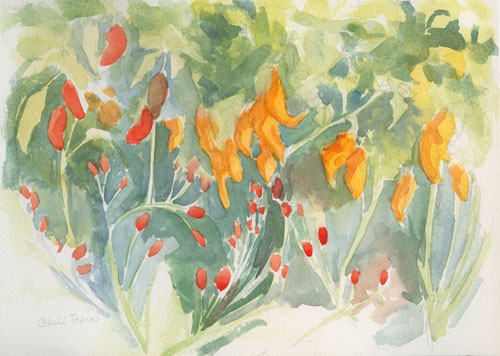
Watercolor sketch in Cachet watercolor sketchbook
I sat in the soil behind a hedge of habaneros, drawing brilliant late summer Capiscums. It’s interesting to see which peppers have kept their leaves. Some of the pepper varieties had leaves that were worn out, yellowed and spotted with autumn; others sported the green foliage of summer. The little mustard habaneros had the freshest leaves of all.
There is an amazing array of peppers growing at the farm. Owner Eric Taylor says he’s growing about 20 varieties of hot chiles, and took me on a tour, handing me peppers like they were candies. “You want to be careful with these,” he warned. “They’re hot.” Now I’m afraid to touch them.
He’s planning on making hot sauce from this year’s crop. I’m not sure if I should be excited or scared to try it…
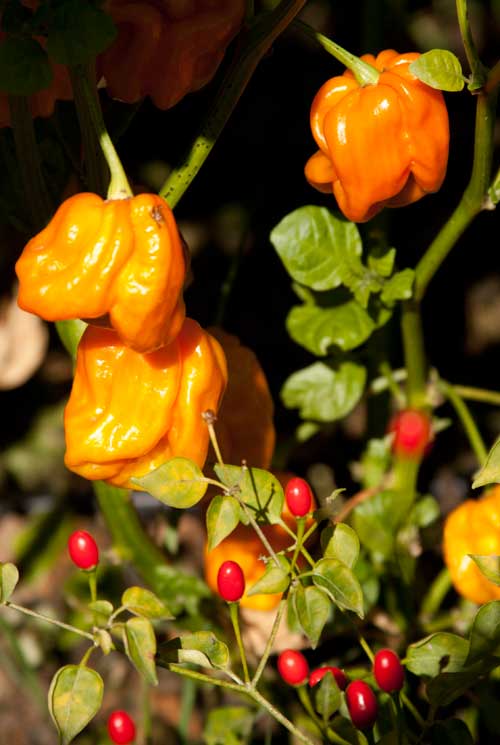
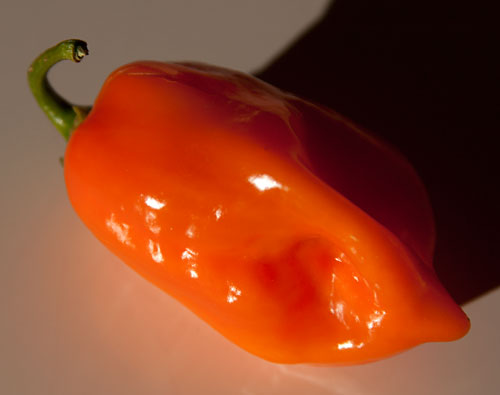
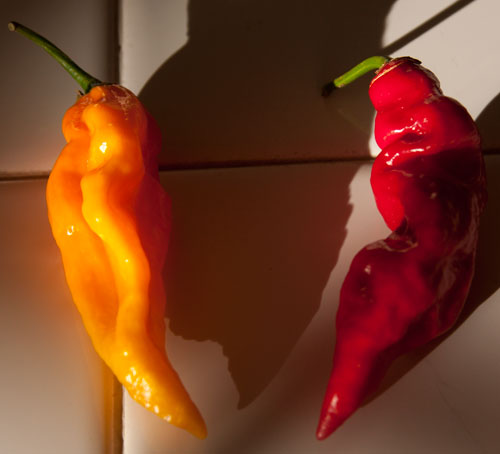
I’m excited to paint a layout of these at home. I’ll keep you updated. In the meantime, I have to ask, how can anything so beautiful create so much pleasurable pain?
You can buy these peppers (and hopefully the hot sauce), plus a bunch of other veggies at the Outer Aisle Farmstand, open on Thursdays, in Douglas Flat, just south of Murphys.
Learning to slow down and take a break

© 2015 Margaret Sloan
Watercolor on Arches hot press #300
In the week after the Ironstone Concourse d’Elegance, we plein air painters who had participated in the event had the opportunity at the winery to display what we had painted.
I chose to opt out.
I had good intentions of submitting a painting, but you know the axiom: Wish in one hand….
I suppose I could have framed my sketches from the event. Here are the reasons I didn’t: 1. The pieces from the concourse were little more than sketches and 2. I didn’t have empty frames that size, so I would have to cannibalize an already framed piece.
Besides, I was working on three large paintings to round out my own solo show at the Atherton Library in the Bay Area. But, ever attempting to be an overachiever (and generally failing), I put show preparation on hold and spent one long evening working on the above small painting.
At the Concourse there is a group that calls themselves “Trailer Trash.” They are trailer collectors who drink cocktails in front of vintage Airstream trailers and teardrop campers circled on the lawn like Conistoga wagons. It’s a popular place to paint. In the late afternoon sun I sketched this little scene and made some mental notes while I sketched. And I snapped a few pictures with a friend’s phone (because my phone hates me and refuses to take photos).
Let me tell you. A photo taken with a camera phone in bad afternoon light is not a good reference. In fact, I find that often photos aren’t good references at all. That’s why I keep my sketchbook closer to me than a dog keeps her fleas. Thank goodness I had that sketch and my notes about the scene.
So with my bad photo, my good sketch, and my Swiss cheese memory to guide me, I painted all evening until the fiddler wandered down to the studio and wailed plaintively, aren’t you finished yet? (No, he didn’t really wail. Only his fiddle wails.) But at night he does often come to the bottom of the house where I struggle in my studio. He likes to walk me “home” (upstairs to the kitchen and living room). You never know when a mountain lion is hanging out under the deck, starving for a bite of pudgy artist.
And I have to admit to you, at that point I gave up on this painting.
There are many reasons to give up on a painting. Here are my reasons: 1. It was late. 2. I was tired 3. The painting wasn’t what I had in mind. 4. A perfectly good fiddler was inviting me upstairs for a glass of wine and some dinner.
And most importantly, I hate being rushed.
I know, we are all in a hurry these days. If something’s worth doing, it’s worth doing fast, right? And we’re all reaching for the stars, trying to achieve greatness, or at least trying to get someone to look at our artwork and expound on its loveliness. Or maybe just trying to get something painted and framed to hang in a last-minute show.
I’ve said this before: I am a slow painter. I think too much, but it’s who I am. I need time to process and plan, to understand what I’m doing. This painting, quickly drawn and painted, was a good start for a larger, better painting. But not good enough to miss spending time with the fiddler.
Plein air painting vintage cars in watercolor

© 2015 Margaret Sloan
Watercolor on Arches hot press #300
If you follow this blog, you know that I was a little nervous about painting at the Ironstone Concourse d’Elegance in Murphys, California.
It’s not that I mind painting in public. Being part of the scenery doesn’t much bother me these days—I actually love talking to people I meet while I’m painting outdoors—but the attendance at the Concourse can be in the thousands. That’s a lot of eyeballs looking over my shoulder as I apply paint and scrub out mistakes. And the weather forecast predicted more tiresome California summer heat.
Yes, the weather was blisteringly hot, but the people who attended—car owners and car lovers alike—were the nicest people. Lubed by Ironstone’s wine and revved up by the event, they were always ready to chat. And best of all, a lovely young woman hired me on-the-spot to paint a portrait of her grandfather’s sweet little red Triumph. (Unfortunately, my iPhone was cranky and refused to snap a photo of the painting, so I can’t show it to you.)
By the end of the day, I was hot and tired with feet that felt flat, but I was still having a ball, splashing paint and schmoozing. I kept painting until I realized that I was no longer able to see and understand color. The color-parsing cones in my eyeballs had seized up like a motor run dry of oil. I quit painting during the car parade and simply admired the beautiful cars as they drove past.
My dad has always been a vintage car fan, and tried to interest me in them all my life, but until the Concourse, I never realized that these old conglomerations of metal, chrome, and rubber are amazing pieces of art, kinetic sculptural forms that are useful as well as gorgeous. And devilishly fun to draw. My next vacation? The National Automobile Museum in Reno, Nevada, or wherever vintage cars are found.

© 2015 Margaret Sloan
Watercolor on Arches hot press #300
Painting cars
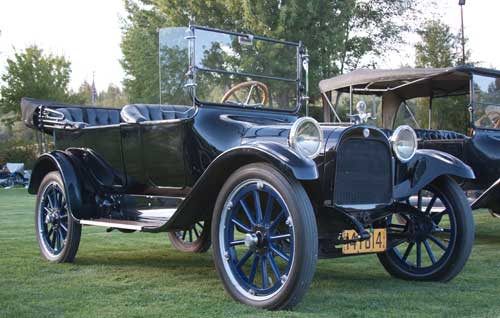
Today I’ll be one of the painters-on-display at the Ironstone Concourse d’Elegance in Murphys, California. I’ve been nervous about this event, unsure of what I’ll find. I’m told that there will be thousands of people there; it will be very crowded.
So I’m taking my cue from Roz Stendahl, and packing the way she does for her state fair jaunts. I’ve torn down a sheet of #300 hot press watercolor paper into 8″ X 10″ cards; packed my backpack with watercolors, water can, and brushes; dressed my self in cargo pants (the kind with all the pockets), and comfy shoes; squirreled away some left over pizza for a snack. The only thing I don’t have that Roz recommends is the spiffy little stool, so I’ll have to stand. (Read here about the way Roz sketches at the Minnesota State Fair.)
But I’m also bringing my french easel, in case there is a space in which I can comfortably set up.
If you’re in attendance, look for me and stop by to say hello (I’ll be the the lady in the cargo pants and floppy hat, furiously sketching and splashing paint around—and nibbing on yesterdays pizza). If you hang around long enough, I’ll put you in one of my sketches!
 Mockingbirds at midnight