

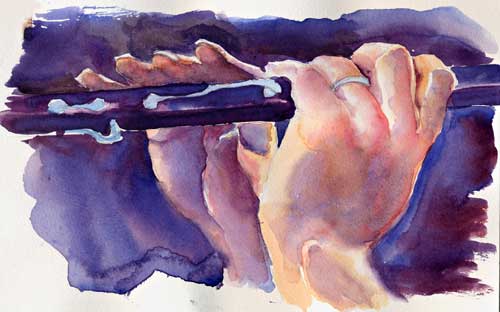
These are the hands of William Bajzek, a very fine Irishflute player from County Santa Clara (that would be in California).
When you play the wooden flute, you feel the flute vibrate through your hands and the air rush up through the finger holes. A well-made flute feels nearly alive in your hands, ready to start singing at barely a breath of air. When I watch William play, it seems to me that his hands as well as his ears are listening to his flute.
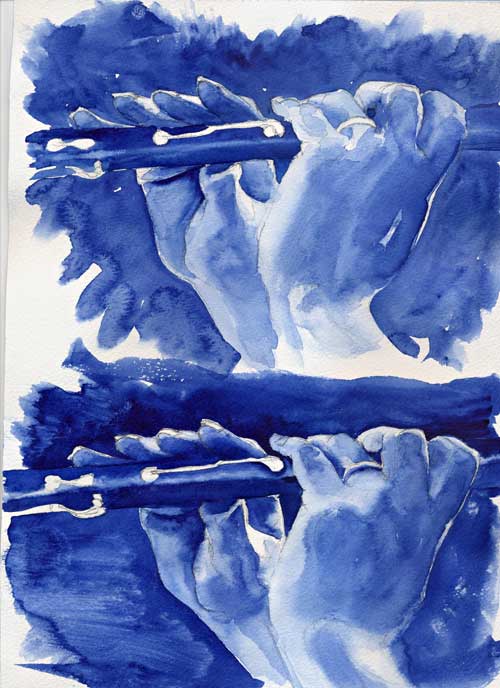 I’ve painted this image in watercolor 8 times. The first 6 paintings were one-color value studies, painted on Biggie watercolor paper, 2- up. I was trying to understand the way the values moved across the forms, and how to manipulate the paint. With watercolor especially, you need to have a plan, a framework around which to build your spontanaity, and I’m trying to figure out that plan.
I’m posting just one pair of my favorite one-color studies. I think it’s nice as one color, but I have a color piece in mind.
The first time I tried to use color was disastrous. Lesson learned: start with light value colors first, and progress to dark values. Also, be very careful with staining color, because it’s nearly impossible to remove.
I’m not entirely happy with this first color version, although it has a freshness to it. But the cheap paper buckles unattractively. And I’d like it to be a little tighter, less impressionistic, although I know that is the style in watercolor right now. Somehow I’d like to combine freshness and control in my watercolors.
If you’d like to know more about woodenflutes, you can start at woodenflute.com.


 Mockingbirds at midnight