Good old fashioned sketchbooking

Guitar playerWell, whattaya know! The Great Bluegrass Festival Drawing Expedition was a blast. Despite my fears at venturing into public drawing, I sketched unscathed at the Good Old Fashioned Bluegrass Festival. Musicians didn’t take offense at my sketching: bass players didn’t mow me down with their gigantic instruments; fiddlers didn’t skewer me on their bows, nor did banjo players strangle me with their twangy metal strings. And the people who looked at me (yes, they did. They actually looked at me with my little journal and bag of pencils) while I drew, why, they were delighted! One woman saw me drawing, grinned widely and said, “what fun is that!”

And darn it, it is fun. Normally I dislike listening to music while I work. I find it distracting—one of the uncomfortable things about being a musician is that there is no background music. My musical brain always stands at attention for anything resembling music, and disallows any action by the other thinking parts of my brain. I am not a good multi-tasker when music is playing.

The Barefoot Nellies singing harmony

But this was different. For one thing, I was prepared for music.  I knew there would be lots of it. Besides, I wanted to sketch musicians while they played.

One thing I learned. Bluegrass really sets your toes tapping and makes your drawing arm swing.

It was really hard to sketch people as they played. Those musicians are moving all the time, and each drawing was an exercise in fast gesture poses—good practice for me. You can see that the drawings weren’t entirely successful, especially around the hands. And even less successful around the instruments.

One of the Winton boys playing dobro and a small sketch of the dad playing guitar.

I point out the unsuccessful parts because drawing at this festival really made me see the areas in which I have smaller knowledge, the parts of the world that I need to really look at and understand. That means concentrated study.

To draw a form rapidly, and draw it well, I think you need study it. It needs to be in your head already. You have to study forms so hard that you can trot out a hand, a foot, a face, a fiddle, and draw it perfectly from memory. Once you’ve internalized it, then I think you can really accomplish something.

Again, it’s the analogy of musical scales. You’ve got to get those major and minor keys down so you can shift between them at any turn of the tune. Then you can really start to have fun when you play with other people.

Fear and sketching in Tres Pinos

RichardThis sketch is of my friend Richard. Richard is a versatile musician. He plays Irish music, old time music, jazz. I’ve known him over a decade now, and he has taught me numerous tunes.  I drew  this picture in a Kunst & Papier watercolor journal I won from  a contest held by one of my favorite bloggers, Roz Stendahl. The paper’s not great for watercolor; it doesn’t hold a lot of  watercolor pigment and it buckles. But it’s a nice feeling book to work in, and the paper will take very light washes of color. I like the way the Tombow goes down, and I like the way pencil slides across the paper. The book is sturdy, and fun to carry around.

I love drawing musicians while they play music. Trouble is, I’m shy about sketching in front of people I don’t know. Or even those I do know, unless I trust them—as I do Richard. I’m still working on my chops in the portrait department, and I still feel inadequate. Criticism isn’t helpful.

I am trying to get over this. I’m trying to get over the feeling that people who look at me while I’m painting are grading me or rejecting me. I think it goes back to an old boyfriend who once said, “You’re not going to be one of those artists who draws in public all the time, are you? People will look at you!”

And people do look. They crane their necks to look at you, stand over you and breath on you, make comments. It’s disconcerting. But of course they look at you.  David Hardy, at the Atelier, tells me that people “are fascinated and consider you special. You have added to the excitement in their life.”  What?! Little old me?

I know that other artists aren’t shy. Roz Stendahl goes to places like the state fair specifically to sketch. She writes about these jaunts as if they were an expedition, packing what she’ll need as if she were going to discover and sketch the headwaters of the Nile. I’ve decided to emulate her.

This weekend we’re going to the Good Old Fashioned  Bluegrass Festival in Tres Pinos.I’ve never been, and I don’t play bluegrass music, although I’ve listened to a fair amount of it. My husband will be appearing in his band, Harmon’s Peak. I’m going on a mission: to draw people. I’m going to have to force myself to do it, as the thought of sketching in public like that makes me weak in the knees. What a wuss I am!

I’m planning it like it’s an expedition. I’ve got to choose what medium to work in, and which sketch book I’ll take. Then I have to remember my glasses. And to take deep breaths. And to have fun.

The long pose in a fast world

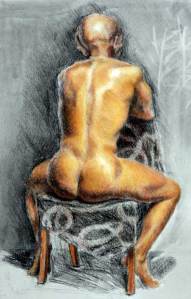
SeatedLongPose
Pastel pencils, charcoal, chalk on toned paper

This pose, drawn at the Atelier School of Classical Realism in Oakland, took about 10 hours. I still have a few hours left (without the model) to “finish” the picture.

It’s very difficult to find a long-pose life drawing session that I’m able to attend the Bay Area. Most evening life drawing session poses max out at 20 minutes; a pose that lasts many hours, like the pose I drew here, seems to interest few evening artists. In our hyper-cyberspaced out world, even artists rush around like roadrunners on amphetamines.

And this style of drawing is unpopular these days. In my head I hear an art teacher I know saying, “your drawing is too fussy, too lifeless.” And on some levels I would have to agree with him. But during the course of this long pose I learned so much about color, form, proportion. It gives me a foundation for the next long pose, and hopefully that one will look  more free and less precious, because of the long pose, and not despite it.

Quick color temperature

Pastel and chalk on toned paper

This year at the atelier I learned modeling using color temperature—we used a limited palette of 4 earth-toned pastel pencils, charcoal and white chalk, and toned paper to create form and shadow.

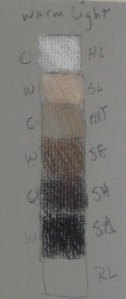
This method is about intellectualizing your drawing. It’s about making a conscious plan rather than just grabbing a color and hoping it will work. We drew value scales in color to denote the color temperature of highlight, strong light, midtones and shadows, paying close attention to warm and cool color temperature and where it was placed in the scale. This is agony for me. I don’t do it well. Scales suck.

Since I am also a musician, I know the value of scales. I think of them as athletic training, like the drills that prepare the football player for that winning 100-yard dash. Playing scales prepare the musician for a blindingly brilliant set. Playing the actual notes become muscle memory, the body goes on automatic pilot and the musician’s  intuitive brain is free to choose the music she hears in her head.

I figure it must be the same for the style of painting I’m yearning to do. Once I’ve internalized color temperature theory, I’ll be more able to make intuitive choices that are based on logic.  That’s when I think true creativity can emerge.

Value chart for warm light

So I drew value scales religiously for each of my drawings this year. They helped. It’s surprising how far astray you can go from your original values over the course of a long pose. I leaned heavily on those value scales to re-orient myself and to overcome frustration. I know I frequently muttered things like, “strong light is cool. Cool, dammit!”

But on the last day of class this year I decided to whip out a drawing using the color temperature principles without agonizing over a value scale. The drawings at the top of the post were of ten minute poses each on toned paper. I did have to write the color temperatures down so I could remember which shadow was cool, which highlight was warm, but I didn’t need to draw a value scale. I was pleased that the concept is beginning to integrate into the way I choose color.

The question of perfection

Fluteplayer <br />  <br>© 2009 Margaret Sloan<br /> <i>Graphite </i>
Flute player © 2009 Margaret Sloan

I’ve been working on this painting for something like a month now, doing color roughs and composition studies. Of course, I don’t work on it every day (the day job, much as I love it, cuts considerably into time for painting and drawing), so I have some (lame) excuses for my slow pace.

This is the drawing for the for the final painting.  It’s given me quite a lot of trouble, because I have been picky about it. Teacher Steve has said, “you’re splitting hairs. I know that’s your working method, but you need to get on with painting!” I know he’s got a point: the piece can get too precious. But I know also that I need to get the base drawing right in order to convey what I have to say in this painting.

First of all, I needed to get the tilt of the flute player’s head as she bends forward to meet her flute. The head is down, the chin tilted to the left, and the body curls around the instrument. (This  flute posture is actually a position I’m trying to modify in my Alexander Technique classes, as playing the flute tends to give me terrible stiff necks and headaches.)

I struggled until I was ready to bite the pencil; the drawing kept looking like a profile, until Steve pointed out that when you look down on a persons face, there are certain cues that tell us the tilt of the head. The brow line curves down  and covers the top of the eye. You can see more of the inside of the bottom eye lid. And you can see more of the top of the head. Yeah, I know that already, but sometimes we’re blinded to the simplest mistakes while drawing. I made those changes, and—shazaam!—the tilt was there.

I also want to convey her age (young) which means her features are rounded, slightly blunt, and soft (I’ll use color also as a symbol of her age, when I do finally start painting). I had to measure the drawing carefully, because her chin and nose kept growing in the drawing, giving her that kind of solid jaw-bone look of grown ups.

But the most important thing I want to convey is the way she’s  listening hard to the tune in her head and reaching into her flute to pull out the music and send it into the world. That’s going to be the magical thing that makes this painting work.

This is to to be a larger size painting than I usually work in, on 12 x 16 Arches watercolor block—blocks being the easiest thing to schlepp back and forth to the Pacific Art League watercolor class, where I do most of my watercolor painting.

Peaking at 50

California

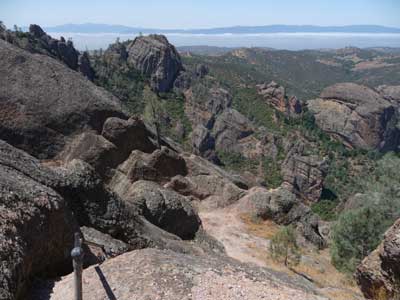
After climbing the steep trail all morning, we missed the fork that would have taken us to the completely tame (or so I was promised) tunnel trail. Now we were high on the mountain side at Pinnacles National Monument, looking out over the state of California all the way to the foggy coast, and the trail only led higher.

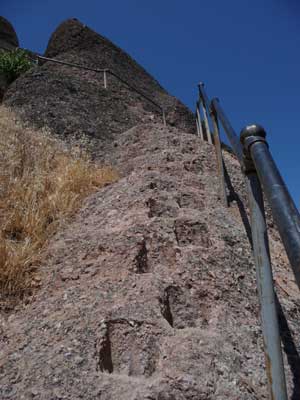
TrialWe clambered around a corner and suddenly we stood at the base of a cliff. Footholds chipped into the rock face marched almost vertically into the sky. There was nothing but the rock, a pipe to cling to, and the air around it.

“Oh my god,” Jo said. “Do you want to go back?”

Camping buddy Jo, who is smart, brave, and intrepid, knows well that as I suffer from an inexplicable terror of heights. This fear is something new that has come with the years. Altitude never bothered me when I was a kid; at 12 I would have scampered right over that mountain face. Twice.

But now,  here I was, two weeks before I turned 50, having a hard time staying calm looking at the crazy steep trail. Maybe you know the feeling: your intestines crawl into your chest and cling to your lungs so you can’t get a breathe, your head gets woozy, and suddenly the only thing you can feel in your hands is a cold sweat.

To be honest, my upcoming birthday, the big 50, is making me feel woozy like I’m standing at the edge of a cliff.  I’m amazed at how two little numbers—a 5 and a 0—can open the door to anxiety and actually send out stamped invitations to an open-bar, fully catered worry affair, complete with band and disco ball. (Ok, ok, I’ve always had a worry party going on in my head. It’s just gotten more crowded as I—gulp—age).

In our culture that’s dirty word—age. Yes, yes, I’ve heard that 50 is the new 30 (Frankly, I’d be happy to see 40 again). Sure, Jamie Lee Curtis received applause for going topless at 50.  And I’ve read that employers are starting to value those of us who have more experience than we have collagen in our lips.  Even Barbie has lost only a smidge of popularity despite reaching the half century mark..

But I live in Silicon Valley, where we worship youth. And why wouldn’t we? The young are so lovely, so luminous. They don’t have years of living that cover the inner shine with a dusty layer of experience.

And I think they’re mostly not afraid to climb over a mountain peak.

Up on that mountain, I had to think hard. I thought over the trail we’d just climbed. We’d huffed and puffed up the Condor Trail (no condors to be seen), then wound our way around and up the side of the mountain. We had to clamber up and down steep rocky bits lined with poison oak. And Central California in May is already hot like summertime; we’d started hiking at 8 that morning in shirt sleeves, and the day wasn’t getting any cooler. The trail was on the west side of the hill where the afternoon sun would be blazing. Did I really want to descend the mountain  using the same trail I’d ascended?

I remembered my grandfather’s motto: Always go home by a different road. Never backtrack.

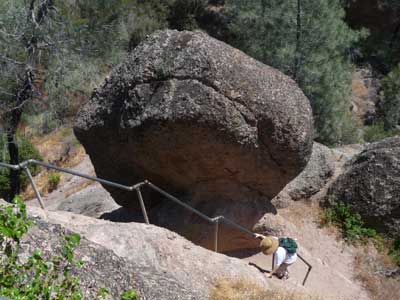
ClimbingI clenched my teeth. Wiped sweat from my eyes. “Jo,” I said. “We can’t go back. So we gotta go forward.”

And I climbed that mountain, dammit. White knuckled it all the way, pressed on even when I felt like I was so exposed that I was flying. Jo talked me over the really scary bits, and both of us slid down one entire passage on our butts.

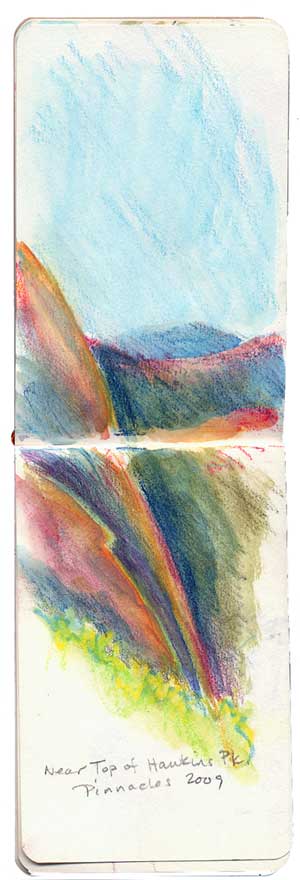
I’d like to say that I felt victorious and renewed afterwards. I guess I did, a little. But mostly I was tired and hungry. And needing to paint something. Out came my little hiking journal, a waterbrush, and a afew Caran d’Ache watercolor sticks. I rested in the shade, ate a tortilla with hummus, and did what any artist at any age might do. I painted a picture of the mountains.

Pinnacles

The big stretch

elephantSometimes trying to be an artist is a big stretch.

The music in your bones

Watercolor color study

Last night after the session wound up, after the last Irish jig and reel danced out across the floor, after the last polka whirled by and the last hornpipe bobbed out for the night, after the flutes were swabbed  clean and the fiddles wrapped and stowed in their cases., we musicians fell to talking a bit about Irish music.

We talked about how we came to this old and eccentric style of music in this land of pop melody and commercial jingles. Nearly every person at that party came into the music during a crisis in their life (many of us, it seemed, found it while ending a bad relationship). We found solace in the music, friendship in our instrument. “When I feel down or troubled,” C. said, “I tell it to my fiddle.”

How well I know that type of long conversation with my flute.

Not everyone who comes to Irish music is an emotional refugee looking for comfort. Some are lucky enough to have been born into the music, and wise enough to continue playing their legacy. Others just enjoy the intellectual exercise of learning stacks of tunes. And most of us love the camaraderie and community that comes from playing this music with others.

But I’d wager that for lots of musicians, the music is more importantly a place of comfort and safety. The familiar tunes are like favorite stories  we tell ourselves when we’re happy, scared, bored, or sad.

No matter our level of competence, just to sit quietly by ourselves and play this music is to have a relationship with the tunes and with our instruments that is as deep and serious as our relationships with our spouses, our children, our parents.  I guess because ultimately, it’s a relationship with ourselves.

Late at night we dream of mice

Symbols in the wee small hours
Dreaming of mice
© 2009 Margaret Sloan
Graphite

I watched a lot of b-grade horror flicks when I was a kid. My dad loved Creature Features, and he and I would stay up late together watching the old movies. We didn’t agree on much else in those days, but we both loved Dracula.

The thing the mouse is pulling is a symbol. It appeared in a dream that woke me very early one morning. I’m well acquainted with the small hours of the morning; I’ve never slept soundly, and I wake often. Not because I want to, but because anxiety drives me from the mattress  to the drawing table. It’s a perfect setting for a monster movie scene.

I imagine this frantic mouse is bringing light to a corner of an old stone kitchen. Christopher Lee has just commanded, “Light, quickly! She’s fainted.” The beautiful ingenue is slumped gracefully into a carved wooden chair. The mouse sits up,  chittering in worry while dreadful shadows leap across the kitchen walls. They assume shapes we can only just recognize. She wakes, screams, then faints again. A window bangs open. The candle is extinguished by a damp wind.

Cut to a commercial.