The practice of music and art

Pastel pencil on colored paper

This is a small drawing I made of my friend Cyndy. It’s from a photo taken as she was sitting around a campfire, playing tunes with a group of musicians.

I know Cyndy’s present teacher. He’s told me that she’s the kind of student a teacher loves to have. She really thinks about the music she plays, and she makes him think about it too. And she practices!

She’s passionate about her fiddle in the way most of us are passionate about a new romantic partner. But, come to think about it, I know a lot of musicians who are married to their instrument, and playing music is simply part of their everyday experience. I also know artists who feel the same way about their art. (I’m torn between the two. Do I play tunes, or do I draw? Tough question, that.)

Sometimes playing music or making art becomes a stale thing, or a stressful thing, fraught with needs and cravings that block the joy of our passions. But if we really think about what we’re doing, and lose ourselves in the process, suddenly the work becomes play, and we amaze ourselves at our success.

Shannon Heaton, one of my favorite Irish flute players, has a terrific blog at Whistle and Drum called The Inner Game of Irish Music about practicing the music. She’s talking about Irish music, but she could be talking about drawing, painting, old time music, classical music, dancing, or even just plain-old, everyday work.
Framing the figure

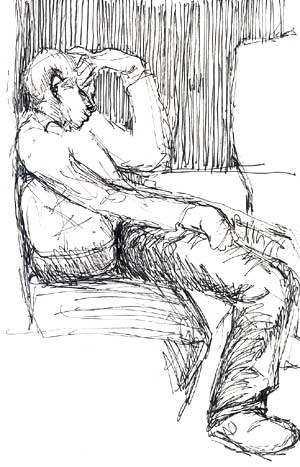
BoyonTrainThis drawing I completed after visiting the Vermeer Milkmaid exhibit at the Metropolitan Museum of Art. What luck to be in the city while the Met had a special exhibit about Vermeer. I was able to study the paintings in real time, and try to understand what made them work.

I wish I could live in that museum (I loved From the Mixed-Up Files of Mrs. Basil E. Frankweiler when I was a kid), but, alas, they will not let me. So whenever I visit New York, I spend as much time in the museum as possible, sketchbook in hand, trying to infuse my brain with master works. I don’t always understand what I’m learning while I’m at the museum, but somehow it ferments in my brain and bubbles to my conscious mind later.

One of the things that I noticed in Vermeer’s work was how he often framed the figure with geometric shapes. In A Woman Asleep, he frames the face of the young woman with a gray square. He often uses a wall hanging of a map as a geometric element that frames the subject—look at Young Woman with a Water Pitcher, Woman with a Lute, and Woman in Blue Reading a Letter. (Incidentally, if you’re interested in Vermeer, The Essential Vermeer is a terrific online resource.) But it really didn’t make a big dent in the attention I was paying to Vermeer’s color and brush technique.

But I must have filed this bit of framing arcana on top of one of the piles of information cluttering my mind, because it surfaced later that evening. After a three hour stretch at the museum, I tiredly took the train back to New Jersey where we were staying. I sat across the aisle from this young man who was trying to sleep, and took out my sketchbook to capture his lanky pose.

Suddenly I realized that it wasn’t his face (I could scarcely see it), or his figure that attracted my attention, but rather, the way he was framed by the dark of the window and the back of the seat. Light bulbs went off in my mind. This was what Vermeer was talking about when he use a shape to frame his focal point!

It’s a simple sketch, but it pleases me because it reminds me that I’ve discovered a new way of seeing.

Visiting Olana and the Hudson River

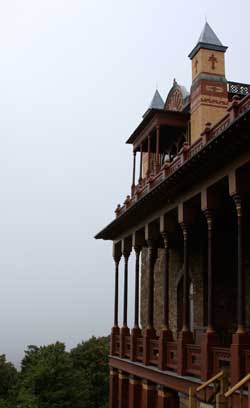
OlanaWhile in upstate New York, we managed a quick visit to Olana, the castle-like home of Frederic Edwin Church, the 19th century landscape painter.

I’ve long admired the Hudson River School of painting, a style that celebrated nature, and especially the landscapes of the New World. During the 19th century it was hot stuff, but it fell out of favor when those darned impressionists brought their pastel-colored personal impressions to the art world. Fauvism (along with modernism) has ruled the art world for the last 100 years, but I think people are rediscovering the realist painters of the past.

Church was one of the most famous of the Hudson River School, known not just for his famous iceberg paintings, he but also paintings of the dark brooding Catskill forests and luminous skies reflecting in the shining Hudson River. Alive when artists could attain rock star status, Church was a box office draw. He also came from money, and had wealth at his fingertips.  So he built a beautiful, over-ornamented home on a hill top overlooking the river valley.

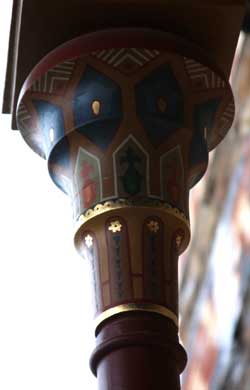
OlanaDetailOlana is a sort of homage to a Victorian-era Persian fantasy. There are Middle-Eastern motifs everywhere you look, right down to fake-Arabic script on the wall panels. Once breathtakingly colorful (Glittery silver and gold decorative painting on the door! Bright yellow drapes! Burgundy and green velvet furniture!), the colors have faded to the muted tones we associate with old photographs.

I have to admit, it’s a little like visiting the Winchester Mystery House in San Jose. It’s a bit over the top, and it’s hard to imagine people actually living and visiting amidst the ornamentation. But how prejudice against decoration are my 21st-century eyes, having been trained and honed by the naked lines and sparsity of mid-20th century modern?

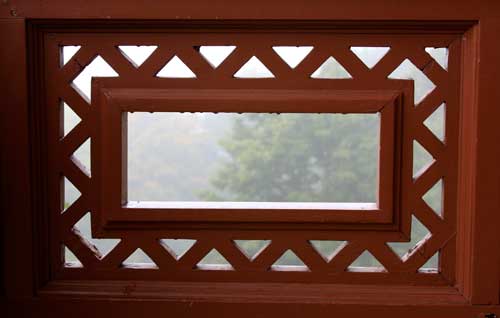
The Victorian era was all about ornamentation, and Olana is a tribute to that design ethic. But more than that, the house is a series of frames for the surrounding landscape. Church wanted the house to frame his beloved Hudson River Valley, and every window and door opens on some incredible view (Unfortunately, a storm obscured the vistas when we were there, and so we only had more intimate views). Even the ornamental balustrades frame views in miniature.

OlanaFrame

It’s something I need to learn more about, this framing of the landscape. Too often I begin drawing before I’ve properly figured out the design of the landscape I’m trying to paint. Then I am overwhelmed by the whole thing and my painting (and my mood) falls apart.

Llamas in New York

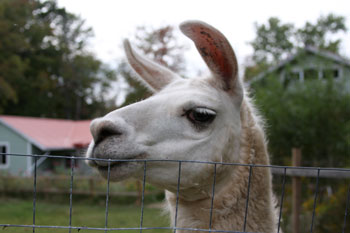
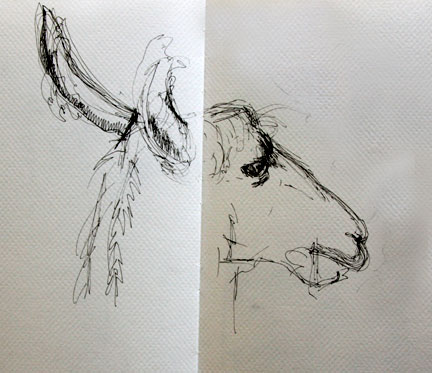
Llamas

To be honest, one of the only reasons I chose to stay at Clove Cottages (near High Falls in upstate New York) was because of the llamas. They have two, Sugar and Cocoa. If they’re curious that day, and you look interesting, they’ll come up to the fence and whiffle softly over your face. They don’t much like petting.

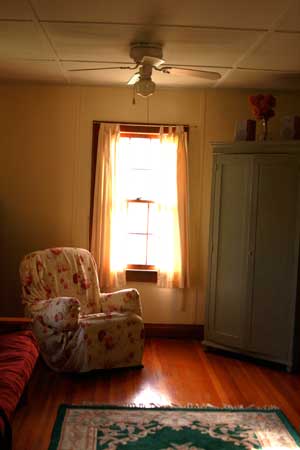
The cottages are very sweet, although a little funky. But what can you expect from buildings that are nearly 80 years old? The floors slope, they smell of old wood, and they are thoroughly charming.

Clovecottage

The llamas have been great fun to draw.

Llamadrawing

Vacation journaling in a sardine can

InsideAirplaneThis was done rapidly in pencil on a packed cross-continental flight for New York. You can barely draw on a flight like this. There’s no elbow room at all; there’s barely room enough to get your pencil and sketchbook out. There’s not a centimeter of extra space for your sketching arm.

Airlines have been packing flights full these days and I guess to make up for the relatively inexpensive airfare, we had to pay by sitting arsehole to elbow with the 169 passengers that a 737-800 seats.

2 bathrooms for those of us in steerage…I mean, coach. The passengers in first class had their own bathroom. Hidden behind a drawn felt curtain, they might have been engaging in the kind of rich people-on-an-airplane debauchery that those of us mashed into the rest of the airplane could only fantasize about. Like getting up and going to the bathroom when they needed to, rather than  planning ahead as if going on safari.

But in the back of the plane, our 2 bathrooms were fair busy. And 20 minutes after the flight attendants bustled through with the refreshment cart, doling out fizzy drinks and weak coffee, it got worse.  Imagine roughly 140 people hearing nature’s call to action in the same 10-minute period. At times, the gotta-go line stretched more than half-way down the aisle.

And that aisle was narrow. Exceedingly so. And here, dear reader, I’d like to make a plea.

People! When you’re waiting in line for the potty on an extremely crowded airplane—and believe me, I know it’s exhausting. I’ve been in that line too. But I don’t care how tired you are—please don’t rest your huge squishy bottom on my shoulder. Don’t rest it on anybody’s shoulder. Especially if said bottom is clad in a worn pink sweatsuit.

And if you do, be aware that some of the folks you’ve rested on might not be as polite as I am.  Some might be inveterate sketchers,  and upon seeing  that expanse of faded pink jersey, might possibly be overcome with the urge to sketch. The person on whom you’re leaning might just whip out their Tombow brush pen and sketch a little scene on your rear end.

Fear of sketching

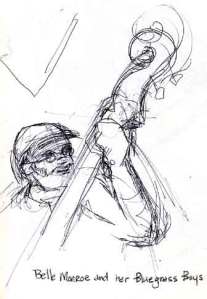
Sketch from Good Old Fashioned Bluegrass festival. While I was sketching, the woman sitting next to me struck up a conversation, and told me how much she enjoyed watching me draw!

WordPress somehow keeps track of search terms folks used to get to my blog. One of the most frequently searched terms is fear of sketching in public.

I’ve written about being afraid to sketch in public before. I am constantly trying to overcome this fear, and apparently, I’m not the only person shy about public sketching.

I’ve been working on solving this problem, because one of the things I really want to be able to do before I die is sketch freely in public, with no shame. If that’s your goal too, here are some suggestions that have helped me.

  • Take some classes to improve your skills. This is top of the list. I’ve studied figure drawing with Rob Anderson at the Atelier School of Classical Realism for 3 years. It’s improved my skill level to the point where I can sketch people and have them look like people. That has allayed my fears incredibly.
  • Plan your sketch trip as if it were an expedition to an exotic country. Expeditions are hard. They are arduous. They can be dangerous. They are adventure that takes a lot of effort, so think ahead. Select your materials with care. Decide where you’re going (make a map if it helps you). Know how you’ll provide for your basic needs (what you’ll eat, where you’ll be able to go to the bathroom.) Once you’re on your expedition, be curious, look around you, document the expedition with sketches to describe the customs of the natives.
  • Choose places where you can sketch in obscurity. At first, it helped me to sketch in large public places like parks, where I could sit on a hillside with my back against some bushes (so no one could creep behind me and look over my shoulder at my drawing). I drew people who were far away, so they didn’t get self conscious that I was drawing them. I could have been drawing them, the view, anything. And I did draw them, the view, anything.
  • Pretend you’ve got no choice. When I went to the Good Old Fashioned Bluegrass festival, I pretended that I was on assignment for a brutal editor and had to come away with ten sketches. I just didn’t have any choice. I had to do it. The sketches didn’t have to be particularly good, but there had to be 10. That worked for me, as I’m used to deadlines and assignments.
  • BassplayerKeep it simple. Don’t try to create a masterpiece. That’s way too much pressure. Draw stick figures if you must. Anyone can draw a stick figure. Try just to get the action or composition down using stick men as shorthand. Stick figures are amusing, and a low commitment for the artist. Later you can hang skin and clothes on the little figures in a place where no one can look over your shoulder and criticize. Same with a landscape. Just try to get the bones of the landscape. Don’t worry about drawing every bush, tree, or leaf.
  • Remember that people don’t see your work the way you do. We artists tend to be our worst critics. We see flaws; others see beauty, or effort, or the coolness factor that you’re an artist.  They may even be thinking, “gee, I wish I had the courage to do that.”

Kiss a bee in the morning

A few weekends ago I visited some friends who live way out in the country in the Sierra. They’ve got a beautiful place that’s fully off the grid, and far from any  highway.

After an evening of music (Richard plays the flute, Lynn plays the banjo) we dragged a big foam pad onto the lawn and Lynn and I slept out under the sky.

SleepingOutside

At first I was sure I wouldn’t sleep. It was too thrilling. I could feel the earth living under me, and all around me. The moon was whitely bright (I had to cover my eyes with the quilt), and down the valley two owls hooted at each other. Tree frogs sang. They startled me. I’ve lived in Sili Valley too long and forgotten what tree frogs sound like.

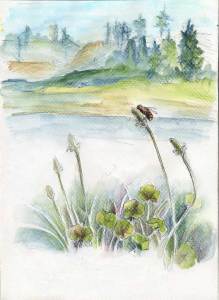
At dawn the sound of a bee buzzing in my ear woke me. She was scarcely 6 inches from my head, clambering over the blossom of a plantain. From ground level I looked across the lawn and saw hundreds of bees—honey, bumble, and black—all working like little flying field hands. Waking on the lawn was easy and natural.

BeeonFlower

It was hard to come back to Bay Area, where the only creatures I hear at night are police sirens and the neighbor blowing his nose (and sometimes snoring in big honking grunts). I can’t sleep outside in the city; the neighbors would be able to watch me (that’s creepy), and the rats in the backyard might chew on my nose. And sometimes scary people frequent our neighborhood.

But many nights as I wrestle with wakefulness I wish fervently that I could sleep outside. Ah, I think, if I could just take a blanket out under the apple trees and stretch out on one of the lawn chairs. If I could feel the connection to the earth that comes from being outside and in the night time, then perhaps I could sleep. And if I didn’t, would it matter?

I don’t have a sleeping porch or an isolated birch tree to sleep under, so I have to make do with sleeping next to the window and feeling the air as it tumbles into the room. If the neighbors turn out their lights (which shine in my window), I can open the blinds and watch the tops of the trees in the back yard. That will often help me sleep.

But in the morning, instead of bees buzzing gently next to me,  I waken to NPR blaring on the radio. The news is the only thing that will launch me—still half sleeping, but ranting and fuming—from bed. While I eat breakfast,  I hear  crows hollering back and forth and squirrels thudding across the roof. In spring, occasionally a mocking bird will sing. But it’s not enough to cross the divide of modern life and put me at peace.

How do you live in an land of concrete and apartments and still keep in touch with the earth?

A fiddle is only as good as it plays

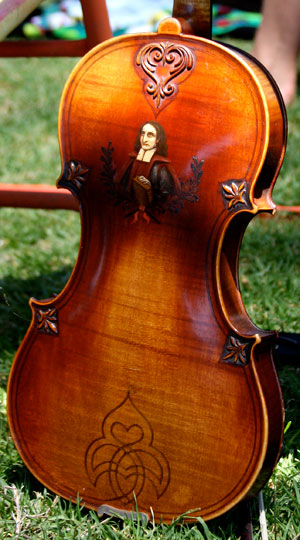
VuillaumeBack

This  fiddle I saw at the Good Old Fashioned Bluegrass Festival. The lady bought it in the 1970s. She thought it was a Vuillaume. Maybe.

VuillaumeBackCl

The name Vuillaume could mean anything. It’s like finding a fiddle in your grandmother’s attic, peering through the f-hole and seeing a  Stradivarius label. Probably not a real Strad. Lots of people have made lots of money selling instruments with phony labels. And musicians tend to give their instruments distinguished pedigrees.

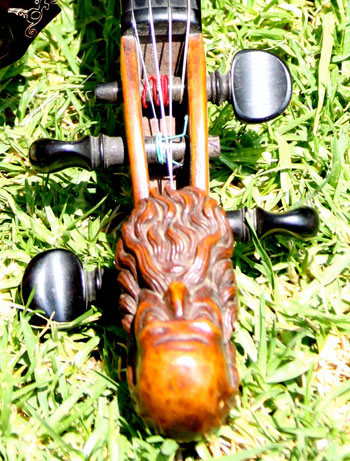
VuillaumeScroll

But whatever this fiddle’s ancestry, it is a lovely piece of work, with a beautifully carved scroll, and cunning carved corners on the back, and Celtic-looking purfling. The scroll does place it sometime during the 19th or early 20th century—a time when ornamentation was popular on all things, and ornamented scrolls decked out many fiddles.

I’m not a violin connoisseur, so I didn’t know enough then to look closely at the painting on the back to see if it is inlay, painting, or both.

The most important things about a fiddle are how it feels when you play it, and how it sounds. An instrument can have the beauty of Grace Kelly, but if it shrieks like a toothless angry old witch, then it’s of no use.

The owner of this fiddle treated it with the casual attention you’d give a favored pet. It sat next to her as she sat listening to the music. She carried it around, cradled in her arms. She loved it. She said it had a great sound.

That’s all that’s important.

Harmon’s Peak

Tombow brushpen and waterbrush
I drew this while Harmon's Peak sang Buffalo Gals, a song from the 19th century that's still a terrific song in the 21st century.

The best part of the Good Old Fashioned Bluegrass Festival was the jamming that took place after the amplified music stopped. There was music all night long—of course bluegrass, but also old time, blues, jazz, and a group of folks having a dance party while they played bluegrass tinged Beatles, R&B, and disco. By 1 am I was exhausted, and I drifted off to sleep under a nearly full moon, hearing banjos, fiddles, guitars, and stand-up bass in the campsite 3 spaces over. Sheer heaven.

The amount of talented folks in everyday life astounds me. People go crazy for superstars, but there’s a lot of people out there who are top-notch musicians. They might even be living next door to you!

The next morning my husband’s band, Harmon’s Peak played. They’re an old time string band, which is a different style of music, but it’s part of the roots of bluegrass. As you can see, they’re the best dressed old time band in the Bay Area.

Harmon's Peak
Harmon's Peak