Moffett Hangar 1: Still with Skin

Image

Moffett Hanger 1: Still with Skin
Oil on panel
Copyright 2011 Margaret Sloan

This fall I had the good fortune to be invited to a paint-out at Moffett Field. I chose to paint Hangar One, the gigantic house for the USS Macon, an airship so huge that even now, in this age of miracles, that it boggles my mind to imagine how big it was.

Hangar One loomed over my childhood landscape, although only from afar, as we weren’t  a military family, and in those days it was forbidden for non-military to visit the base. But it was a landmark that we always remarked on when coming home from vacations in the Sierra, and my dad, who’d actually done some work in the hangar always exclaimed, “that thing is so big, they’ve got their own weather in there!” It is big; see the little door at the bottom right of the painting? That little door is about 10 feet tall.

These days it’s possible for civilians to visit the base and get up close to the hangar. This painting is on view (along with other paintings and drawings) at the Moffet Field Historic Society Museum as part of an exhibit honoring the 70th Anniversary of Pearl Harbor. The exhibit lasts until January 7th, so there’s still some time to see it if you’re in the Bay Area. It’s a very interesting museum; make sure you leave time to get a tour from one of the docents!

English: USS Macon docked inside Hangar One at...
Image via Wikipedia USS Macon docked inside Hangar One
The USS Macon inside Hangar One at Moffett Fie...
Image via Wikipedia USS Macon docked inside Hangar One

St. Stephen’s Day

Yesterday we spend Christmas on the San Francisco Bay. It looked rather like this, although this painting was actually painted this summer, under Felicia Forte’s tutelage.

Baylands
Oil on panel

It was a bright, hazy day yesterday, another spare-the-air day, so we couldn’t see through the smog to the mountains across the bay. But we knew they were there.

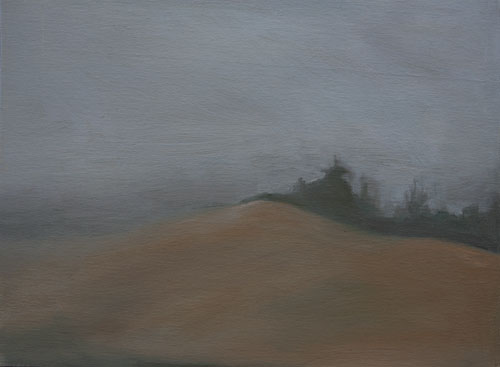
Today looks like this:

Fog study
Oil on Panel

It’s a foggy, muzzy morning, and I’m taking a good rest before the Wren Boy madness that tonight will bring.

Happy holidays to all, and may you have a good winter rest sparked with late night music and dancing!

Edges


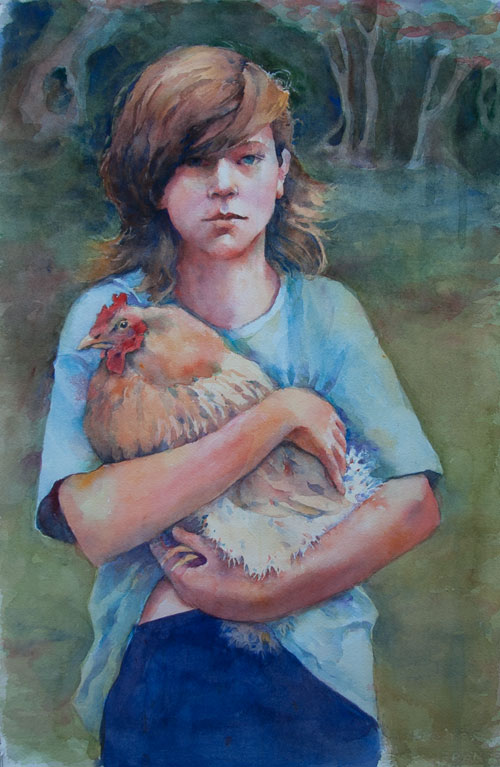
Boy with Chicken

Watercolor
Copyright 2011 Margaret Sloan

I met this young boy at Hidden Villa one late afternoon. He was with his family, looking at the chickens. Suddenly he scooped up one of the hens and cradled her in his arms. She didn’t seem to mind.  I asked if I might take a photo of him. He nodded silently, so I snapped a few photos. I wish I knew who he was so I could give him and his folks a copy of this.

I made this painting after taking Ted Nuttall’s watercolor workshop. If you compare it to the painting of the fiddler that I finished before the workshop, I think you’ll see a lot changes and improvements. At least, I can see them.

In past paintings, I’ve worried the paint to death. I’ve tried to make every transition smooth, and ended up making everything is bland, and even, and lifeless. Ted’s workshop made me finally see that what was missing were edges (although other art teachers have preached edges to me, I evidently wasn’t ready to hear that painting gospel). When I did paint edges, they were too abrupt, unsubtle, unsophisticated.

Edges are important. They give a painting movement and life, tell the story, sing the song. Hard edges can describe a fold, a crease, or the boundary of a cast shadow. Soft edges show a rounded structure, a form shadow, or a distant horizon. Between the nounage of hard and soft edges, there is a whole visual dialect—a spectrum—of edges that make a painting speak with nuance and grace.

When I think about edges in a painting, I’m always reminded that in nature, the edges of eco-systems are the places where life is most abundant. And now, when I paint, I’ve been trying to remember that edges are ok; they are, in fact, necessary to the life of the painting. Edges are where things happen.


Face—Detail of Boy with Chicken

Feathers—Detail of Boy with Chicken

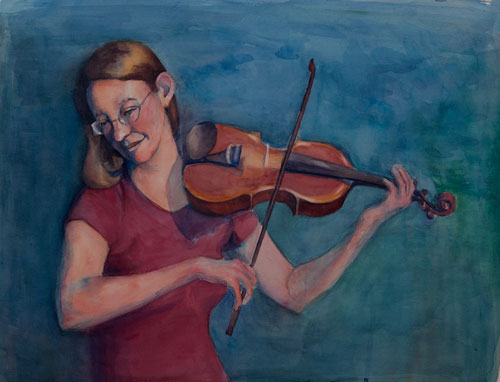
Fiddle player

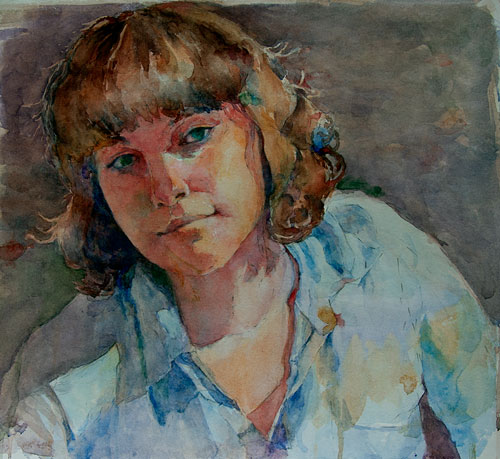
This portrait is on Arches print paper. I inherited this beautiful paper from a friend whose father was an artist. He’d passed a long time ago, and when they finally cleared out his workshop, they found a stack of this lovely paper that probably dates back to the 60’s. Isn’t that an artist’s fantasy—to find beautiful, antique paper from a time when craftsmanship still ruled the day?

I love to draw on this paper, and small sizes worked okay with watercolor. But this painting is big—a full sheet of paper, 22X30—and there were some issues.

Paper for letterpress printing has less sizing than watercolor paper, which makes the press paper lovely and soft, but without the sizing to protect it, the paper sucks up the paint. Plus,  even though I stretched it and stapled it firmly onto a board, when the paper got wet, it got all floppy like a wet cotton sheet. But it dries nice and flat. The painting is still on it’s stretcher board, and I may rework it a bit.

This was painted before I took the Ted Nuttall workshop. I now refer to this as my BT (before Ted) style. Next post, I”ll show you my AT (after Ted) style. Very different.

More about sizing

http://www.arts-in-company.com/paper/additives/sizing.html

http://www.trueart.info/sizing.htm

More about paper

http://www.handprint.com/HP/WCL/paper1.html

Round the house and mind the easel!

Playing for Set Dancers
Graphite

My band has been preparing for a gig. We recorded a tune, and when I listened to it, I was horrified to hear a tempo as ragged and floppy as an old stuffed bunny.

I play Irish flute, specifically dance music. I love the rolling beat, the pulse of the tune lifting and driving dancers through the set. The beat needs to be crisp and perfect to move the dancers.

But that what wasn’t what I was hearing in our recording.

So I’ve spent the last week practicing with a metronome, first lilting the tune in time with the flashing red LED, then trying to match my flute playing to that maddening strobe.

It’s amazing how that little pulsing light seems to slow down and speed up as I play a tune. At first I thought there was something wrong with the metronome, but of course, there’s nothing wrong with the electronics; it’s my playing that’s uneven. But gradually I’ve managed to tame my out-of-control tempo, and the tunes sound all the better for it.

Painting isn’t like playing a flute, but visual arts don’t exist outside of tempo. I think that paintings have their own internal tunes. My favorite paintings are those that make my brain feel like I’m seeing music. Sorolla paintings play tunes to me. Zorns are full of music. Sargent is something like a symphony. Surprisingly (because I prefer realistic work) Paul Klee paintings are like small pipes and fiddles.

I find that external noise while I paint influences a painting’s tempo. My most successful paintings are done in silence, when I really listen to the painting and pay close attention to the pulse that each passage requires. I listen carefully to hear fast strokes that are well conceived; slow shapes of color placed just exactly where they need to be; staccato or slurred edges; the pacing of high and low values. I’m always asking myself, how do I encourage the viewer to dance through a painting?

When I paint, there’s no steady tick-tock of a metronome, other than the drum of my blood and the deep sound a painting makes when it’s making my heart dance. Only if my heart is shouting “house Maggie, mind the dresser!” will I have a chance to let others hear that internal music.

Painter, have no fear

Before the Big Adventure
Watercolor from Ted Nuttall Workshop

Copyright 2011 by Margaret Sloan

In early fall I took a week long watercolor workshop with Ted Nuttall, one of my favorite watercolor painters. Ted is a marvelous painting coach, and I feel like the workshop changed some important circuitry in my painting mind. Ted said that one of the things he hoped to accomplish in this workshop was changing the way we think about painting. I was looking for a change and I was an easy mark; he succeeded.

The most important thing I learned? Do not be afraid. Go ahead and make mistakes. In fact, Ted says he often purposely paints unexpected colors, streaks, daubs, dribble, and of course, his famous “sloppy dots” in order to give himself problems to solve.

Watching him paint is like taking a roller-coaster ride. (Yeah, I know, painters are easily thrilled). Some strokes made me gasp in fear—I’d never make that kind of mark deliberately—but Ted deftly tied it in to the rest of the painting as he moved along.

I’m not quite brave enough to deliberately make mistakes. I make enough accidental problems to solve in the course of a painting. But I think the answer to that is to make more paintings, and learn from all those accidental mistakes.

More painting? That’s never a bad pursuit.

Chicago Irish interlude

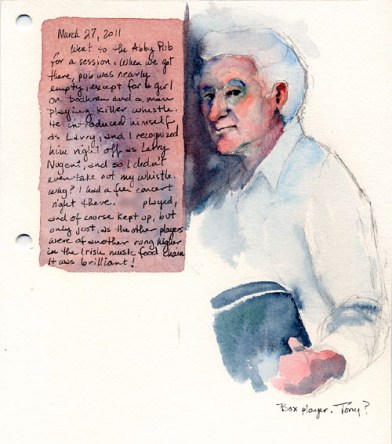
Box player at the Abby

A visit to Chicago would have been incomplete without attending an Irish session. The Chicago Irish music scene is legendary. My fiddler said this was the one thing he really, really, really wanted to do. I, of course, was not against this idea.

We found the Abby, where, when we walked through the door,  we were astounded by the most amazing whistle playing.

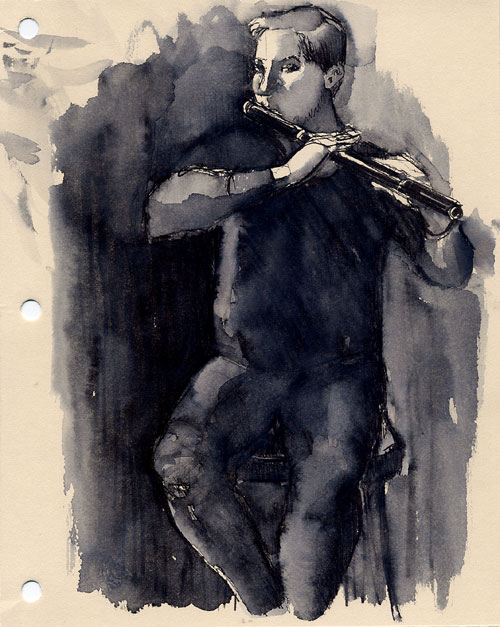
It was Laurence Nugent, a top Irish whistle and flute player. Pretty cool.

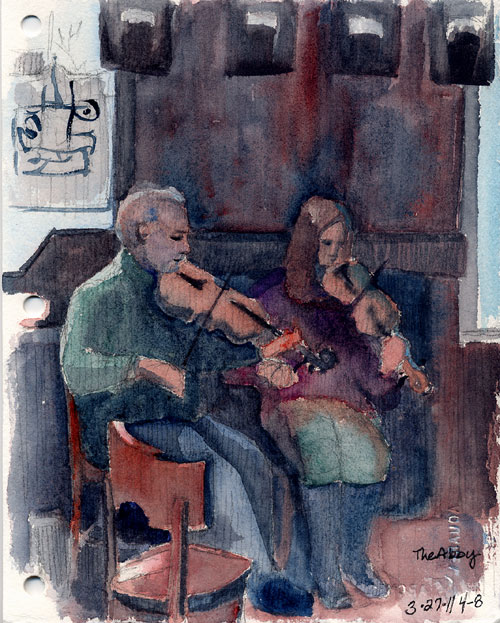
At the Abby

If I’m shy about drawing in public, sometimes I’m even more shy about playing music.  I couldn’t see taking my whistle out and squawking  around on it like a wounded ostrich when there were musicians who were roaring like lions. Instead, I sat at a table, had a beer, and listened to ripping reels, jigs, and hornpipes while I painted. Listeners are an important part of a session too!

I leave you with this video.

Sláinte!

Laurence Nugent

Public sketching and the flame of desire

I’m relatively new to the sport of public painting, and I am sometimes surprised by people’s reactions when they watch me paint. Usually I get the standard “Oh, my mother, father, sister, brother paints. They’re really good.” But sometimes other emotions come bubbling to the surface, and I’m surprised by the intensity.

I made this pencil sketch at the museum restaurant (nothing but graphite in the museum, remember?), and that evening, while sitting in a crowded restaurant, I pulled out my gouache paints and watercolor brush and started adding paint.

The table where we sat was at  a choke point in the floor plan; it slowed traffic considerably.  The customers, intent on ordering tapas, didn’t pay much attention to my splashings, but the waiters did. They stopped briefly each time they passed our table to watch the progress of the color sketch, smiling and whispering to each other.

One young man was particularly interested. He asked several times, insistently, where and how I learned to do that. Then he asked if I taught classes.

“No, I don’t,” I answered. “But in Chicago there are tons of ateliers and schools.”

He grumped. “I tried a school for art once. There was to much book stuff for me. I don’t want to learn other people’s ideas, I want to do my own.”

¡Aye Chihuahua! Not like books? Not study other people’s ideas? That makes my mind reel about like a drunken turkey on Christmas eve.

I tried to keep my flabbergastment to myself, because I could see a flame in his eyes, and I didn’t want to extinguish it. I recognized that flame because I know that bit of fire. It burns inside your chest. It burns and it hurts, because you want to do something so much that you don’t even have words for it, you don’t know how to get there, and you’re afraid to even try.
A flame like that is easily blown out by the wrong word, a flippant remark, or indifference from another artist.

My step-daughter and I spent the rest of dinner  searching our smart phones for  Chicago ateliers and by the end of dinner, we had given him a list of ones that looked promising—schools that looked like they had solid programs in drawing and painting rather than a lot of theory and academics. At the end of the evening, we presented him with the list.

“Try these schools,” I advised. “I think they’ll teach you how to draw and paint. But I hope you look at art books. You’re studying art, so the books you’ll study are full of pictures. And that’s got to be a good thing, right?”

He hesitantly nodded, and took the scrap of journal paper I handed him and stuffed it in his wallet. I hope that strong blue flame I saw in him burns brightly enough to get him down to one of those art schools, do the work, and, yes, read some books.

The House of Two Urns

House of Two Urns

In Chicago we stayed at a B&B called the House of Two Urns. I sketched this view of the sitting room during the inevitable fit of insomnia.

The B&B was filled with art, but not kitschy Victorian art. The owners, Kapra Fleming and Miguel Lopez Lemus, are artists, and have hung their own art throughout the B&B, plus original paintings, drawings, and photos of and by their friends and fellow artists.

This is contemporary art, and while some of it is lyrical and lovely, some of it does not evoke warm and fuzzy feelings. Some of it is quite challenging, emotionally and intellectually. But that is why I chose this B&B, and we were not disappointed.