Learning to slow down and take a break

Airstream trailer
Airstream at camp sketch
© 2015 Margaret Sloan
Watercolor on Arches hot press #300

In the week after the Ironstone Concourse d’Elegance, we plein air painters who had participated in the event had the opportunity at the winery to display what we had painted.

I chose to opt out.

I had good intentions of submitting a painting, but you know the axiom: Wish in one hand….

I suppose I could have framed my sketches from the event. Here are the reasons I didn’t: 1. The pieces from the concourse were little more than sketches and 2. I didn’t have empty frames that size, so I would have to cannibalize an already framed piece.

Besides, I was working on three large paintings to round out my own solo show at the Atherton Library in the Bay Area. But, ever attempting to be an overachiever (and generally failing), I put show preparation on hold and spent one long evening working on the above small painting.

At the Concourse there is a group that calls themselves “Trailer Trash.” They are trailer collectors who drink cocktails in front of vintage Airstream trailers and teardrop campers circled on the lawn like Conistoga wagons. It’s a popular place to paint. In the late afternoon sun I sketched this little scene and made some mental notes while I sketched. And I snapped a few pictures with a friend’s phone (because my phone hates me and refuses to take photos).

Let me tell you. A photo taken with a camera phone in bad afternoon light is not a good reference. In fact, I find that often photos aren’t good references at all. That’s why I keep my sketchbook closer to me than a dog keeps her fleas. Thank goodness I had that sketch and my notes about the scene.

So with my bad photo, my good sketch, and my Swiss cheese memory to guide me, I painted all evening until the fiddler wandered down to the studio and wailed plaintively, aren’t you finished yet? (No, he didn’t really wail. Only his fiddle wails.) But at night he does often come to the bottom of the house where I struggle in my studio. He likes to walk me “home” (upstairs to the kitchen and living room). You never know when a mountain lion is hanging out under the deck, starving for a bite of pudgy artist.

And I have to admit to you, at that point I gave up on this painting.

There are many reasons to give up on a painting. Here are my reasons: 1. It was late. 2. I was tired 3. The painting wasn’t what I had in mind. 4. A perfectly good fiddler was inviting me upstairs for a glass of wine and some dinner.

And most importantly, I hate being rushed.

I know, we are all in a hurry these days. If something’s worth doing, it’s worth doing fast, right? And we’re all reaching for the stars, trying to achieve greatness, or at least trying to get someone to look at our artwork and expound on its loveliness. Or maybe just trying to get something painted and framed to hang in a last-minute show.

I’ve said this before: I am a slow painter. I think too much, but it’s who I am.  I need time to process and plan, to understand what I’m doing. This painting, quickly drawn and painted, was a good start for a larger, better painting. But not good enough to miss spending time with the fiddler.


On the stems of the Calaveras tomato and the importance of observation

Field sketch of Vogliotti tomato Graphite and watercolor in Stillman & Birn Delta Series sketchbook
Field sketch of the Camalay tomato
Graphite and watercolor in Stillman & Birn Delta Series sketchbook

Two weeks ago I spent the hot summer morning sketching amazing tomatoes at Taylor Mountain Gardens, the farm that supplies much of the fresh produce found at the Outer Aisle Farmstand and  Restaurant in Murphys, California. (Read about why I am drawing at this farm here.)

Owner Eric Taylor was understandably proud as he showed me the rows of these magnificent tomato plants, as well grown as everything else on this farm. The vines were big healthy mounds bearing nearly perfect classic tomatoes from pearly green unripe knobs to glowing summer-red fruits.

Originally bred by early Calaveras County Italian settlers (who had been friends of Eric and Christine Taylor)Camalay tomato is a big girl (according to Marianna’s Heirloom Seeds it can reach 2 pounds), is a pure clean red, and according to Eric, is completely suited to growing in Calaveras County.


A tomato such as this deserves its own artwork, and I’ve been working on a finished illustration to honor it (and use as a portfolio piece). I had my field sketches and a couple of blurry iPhone photos to work from.

As I designed the picture, I grew suspicious about this part of the field sketch.

Tomato_StemHad I seen that knobby structure on the stem correctly? Was it really so big? How exactly was it attaching to the tomato stem?

This week I returned to that row of big green plants and looked more carefully.

Field sketch of Vogliotti tomato stems Graphite in Stillman & Birn Delta Series sketchbook
Field sketch of Camalay tomato stems
Graphite in Stillman & Birn Delta Series sketchbook

Indeed, the tomatoes are attached to the plant by burly stems and hefty knobs; the fruit is heavy and so needs secure support. Now I wonder, do all big tomatoes have these odd knobs? I’ve never before looked that closely.

But that’s what’s so wonderful about drawing from life. Slow, careful observation reveals what is hidden from the impatient eye. Direct observation creates space for discoveries, and those revelations not only make my life so much more interesting, but they help me feel connected to my world.  Plus, my illustrations feel so much richer for being correct.

Gentle readers, your assignment for today is to look really hard at something familiar. Try to find something about it that you never before noticed, and note that in your sketchbook or journal.

Then slice a sun-ripened tomato (a Camalay if you can find one), sprinkle with salt or sugar, and while enjoying this summer treat, ponder what you’ve learned by observing what most people ignore.

In the Central Sierra look for Camalay tomatoes (as well as other varieties) at Taylor Mountain Farms booths at farmers markets throughout Calaveras and Tuolumne Counties. In Murphys, check out the Outer Aisle Food Hub or the Outer Aisle CSA.

Paintings of past lives and future projects

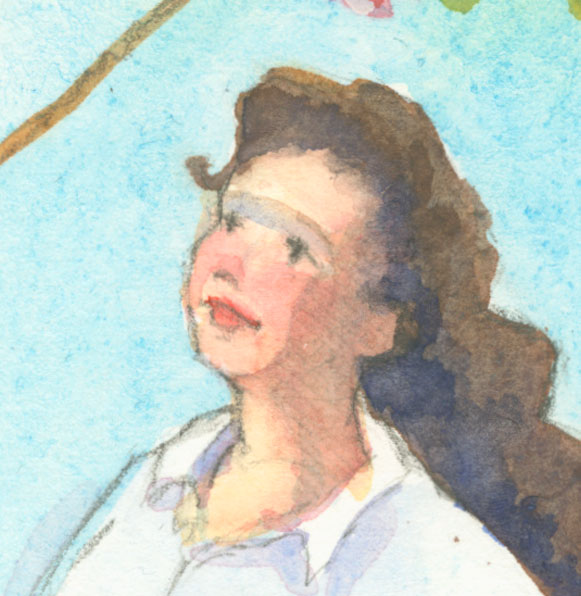
This is an experiment using a failed watercolor portrait from a life drawing session. I recently watched Don Peterson's video on how he does his remarkable paintings. He uses Elemer's glue! So I gave it a shot, as well as using some mastic to block out areas of the painting. I am not sure how I feel about this technique, nor how long it will last, but it does make the colors nice and rich. Mr. Peterson gets an almost glossy look to his paintings, and the colors glow like jewels. I will have to experiment with this more.
This is an experiment using a failed watercolor portrait from a life drawing session. I recently watched Dan Peterson’s video on how he does his remarkable paintings. He uses Elmer’s glue! So I gave it a shot, as well as using some mastic to block out areas of the painting. I am not sure how I feel about this technique, nor how long it will last, but it does make the colors nice and rich. Mr. Peterson gets an almost glossy look to his paintings, and the colors glow like jewels. I will have to experiment

Saturday I went to a studio sale for an artist that I just recently met. But in that way we sometimes have,  I feel like I’ve known him for a very long time. Perhaps he is just that kind of a person, the type of person people connect to easily. Perhaps. Some people are that way.

The gallery was full of his beautiful landscapes, a body of work that encompassed years. He is clearing out his studio, and ready to embark on a new project involving travel, video, and painting, as well as a pilgrimage of sorts to the vast wheat fields of Middle-America. If he’ll agree to share, I’ll try to write about it on my blog.

He’s been a professional painter for a long time. He took a different flight path for his life than I did, and decided he needed to paint when I was still trying to figure out what I wanted to be when I grew up. But his life, like everyone’s life, is still changing and evolving. I couldn’t help but feel sad for the beautiful paintings that he said he was going to burn if they didn’t go to good homes. A big pyre, he said, that he’ll video tape as part of his next project. An incineration perhaps, of earlier chapters of his life, in order to reinvent himself like a firebird.

I looked longingly at the paintings, sadly totting up my finances to figure a way to own one of his works. “Which do you like?” he asked. I pointed out two that I loved, for reasons of my own. “How much?” I said.

He quietly and sweetly gifted them to me.

I’m sure we’ve met before.

This post is in response to a prompt from WordPress University Writing 101: A Room with a View


The seasons of Spring

Painting of the three springs
Three Springs
Watercolor, gouache, and graphite on #140 Arches hot press


We’re in the middle of spring in the Sierra (at least, I think we are. This is my first season here, so I’m still observing). The daphne stopped perfuming the neighborhood a month ago, and the last forsythia flower fell last week. The pink and white bells of the manzanita are nearly all gone, but black oak pollen from dangling catkins dusts cars, decks, roofs with yellow powder. While some dogwoods are blooming, mine seems to be a late-to-the-party Nellie, only just now sprouting leaves. Wildflowers like lupine, California poppies, and paintbrush are in the middle of a jumble of color, and weedy poverty grass is greening up the hills.

It made me think that while we celebrate the 4 seasons of spring, summer, autumn, and winter, we don’t often mark the degrees of each season. But seasons mature, don’t they? Think of spring, going from tender buds, to full flower, to the beginning of fruit. Perhaps when Persephone returns from the underworld, she is reborn as a baby and matures into a woman as spring progresses into summer. Anyway, that’s my fancy.

Here are my three springs.

painting of early spring
Early Spring

Crocus, daffodils, forsythia, almonds, pears.

Painting of mid spring
Mid Spring

Flowering cherries, plums, and apples. Magnolia, Arctostaphylos, coyote bush.

painting of late spring
Late Spring

Oaks, pines….? I don’t know, we’re not there yet!

What’s flowering where you live? What age is your spring right now?

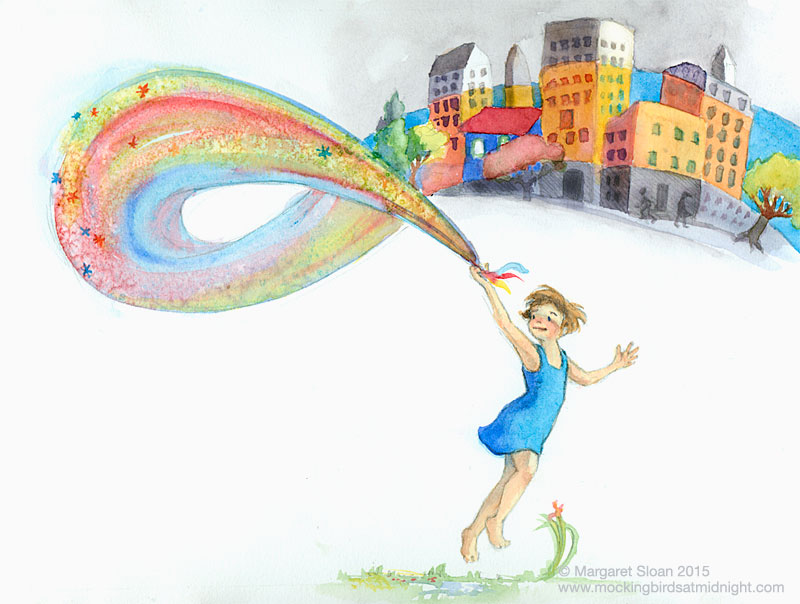
If Persephone celebrated Holi, and brought color to your cold, snowy town

Painting Spring
Painting spring
Watercolor on #140 Arches hot press

This weekend I was thinking of the Hindu celebration of Holi (See some wonderful photos of the holiday here), then I started thinking about all my dear ones buried under who-knows-how-many feet of snow and ice. Then I started thinking about Persephone and the myth of spring, and although I don’t subscribe to child marriages, the image of her as a little girl popped out of my brush.

Happy Spring everyone. It’s coming soon to a town near you.

Painting a watercolor portrait from life when you only have a few minutes to collect yourself

Watercolor portrait
Watercolor portrait from 15-minute life pose at a life drawing session

The painting above was the result of a 15-minute pose at the local life drawing session. 15 minutes isn’t long time. Fruit flies live longer. All I could manage was a quick pencil sketch to capture the model’s likeness and a few brush strokes to remind myself of his overall skin tone (his local color). And one of those brushstrokes—the red stripe on the shadowed side of his cheek—was as awkward as a quarterback in toeshoes.

Oh well. Ted Nuttall once said in a class that sometimes he makes big mistakes just so he has a problem to solve. It keeps him from getting bored.

Watercolor portrait
Watercolor portrait after working on it at home for another 45-minutes.

I haven’t been painting much the last week. I’ve been busy with a few illustration commissions which I was doing in digital space, and haven’t been real-world painting. But Friday morning the call of the paintbox was too strong, that desire to sling pigment and water an unbearable pain in my heart. What could I do? I gave myself an hour behind the brush to play with this painting, setting the alarm for 45 minutes, which would give me 15 minutes to wrap it all up.

During that 45 minutes, the painting began to take shape. But even 45 minutes is not long enough for me to make thoughtful decisions about a painting. More bad brush strokes. Questionable color choices. And unstretched watercolor paper that warps under washes until it’s like painting on a wrinkled wet towel.

watercolor portrait
Watercolor portrait with dark gouache background and ultramarine blue shadows

When the alarm went off, it was time to dry the wrinkly paper with a blast of air from the blow dryer (I’ve heard some folks use a blow dryer to dry their hair. Curious, isn’t it?) and make a couple of large decisions that would finish (or ruin) the portrait.

A dark background of gouache helped ease the brilliance of the colors in the face, and a light wash of ultramarine watercolor over the shadowed side of the face helped unify the shapes and blur the weird red brush stroke that had stumbled across the cheek in the initial 15 minute painting. I had to restate the eye, which wandered a bit. Oh well, we all have a bit of a wandering eye at some point in our lives.

Painting a girl, a car, a road to beyond, and a Valentine’s love story.

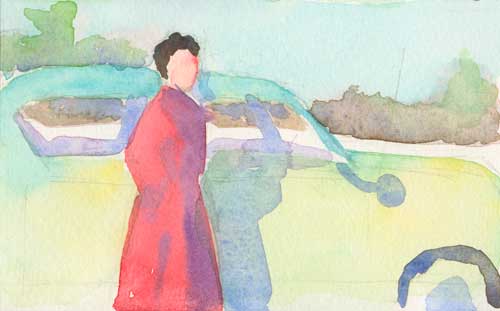
Watercolor of girl with car
The new car
11″ x 8″ watercolor on #300 Arches hot press

This was a commission I recently finished. Long ago I posted about beginning a watercolor painting (You can read the post here) by making small studies to find where you want to go with the work.

This painting was a commission from my Dad, and he wanted the house in the background; the photo was taken in my grandparent’s driveway, and my mom, my dad, and I  still long for that little home in the desert where we were all so happy. But young folk have to go out on their own, and in the reflected landscape in the windows I’ve tried to capture the limitless future that all young people feel they have.

The tiny black and white photo of my mom and her very first car has lived in my dad’s wallet for nearly 60 years. My parents often drift dreamily into rhapsodies about this car; I always ask, why’d you get rid of it? My mom shakes her head and says, “you know your father.” He just looks at his plate and grins. I’m awfully glad they kept each other. They are a wonderful model for a long term, romantic relationship.

These are the original studies.

Study for painting 5" x 3" watercolor study
Study for painting
5″ x 3″ watercolor study
Study for painting 5" x 3" watercolor study
Study for painting
5″ x 3″ watercolor study

If you’ve got an old photo you’d like interpreted with watercolor, contact me at  mockingbirdatmidnight  at  gmail.com  and we’ll talk about a commission. They make wonderful gifts and remembrances. You won’t be sorry.

Slumming with cheap watercolor paper isn’t as sordid as you thought

Figure drawing in watercolor
15-minute poses on cheap watercolor paper

Dear Reader, I originally thought to warn you about using crappy watercolor paper. If you’ve been studying watercolor for long, then I’m sure you’ve heard advice to use quality watercolor paper.

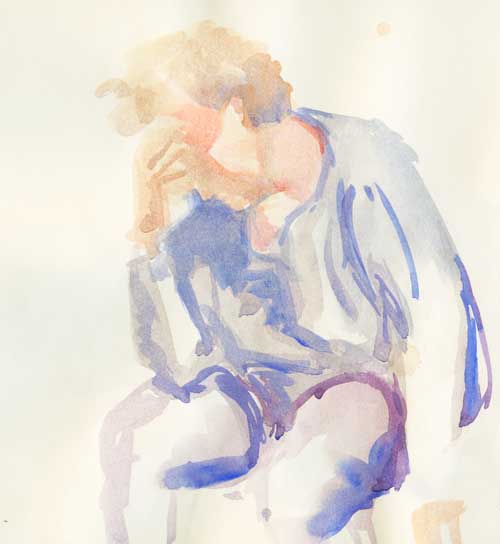
Before I got so snobbish about paper, I actually bought a pad of the cheap stuff. And people have given me pads over the years. So I’ve got quite a bit of it. I’ve never  used much of it because I got all highbrow early on in my watercolor journey. And it is hard to work with; badly sized, this paper sucks in the paint and leaves dull, lifeless washes that look sort of speckley. It buckles as soon as you add water, fights with me like mad racoon, and generally leaves me feeling like this pose.

But I’ve been using this cheap stuff for quick life-drawing warm ups, because then I don’t feel like I’m using up the precious resource of my luscious #300 Arches. And while the buckling, the disappearing paint, and the overall junkiness of this paper really frustrates me, in the end, I put in a lot of brush time on it, and work out a lot of solutions that I remember when I paint using the “good stuff”. So if you limit your painting experience because you’re  afraid to use up your fancy-schmancy, double-sized, extra-heavy oo-la-la papier, grab something cheap at your local art and craft store and get some mileage on your brush.

(Brushes, however? Get the best you can afford.)

30-in-30: Figure drawing in watercolor above the speed limit

Figure drawing in watercolor
2 5-minute poses on cheap watercolor paper

Today I went to the figure drawing session at Town Hall Arts Galerie Copper in Copperopolis.  Unfortunately, the model didn’t show up, so we took turns posing (clothed) for the group. It was fun to have so many different figures changing it up. But unfortunately, it’s really hard for non-models to hold poses even as short at 15 minutes. Readers, a good model who can hold a long pose over and over again? They are worth every penny they earn, and I hope that you always tip your models accordingly.

Figure drawing in watercolor
5-minute poses on cheap watercolor paper

Since the poses had to be really short, I had to develop a kind of shorthand quick-stroke, using very simple shapes that were separated with white space so the paint didn’t all run together into a big wet blob.

The time went so fast that I couldn’t draw with pencil and finish with watercolor. The work below was all I could muster in 10 minutes. I might play around with this a bit in the studio, but I really wish this woman would pose for me (for longer than 10 minutes). She has a beautiful face and elegant demeanor. If she reads this, I hope she’ll agree.

Figure drawing in watercolor
10-minute poses on cheap watercolor paper

Drawing with the paint brush (wait, that’s really painting, right?) forces my brain to judge shapes, angles, and proportion without the help of guidelines, angle marks, extra marks, and erasing. So it’s a great exercise. And it leaves me longing for a good, four-hour pose.

.