Peaking at 50

California

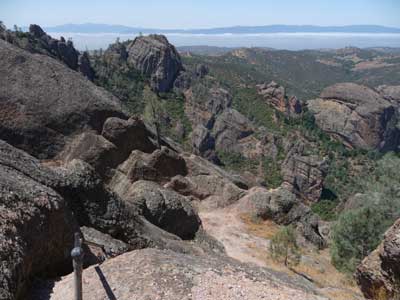
After climbing the steep trail all morning, we missed the fork that would have taken us to the completely tame (or so I was promised) tunnel trail. Now we were high on the mountain side at Pinnacles National Monument, looking out over the state of California all the way to the foggy coast, and the trail only led higher.
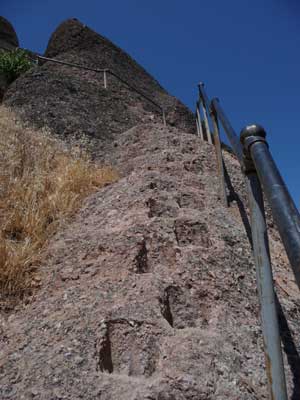
TrialWe clambered around a corner and suddenly we stood at the base of a cliff. Footholds chipped into the rock face marched almost vertically into the sky. There was nothing but the rock, a pipe to cling to, and the air around it.

“Oh my god,” Jo said. “Do you want to go back?”

Camping buddy Jo, who is smart, brave, and intrepid, knows well that as I suffer from an inexplicable terror of heights. This fear is something new that has come with the years. Altitude never bothered me when I was a kid; at 12 I would have scampered right over that mountain face. Twice.

But now,  here I was, two weeks before I turned 50, having a hard time staying calm looking at the crazy steep trail. Maybe you know the feeling: your intestines crawl into your chest and cling to your lungs so you can’t get a breathe, your head gets woozy, and suddenly the only thing you can feel in your hands is a cold sweat.

To be honest, my upcoming birthday, the big 50, is making me feel woozy like I’m standing at the edge of a cliff.  I’m amazed at how two little numbers—a 5 and a 0—can open the door to anxiety and actually send out stamped invitations to an open-bar, fully catered worry affair, complete with band and disco ball. (Ok, ok, I’ve always had a worry party going on in my head. It’s just gotten more crowded as I—gulp—age).

In our culture that’s dirty word—age. Yes, yes, I’ve heard that 50 is the new 30 (Frankly, I’d be happy to see 40 again). Sure, Jamie Lee Curtis received applause for going topless at 50.  And I’ve read that employers are starting to value those of us who have more experience than we have collagen in our lips.  Even Barbie has lost only a smidge of popularity despite reaching the half century mark..

But I live in Silicon Valley, where we worship youth. And why wouldn’t we? The young are so lovely, so luminous. They don’t have years of living that cover the inner shine with a dusty layer of experience.

And I think they’re mostly not afraid to climb over a mountain peak.

Up on that mountain, I had to think hard. I thought over the trail we’d just climbed. We’d huffed and puffed up the Condor Trail (no condors to be seen), then wound our way around and up the side of the mountain. We had to clamber up and down steep rocky bits lined with poison oak. And Central California in May is already hot like summertime; we’d started hiking at 8 that morning in shirt sleeves, and the day wasn’t getting any cooler. The trail was on the west side of the hill where the afternoon sun would be blazing. Did I really want to descend the mountain  using the same trail I’d ascended?

I remembered my grandfather’s motto: Always go home by a different road. Never backtrack.
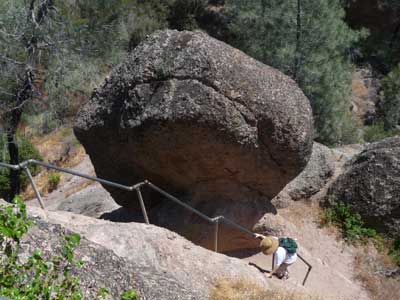
ClimbingI clenched my teeth. Wiped sweat from my eyes. “Jo,” I said. “We can’t go back. So we gotta go forward.”

And I climbed that mountain, dammit. White knuckled it all the way, pressed on even when I felt like I was so exposed that I was flying. Jo talked me over the really scary bits, and both of us slid down one entire passage on our butts.

I’d like to say that I felt victorious and renewed afterwards. I guess I did, a little. But mostly I was tired and hungry. And needing to paint something. Out came my little hiking journal, a waterbrush, and a afew Caran d’Ache watercolor sticks. I rested in the shade, ate a tortilla with hummus, and did what any artist at any age might do. I painted a picture of the mountains.
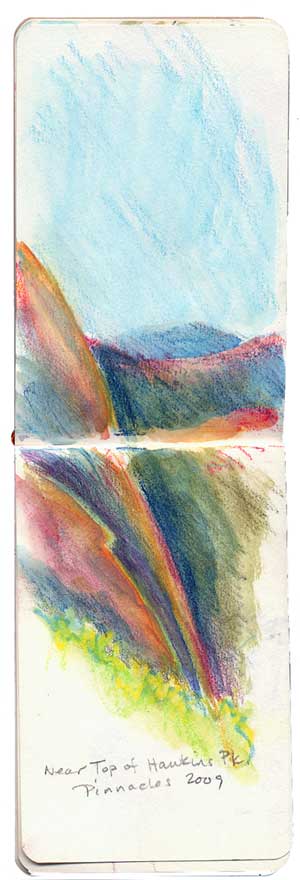
Pinnacles

The music in your bones

Watercolor color study

Last night after the session wound up, after the last Irish jig and reel danced out across the floor, after the last polka whirled by and the last hornpipe bobbed out for the night, after the flutes were swabbed  clean and the fiddles wrapped and stowed in their cases., we musicians fell to talking a bit about Irish music.

We talked about how we came to this old and eccentric style of music in this land of pop melody and commercial jingles. Nearly every person at that party came into the music during a crisis in their life (many of us, it seemed, found it while ending a bad relationship). We found solace in the music, friendship in our instrument. “When I feel down or troubled,” C. said, “I tell it to my fiddle.”

How well I know that type of long conversation with my flute.

Not everyone who comes to Irish music is an emotional refugee looking for comfort. Some are lucky enough to have been born into the music, and wise enough to continue playing their legacy. Others just enjoy the intellectual exercise of learning stacks of tunes. And most of us love the camaraderie and community that comes from playing this music with others.

But I’d wager that for lots of musicians, the music is more importantly a place of comfort and safety. The familiar tunes are like favorite stories  we tell ourselves when we’re happy, scared, bored, or sad.

No matter our level of competence, just to sit quietly by ourselves and play this music is to have a relationship with the tunes and with our instruments that is as deep and serious as our relationships with our spouses, our children, our parents.  I guess because ultimately, it’s a relationship with ourselves.

Study of a flute player

Girl playing flute Graphite value study
Girl playing flute
© 2009 Margaret Sloan
Graphite value study

I met this lovely young woman at Friday Harbor Irish Music Camp. She had a boxwood flute that had bent as it aged, but it sounded lovely.

One day while we were in class, the rain and snow stopped, the sky cleared, and the sun streamed through the windows. Sitting in a shaft of sunlight, the young woman glowed as she practiced her tune. I snapped a photo quickly. There was no time to fool around if I wanted to capture the naturalness in her posture. Youth is a time of great beauty, but also great self consciousness.

I’ve come to understand the importance of doing value studies before beginning a painting. Steve Curl, my watercolor teacher, told me that when I was designing the value study I shouldn’t focus on the details. Instead, he said, look for the large shapes of light and dark; I did, and it made all the difference.

I’ve already practiced painting hands playing the flute, so I should be in good shape for her hands.

Reynard’s accordion

Reynard's accordion 2009 Margaret Sloan Watercolor
Reynard’s accordion
© 2009 Margaret Sloan Watercolor

The accordion has gotten a bad rap in this country, thanks to cheesy lounge lizard music and guys in glittery suits. But there are other sides to this instrument, facets that do not include champagne bubbles and Lady of Spain. Accordions have morphed into something new whenever a culture touched them.

I like accordion music, particularly music played on the button box. Particularly Irish music played on the button box (no surprise there), although I’ll take a good French Canadian reel too. English country music on the button box sounds great. And don’t forget accordion is a staple in  Cajun music.

It makes sense to me that a fox should play the accordion. And the fellow in this painting reminds me of a fox.

Raynard the fox was, in European folklore, a trickster, a shape-shifter, a magical animal. May Day seems like a day he is in top form.

I like to think of my Raynard  attracting fluffy white rabbits with his accordion, wooing them with a rockin’ reel or a seductive waltz on dry-tuned reeds and then…well, what he does with the bunnies when he catches them is best left to your imagination. I can assure you that my Reynard doesn’t bite their little heads off, and that they’re pretty happy to have been caught.

May day Morris dancing

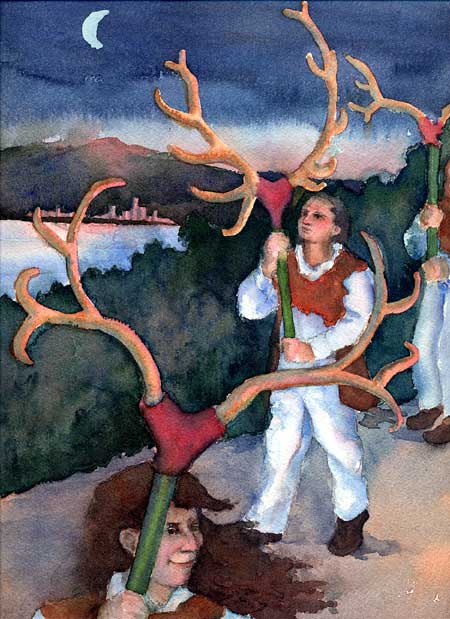
The Palo Alto Baylands before dawn on the first day in May is a chilly place, quiet except for a few startled shorebirds and the shuffling of feet. People gather in the parking lot, talking quietly between yawns. Later there will be revelry, laughter, and silliness, but right now they wait. And just before the sun comes up, men carrying deer horns emerge from the darkness to dance to a haunting tune in a minor key.

Abbots Brumley Horn Dance (Thaxted version)  Watercolor on Arches paper
Abbots Bromley Horn Dance (Thaxted version) Watercolor on Arches paper

This is Morris Dancing, an English style of folk dance that is very old. No one is quite sure how old it is, but evidently records dating back to the 1600s mention it. It’s almost died out several times—Cromwell and his puritans put a temporary halt to it, then the industrial revolution bled people from their culture and nearly killed it—but was revived in the early part of the 20th century. How ironic that it’s had another revival in this age of technology killing culture. In fact, it may be that technology has helped it grow (although some predict a decline),  and now Morris teams all over the world clash swords, shake bells, wave hankies, and dance to the music of accordions and fiddles. They dance to help the sun rise on May 1, a brilliant endeavor, and a happy one. Then, I believe, they go have some beer.

The dance I’ve painted here is the Thaxted version of the Abbots Bromley Horn Dance.  The Thaxted version is haunting, mystical. You feel like you’ve stumbled upon some primitive rite in the midst of the megalopolis. Like an ancient god will spring from the bay mud and perhaps accept  a sacrifice as the dancers make their moves. It’s deliciously chilling and meaningful.

But the Thaxted version an after-market dance. The original, still performed in Abbots Bromley after something like 800 years, is lively, fun, and a little goofy. Danced in daylight. Lot’s of bouncy tunes. To this Yank, Monty Python springs to mind. In the best possible sense, of course.

This is a study for a larger painting I have in mind. As always, I imagine I’ll paint it many times before I get it to the place I want it to be.

If you’re up before dawn on May 1, find a Morris team near you and go help them dance up the sun.

Whistles in the dark

Three Penny Whistles Graphite on paper
Three Penny Whistles
Graphite on paper

My wonderful husband gifted me with a Michael Burke whistle for our anniversary. I’ve been craving one.

I have to admit that, as a whistle player, I have many whistles. I don’t know why, but whistle players often have more whistles than does a bird singing in the moonlight. Perhaps we are always looking for that perfect instrument that will give us a nice loud true middle d, as well as a soft, chiffy high b. A whistle that can be heard above the din of fiddles and pipes. A whistle that won’t screech so loud your fillings fall out. It’s a never ending search and whistle makers oblige us in our quest.

I was struck by the differences of whistle construction, and this week during a sleepless night, drew three of my favorites (from left to right, Susato, Water Weasel, and Burke) to learn how to draw the materials they are made of (black plastic, pvc, and brass). And to admire my new Burke.

The Susato is a good loud session whistle. I played it happily for years. Then the Water Weasel was my favorite whistle until it cracked. It never played the same again, even after it’s creator, Glenn Schultz, repaired it. Now it’s cracked again, and unfortunately, Glenn has passed away.

The Burke is lovely. It’s not very loud, which is great for playing in our apartment. It’s got a sweet sound. It’s a little chiffy on the high notes, which I like. All in all, I’d say the husband got a good lot of husband points for this gift.

Finally! It doesn’t take this long to play the tune!

Trim the Velvet <p>Watercolor</p> <p> Copyright Margaret Sloan 2009
Trim the Velvet
Copyright Margaret Sloan 2009

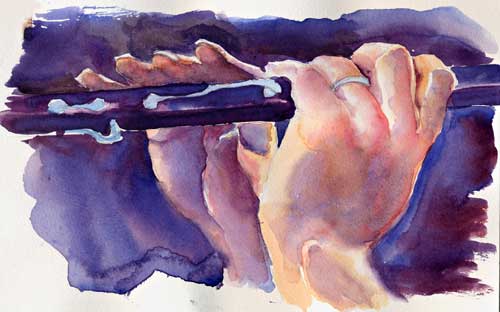
This week I painted my final version of William Bajzek’s hands playing flute. I think I’ve painted about 12 versions of this; I’m happiest with this last version, although I also like the earlier version I posted in February.

I’m calling it Trim the Velvet, one of my favorite Irish tunes. It’s a tune that falls beautifully on the flute, and one that William plays really well. You can hear sound samples of William playing Irish music with his wife, Angeline, in their duo called Castlerock. Unfortunately, they haven’t any sound samples of Trim the Velvet on their website. They should.

12 versions of the same painting. That’s a pretty compulsive thing to do. But I made about every mistake a person can make in those 12 paintings. Sometimes I made pretty awful color decisions (and sometimes no decisions at all). I struggled to create soft edges. I roared into the painting and impatiently splashed dark values onto the paper too soon. I didn’t pay attention to the paint.

These are the things I learned: Painting a watercolor is a lot like starting a relationship. It’s best to be delicate in the beginning, leaving room for the big decisions that you’ll have to make later on. Plan well. Make clear choices. Use a light touch. Be happy with what the painting wants to be.

Prud’hon method

Self-portrait in charcoal and white chalk

In the third year at the atelier, Rob started teaching us different techniques which will eventually lead to color temperature theory. Leaping into technique was a little daunting, as I was still (am still!) struggling to get an accurate rendition of the figure on my paper. Rob has an exacting eye, and with his help, I’m slowly learning to see where I go wrong in the initial stages of a drawing. These days, when I’m working on a drawing, I don’t just accept the first marks that go on my paper; instead, I try to use a more critical approach.  And measure, measure, measure.

After we started working on colored paper, Rob introduced the Prud’hon method. Prud’hon was a French Romantic painter who produced some amazing drawings using toned paper, charcoal, and white chalk. A brilliant Bay Area teacher, Rebecca Alzofon (who, unfortunately is no longer teaching) has a tutorial on the Prud’hon method. I rarely follow tutorials, but I did follow some of this, and found it helpful to build on what I’d learned in Rob’s class.)

There’s a lot of smudging going on with this method. Tone is put down by a series of hatch marks, which are then smudged and blended. Charcoal and chalk can be blended, or not. After you’ve built the volume and form, to accent areas, you use line—not contour line, which would go across the form, but rather, line that follows the direction of the form.

Painting hands

hands playing flute

These are the hands of William Bajzek, a very fine Irishflute player from County Santa Clara (that would be in California).

When you play the wooden flute, you feel the flute vibrate through your hands and the air rush up through the finger holes. A well-made flute feels nearly alive in your hands, ready to start singing at barely a breath of air. When I watch William play, it seems to me that his hands as well as his ears are listening to his flute.

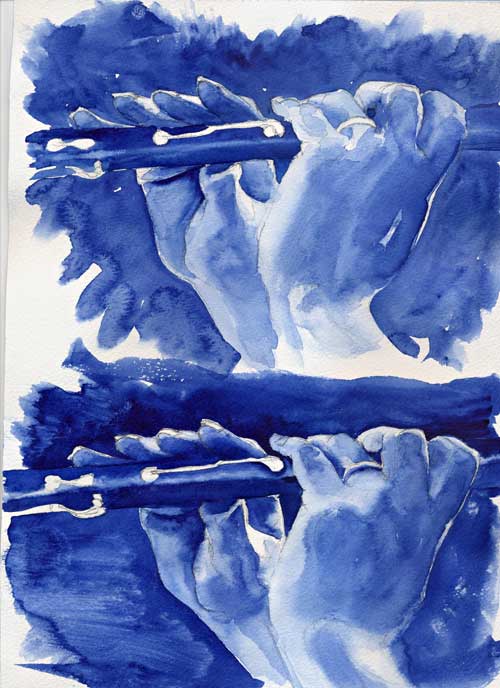
monochromaticstudyI’ve painted this image in watercolor 8 times. The first 6 paintings were one-color value studies, painted on Biggie watercolor paper, 2- up. I was trying to understand the way the values moved across the forms, and how to manipulate the paint. With watercolor especially, you need to have a plan, a framework around which to build your spontanaity, and I’m trying to figure out that plan.

I’m posting just one pair of my favorite one-color studies. I think it’s nice as one color, but I have a color piece in mind.

The first time I tried to use color was disastrous. Lesson learned: start with light value colors first, and progress to dark values. Also, be very careful with staining color, because it’s nearly impossible to remove.

I’m not entirely happy with this first color version, although it has a freshness to it. But the cheap paper buckles unattractively. And I’d like it to be a little tighter, less impressionistic, although I know that is the style in watercolor right now. Somehow I’d like to combine freshness and control in my watercolors.

If you’d like to know more about woodenflutes, you can start at woodenflute.com.