Painter, have no fear

Before the Big Adventure
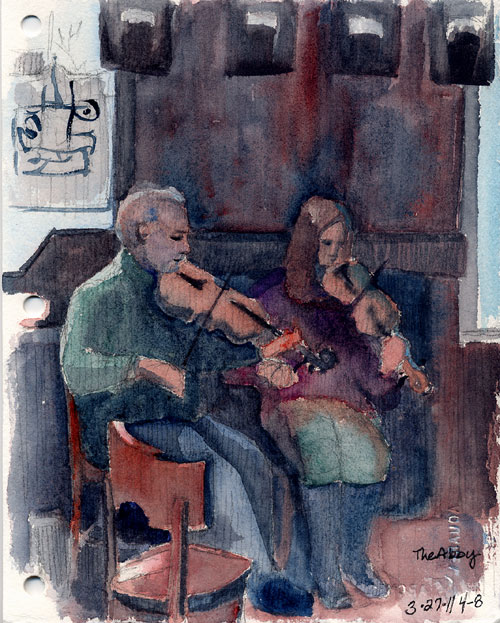
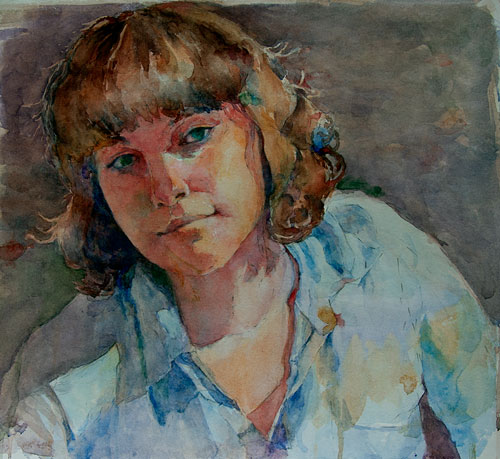
Watercolor from Ted Nuttall Workshop

Copyright 2011 by Margaret Sloan

In early fall I took a week long watercolor workshop with Ted Nuttall, one of my favorite watercolor painters. Ted is a marvelous painting coach, and I feel like the workshop changed some important circuitry in my painting mind. Ted said that one of the things he hoped to accomplish in this workshop was changing the way we think about painting. I was looking for a change and I was an easy mark; he succeeded.

The most important thing I learned? Do not be afraid. Go ahead and make mistakes. In fact, Ted says he often purposely paints unexpected colors, streaks, daubs, dribble, and of course, his famous “sloppy dots” in order to give himself problems to solve.

Watching him paint is like taking a roller-coaster ride. (Yeah, I know, painters are easily thrilled). Some strokes made me gasp in fear—I’d never make that kind of mark deliberately—but Ted deftly tied it in to the rest of the painting as he moved along.

I’m not quite brave enough to deliberately make mistakes. I make enough accidental problems to solve in the course of a painting. But I think the answer to that is to make more paintings, and learn from all those accidental mistakes.

More painting? That’s never a bad pursuit.
Chicago Irish interlude

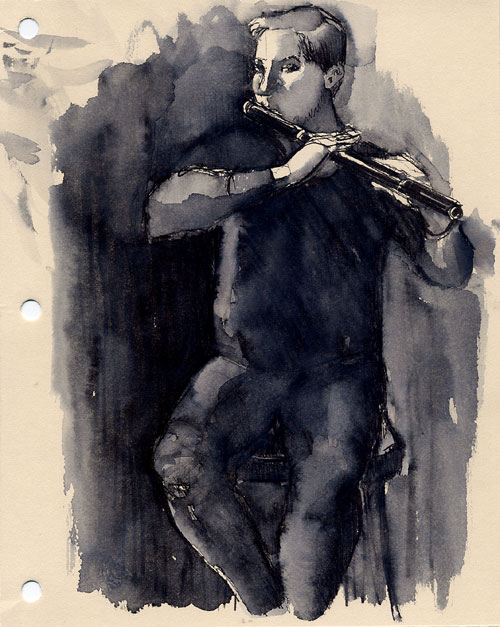
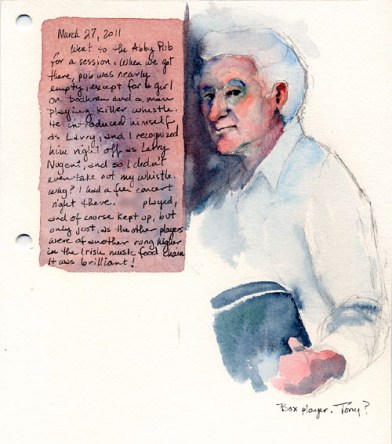
Box player at the Abby

A visit to Chicago would have been incomplete without attending an Irish session. The Chicago Irish music scene is legendary. My fiddler said this was the one thing he really, really, really wanted to do. I, of course, was not against this idea.

We found the Abby, where, when we walked through the door,  we were astounded by the most amazing whistle playing.

It was Laurence Nugent, a top Irish whistle and flute player. Pretty cool.

At the Abby

If I’m shy about drawing in public, sometimes I’m even more shy about playing music.  I couldn’t see taking my whistle out and squawking  around on it like a wounded ostrich when there were musicians who were roaring like lions. Instead, I sat at a table, had a beer, and listened to ripping reels, jigs, and hornpipes while I painted. Listeners are an important part of a session too!

I leave you with this video.

Sláinte!

Laurence Nugent

Can a painter travel lightly across the land?

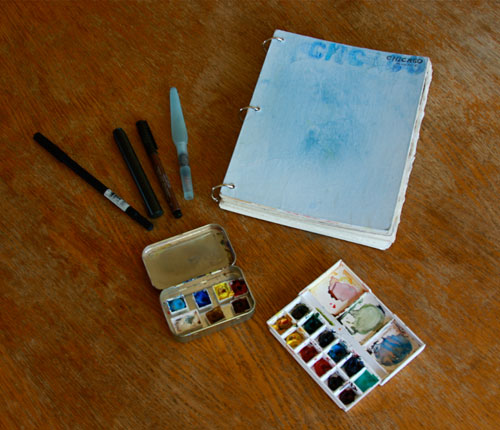
Painter's travel kit

I haven’t been posting much lately, because I’ve been painting! Painting and traveling.

We took a trip to Chicago in the spring. Despite the Chicagoan’s fanstasies that the weather was springlike, it was a bitterly cold city. (Where I’m from, we complain when we have to put socks on in the winter. Any temperature under 59 degrees F., and I’m done.)

It was also a city where, I was advised, we wouldn’t need a car, since the public transportation is epically transportational.

What? No car? I’m a person who chooses automobiles based on the amount of nooks and crannies on the passenger side. When I travel, I need a rolling art studio. I paint while my husband drives.

The best car I ever used was a Dodge van we rented for a camping trip. Cubbies in the door held paintbrushes, pencils, and pens at the ready; 4 drink holders between the front seats kept steady two cups of water and two cups of coffee; the deep, wide dashboard displayed paintings that were not yet dry; and the open door of the glove box made the perfect mobile easel.

You can imagine how much stuff I brought on that (or any) camping trip. Several sketchbooks, a folder of watercolor paper, a couple of Arches watercolor blocks, and a lined notebook. I even brought the laptop and Wacom tablet.

But in Chicago, traveling by bus and subway, I had to pare down. Way down.

Homemade travel journal

What you see in the photo above is what I came up with.

I’m not a book binder, so I couldn’t stitch together anything fancy; instead I cut to size a variety of papers: Strathmore drawing paper, BFK Rives printing paper (tan colored), and Arches 300-lb cold and hot press papers.

Then I got the local copy shop to drill holes in the paper. They couldn’t—or wouldn’t—move the bits on their drill, so I was lucky my notebook fit in the 8.5-inch slot on the paper-drilling machine.

They wouldn’t drill the covers. They said, what the h*ll is this stuff? It was merely illustration board covered with acrylic gesso, but I guess it looked like some strange building material to them.  I had to drill those with my trusty hand drill (it used to belong to my grandfather. It’s probably 60 years old, and still works like a champ.)

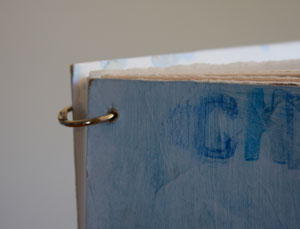
Binder ring journal

The paper was all held together with binder rings.

It was perfect for the trip. I could paint or draw on whatever type paper I wanted that day. I didn’t have to work sequentially, because at the end of the day I could reorder the paper as I liked. And to reduce weight (and protect the already painted pages), I would only bring part of the journal each day as I shivered my way around Chicago.

Farm memories

Although I grew up in the city, I come from farming people. I grew up with so many stories of the farm, the family, and the various chickens, goats, and cows, that I sometimes feel I lived alongside my ancestors.

I’ve certainly romaticized their lives, although I know that it was a hard life; subsistence living is never easy. But I’ve heard their stories, told with a slight bitterness towards the privations, but mostly washed by a greater love of their lives. It makes me wonder if today, in our lives of relative ease, are we really happier?

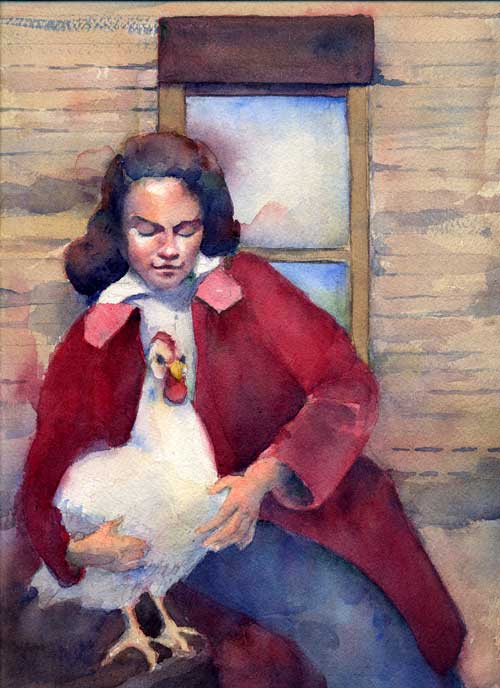
Her Favorite Red Coat
Watercolor © 2011 Margaret Sloan

This is a small painting: 9″ x 12″ on Arches cold press. Yes, it’s from a photo-a black and white photo at that. Right now I’m enjoying working from black and white photos. They give me greater freedom in color choices and combinations. Unchained from the tyranny of the camera’s red-blue-green, I can make my own statements. (Of course, now that the painting has been fed back into the camera and computer, I can see errors that will need fixing, mostly edges that need softening.)

That little girl is all grown up now, and that chicken long emigrated to chicken heaven (grasshoppers and freshly sprouted gardens abound!). Some painters gripe about painters who paint from photos. “Why paint it if you can take a photo of it?” they ask. But without this dusty photo, I could not have made this sweet painting, and this little girl would have been lost.

Are you a painter? What do you think about using photos?

Been busy

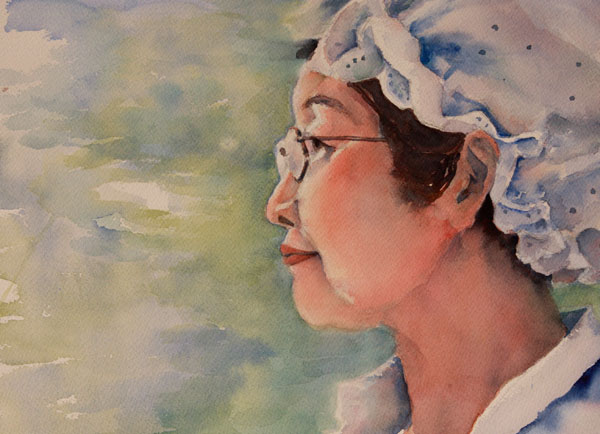
Waterolor painting of Lee
Lee by Margaret Sloan Watercolor on paper

I’ve been tremendously busy for the last few weeks; that’s why I’ve not posted. Yes! I’ve been painting. I’m working on a portrait right now of a friend, and I’m working much more slowly (even more slowly than usual!) as I try to nail down the design and the colors. But it’s been absorbing me to the point that I don’t do much else (except the day job, of course).

Here’s a painting of a friend of mine. I made this last month. Took me four tries to get what I wanted. She’s a dancer, but was taking a break and listening intently to the music.

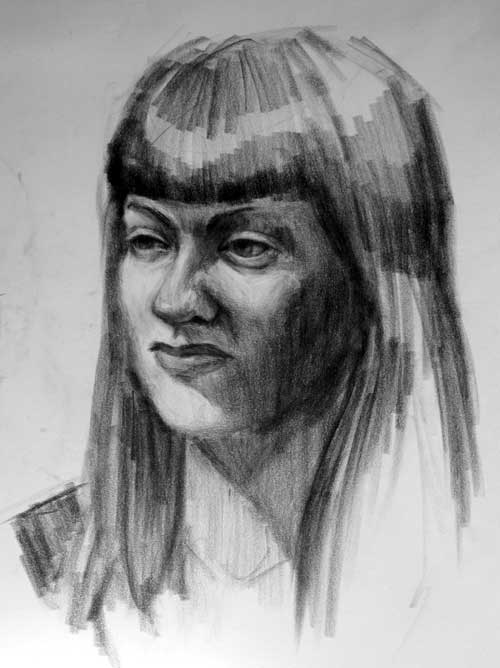
Drawing the portrait: Week 5

All that playing with charcoal paid off when I drew this portrait. It came together nicely.

We draw the same model in the same pose for about 4 20-minutes blocks of time. During the last block of time, Felicia talked about looking at your drawing and taking away what was non-essential. So I stepped back and really looked at my drawing, and used the kneaded eraser to give more form to areas and shape the strong light and highlights.

I feel like I am making some progress!

Charcoal drawing…for fun!

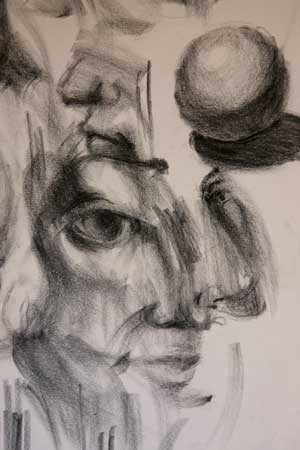
I’ve been struggling to control my charcoal pencils. I keep making scratchy liney-lines, when what I want is a soft, rich, even tone. So I got out a piece of smooth newsprint and just doodled, trying to gain some control.

I’m not used to this technique. The pencil is whittled (I use a box cutter), stripping away the outer layer of wood, and leaving a slender charcoal twig about an inch and a half long. Then one side of that fragile stick of charcoal is flattened on a sanding block. This gives it a wide surface to make soft tone or expressive line.

But you have to have the right touch, and be in tune with your pencil. I keep losing the flattened edge on my charcoal. Then I have to scruff around in the margins of the paper until I can find that sweet spot again.

I need to do many of these kinds of sheets. Just play with the pencil and exercise my arm and eye.

Drawing the portrait: Week 4

Charcoal on smooth newsprint

The image I see in my head when I start to draw a portrait is ever so much better than what I actually draw; why won’t that image in my mind come out through my fingertips onto the paper? While I was happy that I caught the likeness of the model in this portrait (week 4 of Felicia’s portrait drawing class), the rest of it leaves me, well, disappointed.

Felicia often tapes tracing paper over students’ drawings to demonstrate how they might better change their drawings. As she demonstrates, she often mutters to herself. In those half-verbalized thoughts, there is a whole lecture for the student who pays close attention.

That night, she traced over my drawing of the model, concentrating on the nose. She talked about where she saw edges. Were they crisp edges? Soft edges? Form or cast shadows? How did they wrap around the form; where did they create a sharp angle? She applied her charcoal pencil as if it were the finest sable brush, and modeled a perfectly dimensional nose in a few strokes.

I realized—once again—that I still wield my pencil like a bludgeon. I need practice in order to handle it like a fine brush.

I need to go home and simply play with the materials we used for the class. Play with them with no expectation of results, except for learning what a simple charcoal pencil can do.

Now there’s some great homework. Play. Play. And more play.

I’m smiling.

If the Northern Lights played the fiddle

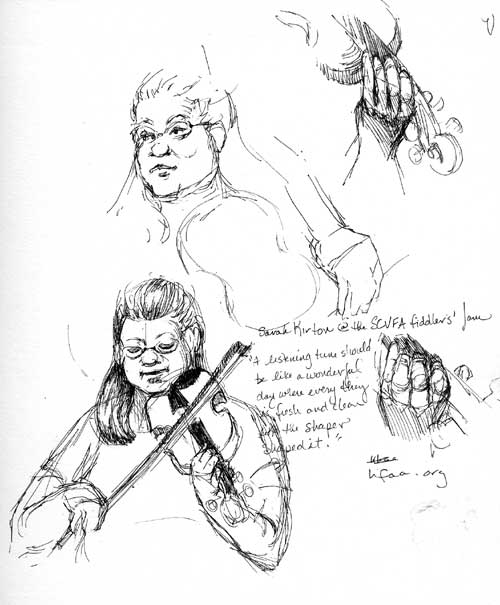
The text says: "A Listening tune should be like a wonderful day where everything is as fresh and clean as when the Shaper shaped it."

Today we went to the Santa Clara Valley Fiddlers Association to hear fiddler Sarah Kirton play her hardingfele. It was sheer magic.

The hardingfele, or hardanger fiddle, is a traditional instrument of Norway. It’s got 4 strings stretched across the top of the instrument, like a regular fiddle, but beneath those strings are 4 more strings that buzz and moan in sympathy when the top strings are played. The music is other-worldly. When I hear it, I think of ice goddesses, snow fields, midnight suns, birch trees in brilliant green meadows.

If the northern lights played music, it would be on the hardingfele.

In the Bay Area we gab ceaselessly about diversity, and yet, most people only really listen to music presented to them by mainstream radio; they don’t know that there is a whole world of music out there that isn’t just Lady Gaga and Justin Beiber.  It’s the musical equivalent of eating at only McDonalds when you live 2 blocks from a wonderful street where every restaurant serves food from a different country . If you never go down that street, you never even know that there are other foods.

If you want to taste some Norwegian hardingele music, you might start at the Hardanger Fiddle Association of America. There are some sound files to give you an idea of what this wonderful and mysterious music sounds like.  And there’s a radio show about the fiddle (Sarah’s in it!) here.

And you might want to explore some of the fabulous musical menus that the world has to offer. Who knows? There might be a hardingele fiddler living right next door to you!