I was lucky enough to have a front row seat and plenty of light, so out came the sketchbook. How much happier could I be than to listen to amazing music while drawing the amazing musicians making said music?
Last night we heard the trio Veretski Pass play their Klezmer Shul, a beautiful piece of music that combines Jewish sacred and secular music of Eastern Europe (and maybe some “co-territorial” music from other cultures).
In a talk with the audience after, the fiddler Cookie Segelstien (oh, alright, she’s a violinist, if you want to reference her work in the classical world. As if being an amazing Klezmer fiddler isn’t enough) told us that there used to be, a long time ago, special shuls (houses of worship) dedicated to specific tradesmen. There were shuls for builders, and tailors, and, they think, there were shuls for musicians. Cookie said, “we asked the question, in that light, what kind of music would Klezmer musicians jam on?”
The music was terrific. It was haunting, and joyful, and all the things you’d expect from three amazingly gifted musicians mining the very roots of their musical souls. The Klezmer Shul is what happens when classically trained musicans cross over into folk music and create something new and wonderful.
I loved what I heard last night, but it was more academically inclined (not that this is a bad thing, mind you). It’s just that the kind of music in the clip below makes my heart dance. This video clip is pure Klezmer.
I’m hoping we’ll have some of this music in the house soon. My own fiddler has been away these last two days, attending Klezmer workshops at the KlezCalifornia yiddish Culture Festival at Congregation Etz Chayim in Palo Alto. I would have loved to join in the fun, but I just can’t take on another hobby right now. But I’m hoping he brings home some tunes.
If you think this blog might be of comfort to someone, please share it
This is a small drawing I made of my friend Cyndy. It’s from a photo taken as she was sitting around a campfire, playing tunes with a group of musicians.
I know Cyndy’s present teacher. He’s told me that she’s the kind of student a teacher loves to have. She really thinks about the music she plays, and she makes him think about it too. And she practices!
She’s passionate about her fiddle in the way most of us are passionate about a new romantic partner. But, come to think about it, I know a lot of musicians who are married to their instrument, and playing music is simply part of their everyday experience. I also know artists who feel the same way about their art. (I’m torn between the two. Do I play tunes, or do I draw? Tough question, that.)
Sometimes playing music or making art becomes a stale thing, or a stressful thing, fraught with needs and cravings that block the joy of our passions. But if we really think about what we’re doing, and lose ourselves in the process, suddenly the work becomes play, and we amaze ourselves at our success.
Shannon Heaton, one of my favorite Irish flute players, has a terrific blog at Whistle and Drum called The Inner Game of Irish Music about practicing the music. She’s talking about Irish music, but she could be talking about drawing, painting, old time music, classical music, dancing, or even just plain-old, everyday work.
If you think this blog might be of comfort to someone, please share it
Well, whattaya know! The Great Bluegrass Festival Drawing Expedition was a blast. Despite my fears at venturing into public drawing, I sketched unscathed at the Good Old Fashioned Bluegrass Festival. Musicians didn’t take offense at my sketching: bass players didn’t mow me down with their gigantic instruments; fiddlers didn’t skewer me on their bows, nor did banjo players strangle me with their twangy metal strings. And the people who looked at me (yes, they did. They actually looked at me with my little journal and bag of pencils) while I drew, why, they were delighted! One woman saw me drawing, grinned widely and said, “what fun is that!”
And darn it, it is fun. Normally I dislike listening to music while I work. I find it distracting—one of the uncomfortable things about being a musician is that there is no background music. My musical brain always stands at attention for anything resembling music, and disallows any action by the other thinking parts of my brain. I am not a good multi-tasker when music is playing.
The Barefoot Nellies singing harmony
But this was different. For one thing, I was prepared for music. I knew there would be lots of it. Besides, I wanted to sketch musicians while they played.
One thing I learned. Bluegrass really sets your toes tapping and makes your drawing arm swing.
It was really hard to sketch people as they played. Those musicians are moving all the time, and each drawing was an exercise in fast gesture poses—good practice for me. You can see that the drawings weren’t entirely successful, especially around the hands. And even less successful around the instruments.
One of the Winton boys playing dobro and a small sketch of the dad playing guitar.
I point out the unsuccessful parts because drawing at this festival really made me see the areas in which I have smaller knowledge, the parts of the world that I need to really look at and understand. That means concentrated study.
To draw a form rapidly, and draw it well, I think you need study it. It needs to be in your head already. You have to study forms so hard that you can trot out a hand, a foot, a face, a fiddle, and draw it perfectly from memory. Once you’ve internalized it, then I think you can really accomplish something.
Again, it’s the analogy of musical scales. You’ve got to get those major and minor keys down so you can shift between them at any turn of the tune. Then you can really start to have fun when you play with other people.
If you think this blog might be of comfort to someone, please share it
This sketch is of my friend Richard. Richard is a versatile musician. He plays Irish music, old time music, jazz. I’ve known him over a decade now, and he has taught me numerous tunes. I drew this picture in a Kunst & Papier watercolor journal I won from a contest held by one of my favorite bloggers, Roz Stendahl. The paper’s not great for watercolor; it doesn’t hold a lot of watercolor pigment and it buckles. But it’s a nice feeling book to work in, and the paper will take very light washes of color. I like the way the Tombow goes down, and I like the way pencil slides across the paper. The book is sturdy, and fun to carry around.
I love drawing musicians while they play music. Trouble is, I’m shy about sketching in front of people I don’t know. Or even those I do know, unless I trust them—as I do Richard. I’m still working on my chops in the portrait department, and I still feel inadequate. Criticism isn’t helpful.
I am trying to get over this. I’m trying to get over the feeling that people who look at me while I’m painting are grading me or rejecting me. I think it goes back to an old boyfriend who once said, “You’re not going to be one of those artists who draws in public all the time, are you? People will look at you!”
And people do look. They crane their necks to look at you, stand over you and breath on you, make comments. It’s disconcerting. But of course they look at you. David Hardy, at the Atelier, tells me that people “are fascinated and consider you special. You have added to the excitement in their life.” What?! Little old me?
I know that other artists aren’t shy. Roz Stendahl goes to places like the state fair specifically to sketch. She writes about these jaunts as if they were an expedition, packing what she’ll need as if she were going to discover and sketch the headwaters of the Nile. I’ve decided to emulate her.
This weekend we’re going to the Good Old Fashioned Bluegrass Festival in Tres Pinos.I’ve never been, and I don’t play bluegrass music, although I’ve listened to a fair amount of it. My husband will be appearing in his band, Harmon’s Peak. I’m going on a mission: to draw people. I’m going to have to force myself to do it, as the thought of sketching in public like that makes me weak in the knees. What a wuss I am!
I’m planning it like it’s an expedition. I’ve got to choose what medium to work in, and which sketch book I’ll take. Then I have to remember my glasses. And to take deep breaths. And to have fun.
If you think this blog might be of comfort to someone, please share it
I’ve been working on this painting for something like a month now, doing color roughs and composition studies. Of course, I don’t work on it every day (the day job, much as I love it, cuts considerably into time for painting and drawing), so I have some (lame) excuses for my slow pace.
This is the drawing for the for the final painting. It’s given me quite a lot of trouble, because I have been picky about it. Teacher Steve has said, “you’re splitting hairs. I know that’s your working method, but you need to get on with painting!” I know he’s got a point: the piece can get too precious. But I know also that I need to get the base drawing right in order to convey what I have to say in this painting.
First of all, I needed to get the tilt of the flute player’s head as she bends forward to meet her flute. The head is down, the chin tilted to the left, and the body curls around the instrument. (This flute posture is actually a position I’m trying to modify in my Alexander Technique classes, as playing the flute tends to give me terrible stiff necks and headaches.)
I struggled until I was ready to bite the pencil; the drawing kept looking like a profile, until Steve pointed out that when you look down on a persons face, there are certain cues that tell us the tilt of the head. The brow line curves down and covers the top of the eye. You can see more of the inside of the bottom eye lid. And you can see more of the top of the head. Yeah, I know that already, but sometimes we’re blinded to the simplest mistakes while drawing. I made those changes, and—shazaam!—the tilt was there.
I also want to convey her age (young) which means her features are rounded, slightly blunt, and soft (I’ll use color also as a symbol of her age, when I do finally start painting). I had to measure the drawing carefully, because her chin and nose kept growing in the drawing, giving her that kind of solid jaw-bone look of grown ups.
But the most important thing I want to convey is the way she’s listening hard to the tune in her head and reaching into her flute to pull out the music and send it into the world. That’s going to be the magical thing that makes this painting work.
This is to to be a larger size painting than I usually work in, on 12 x 16 Arches watercolor block—blocks being the easiest thing to schlepp back and forth to the Pacific Art League watercolor class, where I do most of my watercolor painting.
If you think this blog might be of comfort to someone, please share it
Last night after the session wound up, after the last Irish jig and reel danced out across the floor, after the last polka whirled by and the last hornpipe bobbed out for the night, after the flutes were swabbed clean and the fiddles wrapped and stowed in their cases., we musicians fell to talking a bit about Irish music.
We talked about how we came to this old and eccentric style of music in this land of pop melody and commercial jingles. Nearly every person at that party came into the music during a crisis in their life (many of us, it seemed, found it while ending a bad relationship). We found solace in the music, friendship in our instrument. “When I feel down or troubled,” C. said, “I tell it to my fiddle.”
How well I know that type of long conversation with my flute.
Not everyone who comes to Irish music is an emotional refugee looking for comfort. Some are lucky enough to have been born into the music, and wise enough to continue playing their legacy. Others just enjoy the intellectual exercise of learning stacks of tunes. And most of us love the camaraderie and community that comes from playing this music with others.
But I’d wager that for lots of musicians, the music is more importantly a place of comfort and safety. The familiar tunes are like favorite stories we tell ourselves when we’re happy, scared, bored, or sad.
No matter our level of competence, just to sit quietly by ourselves and play this music is to have a relationship with the tunes and with our instruments that is as deep and serious as our relationships with our spouses, our children, our parents. I guess because ultimately, it’s a relationship with ourselves.
If you think this blog might be of comfort to someone, please share it
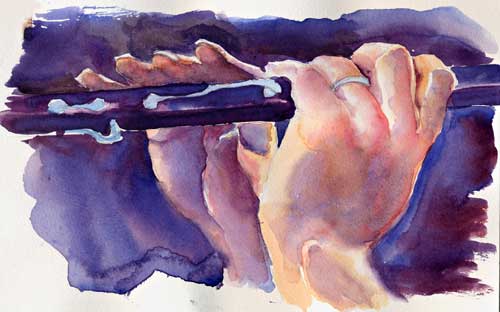
This week I painted my final version of William Bajzek’s hands playing flute. I think I’ve painted about 12 versions of this; I’m happiest with this last version, although I also like the earlier version I posted in February.
I’m calling it Trim the Velvet, one of my favorite Irish tunes. It’s a tune that falls beautifully on the flute, and one that William plays really well. You can hear sound samples of William playing Irish music with his wife, Angeline, in their duo called Castlerock. Unfortunately, they haven’t any sound samples of Trim the Velvet on their website. They should.
12 versions of the same painting. That’s a pretty compulsive thing to do. But I made about every mistake a person can make in those 12 paintings. Sometimes I made pretty awful color decisions (and sometimes no decisions at all). I struggled to create soft edges. I roared into the painting and impatiently splashed dark values onto the paper too soon. I didn’t pay attention to the paint.
These are the things I learned: Painting a watercolor is a lot like starting a relationship. It’s best to be delicate in the beginning, leaving room for the big decisions that you’ll have to make later on. Plan well. Make clear choices. Use a light touch. Be happy with what the painting wants to be.
If you think this blog might be of comfort to someone, please share it
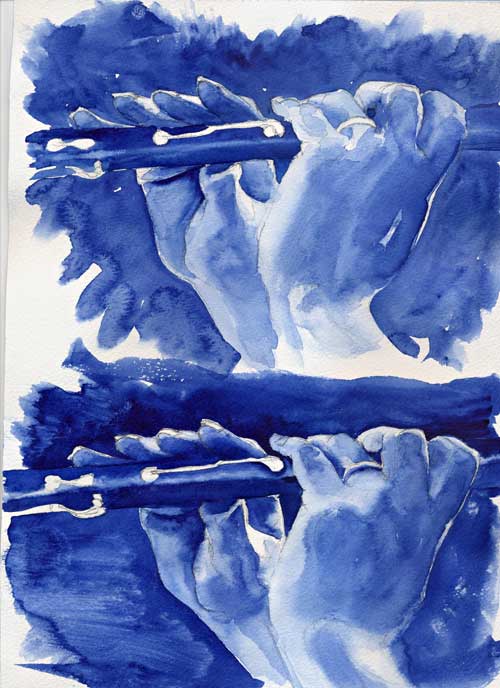
These are the hands of William Bajzek, a very fine Irishflute player from County Santa Clara (that would be in California).
When you play the wooden flute, you feel the flute vibrate through your hands and the air rush up through the finger holes. A well-made flute feels nearly alive in your hands, ready to start singing at barely a breath of air. When I watch William play, it seems to me that his hands as well as his ears are listening to his flute.
I’ve painted this image in watercolor 8 times. The first 6 paintings were one-color value studies, painted on Biggie watercolor paper, 2- up. I was trying to understand the way the values moved across the forms, and how to manipulate the paint. With watercolor especially, you need to have a plan, a framework around which to build your spontanaity, and I’m trying to figure out that plan.
I’m posting just one pair of my favorite one-color studies. I think it’s nice as one color, but I have a color piece in mind.
The first time I tried to use color was disastrous. Lesson learned: start with light value colors first, and progress to dark values. Also, be very careful with staining color, because it’s nearly impossible to remove.
I’m not entirely happy with this first color version, although it has a freshness to it. But the cheap paper buckles unattractively. And I’d like it to be a little tighter, less impressionistic, although I know that is the style in watercolor right now. Somehow I’d like to combine freshness and control in my watercolors.
If you’d like to know more about woodenflutes, you can start at woodenflute.com.
If you think this blog might be of comfort to someone, please share it


 Mockingbirds at midnight