Nicholas the elephant Available in my Etsy shop and at open studios
I’ll be exhibiting with two artists this weekend in Mountain Ranch as part of Calaveras County Arts Councils Artist Studio tours. I’m working feverishly to have some new work, things you haven’t seen yet, plus I’ll have prints of old favorites, so if you get a chance, come up the hill to visit. Each artist has widely different styles, so it should be interesting to see all of them together.
Saturday and Sunday, September 24 &25
10:00 a.m. to 5:00 p.m.
6814 Michel Road
Mountain Ranch, California
209/754-5650
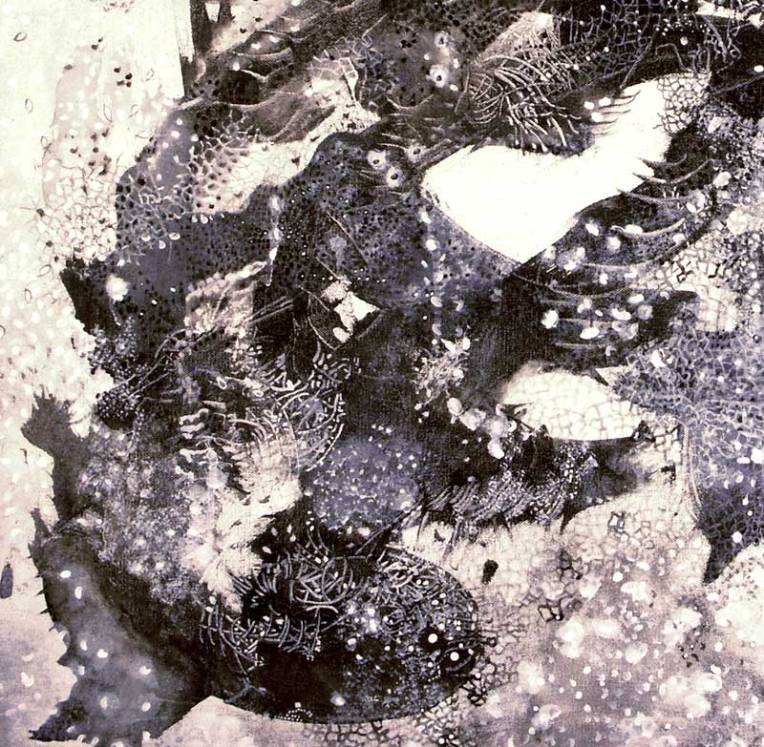
Fledgling By Gayle Lorraine Acrylic on canvas
Gayle Lorraine paints intuitively, and her black and white canvases speak of hidden landscapes, barely seen truths, and unknown dreams. Her website: www.gaylelorraine.com
House Painting by George Allen Durkee Oil on canvas
George paints landscapes full of color, energy, and life. He’s been a painter for all most of his life, and his new paintings distill a scene into just what needs to be there and no more. His website: www.gadurkee.com
If you think this blog might be of comfort to someone, please share it
I was fortunate to be selected, along with 54 other (excellent) artists and writers, to create a painting for a show called “AnimalScapes of the Sierra Nevada Foothills.” This show was a huge undertaking for the arts councils of our tri-county area, and it was with the generosity of many donors that it happened at all. As one of the artists, I’m very grateful.
Tomorrow (Saturday, January 16) is the first opening for the art show at Ironstone Winery in Murphys, California. The paintings, sculptures, and writings will be at Ironstone until February 15, then will move to Hotel Sutter in Sutter Creek (Feb. 17 – March 13), then will move once again to Black Oak Casino Hotel in Sonora (March 15 – April 3). If you are near, I hope you’ll attend, drink some wine and view (and maybe buy) some art. I think it will be worth it.
A couple of the organizers voiced their hopes that this large group show might help our area heal in some small way from last summer’s nightmare Butte Fire. I hope that it might, if art can help in that way.
Here’s the official press release: ““AnimalScapes of the Sierra Nevada Foothills” is a Tri-County Project of the Calaveras County Arts Council (CCAC), Tuolumne County Arts Alliance (TCAA), Amador County Arts Council (ACAC) and its 2 other major partners: Performing Animal Welfare Society (PAWS) www.pawsweb.org and the California Dept. of Fish & Wildlife. This project is partially funded by the California Arts Council (CAC) through a “Creative California Communities Grant” and the National Endowment for the Arts. The $23,200 CAC Grant is a “matching grant” dollar for dollar. There are also opportunities once more than half of the match has been made for in-kind donations.”
If you think this blog might be of comfort to someone, please share it
Sketch Watercolor in Strathmore Mixed Media Journal
Coming clean here: For the last couple days I’ve been painting like crazy to finish a painting for the art show Animalscapes (More about this show in another blog post). Up against the deadline? Yep.
But that doesn’t mean I haven’t been painting my 30 paintings in 30 days. Just not blogging about them.
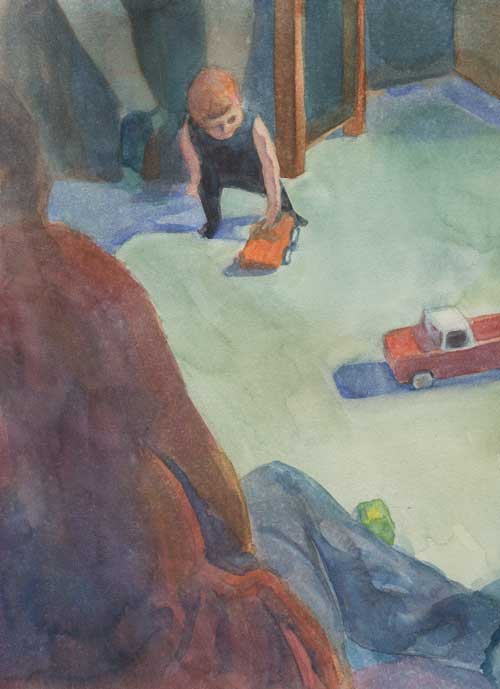
Two days ago I painted the tiny study you see at the top of this post. I painted while the fiddler drove. The painting is just a small block of color in my sketchbook of a photo I took at Christmas. The photo is dreadful; I think I dropped the camera and accidentally snapped the picture. But there was something about it that intrigued me. Maybe it’s the angles of the large green carpeted space.
In a class taught by one of my favorite artists, Felicia Forte, I learned to look at these blurry, awkward photos in a different way. Can they be cropped to create an interesting composition? Are there interesting shape or color combinations? Is there something of use?
There is something in the original photo that makes me want to keep playing with this image, and give it a bit more time.
The only baby at Christmas Watercolor sketch on 9″ x 12″ Ampersand Aquabord
If you think this blog might be of comfort to someone, please share it
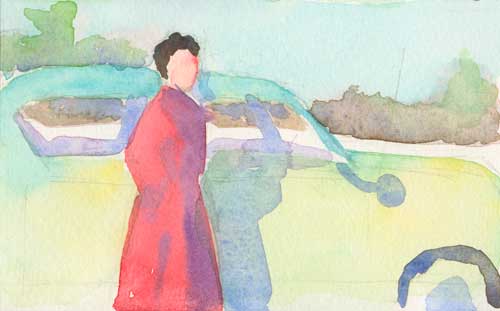
This painting was a commission from my Dad, and he wanted the house in the background; the photo was taken in my grandparent’s driveway, and my mom, my dad, and I still long for that little home in the desert where we were all so happy. But young folk have to go out on their own, and in the reflected landscape in the windows I’ve tried to capture the limitless future that all young people feel they have.
The tiny black and white photo of my mom and her very first car has lived in my dad’s wallet for nearly 60 years. My parents often drift dreamily into rhapsodies about this car; I always ask, why’d you get rid of it? My mom shakes her head and says, “you know your father.” He just looks at his plate and grins. I’m awfully glad they kept each other. They are a wonderful model for a long term, romantic relationship.
These are the original studies.
Study for painting 5″ x 3″ watercolor studyStudy for painting 5″ x 3″ watercolor study
If you’ve got an old photo you’d like interpreted with watercolor, contact me at mockingbirdatmidnight at gmail.com and we’ll talk about a commission. They make wonderful gifts and remembrances. You won’t be sorry.
If you think this blog might be of comfort to someone, please share it
One of the things I learned last weekend at Silicon Valley Open Studios was that I needed more work to display.
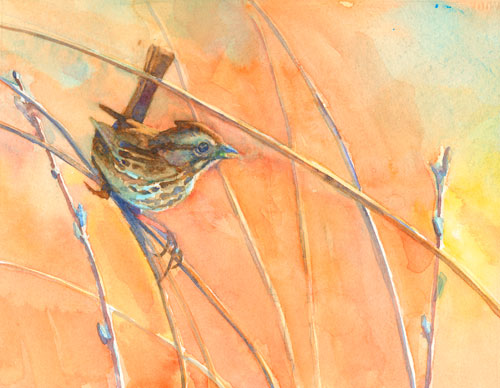
So this week I’ve been painting: Birds!
I’m a portrait painter. I seriously love painting people, but the few animal paintings I had at open studios were the most popular (read: sales.) So this week I combed through my photos and painted a few birds.
Last week I lived beyond cell phone and internet reach as I attended a week long workshop taught by watercolorist Ted Nuttall. As I expected, I learned so much (yes, the back of my head blew off a couple times!). Let me share just a few of the most important concepts I took away from this wonderful experience..
1. Slow down. No, I mean s-l-o-w d-o-w-n. I spent a lot of time thinking about my next brush stroke. Where should it go? What color should it be? How would it react with the other colors already on the paper? When I finally acted, it was with intention rather than panicked splashiness.
Abstract 2
2. Think abstractly. This was probably the single most important concept I tried to internalize. I’ve been unhappy with my work lately, finding it a bit flat, and lacking the broken color and fine edges that make my head ring with internal music. By concentrating on making each small passage its own tiny abstract painting, (that of course, relates to the whole image) I was able to add interest and visual variety to otherwise flat passages.
Abstract 3
3. Think color. I tend to get stuck in one single color: orangey-red flesh tone. But that’s not what a person looks like. Skin tones are made up of many different hues and chromas. By varying color, saturation, and value, the painting is not only more exciting, but more like life. So I went (a little) crazy with color, using combinations I don’t normally choose.
Abstract 4
4. Be uncomfortable. I made a decision that every brush stroke I put down would make me uncomfortable. I not only walked a watercolor tight rope, but I bounced a bit on the artistic high wire. Sometimes my brushstrokes set me teetering and wheeling, but after a bit of nail biting (and whining), I regained my balance and continued painting. You know what? Those seemingly near disasters turned out to be the best parts of the painting.
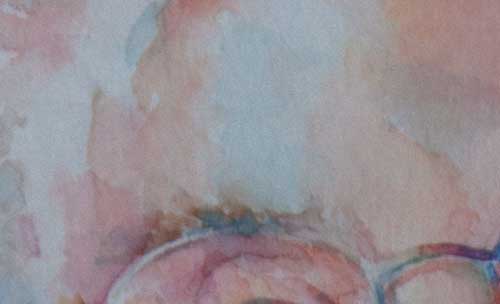
My workshop painting is still not quite finished, so I’ll not post it yet, but I’ve cropped a few of the tiny abstract paintings that make up the whole. I find them quite lovely all by themselves.
If you think this blog might be of comfort to someone, please share it
Portrait of the artist seeking perfection Watercolor on Yupo
Blogger Drew at the Skinny Artist recently posted about the perils and paralysis of perfectionism. The kind of perfectionism that keeps painters from painting, writers from writing, and musicians from musicking. You probably have felt it: the need to make sure everything is just so before beginning, working on, or finishing a piece of work. It can be a problem for creatives. It can keep us from accomplishing our goals, telling our stories, meeting deadlines, and making our dreams come true.
I know, I know, it’s hard to let go of the tyranny of perfectionism. I work at freeing myself from it constantly. But it’s possible to break those chains. Here 8 simple bullet point items that work for me.
1. Just start. Fear of failure can derail my creative train before it ever gets out of the station. But come on. It’s art, not mass transportation; if I go off the artistic tracks, nobody dies. Truly. So I chug ahead by doing something. Anything. I copy a Bargue plate; study how to draw a particular body part (right now I’m doing knees); make some color charts; even—when I’m least inspired—drag a brush or pen across a piece of paper just to make some marks. It often sparks an idea and stokes that creative choo-choo. 2. Do a lot of work. Everyday. With plenty of work going on, I don’t end up hunched over one painting hissing “my precioussss”. I’ve got other fish to fry. If a particular painting isn’t working, I move on to something else for a while. 3. Make a mistake early in the process. I work in watercolor, and we all know how hard it can be to correct an errant . Rather than live in fear that I’ll ruin my perfect piece, I often deliberately make a mistake, just to get it over with so I can paint in peace. 4. Forge ahead and find those mistakes. As an artist, I’m an explorer. I’m seeking the fountain of eternal personal vision, but along the way I’m sure get stuck in the bog of bad brushstrokes, or lost in the desert of dumb ideas. My job is to find those places too; while slogging through them, I’m also mapping them. Who knows? There might be something there I’ll need in the future. 5. When the inner critic starts blathering, change the station. Sometimes there’s a reason to listen to that gremlin, but usually there’s not. When mine starts to cackle in glee at a mistake, I shut him out by thinking of my past teachers, and imagining that they’re standing at my shoulder helping me out of a sticky situation (fortunately I’ve only ever had wonderful, supportive teachers). 6. Let it go. Take a breath. Turn the work to the wall. Go eat some cookies. When you come back to the work, you might discover the fix for any mistakes that have been bugging you. Or you might just discover that you are, in fact, finished, and ready to take what you’ve learned from this work on to the next. 7. Embrace rejection. I once asked a magazine editor friend how she dealt with the constant rejection of her ideas at story meetings. She laughed. “Ideas are cheap. I come up with a hundred of them everyday. Most of them get rejected; I don’t take it personally.” So, go back to #2 in this list. Or move on to #8. 8. Did I say work? Yeah. Work some more. Sleep. Then get back to work. Over the years I’ve noticed that many of the successful artists I admire don’t really have time for existential angst over perfectionism. They don’t have time to, well, spend a lot of time obsessing. Painters pick up the brush and paint; writers sit down at the computer and write. My fiddler takes up his fiddle and plays. There might be angst contained in the process, and they always try to do their best, but the work? It gets done.
**Disclaimer: Understand that I’m just whistling in the dark here. But the thin tune I’m singing can bolster my courage and gumption to get over that fear of failure. Because really, the game may be a foot, but still, it’s all in the mind.
Get to work.
If you think this blog might be of comfort to someone, please share it
Yesterday while plein air painting on the cliff overlooking Bean Hollow State Beach, I watched legions of families troop down to the pebbly beach. Every so often kids would stop and politely ask if they might look at my painting; My goodness, yes!
A small boy sat at the edge of the cliff next to me, a packet of colored pens and a sketchbook in hand.
“Yes,” he said quietly, “I think this will do nicely.” And he opened his sketchbook, ready to draw.
But those cliffs are slippery; it’s best to be careful on the California coast. Absorbed in the view, the little boy leaned forward, and in a scraping of dust and sand he slid down the cliff to the beach below. (Don’t worry. The cliff face is shallow, the surface smooth from generations of kids zooming down on their bottoms, and the sand and pebbles below make the landing soft and delightfully scrunchy.)
He never dropped his art supplies. He stood, brushed himself off and gazed out to sea. Then he turned and ran up the stairs, around my easel, and, still grasping pens and sketchbook, slid down the cliff again.
Gentle painters and sketchers, take a lesson from this small boy. Even though life might send you sliding down a cliff, never let go of your sketchbook!
Waves at Bean Hollow.Waves at sunset after a beautiful day.
If you think this blog might be of comfort to someone, please share it











 Mockingbirds at midnight