The landscape painter as tourist attraction

Badwater

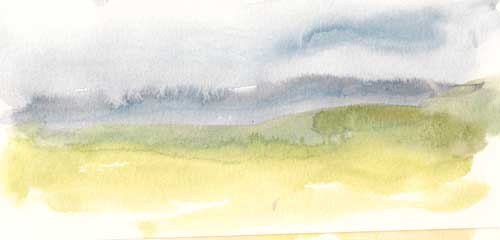
View from Badwater parking lot. Quick watercolor sketch on a piece of 3.5 x 5″ Arches 300 lb. hot press

I had planned a full day of non-painting sight-seeing with my non-painter traveling companions, but that was derailed when J. realized that she wasn’t quite recovered from a bad flu and she needed some rest.  Fortunately I had packed my watercolors, just in case I had a few moments while the others were hiking. (Always take some kind of painting supplies with you!) When the group decided to go back to the motel, I was able to split off and spend the afternoon painting.

I pulled off the road at the Devil’s Golf Course and set up my easel on the shady side of the car. Even in January, it’s often quite warm in Death Valley and I was grateful for the wee bit of shade.

DevilsGolfCourse

View from the cutoff to the Devil’s Golf Course. Watercolor sketch on 8 x 10″ Arches 300 lb. hot press.

When painting in public, I often feel like I become part of the scenery. On their way to the Devil’s Golf Course, tourists stopped and from the comfort of their car watched me paint. Some stopped twice: once on their way in and once again as they drove out, checking my progress. One man, a tourist from New York City, asked, “Can I take your photo? It’s a great shot, with you painting and the whole valley around you.”

I must be quite picturesque. I think it’s the hat.

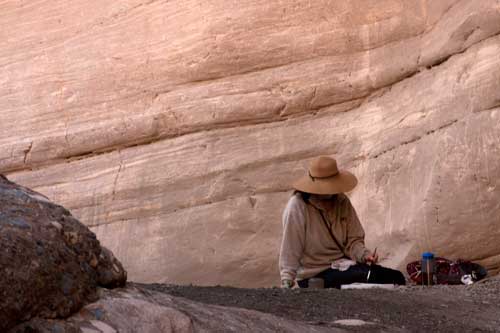
TheHatView of me, painting in the middle of Mosaic Canyon. 
Rain in the desert

Death Valley gets about 2 inches of rain a year. Just my luck, they got a fair percentage of that 2 inches on Friday night with a soft rain that began about 8 pm and lasted until the next morning.

From my first trip there, I remember the skies being a deep but empty blue. On Friday, with the storm front blowing through, the skies were full, competing with the mountains to show the most spectacular scenery. Storms in the desert are otherworldly. Water makes the desert a different place, with dampness on the wind, the smell of creosote and wet earth, and the sound of rain like an unexpected but most welcome visitor.

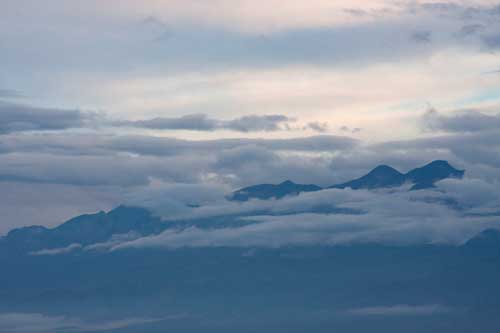
DeathValleyClouds1The morning after the rain, clouds hugged the peaks around us.

DeathValleyClouds2

They slid right down to the valley floor, wrapping the smaller hills in damp blankets.

DeathValleyClouds5

Great banks of moisture left reluctantly in the morning sun.

DeathValleyClouds3And climbed high into the desert air.

DeathValleyClouds4Eventually the valley pushed them back, and went on with its dry manner.

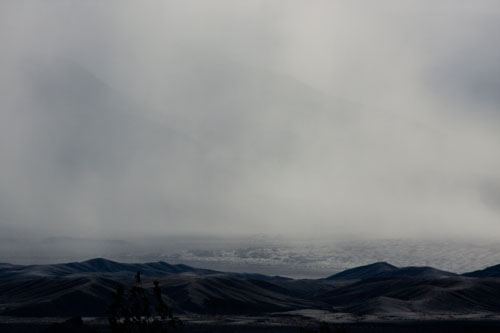
DeathValleySandStormAnd then, in another change of desert heart, a sandstorm clouded the valley floor and made the dunes shimmer and glint like Antarctic ice.


Road Trip!

PachecoPass3
Last week we were off to Death Valley with a group of friends! Painting! Hiking! More painting!

It’s a long trip to DV.  Eleven hours for us, stopping often to drain our radiators, stretch creaky backs, eat, and just generally look around. I can paint a little on the road (the fiddler does the driving), but the scenery moves too fast for an even partially realized landscape. There’s only enough time for quick color sketches.

PachecoPass1

———————————————————–

PachecoPass2

Quick color sketches in watercolor on Aquabee Super Deluxe Sketch Book paper. This paper is not sized as well as it used to be so the colors don’t sit as nicely on the paper as they do on Arches 300 lb. hot press. But for quick studies in the car, it’s enough.

I also filled in some pages of color blocks in my color journal.

colorblocks

My color journal is a Daler & Rowney Cachet watercolor journal. Again, it’s adequate, but the paint is not as vibrant or well behaved on this paper. When I’ve filled up this journal, I think I will make one bound with binder rings of my favorite Arches hot  press.

My tiny pocket palette has a mysterious collection of pigments; I don’t remember what I was thinking when I poured the paint but there are decidedly too many oranges in this palette. Most of my mixtures from the pocket palette end up being built around Mayan blue and transparent orange, with Hooker’s green and a yellow (lemon or aureolin) as secondary colors.

Anyone who likes to paint on the road really should take a look at the book A Pocketful of Watercolors: Philip Enquist. It’s a little book full of little watercolor sketches that shows just how evocative such simplicity can be.

Little cloud

Little Cloud
Oil on Panel
© 2012 Margaret Sloan

This painting captures a fleeting hour of a Northern California morning on Windy Hill. The South Bay stretched gloriously at our feet, but I blinkered my eyes and found a less dramatic scene: the last of the morning fog drifting over a little hill. It was the kind of hill that I might have climbed when I was a child, peering in squirrel holes and looking for foxes.

These days I’m finding greater success in painting small slices of the view, in making the landscape more intimate. Limiting the painting to this small view made seeing the composition and the values easier. I was able to wrap my head around the color shifts, and win more arguments with the paint than I lost.

Maybe that’s the kind of person I am right now; my present tense has gotten smaller, more confined to small views. Once-upon-a-time I took epic (seeming to me) journeys, traveling across desert horizons and through mountains of rainforests. But now I stay home mostly, in the place where I was raised.

My friend Cynthia Brannvall (an artist whose wonderful work taps into some larger, softer universal landscape) wrote to me, “One of the things that I find so beautiful about your work are the little, beautiful moments of everyday life…in this day and age when we are assaulted with stimulation and virtual realities, I find the little and ordinary gestures of real life to be more and more precious.”

I guess for me, small is comfortable. I like the up-close view, the things seen at trailside. I find value in landscapes that are familiar to children, in the possibilities of squirrel holes, foxes, and little white clouds.