At cliff edge with a sketchbook

Bean Hollow
Looking out over Bean Hollow State Beach.

Yesterday while plein air painting on the cliff overlooking Bean Hollow State Beach, I watched legions of families troop down to the pebbly beach. Every so often kids would stop and politely ask if they might look at my painting; My goodness, yes!

A small boy sat at the edge of the cliff next to me, a packet of colored pens and a sketchbook in hand.

“Yes,” he said quietly, “I think this will do nicely.” And he opened his sketchbook, ready to draw.

But those cliffs are slippery; it’s best to be careful on the California coast. Absorbed in the view, the little boy leaned forward, and in a scraping of dust and sand he slid down the cliff to the beach below. (Don’t worry. The cliff face is shallow, the surface smooth from generations of kids zooming down on their bottoms, and the sand and pebbles below make the landing soft and delightfully scrunchy.)

He never dropped his art supplies. He stood, brushed himself off and gazed out to sea. Then he turned and ran up the stairs, around my easel, and, still grasping pens and sketchbook, slid down the cliff again.

Gentle painters and sketchers, take a lesson from this small boy. Even though life might send you sliding down a cliff, never let go of your sketchbook!

Breaking waves
Waves at Bean Hollow.
Breaking waves
Waves at sunset after a beautiful day.

Music Sunday

JohnFiddling

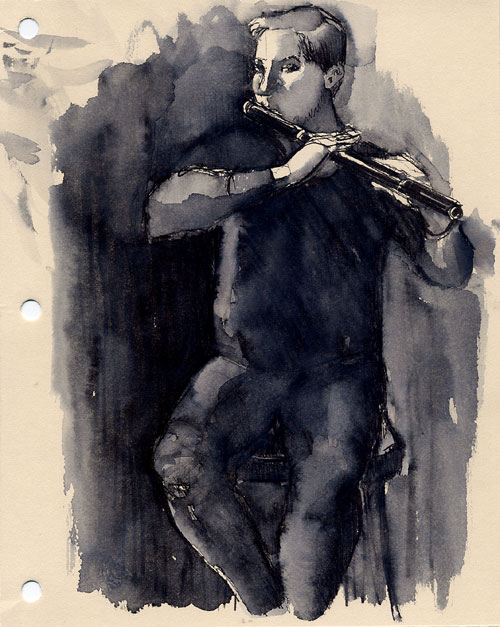
Portrait of a fiddler (but not my fiddler), done in a Canson sketch book with a Pigma Micron pen.

Music is an essential part of my life. You all know what that means. I almost never play much music anymore.

People are funny that way; the things that mean the most to us often take a back seat to everything else. And despite the fact that the fiddler and I love to play music, (in fact, playing traditional Irish music is the oldest, strongest part of our relationship) we are both scheduled to the hilt with non-musical tasks, and so we don’t often have a day devoted to tunes.  To break this trend, we decided to make last Sunday a music day.

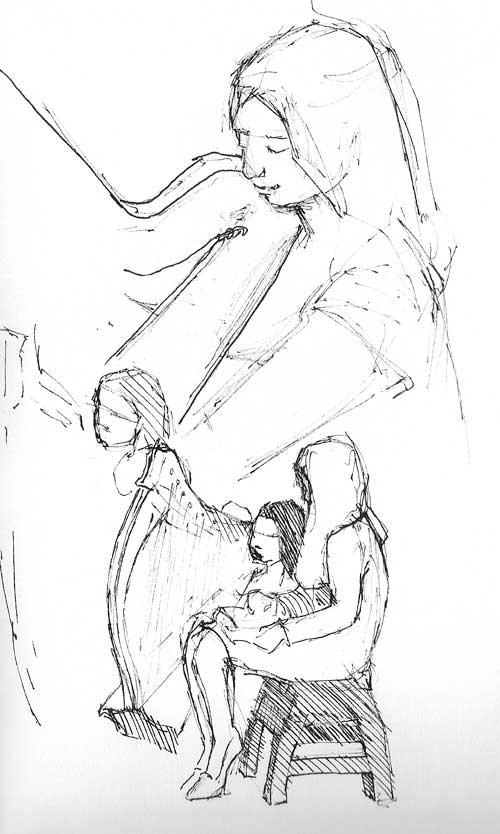
The first event we attended was the 9th Annual Santa Cruz Harp Festival at Our Lady Star of The Sea Church, presented by Shelley Phillips of the Community Music School of Santa Cruz. I hope you’ll see more about this wonderful school in future posts.

Harp players

I’ve never seen so many harps in one place! Pixie harps, celtic harps, concert harps, wire strung harps. The music was lovely, the church was beautiful, with lots of milky winter ocean light pouring through etched-glass windows. Perfect for drawing, but the sanctuary was crowded, and I was, of course, struck with extreme shyness.  Someone might look at me! Oh! The Horror! But I dredged up some grit, got out my journal and sketched while the musicians played. If anyone watched me, I didn’t know about it. I listened to the music and drew. It was like a little bit of heaven.

WomanFiddling

If you click on this sketch, you’ll be able to see a blurry bit on the fiddler’s chin (also not my fiddler) where my pennywhistle dripped moisture as I played a tune over the half finished drawing. Although the pen was a Pigma Micron, and supposedly waterproof, I guess it’s not immune to pennywhistle drool. 

Afterwards we stopped at The Poet & The Patriot Pub for the last bit of the Irish session. It was brilliant fun, and once again I forced myself to open the journal and draw (mostly while the other musicians played tunes I didn’t know). No one even payed attention; they were intent on their jigs and reels. And that was the most lovely thing of all.

Celtic harp

Chicago Irish interlude

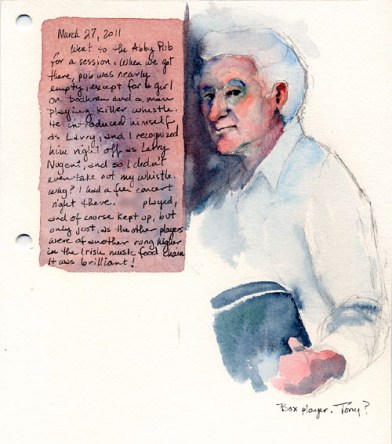
Box player at the Abby

A visit to Chicago would have been incomplete without attending an Irish session. The Chicago Irish music scene is legendary. My fiddler said this was the one thing he really, really, really wanted to do. I, of course, was not against this idea.

We found the Abby, where, when we walked through the door,  we were astounded by the most amazing whistle playing.

It was Laurence Nugent, a top Irish whistle and flute player. Pretty cool.

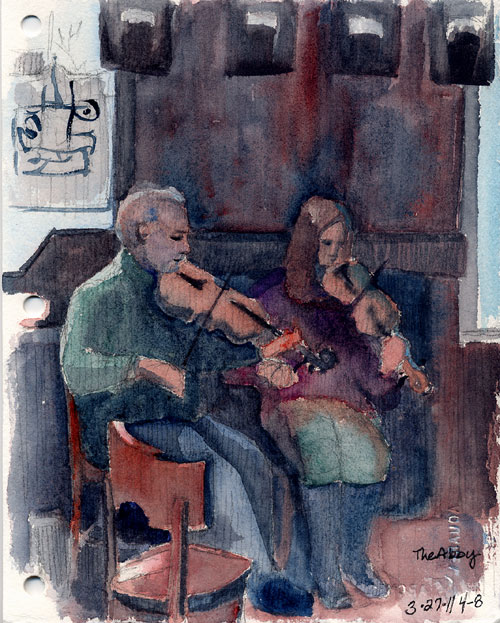
At the Abby

If I’m shy about drawing in public, sometimes I’m even more shy about playing music.  I couldn’t see taking my whistle out and squawking  around on it like a wounded ostrich when there were musicians who were roaring like lions. Instead, I sat at a table, had a beer, and listened to ripping reels, jigs, and hornpipes while I painted. Listeners are an important part of a session too!

I leave you with this video.

Sláinte!

Laurence Nugent

Public sketching and the flame of desire

I’m relatively new to the sport of public painting, and I am sometimes surprised by people’s reactions when they watch me paint. Usually I get the standard “Oh, my mother, father, sister, brother paints. They’re really good.” But sometimes other emotions come bubbling to the surface, and I’m surprised by the intensity.

I made this pencil sketch at the museum restaurant (nothing but graphite in the museum, remember?), and that evening, while sitting in a crowded restaurant, I pulled out my gouache paints and watercolor brush and started adding paint.

The table where we sat was at  a choke point in the floor plan; it slowed traffic considerably.  The customers, intent on ordering tapas, didn’t pay much attention to my splashings, but the waiters did. They stopped briefly each time they passed our table to watch the progress of the color sketch, smiling and whispering to each other.

One young man was particularly interested. He asked several times, insistently, where and how I learned to do that. Then he asked if I taught classes.

“No, I don’t,” I answered. “But in Chicago there are tons of ateliers and schools.”

He grumped. “I tried a school for art once. There was to much book stuff for me. I don’t want to learn other people’s ideas, I want to do my own.”

¡Aye Chihuahua! Not like books? Not study other people’s ideas? That makes my mind reel about like a drunken turkey on Christmas eve.

I tried to keep my flabbergastment to myself, because I could see a flame in his eyes, and I didn’t want to extinguish it. I recognized that flame because I know that bit of fire. It burns inside your chest. It burns and it hurts, because you want to do something so much that you don’t even have words for it, you don’t know how to get there, and you’re afraid to even try.
A flame like that is easily blown out by the wrong word, a flippant remark, or indifference from another artist.

My step-daughter and I spent the rest of dinner  searching our smart phones for  Chicago ateliers and by the end of dinner, we had given him a list of ones that looked promising—schools that looked like they had solid programs in drawing and painting rather than a lot of theory and academics. At the end of the evening, we presented him with the list.

“Try these schools,” I advised. “I think they’ll teach you how to draw and paint. But I hope you look at art books. You’re studying art, so the books you’ll study are full of pictures. And that’s got to be a good thing, right?”

He hesitantly nodded, and took the scrap of journal paper I handed him and stuffed it in his wallet. I hope that strong blue flame I saw in him burns brightly enough to get him down to one of those art schools, do the work, and, yes, read some books.

Copying art in the Art Institute

The first place I went in Chicago was the Art Institute. That was the first stop on our trip; I really didn’t care what else I saw in that big city. The art museum was my “it” stop.

People have asked me (rhetorically, of course) how many hours can you stand to be in a museum? I snort. I can stand in front of one painting for at least an hour! Sheesh! How can you stand to leave an art museum!

My family went along with my obsession, but they began to look a bit gray after 4 hours of wandering through illustration, folk art, modern art, and impressionism.

And then I discovered gallery 273, the room that held works by John Singer Sargent. Hearing my squeals of excitement, husband and step-daughter sighed, collapsed on a bench, and whispered to each other until they fell into art-induced comas.  I wallowed in the paintings.

The Chicago Institute of art allows only pencil and paper in the museum, so I copied this painting (after Sargent’s Madame Paul Escudier) in graphite on BFK Rives, making notes about the color and value. That night in our B&B, I sat at one of the fussy little Victorian-style tables and added gouache paints to the drawing. The Rives takes gouache very well.

The design in this painting was so powerful. I love the little shapes of the lighted windows behind the heavy dark curtains and the figure. She seems to be trapped by those curtains. If you squint your eyes, she becomes a part of them, the dark value of her skirts forming another bar against the bright daylight behind her.

We also saw the play Ethan Frome, and the ticket stub as well as the theme of the play seemed to fit nicely on this page of Victoriana.

Vacation journaling in a sardine can

InsideAirplaneThis was done rapidly in pencil on a packed cross-continental flight for New York. You can barely draw on a flight like this. There’s no elbow room at all; there’s barely room enough to get your pencil and sketchbook out. There’s not a centimeter of extra space for your sketching arm.

Airlines have been packing flights full these days and I guess to make up for the relatively inexpensive airfare, we had to pay by sitting arsehole to elbow with the 169 passengers that a 737-800 seats.

2 bathrooms for those of us in steerage…I mean, coach. The passengers in first class had their own bathroom. Hidden behind a drawn felt curtain, they might have been engaging in the kind of rich people-on-an-airplane debauchery that those of us mashed into the rest of the airplane could only fantasize about. Like getting up and going to the bathroom when they needed to, rather than  planning ahead as if going on safari.

But in the back of the plane, our 2 bathrooms were fair busy. And 20 minutes after the flight attendants bustled through with the refreshment cart, doling out fizzy drinks and weak coffee, it got worse.  Imagine roughly 140 people hearing nature’s call to action in the same 10-minute period. At times, the gotta-go line stretched more than half-way down the aisle.

And that aisle was narrow. Exceedingly so. And here, dear reader, I’d like to make a plea.

People! When you’re waiting in line for the potty on an extremely crowded airplane—and believe me, I know it’s exhausting. I’ve been in that line too. But I don’t care how tired you are—please don’t rest your huge squishy bottom on my shoulder. Don’t rest it on anybody’s shoulder. Especially if said bottom is clad in a worn pink sweatsuit.

And if you do, be aware that some of the folks you’ve rested on might not be as polite as I am.  Some might be inveterate sketchers,  and upon seeing  that expanse of faded pink jersey, might possibly be overcome with the urge to sketch. The person on whom you’re leaning might just whip out their Tombow brush pen and sketch a little scene on your rear end.

Fear of sketching

Sketch from Good Old Fashioned Bluegrass festival. While I was sketching, the woman sitting next to me struck up a conversation, and told me how much she enjoyed watching me draw!

WordPress somehow keeps track of search terms folks used to get to my blog. One of the most frequently searched terms is fear of sketching in public.

I’ve written about being afraid to sketch in public before. I am constantly trying to overcome this fear, and apparently, I’m not the only person shy about public sketching.

I’ve been working on solving this problem, because one of the things I really want to be able to do before I die is sketch freely in public, with no shame. If that’s your goal too, here are some suggestions that have helped me.

  • Take some classes to improve your skills. This is top of the list. I’ve studied figure drawing with Rob Anderson at the Atelier School of Classical Realism for 3 years. It’s improved my skill level to the point where I can sketch people and have them look like people. That has allayed my fears incredibly.
  • Plan your sketch trip as if it were an expedition to an exotic country. Expeditions are hard. They are arduous. They can be dangerous. They are adventure that takes a lot of effort, so think ahead. Select your materials with care. Decide where you’re going (make a map if it helps you). Know how you’ll provide for your basic needs (what you’ll eat, where you’ll be able to go to the bathroom.) Once you’re on your expedition, be curious, look around you, document the expedition with sketches to describe the customs of the natives.
  • Choose places where you can sketch in obscurity. At first, it helped me to sketch in large public places like parks, where I could sit on a hillside with my back against some bushes (so no one could creep behind me and look over my shoulder at my drawing). I drew people who were far away, so they didn’t get self conscious that I was drawing them. I could have been drawing them, the view, anything. And I did draw them, the view, anything.
  • Pretend you’ve got no choice. When I went to the Good Old Fashioned Bluegrass festival, I pretended that I was on assignment for a brutal editor and had to come away with ten sketches. I just didn’t have any choice. I had to do it. The sketches didn’t have to be particularly good, but there had to be 10. That worked for me, as I’m used to deadlines and assignments.
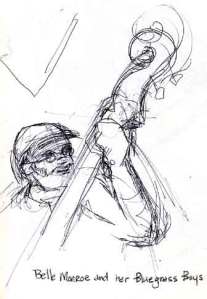
  • BassplayerKeep it simple. Don’t try to create a masterpiece. That’s way too much pressure. Draw stick figures if you must. Anyone can draw a stick figure. Try just to get the action or composition down using stick men as shorthand. Stick figures are amusing, and a low commitment for the artist. Later you can hang skin and clothes on the little figures in a place where no one can look over your shoulder and criticize. Same with a landscape. Just try to get the bones of the landscape. Don’t worry about drawing every bush, tree, or leaf.
  • Remember that people don’t see your work the way you do. We artists tend to be our worst critics. We see flaws; others see beauty, or effort, or the coolness factor that you’re an artist.  They may even be thinking, “gee, I wish I had the courage to do that.”

Good old fashioned sketchbooking

Guitar playerWell, whattaya know! The Great Bluegrass Festival Drawing Expedition was a blast. Despite my fears at venturing into public drawing, I sketched unscathed at the Good Old Fashioned Bluegrass Festival. Musicians didn’t take offense at my sketching: bass players didn’t mow me down with their gigantic instruments; fiddlers didn’t skewer me on their bows, nor did banjo players strangle me with their twangy metal strings. And the people who looked at me (yes, they did. They actually looked at me with my little journal and bag of pencils) while I drew, why, they were delighted! One woman saw me drawing, grinned widely and said, “what fun is that!”

And darn it, it is fun. Normally I dislike listening to music while I work. I find it distracting—one of the uncomfortable things about being a musician is that there is no background music. My musical brain always stands at attention for anything resembling music, and disallows any action by the other thinking parts of my brain. I am not a good multi-tasker when music is playing.

The Barefoot Nellies singing harmony

But this was different. For one thing, I was prepared for music.  I knew there would be lots of it. Besides, I wanted to sketch musicians while they played.

One thing I learned. Bluegrass really sets your toes tapping and makes your drawing arm swing.

It was really hard to sketch people as they played. Those musicians are moving all the time, and each drawing was an exercise in fast gesture poses—good practice for me. You can see that the drawings weren’t entirely successful, especially around the hands. And even less successful around the instruments.

One of the Winton boys playing dobro and a small sketch of the dad playing guitar.

I point out the unsuccessful parts because drawing at this festival really made me see the areas in which I have smaller knowledge, the parts of the world that I need to really look at and understand. That means concentrated study.

To draw a form rapidly, and draw it well, I think you need study it. It needs to be in your head already. You have to study forms so hard that you can trot out a hand, a foot, a face, a fiddle, and draw it perfectly from memory. Once you’ve internalized it, then I think you can really accomplish something.

Again, it’s the analogy of musical scales. You’ve got to get those major and minor keys down so you can shift between them at any turn of the tune. Then you can really start to have fun when you play with other people.

Fear and sketching in Tres Pinos

RichardThis sketch is of my friend Richard. Richard is a versatile musician. He plays Irish music, old time music, jazz. I’ve known him over a decade now, and he has taught me numerous tunes.  I drew  this picture in a Kunst & Papier watercolor journal I won from  a contest held by one of my favorite bloggers, Roz Stendahl. The paper’s not great for watercolor; it doesn’t hold a lot of  watercolor pigment and it buckles. But it’s a nice feeling book to work in, and the paper will take very light washes of color. I like the way the Tombow goes down, and I like the way pencil slides across the paper. The book is sturdy, and fun to carry around.

I love drawing musicians while they play music. Trouble is, I’m shy about sketching in front of people I don’t know. Or even those I do know, unless I trust them—as I do Richard. I’m still working on my chops in the portrait department, and I still feel inadequate. Criticism isn’t helpful.

I am trying to get over this. I’m trying to get over the feeling that people who look at me while I’m painting are grading me or rejecting me. I think it goes back to an old boyfriend who once said, “You’re not going to be one of those artists who draws in public all the time, are you? People will look at you!”

And people do look. They crane their necks to look at you, stand over you and breath on you, make comments. It’s disconcerting. But of course they look at you.  David Hardy, at the Atelier, tells me that people “are fascinated and consider you special. You have added to the excitement in their life.”  What?! Little old me?

I know that other artists aren’t shy. Roz Stendahl goes to places like the state fair specifically to sketch. She writes about these jaunts as if they were an expedition, packing what she’ll need as if she were going to discover and sketch the headwaters of the Nile. I’ve decided to emulate her.

This weekend we’re going to the Good Old Fashioned  Bluegrass Festival in Tres Pinos.I’ve never been, and I don’t play bluegrass music, although I’ve listened to a fair amount of it. My husband will be appearing in his band, Harmon’s Peak. I’m going on a mission: to draw people. I’m going to have to force myself to do it, as the thought of sketching in public like that makes me weak in the knees. What a wuss I am!

I’m planning it like it’s an expedition. I’ve got to choose what medium to work in, and which sketch book I’ll take. Then I have to remember my glasses. And to take deep breaths. And to have fun.