Monday life drawing at the last minute

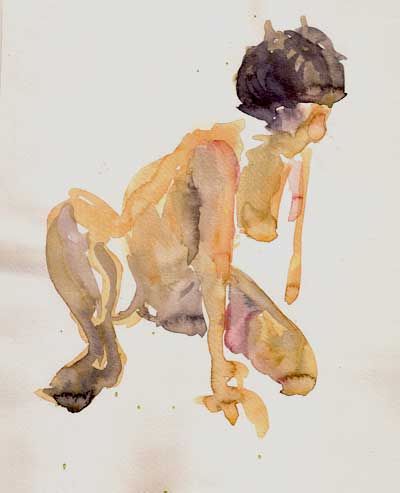
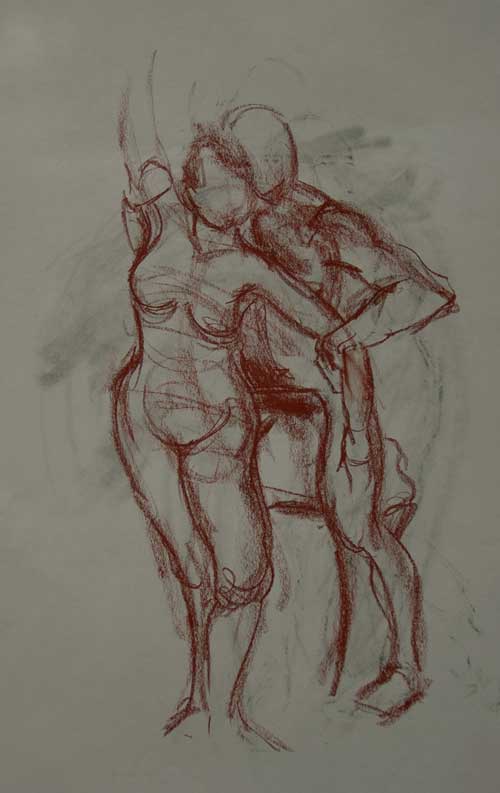
5 minute gesture drawings with Micron Pigma pens on card stock
5-minute gesture drawings with Pigma pens on card stock

On Monday night I had planned on attending the local life drawing session after work. But when the demands of the day job made me late, I almost bagged it. I didn’t have time to go home to get my charcoal and Biggie pad of paper, and I wanted my dinner (like an army , I travel–and draw–on my stomach).

I had a little pouch full of Pigma pens, and a sketchbook too, but I didn’t want to fill the sketchbook with millions of gesture drawings. I’m fussy about that kind of thing. It takes me a long time to warm up, so that my first 1- and 2- minute gesture drawings are big messes. I like to use cheap paper I can throw away. I’m less precious when I use crummy paper for warm up sketches, and I don’t feel bad about all the mistakes.

I didn’t have cheap newsprint with me Monday night, but I did have a calendar made from cardstock and bound with wire. Cheap. Temporary (I’ll throw it away at the end of the year). So I did my quick sketches on the back of the calendar pages.

Wow! What a pleasure it was to draw those Pigma pens across that cheap card stock. I loved the graceful line and delicate shading that was possible on the semi-smooth surface, and the ink dried quickly, so I didn’t smudge.

And the model, when he saw that I was drawing on my calendar said, “Cool, I always wanted to be on a calendar. What month am I?”

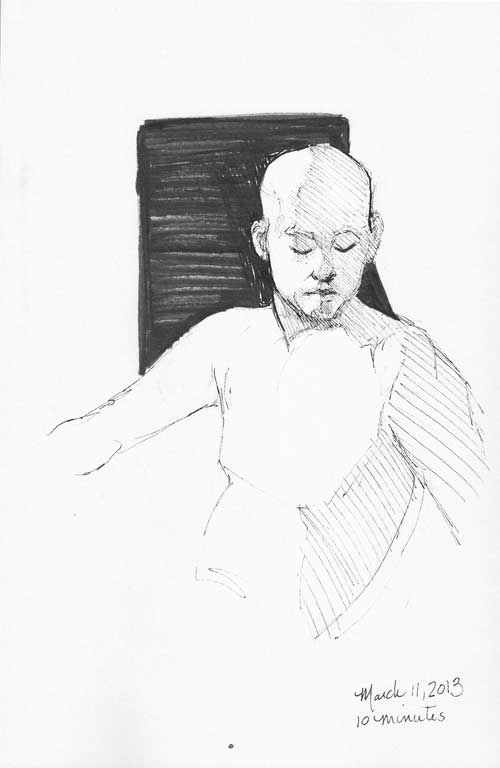
Jesse10minutes

Mr. February

Music Sunday

JohnFiddling

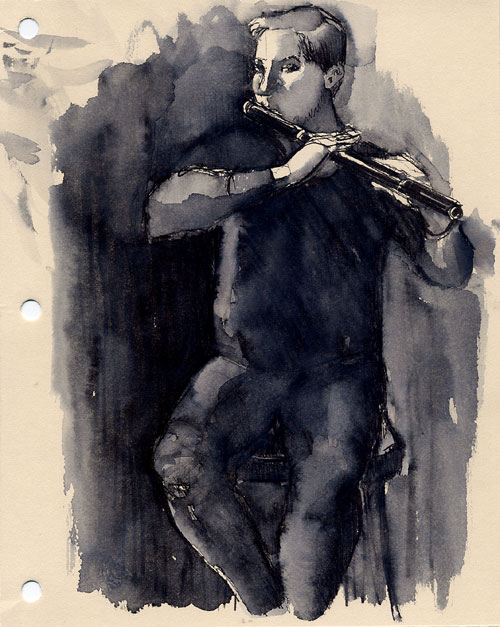
Portrait of a fiddler (but not my fiddler), done in a Canson sketch book with a Pigma Micron pen.

Music is an essential part of my life. You all know what that means. I almost never play much music anymore.

People are funny that way; the things that mean the most to us often take a back seat to everything else. And despite the fact that the fiddler and I love to play music, (in fact, playing traditional Irish music is the oldest, strongest part of our relationship) we are both scheduled to the hilt with non-musical tasks, and so we don’t often have a day devoted to tunes.  To break this trend, we decided to make last Sunday a music day.

The first event we attended was the 9th Annual Santa Cruz Harp Festival at Our Lady Star of The Sea Church, presented by Shelley Phillips of the Community Music School of Santa Cruz. I hope you’ll see more about this wonderful school in future posts.

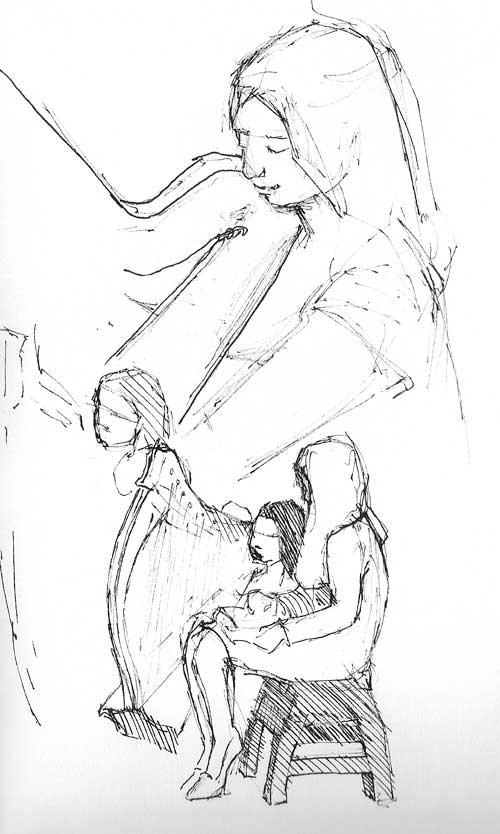
Harp players

I’ve never seen so many harps in one place! Pixie harps, celtic harps, concert harps, wire strung harps. The music was lovely, the church was beautiful, with lots of milky winter ocean light pouring through etched-glass windows. Perfect for drawing, but the sanctuary was crowded, and I was, of course, struck with extreme shyness.  Someone might look at me! Oh! The Horror! But I dredged up some grit, got out my journal and sketched while the musicians played. If anyone watched me, I didn’t know about it. I listened to the music and drew. It was like a little bit of heaven.

WomanFiddling

If you click on this sketch, you’ll be able to see a blurry bit on the fiddler’s chin (also not my fiddler) where my pennywhistle dripped moisture as I played a tune over the half finished drawing. Although the pen was a Pigma Micron, and supposedly waterproof, I guess it’s not immune to pennywhistle drool. 

Afterwards we stopped at The Poet & The Patriot Pub for the last bit of the Irish session. It was brilliant fun, and once again I forced myself to open the journal and draw (mostly while the other musicians played tunes I didn’t know). No one even payed attention; they were intent on their jigs and reels. And that was the most lovely thing of all.

Celtic harp

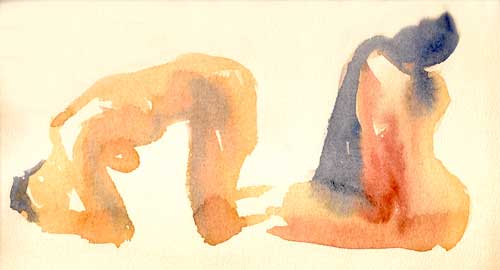
Figures under water

After reading Sue Smith’s blog at Ancient Artists about pushing your art to the next level, I felt I needed to challenge myself. So, watercolor backpack in hand, and a stack of failed paintings (the backs of the paper still pristine, ready for work) under my arm, I headed to a local life drawing session to try my hand at sketching with water and paint.

I was in a kerfuffle from the first moments, adrift without the guiding compass of charcoal pencils and kneaded eraser.  And painting at the session was completely different from painting at home. Normally I stand at my easel and work on a vertical surface; at the session, I sat at a table, paper propped on my backpack.

1-minute watercolor war zone

Right away, my body rebelled against sitting. My neck and back ached, my hands stung, and my butt fell into a pins-and-needle coma. The process of painting like that was awful.

I floundered during the first 20-minute set of 1-minute poses, completely rudderless and out of control. I thrashed about with brush, paper, paint, water, making a mess.

The quick gesture paintings looked like a war zone. Body parts were disconnected. Chaotic limbs and runny torsos bled across the page. The figures turned into misshapen blobs of color.

During the break in poses, I screwed up my courage and asked if it would bother anyone if I stood. Talking to people! Asking for something! That was a breakthrough in itself, overcoming my  little mouse-self that doesn’t like to make a fuss in public.

You know what? Nobody cared. So I stood.

That helped. The next set of 2-minute poses made me much happier. I began to make friends again with my paintbrush, and like any good friend, my trusty Kolinsky sable helped me to see in a new way. It taught me to look for the large shapes, forms, and shadow patterns.

2-minute watercolor sketches

The 5-minute poses came along a bit better . The one below is my favorite. The horns on her helmet-hair were accidental, but I love them. Watercolor warrior woman!

5-minute watercolor sketch

At 10-minutes I thought that I could give myself a few graphite guidelines to help me control where I put the paint. And that is where I lost the energy of the previous paintings.

10-minute watercolor sketch

Below you can see the final 20-minute pose. Except for the extraordinarily long arm, it’s a pretty correct representation of the model’s position. But that’s about it.  It has lost some of the wonderful freedom of the quick sketches.

20-minute watercolor sketch

Somewhere  between loss of control and total control there are pictures to be made. The challenge is to navigate to that tricky space.

Dancing the charcoal fantastique

A few years ago I studied briefly with a life-drawing teacher who made me stand arm length from the paper, take up a hand-size piece of charcoal, and dance while I drew.

“Keep your arm straight, he directed. “Draw from the shoulder, not the wrist. Move your body!”

He turned on some jazzy music, and insisted that I dance throughout the whole 20-minute set of short poses.

“You already know how to find proportions,” the teacher said. “You know how to draw the parts of the body. You’ve got a good eye. Now you have to find some life, some joy in your drawings.”

You must understand. I’m not a cheeky, dancing-on-the-table party-girl kind of person; I’m a focused, earnest, git-r-done kind of person. Generally, I don’t dance; I plod.

And I was deadly serious about learning to draw. I had been studying with Rob Anderson for a couple of years, and was used to doing slow, careful, accurate work. I was strict with myself.

Doing a dance step and shaking my hips while trying to capture on paper the motion of a model? It was a little weird. Okay, so it was a lot weird. And I was afraid I’d let go of the drafting skills I’d worked so hard to gain. I was afraid the outcome would be terrible.

But you know what? The dancing didn’t destroy my hard-won knowledge of proportions, comparative drawing, and anatomy. All the practice I’d done previously was lodged in my subconscious, and when the music started and I started moving, the knowledge and skill bubbled up and gave form to my dancing.

I wasn’t just head banging in a papery mosh pit; I was floating around gracefully on a dance floor sprung with newsprint and chalk. And the drawings were something entirely different from anything I’d done before.

All that dancing had helped set me free from precious scratchy little marks and awkward figures. Those dance-infused drawings marked a huge leap of progress for me.

I normally work in a silent studio, but these days, when my drawings start to seize up into crabbed little wads of chalk-snot, I put on my headphones, spin my Ipod dial to music, and do a little shimmy at the easel.

A meditation on gesture drawing


1-minute gesture drawing
Charcoal on newsprint

Last month I spent a brilliant morning drawing at a model guild benefit, and it reignited my love of life drawing, and especially the gesture. And since I get an disproportionate number of hits for “gesture drawing,”  I thought I’d scratch out some thoughts on gesture drawing from life.

Gesture drawing is often described as capturing the action of a pose, the feeling of a thing, the “inner essence”. It’s quick, it’s forceful, it’s to-the-point. It captures an active moment in time. A frozen glimpse of a model balancing on one leg; a dog loping along the beach; a bank of clouds blowing like boulders across the horizon.

At it’s most academic, gesture drawing is about studying. It’s about drawing—a lot of—poses, or people, or animals, or landscapes, in a short amount of time. It’s a rapid and deep immersion into a multiplicity of form and line. It’s an exploration of media and mind. A flick of the wrist and the arc of the arm discover new shapes and spaces, new angles and elements, new ideas  to build upon later when drawing time has once again slowed to a careful crawl.

But at it’s most basic level, gesture drawing is simply and awfully darn fun.

4 1-minute gesture drawings
Charcoal on newsprint

Chicago Irish interlude

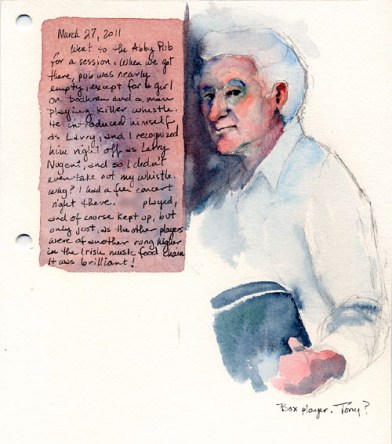
Box player at the Abby

A visit to Chicago would have been incomplete without attending an Irish session. The Chicago Irish music scene is legendary. My fiddler said this was the one thing he really, really, really wanted to do. I, of course, was not against this idea.

We found the Abby, where, when we walked through the door,  we were astounded by the most amazing whistle playing.

It was Laurence Nugent, a top Irish whistle and flute player. Pretty cool.

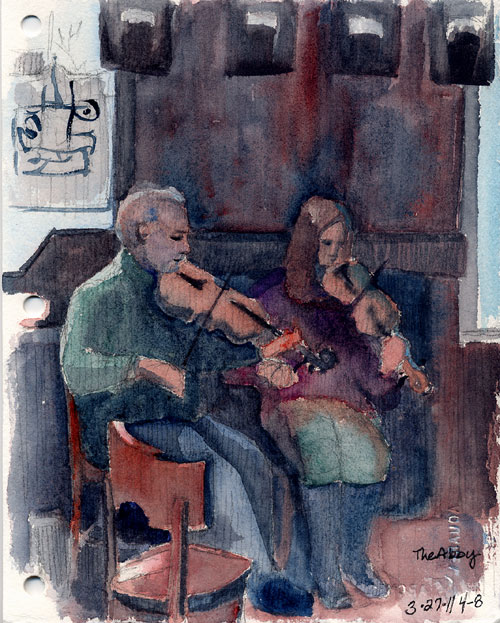
At the Abby

If I’m shy about drawing in public, sometimes I’m even more shy about playing music.  I couldn’t see taking my whistle out and squawking  around on it like a wounded ostrich when there were musicians who were roaring like lions. Instead, I sat at a table, had a beer, and listened to ripping reels, jigs, and hornpipes while I painted. Listeners are an important part of a session too!

I leave you with this video.

Sláinte!

Laurence Nugent

Public sketching and the flame of desire

I’m relatively new to the sport of public painting, and I am sometimes surprised by people’s reactions when they watch me paint. Usually I get the standard “Oh, my mother, father, sister, brother paints. They’re really good.” But sometimes other emotions come bubbling to the surface, and I’m surprised by the intensity.

I made this pencil sketch at the museum restaurant (nothing but graphite in the museum, remember?), and that evening, while sitting in a crowded restaurant, I pulled out my gouache paints and watercolor brush and started adding paint.

The table where we sat was at  a choke point in the floor plan; it slowed traffic considerably.  The customers, intent on ordering tapas, didn’t pay much attention to my splashings, but the waiters did. They stopped briefly each time they passed our table to watch the progress of the color sketch, smiling and whispering to each other.

One young man was particularly interested. He asked several times, insistently, where and how I learned to do that. Then he asked if I taught classes.

“No, I don’t,” I answered. “But in Chicago there are tons of ateliers and schools.”

He grumped. “I tried a school for art once. There was to much book stuff for me. I don’t want to learn other people’s ideas, I want to do my own.”

¡Aye Chihuahua! Not like books? Not study other people’s ideas? That makes my mind reel about like a drunken turkey on Christmas eve.

I tried to keep my flabbergastment to myself, because I could see a flame in his eyes, and I didn’t want to extinguish it. I recognized that flame because I know that bit of fire. It burns inside your chest. It burns and it hurts, because you want to do something so much that you don’t even have words for it, you don’t know how to get there, and you’re afraid to even try.
A flame like that is easily blown out by the wrong word, a flippant remark, or indifference from another artist.

My step-daughter and I spent the rest of dinner  searching our smart phones for  Chicago ateliers and by the end of dinner, we had given him a list of ones that looked promising—schools that looked like they had solid programs in drawing and painting rather than a lot of theory and academics. At the end of the evening, we presented him with the list.

“Try these schools,” I advised. “I think they’ll teach you how to draw and paint. But I hope you look at art books. You’re studying art, so the books you’ll study are full of pictures. And that’s got to be a good thing, right?”

He hesitantly nodded, and took the scrap of journal paper I handed him and stuffed it in his wallet. I hope that strong blue flame I saw in him burns brightly enough to get him down to one of those art schools, do the work, and, yes, read some books.

Copying art in the Art Institute

The first place I went in Chicago was the Art Institute. That was the first stop on our trip; I really didn’t care what else I saw in that big city. The art museum was my “it” stop.

People have asked me (rhetorically, of course) how many hours can you stand to be in a museum? I snort. I can stand in front of one painting for at least an hour! Sheesh! How can you stand to leave an art museum!

My family went along with my obsession, but they began to look a bit gray after 4 hours of wandering through illustration, folk art, modern art, and impressionism.

And then I discovered gallery 273, the room that held works by John Singer Sargent. Hearing my squeals of excitement, husband and step-daughter sighed, collapsed on a bench, and whispered to each other until they fell into art-induced comas.  I wallowed in the paintings.

The Chicago Institute of art allows only pencil and paper in the museum, so I copied this painting (after Sargent’s Madame Paul Escudier) in graphite on BFK Rives, making notes about the color and value. That night in our B&B, I sat at one of the fussy little Victorian-style tables and added gouache paints to the drawing. The Rives takes gouache very well.

The design in this painting was so powerful. I love the little shapes of the lighted windows behind the heavy dark curtains and the figure. She seems to be trapped by those curtains. If you squint your eyes, she becomes a part of them, the dark value of her skirts forming another bar against the bright daylight behind her.

We also saw the play Ethan Frome, and the ticket stub as well as the theme of the play seemed to fit nicely on this page of Victoriana.

If the Northern Lights played the fiddle

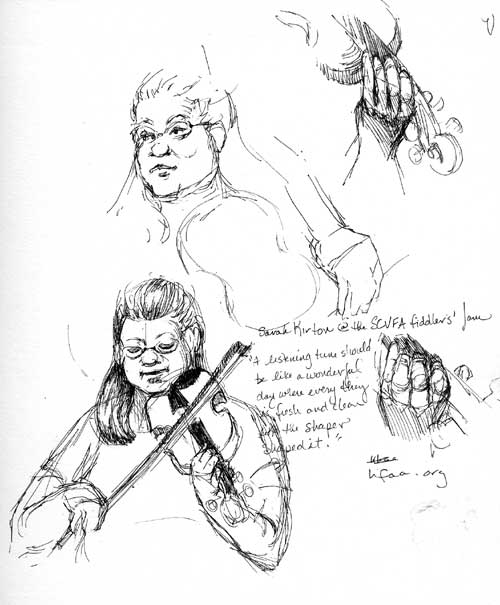
The text says: "A Listening tune should be like a wonderful day where everything is as fresh and clean as when the Shaper shaped it."

Today we went to the Santa Clara Valley Fiddlers Association to hear fiddler Sarah Kirton play her hardingfele. It was sheer magic.

The hardingfele, or hardanger fiddle, is a traditional instrument of Norway. It’s got 4 strings stretched across the top of the instrument, like a regular fiddle, but beneath those strings are 4 more strings that buzz and moan in sympathy when the top strings are played. The music is other-worldly. When I hear it, I think of ice goddesses, snow fields, midnight suns, birch trees in brilliant green meadows.

If the northern lights played music, it would be on the hardingfele.

In the Bay Area we gab ceaselessly about diversity, and yet, most people only really listen to music presented to them by mainstream radio; they don’t know that there is a whole world of music out there that isn’t just Lady Gaga and Justin Beiber.  It’s the musical equivalent of eating at only McDonalds when you live 2 blocks from a wonderful street where every restaurant serves food from a different country . If you never go down that street, you never even know that there are other foods.

If you want to taste some Norwegian hardingele music, you might start at the Hardanger Fiddle Association of America. There are some sound files to give you an idea of what this wonderful and mysterious music sounds like.  And there’s a radio show about the fiddle (Sarah’s in it!) here.

And you might want to explore some of the fabulous musical menus that the world has to offer. Who knows? There might be a hardingele fiddler living right next door to you!