Gold Rush dancing and great news

Dancing
Dancing

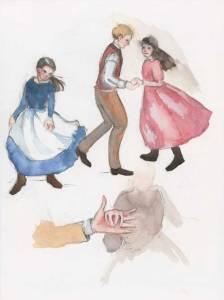
Saturday night the fiddler had a gig in Columbia State Historic Park playing tunes for the annual Lamplight Tours. Docents dressed like they stepped out of 1849 give tours of Columbia, and players perform skits so that you can see what it might have been like when the West was still wild. Afterwards in Angelo’s Hall there was dancing, cake, and merriment. And beautiful costumes.

Waiting to Dance
Waiting to be asked

I am always amazed at the time and effort the docents take in creating their costumes. Corsets and collars, tucks and pleats, hand-crocheted lace and yards of trim: All the details are researched and historically accurate, I’m told. Right down to what’s under the crinolines. The ladies looked like flowers spinning on the dance floor.

I always covet these dresses. Someday, when I learn to sew…

Of course I had to sketch the dance (when I wasn’t playing tunes).
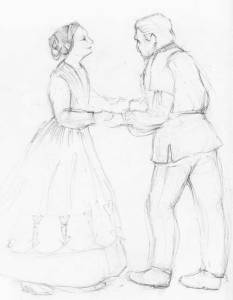
couple dancing
The Sailor’s Dance

I was off my game, though, thanks to the miracle of modern medicine. The previous day I’d had a procedure that would have been unimaginable during the Gold Rush. Thankfully the doctor gave me a two-year pass until the next time I need the test. I’m certified cancer-free! Yippeee! No wasting sickness for me. If I’d had a long dress, I’d have been spinning with the other girls.

But the drugs block the signal between my brain and hand. I could remember tunes, but my fingers wouldn’t play them. While drawing, I fumbled and erased a lot. But it was still fun to  capture an older entertainment with an even older technology.

Dance Teacher
Dance teacher

Really, more people should get out and dance. It’s a lot of fun.


Round the house and mind the easel!

Playing for Set Dancers
Graphite

My band has been preparing for a gig. We recorded a tune, and when I listened to it, I was horrified to hear a tempo as ragged and floppy as an old stuffed bunny.

I play Irish flute, specifically dance music. I love the rolling beat, the pulse of the tune lifting and driving dancers through the set. The beat needs to be crisp and perfect to move the dancers.

But that what wasn’t what I was hearing in our recording.

So I’ve spent the last week practicing with a metronome, first lilting the tune in time with the flashing red LED, then trying to match my flute playing to that maddening strobe.

It’s amazing how that little pulsing light seems to slow down and speed up as I play a tune. At first I thought there was something wrong with the metronome, but of course, there’s nothing wrong with the electronics; it’s my playing that’s uneven. But gradually I’ve managed to tame my out-of-control tempo, and the tunes sound all the better for it.

Painting isn’t like playing a flute, but visual arts don’t exist outside of tempo. I think that paintings have their own internal tunes. My favorite paintings are those that make my brain feel like I’m seeing music. Sorolla paintings play tunes to me. Zorns are full of music. Sargent is something like a symphony. Surprisingly (because I prefer realistic work) Paul Klee paintings are like small pipes and fiddles.

I find that external noise while I paint influences a painting’s tempo. My most successful paintings are done in silence, when I really listen to the painting and pay close attention to the pulse that each passage requires. I listen carefully to hear fast strokes that are well conceived; slow shapes of color placed just exactly where they need to be; staccato or slurred edges; the pacing of high and low values. I’m always asking myself, how do I encourage the viewer to dance through a painting?

When I paint, there’s no steady tick-tock of a metronome, other than the drum of my blood and the deep sound a painting makes when it’s making my heart dance. Only if my heart is shouting “house Maggie, mind the dresser!” will I have a chance to let others hear that internal music.

The short long pose


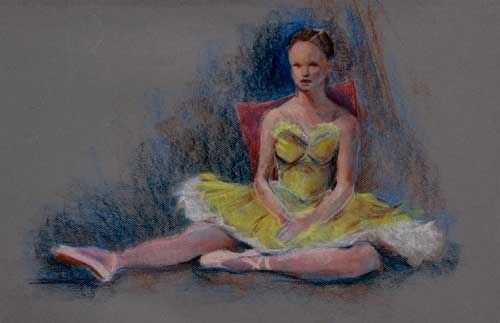
I dropped in on Linda Corbett’s life drawing class last week. I was at the Pacific Art League for a portrait class, but it had been canceled and Linda said, “You’re welcome to stay for my class. We have a ballerina for the model tonight.” And on cue, a beautiful young woman strolled in, a tutu under one arm.

Good teacher. She knows what kind of lure will catch a student.

The drawing I’ve posted above is a “long” pose—two 20-minute sets and two 15s. That’s not much time for me; I’m used to much longer poses at the Atelier. I have clocked in 20 to 30 hours on one pose. I haven’t drawn from short poses much in the last couple years.

It meant I had to manage my time more rigidly so that I could bring the entire drawing up to some small amount of finish by the end of the evening. I allowed myself only the first 20 minutes for the block in, 10 minutes into the second pose to check measurements and make any adjustments, then the remaining time to build up the form with pastel color.

That was an exciting exercise. At the time it felt like drawing like the wind. But now I can see all the flaws in execution. It felt good to draw that way, but I traded emotion for precision.

On the other hand, this sketch above was done in about 2 minutes as the model was tying on her toe shoes. Although the proportions are off, the sketch still has an energy and integrity lacking in the twenty minute sketch. Weird how that works. Sometimes a really fast sketch will capture the model better than a longer pose.

I decided to attend the rest of the class—4 classes in all—and concentrate on pastel portraits. I’m interested to see what happens when I only have one 20-minute pose to catch a likeness.


Harmon’s Peak

Tombow brushpen and waterbrush
I drew this while Harmon's Peak sang Buffalo Gals, a song from the 19th century that's still a terrific song in the 21st century.

The best part of the Good Old Fashioned Bluegrass Festival was the jamming that took place after the amplified music stopped. There was music all night long—of course bluegrass, but also old time, blues, jazz, and a group of folks having a dance party while they played bluegrass tinged Beatles, R&B, and disco. By 1 am I was exhausted, and I drifted off to sleep under a nearly full moon, hearing banjos, fiddles, guitars, and stand-up bass in the campsite 3 spaces over. Sheer heaven.

The amount of talented folks in everyday life astounds me. People go crazy for superstars, but there’s a lot of people out there who are top-notch musicians. They might even be living next door to you!

The next morning my husband’s band, Harmon’s Peak played. They’re an old time string band, which is a different style of music, but it’s part of the roots of bluegrass. As you can see, they’re the best dressed old time band in the Bay Area.

Harmon's Peak
Harmon's Peak