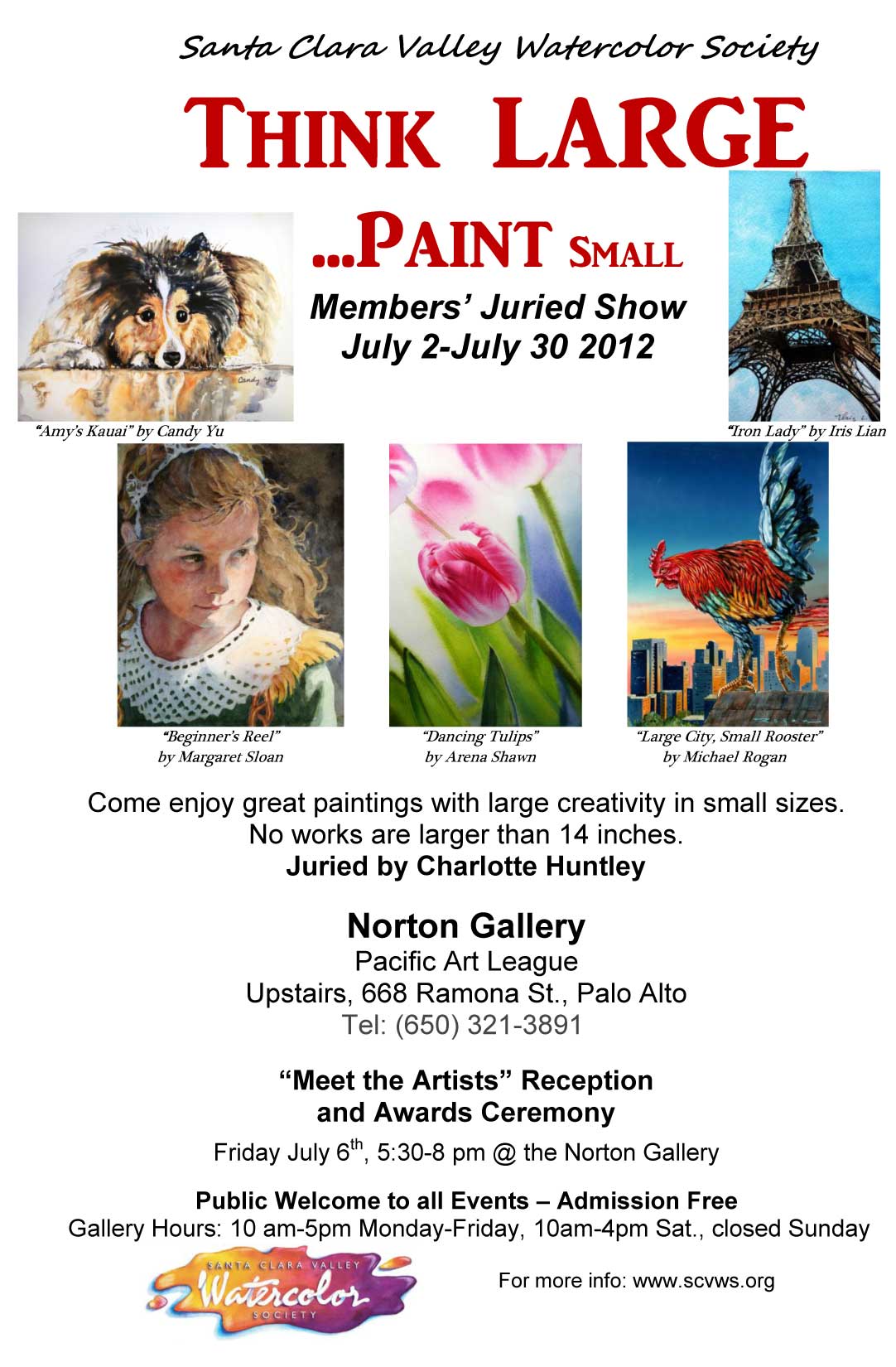
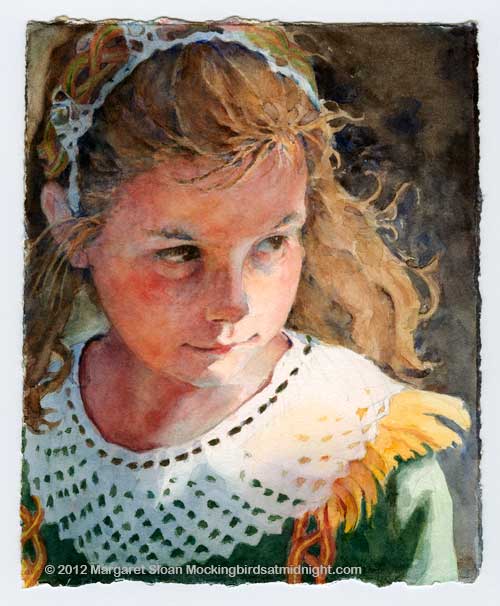
I’m super excited to tell you that this painting of a little Irish dancer has been accepted to the Santa Clara Valley Watercolor Society’s show, “Think Large…Paint Small.”
It’s one of my favorite paintings I’ve made this year. I saw this little girl dance last spring at an exhibition show for children at the Bay Area Discovery Museum; she was the only one in her beginner class, and she danced alone. I thought her quite a brave little girl to dance solo for an audience of her peers.
If you think this blog might be of comfort to someone, please share it
Happy After-Solstice Saturday!
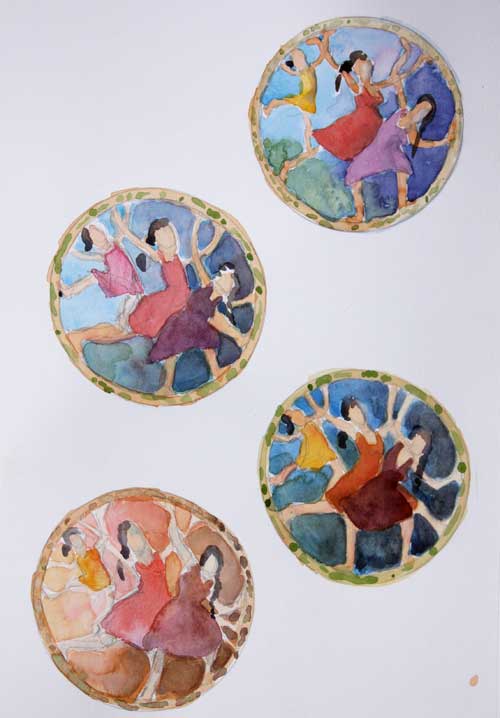
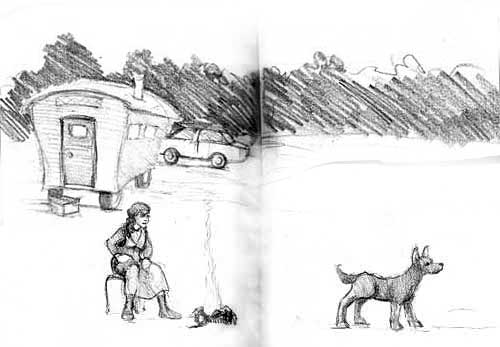
My birthday doodle has turned into a painting idea.
I like to plan my paintings, doing lots of composition sketches, and then making thumbnail color sketches. (which color combination do you like best?).
Then I spend time perfecting the drawing.
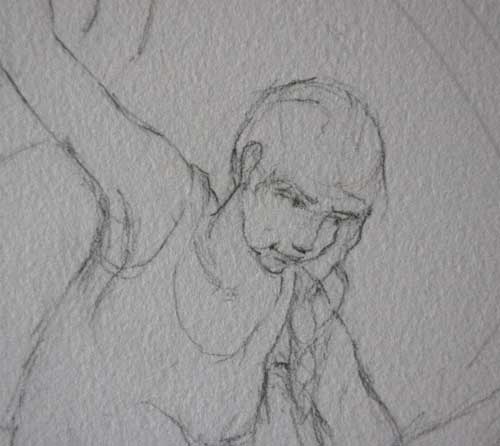
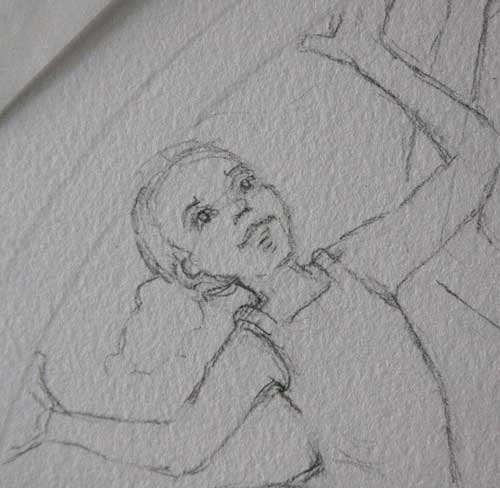
Still some work to do on the woman’s arms and torso, and some cleaning up of the face.
The little girl finally has a face.
Tomorrow I’m hoping to begin painting.
My artist friend Cynthia says that I like the planning part best; that’s the big part of my process of making art. Yes, she’s right.
I do like to plan, and not just because I’m a tad bit compulsive. I like to plan because that allows me to be more spontaneous when I get to the big painting (on the expensive paper). I like to experiment before I start, trying out many different things. In fact, I wish I had time to do more of it.
Who knows how this painting will turn out? Sometimes it’s all a crap shoot, really. Sometimes all the pre-planning in the world doesn’t make for a good painting.
My blogging friend Chris (who brilliantly identified this drawing as a mandala, before I even made that connection), at Groundswell, likes to play Mahjong at the computer. She wrote last week:
“We think we are at the end. . . that no other possibilities for movement exist. . . and then, we see one more tile, turn it over, and everything opens up, everything changes.
We can never see everything or be fully “prepared” for what’s to come. And in this Mystery is much of the joy that is life, and, of course, some of the suffering.”
If you think this blog might be of comfort to someone, please share it
After reading Sue Smith’s blog at Ancient Artists about pushing your art to the next level, I felt I needed to challenge myself. So, watercolor backpack in hand, and a stack of failed paintings (the backs of the paper still pristine, ready for work) under my arm, I headed to a local life drawing session to try my hand at sketching with water and paint.
I was in a kerfuffle from the first moments, adrift without the guiding compass of charcoal pencils and kneaded eraser. And painting at the session was completely different from painting at home. Normally I stand at my easel and work on a vertical surface; at the session, I sat at a table, paper propped on my backpack.
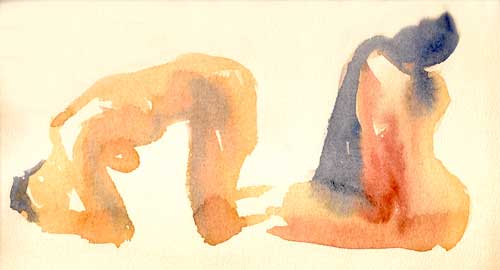
1-minute watercolor war zone
Right away, my body rebelled against sitting. My neck and back ached, my hands stung, and my butt fell into a pins-and-needle coma. The process of painting like that was awful.
I floundered during the first 20-minute set of 1-minute poses, completely rudderless and out of control. I thrashed about with brush, paper, paint, water, making a mess.
The quick gesture paintings looked like a war zone. Body parts were disconnected. Chaotic limbs and runny torsos bled across the page. The figures turned into misshapen blobs of color.
During the break in poses, I screwed up my courage and asked if it would bother anyone if I stood. Talking to people! Asking for something! That was a breakthrough in itself, overcoming my little mouse-self that doesn’t like to make a fuss in public.
You know what? Nobody cared. So I stood.
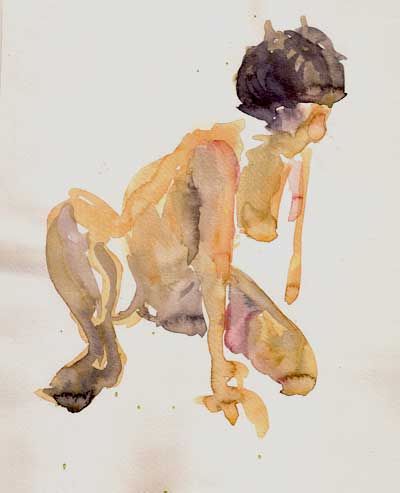
That helped. The next set of 2-minute poses made me much happier. I began to make friends again with my paintbrush, and like any good friend, my trusty Kolinsky sable helped me to see in a new way. It taught me to look for the large shapes, forms, and shadow patterns.
2-minute watercolor sketches
The 5-minute poses came along a bit better . The one below is my favorite. The horns on her helmet-hair were accidental, but I love them. Watercolor warrior woman!
5-minute watercolor sketch
At 10-minutes I thought that I could give myself a few graphite guidelines to help me control where I put the paint. And that is where I lost the energy of the previous paintings.
10-minute watercolor sketch
Below you can see the final 20-minute pose. Except for the extraordinarily long arm, it’s a pretty correct representation of the model’s position. But that’s about it. It has lost some of the wonderful freedom of the quick sketches.
20-minute watercolor sketch
Somewhere between loss of control and total control there are pictures to be made. The challenge is to navigate to that tricky space.
If you think this blog might be of comfort to someone, please share it
Last month I spent a brilliant morning drawing at a model guild benefit, and it reignited my love of life drawing, and especially the gesture. And since I get an disproportionate number of hits for “gesture drawing,” I thought I’d scratch out some thoughts on gesture drawing from life.
Gesture drawing is often described as capturing the action of a pose, the feeling of a thing, the “inner essence”. It’s quick, it’s forceful, it’s to-the-point. It captures an active moment in time. A frozen glimpse of a model balancing on one leg; a dog loping along the beach; a bank of clouds blowing like boulders across the horizon.
At it’s most academic, gesture drawing is about studying. It’s about drawing—a lot of—poses, or people, or animals, or landscapes, in a short amount of time. It’s a rapid and deep immersion into a multiplicity of form and line. It’s an exploration of media and mind. A flick of the wrist and the arc of the arm discover new shapes and spaces, new angles and elements, new ideas to build upon later when drawing time has once again slowed to a careful crawl.
But at it’s most basic level, gesture drawing is simply and awfully darn fun.
4 1-minute gesture drawings
Charcoal on newsprint
If you think this blog might be of comfort to someone, please share it
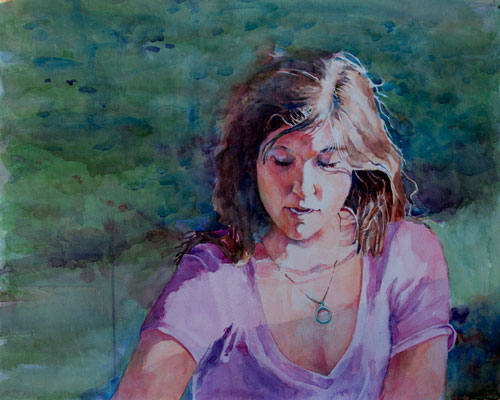
Kate Watercolor 23″ X 19″ 300# Arches hot press
Copyright 2012 by Margaret Sloan
When I painted this picture, I remembered that Mary Whyte, in a workshop, told us to name our paintings before we made our first washes of color. I couldn’t for the life of me remember this girl’s name (the daughter of a cousin-in-law, she’s a delightful girl, but I only met her once), so I just called her princess. I don’t mean princess in a bad way—all diva and finer-than-thou—but princess in a good way, a fairytale Cinderella-sorting-ashes or brave-and-loading-bullets sort of way.
As readers of fairy tales and fantasy-fiction know, names have power. So I let the word princess guide my brush. When I was stuck for a color choice, I whispered the word: princess. The taste of the word on my tongue gave me the flavor of the color I needed to use in that passage.
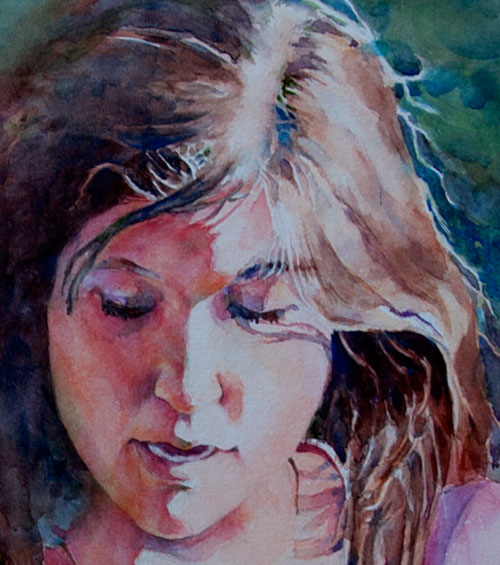
My favorite part of the painting, and the whole reason I wanted to paint this, is the shadow that curls under the sunlit eye. I love the way the curve describes the roundness of the cheek. There’s something delicate and fragile in that shadow, a sweetness and hope particular to young women.
Kate Detail Watercolor 23″ X 19″ 300# Arches hot press Copyright 2012 by Margaret Sloan
Then suddenly, as I approached the end of the painting, I recalled that her name is, or might be, Kate. If it’s not, it’s still the name of this painted princess-girl.
If you think this blog might be of comfort to someone, please share it
6 years ago I got serious about my artistic development. Before, I’d always played at art—painting, drawing, leather masks, weaving—but I’d never spent concentrated time studying. Sure, I had ideas, but no skills to get those thoughts out of my head.
So I embarked on my own personal quest. Imagine the young (at least, younger than I am now) heroine setting off along a charcoal-dusty road.
I enrolled in the Atelier School of Classical Realism to study anatomy under Rob Anderson (4 years, every other Saturday). Along the way, I absorbed as much as I could from the school’s founder, David Hardy. I spent nearly every Tuesday night for 5 years working in watercolor with Steve Curl. I took workshops from Christian Fagerlund, Mary White, and Ted Nuttall. I studied color with Linda Lum. Most recently, I’ve been learning oil painting from Felicia Forte. They are all wonderful painters and teachers.
But recently during a workshop, as the teacher gave a short lecture on facial features, I realized that, because of the time constraints of a workshop, the instructor was pointing at a signpost on a road I’d already been traveling for half a decade.
A teacher is a good thing. They can stand at your shoulder and whisper directions into your ear, direct your hand, push you up the hill when you get stuck. But eventually the student has to do the work herself and synthesize all that she’s learned to create a thing that belongs to her.
I think that time has come for me. I need to hop off the classroom cart and travel on my own for a while. I need to take the paint-craft skills and ideas my teachers have given me and start a new quest in my studio.
I know that someday (probably soon) I’ll need to again join up with a teacher, but for now, I need to figure out some stuff on my own.
I need to spend some time walking down that painting road alone, on my own feet. Make solitary camp, live rough, and paint until my fingers bleed.
Moffett Hanger 1: Still with Skin Oil on panel Copyright 2011 Margaret Sloan
This fall I had the good fortune to be invited to a paint-out at Moffett Field. I chose to paint Hangar One, the gigantic house for the USS Macon, an airship so huge that even now, in this age of miracles, that it boggles my mind to imagine how big it was.
Hangar One loomed over my childhood landscape, although only from afar, as we weren’t a military family, and in those days it was forbidden for non-military to visit the base. But it was a landmark that we always remarked on when coming home from vacations in the Sierra, and my dad, who’d actually done some work in the hangar always exclaimed, “that thing is so big, they’ve got their own weather in there!” It is big; see the little door at the bottom right of the painting? That little door is about 10 feet tall.
These days it’s possible for civilians to visit the base and get up close to the hangar. This painting is on view (along with other paintings and drawings) at the Moffet Field Historic Society Museum as part of an exhibit honoring the 70th Anniversary of Pearl Harbor. The exhibit lasts until January 7th, so there’s still some time to see it if you’re in the Bay Area. It’s a very interesting museum; make sure you leave time to get a tour from one of the docents!
Image via Wikipedia USS Macon docked inside Hangar OneImage via Wikipedia USS Macon docked inside Hangar One
If you think this blog might be of comfort to someone, please share it
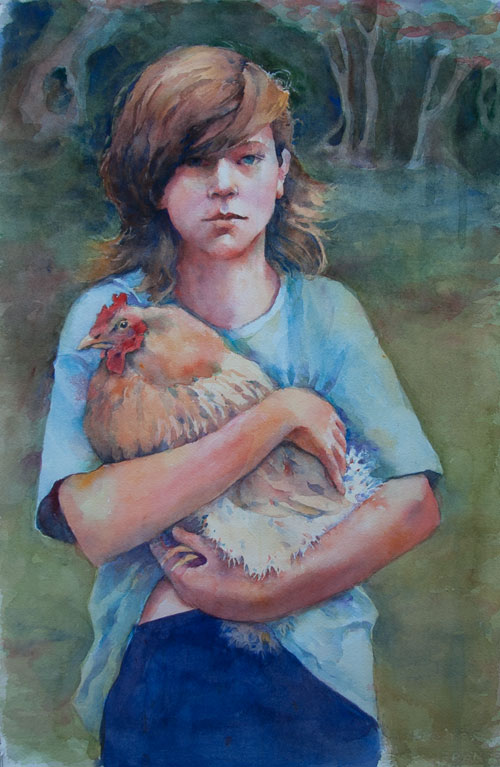
Boy with Chicken Watercolor
Copyright 2011 Margaret Sloan
I met this young boy at Hidden Villa one late afternoon. He was with his family, looking at the chickens. Suddenly he scooped up one of the hens and cradled her in his arms. She didn’t seem to mind. I asked if I might take a photo of him. He nodded silently, so I snapped a few photos. I wish I knew who he was so I could give him and his folks a copy of this.
I made this painting after taking Ted Nuttall’s watercolor workshop. If you compare it to the painting of the fiddler that I finished before the workshop, I think you’ll see a lot changes and improvements. At least, I can see them.
In past paintings, I’ve worried the paint to death. I’ve tried to make every transition smooth, and ended up making everything is bland, and even, and lifeless. Ted’s workshop made me finally see that what was missing were edges (although other art teachers have preached edges to me, I evidently wasn’t ready to hear that painting gospel). When I did paint edges, they were too abrupt, unsubtle, unsophisticated.
Edges are important. They give a painting movement and life, tell the story, sing the song. Hard edges can describe a fold, a crease, or the boundary of a cast shadow. Soft edges show a rounded structure, a form shadow, or a distant horizon. Between the nounage of hard and soft edges, there is a whole visual dialect—a spectrum—of edges that make a painting speak with nuance and grace.
When I think about edges in a painting, I’m always reminded that in nature, the edges of eco-systems are the places where life is most abundant. And now, when I paint, I’ve been trying to remember that edges are ok; they are, in fact, necessary to the life of the painting. Edges are where things happen.
Face—Detail of Boy with Chicken
Feathers—Detail of Boy with Chicken
If you think this blog might be of comfort to someone, please share it
My band has been preparing for a gig. We recorded a tune, and when I listened to it, I was horrified to hear a tempo as ragged and floppy as an old stuffed bunny.
I play Irish flute, specifically dance music. I love the rolling beat, the pulse of the tune lifting and driving dancers through the set. The beat needs to be crisp and perfect to move the dancers.
But that what wasn’t what I was hearing in our recording.
So I’ve spent the last week practicing with a metronome, first lilting the tune in time with the flashing red LED, then trying to match my flute playing to that maddening strobe.
It’s amazing how that little pulsing light seems to slow down and speed up as I play a tune. At first I thought there was something wrong with the metronome, but of course, there’s nothing wrong with the electronics; it’s my playing that’s uneven. But gradually I’ve managed to tame my out-of-control tempo, and the tunes sound all the better for it.
Painting isn’t like playing a flute, but visual arts don’t exist outside of tempo. I think that paintings have their own internal tunes. My favorite paintings are those that make my brain feel like I’m seeing music. Sorolla paintings play tunes to me. Zorns are full of music. Sargent is something like a symphony. Surprisingly (because I prefer realistic work) Paul Klee paintings are like small pipes and fiddles.
I find that external noise while I paint influences a painting’s tempo. My most successful paintings are done in silence, when I really listen to the painting and pay close attention to the pulse that each passage requires. I listen carefully to hear fast strokes that are well conceived; slow shapes of color placed just exactly where they need to be; staccato or slurred edges; the pacing of high and low values. I’m always asking myself, how do I encourage the viewer to dance through a painting?
When I paint, there’s no steady tick-tock of a metronome, other than the drum of my blood and the deep sound a painting makes when it’s making my heart dance. Only if my heart is shouting “house Maggie, mind the dresser!” will I have a chance to let others hear that internal music.
If you think this blog might be of comfort to someone, please share it









 Mockingbirds at midnight