Quick color temperature

Pastel and chalk on toned paper

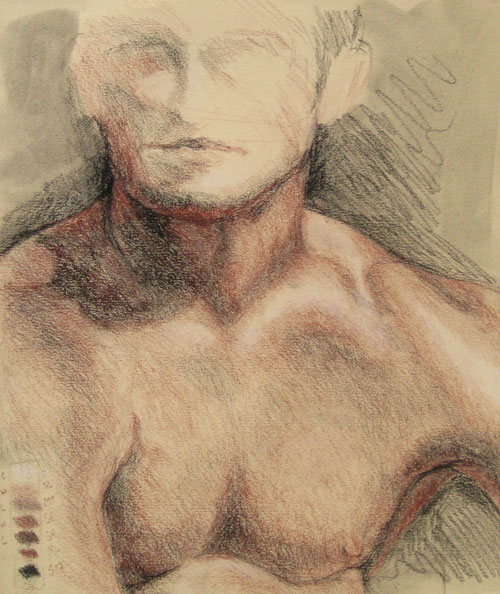
This year at the atelier I learned modeling using color temperature—we used a limited palette of 4 earth-toned pastel pencils, charcoal and white chalk, and toned paper to create form and shadow.

This method is about intellectualizing your drawing. It’s about making a conscious plan rather than just grabbing a color and hoping it will work. We drew value scales in color to denote the color temperature of highlight, strong light, midtones and shadows, paying close attention to warm and cool color temperature and where it was placed in the scale. This is agony for me. I don’t do it well. Scales suck.

Since I am also a musician, I know the value of scales. I think of them as athletic training, like the drills that prepare the football player for that winning 100-yard dash. Playing scales prepare the musician for a blindingly brilliant set. Playing the actual notes become muscle memory, the body goes on automatic pilot and the musician’s  intuitive brain is free to choose the music she hears in her head.

I figure it must be the same for the style of painting I’m yearning to do. Once I’ve internalized color temperature theory, I’ll be more able to make intuitive choices that are based on logic.  That’s when I think true creativity can emerge.
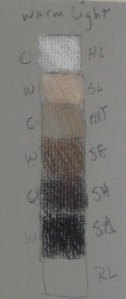
Value chart for warm light

So I drew value scales religiously for each of my drawings this year. They helped. It’s surprising how far astray you can go from your original values over the course of a long pose. I leaned heavily on those value scales to re-orient myself and to overcome frustration. I know I frequently muttered things like, “strong light is cool. Cool, dammit!”

But on the last day of class this year I decided to whip out a drawing using the color temperature principles without agonizing over a value scale. The drawings at the top of the post were of ten minute poses each on toned paper. I did have to write the color temperatures down so I could remember which shadow was cool, which highlight was warm, but I didn’t need to draw a value scale. I was pleased that the concept is beginning to integrate into the way I choose color.

The question of perfection

Fluteplayer <br />  <br>© 2009 Margaret Sloan<br /> <i>Graphite </i>
Flute player © 2009 Margaret Sloan

I’ve been working on this painting for something like a month now, doing color roughs and composition studies. Of course, I don’t work on it every day (the day job, much as I love it, cuts considerably into time for painting and drawing), so I have some (lame) excuses for my slow pace.

This is the drawing for the for the final painting.  It’s given me quite a lot of trouble, because I have been picky about it. Teacher Steve has said, “you’re splitting hairs. I know that’s your working method, but you need to get on with painting!” I know he’s got a point: the piece can get too precious. But I know also that I need to get the base drawing right in order to convey what I have to say in this painting.

First of all, I needed to get the tilt of the flute player’s head as she bends forward to meet her flute. The head is down, the chin tilted to the left, and the body curls around the instrument. (This  flute posture is actually a position I’m trying to modify in my Alexander Technique classes, as playing the flute tends to give me terrible stiff necks and headaches.)

I struggled until I was ready to bite the pencil; the drawing kept looking like a profile, until Steve pointed out that when you look down on a persons face, there are certain cues that tell us the tilt of the head. The brow line curves down  and covers the top of the eye. You can see more of the inside of the bottom eye lid. And you can see more of the top of the head. Yeah, I know that already, but sometimes we’re blinded to the simplest mistakes while drawing. I made those changes, and—shazaam!—the tilt was there.

I also want to convey her age (young) which means her features are rounded, slightly blunt, and soft (I’ll use color also as a symbol of her age, when I do finally start painting). I had to measure the drawing carefully, because her chin and nose kept growing in the drawing, giving her that kind of solid jaw-bone look of grown ups.

But the most important thing I want to convey is the way she’s  listening hard to the tune in her head and reaching into her flute to pull out the music and send it into the world. That’s going to be the magical thing that makes this painting work.

This is to to be a larger size painting than I usually work in, on 12 x 16 Arches watercolor block—blocks being the easiest thing to schlepp back and forth to the Pacific Art League watercolor class, where I do most of my watercolor painting.

Late at night we dream of mice

Symbols in the wee small hours
Dreaming of mice
© 2009 Margaret Sloan
Graphite

I watched a lot of b-grade horror flicks when I was a kid. My dad loved Creature Features, and he and I would stay up late together watching the old movies. We didn’t agree on much else in those days, but we both loved Dracula.

The thing the mouse is pulling is a symbol. It appeared in a dream that woke me very early one morning. I’m well acquainted with the small hours of the morning; I’ve never slept soundly, and I wake often. Not because I want to, but because anxiety drives me from the mattress  to the drawing table. It’s a perfect setting for a monster movie scene.

I imagine this frantic mouse is bringing light to a corner of an old stone kitchen. Christopher Lee has just commanded, “Light, quickly! She’s fainted.” The beautiful ingenue is slumped gracefully into a carved wooden chair. The mouse sits up,  chittering in worry while dreadful shadows leap across the kitchen walls. They assume shapes we can only just recognize. She wakes, screams, then faints again. A window bangs open. The candle is extinguished by a damp wind.

Cut to a commercial.

Study of a flute player

Girl playing flute Graphite value study
Girl playing flute
© 2009 Margaret Sloan
Graphite value study

I met this lovely young woman at Friday Harbor Irish Music Camp. She had a boxwood flute that had bent as it aged, but it sounded lovely.

One day while we were in class, the rain and snow stopped, the sky cleared, and the sun streamed through the windows. Sitting in a shaft of sunlight, the young woman glowed as she practiced her tune. I snapped a photo quickly. There was no time to fool around if I wanted to capture the naturalness in her posture. Youth is a time of great beauty, but also great self consciousness.

I’ve come to understand the importance of doing value studies before beginning a painting. Steve Curl, my watercolor teacher, told me that when I was designing the value study I shouldn’t focus on the details. Instead, he said, look for the large shapes of light and dark; I did, and it made all the difference.

I’ve already practiced painting hands playing the flute, so I should be in good shape for her hands.

Reynard’s accordion

Reynard's accordion 2009 Margaret Sloan Watercolor
Reynard’s accordion
© 2009 Margaret Sloan Watercolor

The accordion has gotten a bad rap in this country, thanks to cheesy lounge lizard music and guys in glittery suits. But there are other sides to this instrument, facets that do not include champagne bubbles and Lady of Spain. Accordions have morphed into something new whenever a culture touched them.

I like accordion music, particularly music played on the button box. Particularly Irish music played on the button box (no surprise there), although I’ll take a good French Canadian reel too. English country music on the button box sounds great. And don’t forget accordion is a staple in  Cajun music.

It makes sense to me that a fox should play the accordion. And the fellow in this painting reminds me of a fox.

Raynard the fox was, in European folklore, a trickster, a shape-shifter, a magical animal. May Day seems like a day he is in top form.

I like to think of my Raynard  attracting fluffy white rabbits with his accordion, wooing them with a rockin’ reel or a seductive waltz on dry-tuned reeds and then…well, what he does with the bunnies when he catches them is best left to your imagination. I can assure you that my Reynard doesn’t bite their little heads off, and that they’re pretty happy to have been caught.

May day Morris dancing

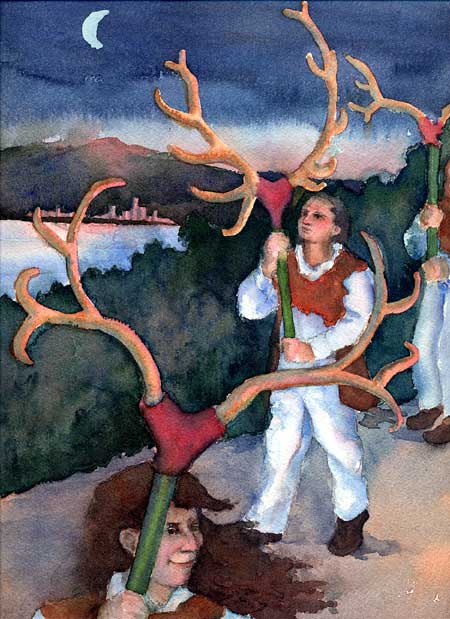
The Palo Alto Baylands before dawn on the first day in May is a chilly place, quiet except for a few startled shorebirds and the shuffling of feet. People gather in the parking lot, talking quietly between yawns. Later there will be revelry, laughter, and silliness, but right now they wait. And just before the sun comes up, men carrying deer horns emerge from the darkness to dance to a haunting tune in a minor key.

Abbots Brumley Horn Dance (Thaxted version)  Watercolor on Arches paper
Abbots Bromley Horn Dance (Thaxted version) Watercolor on Arches paper

This is Morris Dancing, an English style of folk dance that is very old. No one is quite sure how old it is, but evidently records dating back to the 1600s mention it. It’s almost died out several times—Cromwell and his puritans put a temporary halt to it, then the industrial revolution bled people from their culture and nearly killed it—but was revived in the early part of the 20th century. How ironic that it’s had another revival in this age of technology killing culture. In fact, it may be that technology has helped it grow (although some predict a decline),  and now Morris teams all over the world clash swords, shake bells, wave hankies, and dance to the music of accordions and fiddles. They dance to help the sun rise on May 1, a brilliant endeavor, and a happy one. Then, I believe, they go have some beer.

The dance I’ve painted here is the Thaxted version of the Abbots Bromley Horn Dance.  The Thaxted version is haunting, mystical. You feel like you’ve stumbled upon some primitive rite in the midst of the megalopolis. Like an ancient god will spring from the bay mud and perhaps accept  a sacrifice as the dancers make their moves. It’s deliciously chilling and meaningful.

But the Thaxted version an after-market dance. The original, still performed in Abbots Bromley after something like 800 years, is lively, fun, and a little goofy. Danced in daylight. Lot’s of bouncy tunes. To this Yank, Monty Python springs to mind. In the best possible sense, of course.

This is a study for a larger painting I have in mind. As always, I imagine I’ll paint it many times before I get it to the place I want it to be.

If you’re up before dawn on May 1, find a Morris team near you and go help them dance up the sun.

Drawing in three colors

Neck study  Charcoal, chalk, sanguine on toned paper
Neck study
Charcoal, chalk, sanguine on toned paper

At the Atelier  School of Classical Realism, we’ve graduated from using only charcoal and white chalk. We’ve added a third chalk: red-hued sanguine. Boy, what a difference! With charcoal, white chalk, sanguine, and the toned paper, we’re actually working with four colors, and it’s amazing how many variations in value and hue we can mix.

At the bottom left of the drawing above, you can see my value chart. Working out your values before you start adding tone is absolutely the way to go. It doesn’t pay to be lazy in this regard; you’ll end up either working harder in the end, or just giving up on the drawing.

This drawing was done in about 3.5 hours, and with this limited amount of time (we do lo-o-o-ng poses in this class. I’ve worked on drawings up to 15-20 hours, so 3.5 hours was brief for me) I chose to do a study of a neck because Rob had just given us a terrific lecture on how to stick the head on the torso (always an important thing!) and I wanted to try out his ideas.

The key to getting the head on right is placing the neck properly. And the key to placing the neck is to think of it as a column emerging from top of the torso.

Sounds simple, but it’s not.

Whistles in the dark

Three Penny Whistles Graphite on paper
Three Penny Whistles
Graphite on paper

My wonderful husband gifted me with a Michael Burke whistle for our anniversary. I’ve been craving one.

I have to admit that, as a whistle player, I have many whistles. I don’t know why, but whistle players often have more whistles than does a bird singing in the moonlight. Perhaps we are always looking for that perfect instrument that will give us a nice loud true middle d, as well as a soft, chiffy high b. A whistle that can be heard above the din of fiddles and pipes. A whistle that won’t screech so loud your fillings fall out. It’s a never ending search and whistle makers oblige us in our quest.

I was struck by the differences of whistle construction, and this week during a sleepless night, drew three of my favorites (from left to right, Susato, Water Weasel, and Burke) to learn how to draw the materials they are made of (black plastic, pvc, and brass). And to admire my new Burke.

The Susato is a good loud session whistle. I played it happily for years. Then the Water Weasel was my favorite whistle until it cracked. It never played the same again, even after it’s creator, Glenn Schultz, repaired it. Now it’s cracked again, and unfortunately, Glenn has passed away.

The Burke is lovely. It’s not very loud, which is great for playing in our apartment. It’s got a sweet sound. It’s a little chiffy on the high notes, which I like. All in all, I’d say the husband got a good lot of husband points for this gift.