Prud’hon method

Self-portrait in charcoal and white chalk

In the third year at the atelier, Rob started teaching us different techniques which will eventually lead to color temperature theory. Leaping into technique was a little daunting, as I was still (am still!) struggling to get an accurate rendition of the figure on my paper. Rob has an exacting eye, and with his help, I’m slowly learning to see where I go wrong in the initial stages of a drawing. These days, when I’m working on a drawing, I don’t just accept the first marks that go on my paper; instead, I try to use a more critical approach.  And measure, measure, measure.

After we started working on colored paper, Rob introduced the Prud’hon method. Prud’hon was a French Romantic painter who produced some amazing drawings using toned paper, charcoal, and white chalk. A brilliant Bay Area teacher, Rebecca Alzofon (who, unfortunately is no longer teaching) has a tutorial on the Prud’hon method. I rarely follow tutorials, but I did follow some of this, and found it helpful to build on what I’d learned in Rob’s class.)

There’s a lot of smudging going on with this method. Tone is put down by a series of hatch marks, which are then smudged and blended. Charcoal and chalk can be blended, or not. After you’ve built the volume and form, to accent areas, you use line—not contour line, which would go across the form, but rather, line that follows the direction of the form.
Painting hands

hands playing flute

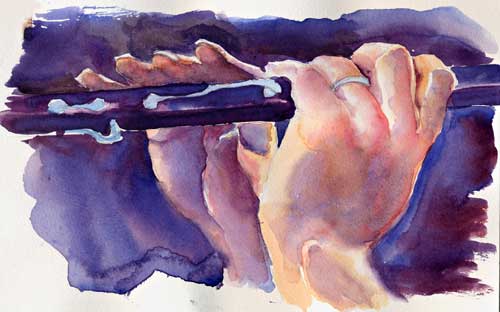
These are the hands of William Bajzek, a very fine Irishflute player from County Santa Clara (that would be in California).

When you play the wooden flute, you feel the flute vibrate through your hands and the air rush up through the finger holes. A well-made flute feels nearly alive in your hands, ready to start singing at barely a breath of air. When I watch William play, it seems to me that his hands as well as his ears are listening to his flute.

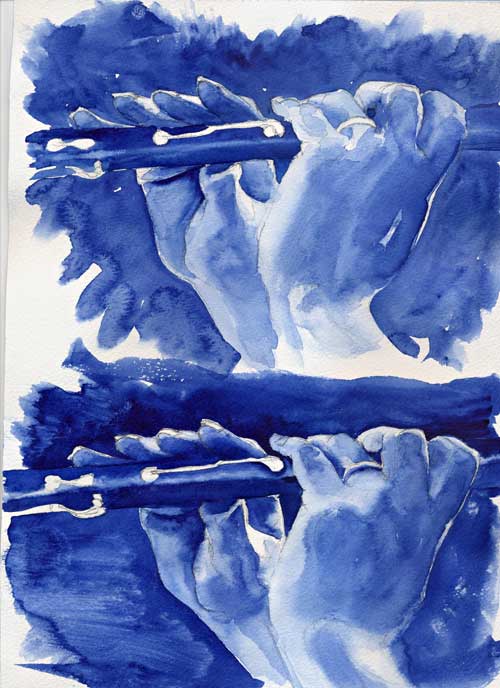
monochromaticstudyI’ve painted this image in watercolor 8 times. The first 6 paintings were one-color value studies, painted on Biggie watercolor paper, 2- up. I was trying to understand the way the values moved across the forms, and how to manipulate the paint. With watercolor especially, you need to have a plan, a framework around which to build your spontanaity, and I’m trying to figure out that plan.

I’m posting just one pair of my favorite one-color studies. I think it’s nice as one color, but I have a color piece in mind.

The first time I tried to use color was disastrous. Lesson learned: start with light value colors first, and progress to dark values. Also, be very careful with staining color, because it’s nearly impossible to remove.

I’m not entirely happy with this first color version, although it has a freshness to it. But the cheap paper buckles unattractively. And I’d like it to be a little tighter, less impressionistic, although I know that is the style in watercolor right now. Somehow I’d like to combine freshness and control in my watercolors.

If you’d like to know more about woodenflutes, you can start at woodenflute.com.

Sketching at the Dickens Fair

victorianhats

victorianfiddlers
These two fiddlers played for Morris Dancing. Very high energy.
victoriandresses
These two ladies were in exquisite dresses. I want a hoop skirt!

These are sketches I made at the Great Dickens Christmas Fair this year. The fair is enormous fun. It’s a whole day of theater. The costumes are fabulous, and everywhere you look there’s something happening. It bubbles up all around you. I call it immersion theater. Dickens’s characters are all there: Scrooge and Marley bicker in the streets, Miss Havisham wanders through the lanes, Fagin teaches Oliver to pick pockets in an alley, and a cast of extras exclaims over the scandalous window models at the Dark Garden (Ok, so the hilarious window undressings are not really Dickensian, but those models are terrific).

This is the first time I’ve taken my sketchbook to a very public place and sketched. It was fun! And I was happy with my short sketches.

I have to admit, I was nervous about it. I’ve mostly been embarrassed to draw in public, but after these last three years of practice at the atelier, I’ve built my skills to the point where I’m much more confident.

Why so shy? Because anyone can—and will—look over your shoulder at your painting or drawing. We all know not every painting or drawing is a success, but when you work in public, good or bad, it’s on view for all the world. And the world is remarkably free in dispensing comments and criticism.

To be an artist in public, it takes a thick skin. You must get used to every kind of comment, and take none of them, even the good ones, to heart. You must be brave.

The Great Dickens Fair seemed like the perfect place to begin being courageous.

I keep on working.

There was a terrific Middle Eastern dance troupe called Hahbi 'Ru
There was a terrific Middle Eastern dance troupe called Hahbi 'Ru. One lady danced with a huge sword. I drew with a Bic pen.