Despite my best intentions to control my time, this painting of a little tea pot got away from me. I spent far more than one hour on it and it’s only beginning to be what I want it to be.
I worked hard on the initial drawing. I wanted it to be correct before I began splashing paint around, as pencil is easier to change than watercolor. But I could have worked on it longer; man made objects are hard to draw accurately.
Now the question is, should I work on it a few more hours, or should I give up and start over with a fresh drawing of a better composition? One of my favorite painters, Thomas Aquinas Daly, might simply scrub out parts of the painting. Sometimes I think we give up too soon on paintings, so I’ll keep hacking at this one until it’s destroyed or becomes a better painting.
Plus I’ll start something new tomorrow.
Teapot Close up Watercolor on Arches #300 hot press
Thought it might be interesting to see some of the brush strokes.
If you think this blog might be of comfort to someone, please share it
After the complexity of painting an antler in my new shadowbox, I thought that it might be easier to so something simpler, less complex.
It turns out that painting an egg is harder than you’d think. Yes, I’ll try painting an egg another day (maybe not tomorrow). Really seeing that blanquillo—that little white one—is a challenge. Really seeing the colors and values and figuring out how to portray them in paint flummoxed me.
Despair. I should just study accounting (actually, I am).
While I was slopping away at this egg painting, getting more and more frustrated, I was listening to NPR’s new podcast, Inivisibilia. The story of Martin Pistorius, locked in his mind and unable to communicate at all, sort of slammed my psyche up against the wall. If you haven’t listened to this show, go straight there, right now, and listen to Locked-in Man (click here) Then come back and let’s talk.
Sometimes living the artist life is frightening and frustrating, and full of mistakes, wrong turns, and dissatisfaction. My mind is constantly scolding me for choices I’ve made, big and little, and telling me horror stories about the past, present, and future. Sometimes I get locked in to my own fears, and they’re all I can hear. It gets in the way.
The story of Martin was a little like a thunderbolt in my brain. Imagine living so locked in, so completely out of your own control, with the sound in your head of your mother’s words: “I wish you’d die.” Not just living with those words, but unable to talk back, to cry, to fight. Then imagine coming to the realization that those words came from a place of deep compassion from your momma’s heart, and forgiving her for those hard harsh words. Good heavens.
Martin let his thoughts float by, examined them without getting torn up by them, and built his own inner life. Very Zen, and very hard to do. But it seems like it would be so worth it to be able to do that. I see the necessity. Now I need to figure out the methods.
I’d love to hear from you. Reader, if you’ve figured out how to “let it go,” share it with us in the comment section.
If you think this blog might be of comfort to someone, please share it
People often ask if I paint portraits from life. Yes, I do, and I prefer it actually. But no one wants to sit still for that as many hours as it takes me to paint a portrait.
But as part of my 30 in 30 challenge (30 days of painting for at least an hour a day from life only), I persuaded a visiting friend to sit for me for about 2 hours. We were listening to my fiddler and her banjo-player have some major old-time tunes, and she was itching to dance (she’s an avid and talented dancer). Between the wiggles and the occasional clogging break, I managed to get this quick portrait of her.
By the way, if you’re looking for a journal that will take watercolor, I suggest the Strathmore 500 Series Mixed Media Hardbound Art Journal. It will take several sloppy washes and a lot of pigment with only a minimal amount of buckling. And the image doesn’t bleed through to the other side too much, which makes it useful for journaling. And the binding is a sort of fake leathery-looking material, so it feels a bit rich and special, which we all need sometimes.
You can hear the music here:
If you think this blog might be of comfort to someone, please share it
Why, oh why do I always gravitate towards the complex, the difficult, the ornate?
This antler (naturally shed, I’ve been assured) was just given to me. How exciting! I’ve wanted to make some antler images for a long time, but deer aren’t just dropping their horns all over the place in the Bay Area. This antler was actually the reason I finally got myself together to make a shadow box for still lives.
I will admit, this painting took me longer than the hour I’ve allowed for the 30-in-30 challenge; I worked on it for about 2.5 hours. So much for my day. But I love the shadow box!
What’s wrong with this painting
When I complain to the fiddler about my paintings, his question to me is always, what’s wrong with it and how can you fix it? So I thought I’d publicly pick this one apart a little.
Part of the problem is the placement of the antler in the space. The paper is 8″ x 10″. You can see that, while the shape of the antler is interesting, it’s not really filling the space.
The solution
With our friend Photoshop, I cropped the painting.
Antler (cropped) Watercolor on Arches #300 hot press
That is much better. Now the beautiful spaces between the horns are more noticeable, and the shapes the object makes against the background are more interesting. The antler fills the space, and gives the eye a shorter distance to move to the edges of the paper, which helps lead the viewer around the painting.
Another problem is that I didn’t take time to draw the antler carefully, and pay attention to the form shadows. I’ll be revisiting this subject in charcoal, so seek a better understanding of how it takes up space.
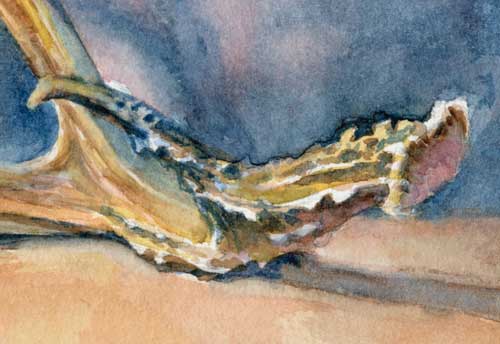
Antler (close up) Watercolor on Arches #300 hot press
Here’s a close up. I tried to simplify the bumpy parts of the horn, while still wrapping my mind around all the patterns of the littler forms.
Next painting? Maybe something simple. An egg?
If you think this blog might be of comfort to someone, please share it
This is the first post in a what I hope will be a regular series called Saturday Studio Time, about the trickery and design of setting up an art studio, whether it’s in a living room, a barn, or a fabulous heated room filled with glowing north light (I wish!). I intend to interview other artists as well as write about my own studio.
Shadow box. I didn’t have enough materials for the bottom, and the top is really two pieces of mat board taped to the shelf above.
I realized that my hour-a-day still-life studies for the 30-in-30 painting challenge need a better set up than a south facing window (although the window set up does give me some terrific back lighting).
A shadow box was needed, a place where I could light the subject independently of the light source of the room. But I don’t have a lot of room in my studio, or a lot of time and patience to build something fancy.
But I did have an empty shelf—at eye level when I stand—on my Ivar bookshelves from Ikea (the ugliest bookshelves in the world, but so, so useful to an artist). And I had a black mat board left over from long ago graphic design classes, when we used to mount and display our work. (Does anybody do that kind of handwork anymore? Or do all teachers and clients merely view digital offerings?)
And I had that modern miracle, duct tape.
A cheap clamp light from OSH is the light source. The bulb is a little strong for this set up; I’m going to replace it with a daylight bulb of a smaller wattage. See the duct tape holding the whole thing together? Hooray for duct tape!
I cut the mat board to fit in the Ivar shelve space and taped together a box. It’s not the fanciest shadow box in the world, certainly not like this one, or even this one, and I still am not sure how to shield the front of the box from ambient light, but for a quick and dirty solution, it works fairly well.
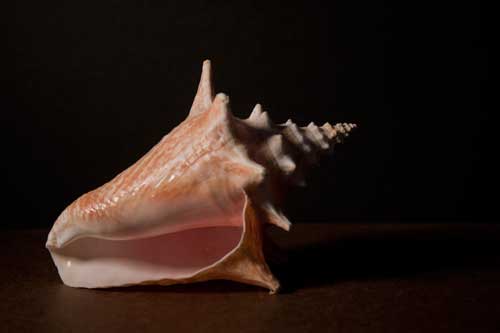
Photo of a shell in shadow box. The fact that it’s a jury-rigged box doesn’t mean it doesn’t work pretty well. It’s all about the illusion.
Back to painting!
If you think this blog might be of comfort to someone, please share it
Trees outside my window, January 9 Watercolor on Arches #300 hot press
Some days you just want to slop paint on paper. I woke up with a yen to work wet on wet (I normally work wet over dry).
My friend Cynthia Brannvall once said to me that she liked art that suggested rather than described, so that she could make up her own story. I try for that in my work, but my literal mind often wants to control my hand. I love how sometimes watercolor will puddle into suggestions, the less help from me, the better.
Note to self: play more.
This is part of a series exploring one 1-hour painting (nearly) every day in January as part of Leslie Saeta’s series, Thirty Paintings in Thirty Days. To see my experience with the entire series, click on the category, 30 in 30, at right.
If you think this blog might be of comfort to someone, please share it
Pescadero Beach, January 6 Landscape sketch in oils. Sometimes we all must fail.
Monday I was fortunate to attend a landscape painting class taught by Halcyon Teed. The weather was balmy, the light exquisite. I was excited to be there.
But painting that day was like trying to run through sand; a slog all morning. It’s been a while since I painted in oil, and I just couldn’t re-friend my colors. My thought at the end of the day? Fail.
I’m showing you this stinker because I think it’s important to fail. And it’s important for those of you, dear readers, who may be knotted up in your own artistic struggle, to see other artists fail. (And if you’re a successful artist, well then, feel free to snigger.)
So often when we look at the work of others, all we see are the successes, the award winners, the masterworks and show pieces. We don’t see the fumbles, the embarrassments, the groaners. The awkward marks and homely scumbles that get rubbed out before anyone can comment.
I think it’s a false picture. It’s an artistic version of the Facebook effect. Everybody is a mo’ bettah painter than I am. And when I’m scrabbling away at frustration, all that perfection from others is demoralizing.
“The first thing you have to do is pick up the brush. Then, make as many mistakes as you wish. Every stroke is just practice.”
That’s a good mantra to paint by. Part of the reason I’m playing the 30 in 30 challenge is because I want to pick up that brush everyday and make as many mistakes as I can. Spending a specified amount of time each day painting thoughtfully is also creating a lot of work, and the more work I make, the less precious it becomes. I’m better able to sort through the clinkers and find the shiny stuff.
It’s kind of like playing scales on an instrument; sometimes they’re just scales, sometimes they’re noise, but occasionally, they’re music.
Once in a while, I may make a painting.
This is part of a series exploring one 1-hour painting (nearly) every day in January as part of Leslie Saeta’s series, Thirty Paintings in Thirty Days. To see my experience with the entire series, click on the category, 30 in 30, at right.
If you think this blog might be of comfort to someone, please share it
January 4: Shell in window Watercolor on Arches #300 hot press
I needed a change from cyclamen and orchids, so I chose a conch shell that reminds me of my years living in the tropical seas. During the chilly mountain winter I sometimes miss the torrid tropical heat.
This complicated subject really begs to be a long, painstakingly arduous still life. All the while maintaining the freshness of this hour-long sketch. Super exciting!
The secret to creating the glow of sun through shell is in making your dark values deep enough to contrast with the lights, all the while avoiding the chalkiness that sometimes comes from dark watercolor pigment. This means I had to lay down multiple translucent layers of progressively darker paint. I use Arches #300 paper because it soaks in the moisture and dries faster than the thinner papers. Try it; it’s worth the expense.
This is part of a series exploring one 1-hour painting (nearly) every day in January as part of Leslie Saeta’s series, Thirty Paintings in Thirty Days. To see my experience with the entire series, click on the category, 30 in 30, at right.
If you think this blog might be of comfort to someone, please share it
This is part of a series exploring one 1-hour painting (nearly) every day in January as part of Leslie Saeta’s series, Thirty Paintings in Thirty Days. To see my experience with the entire series, click on the category, 30 in 30, at right.
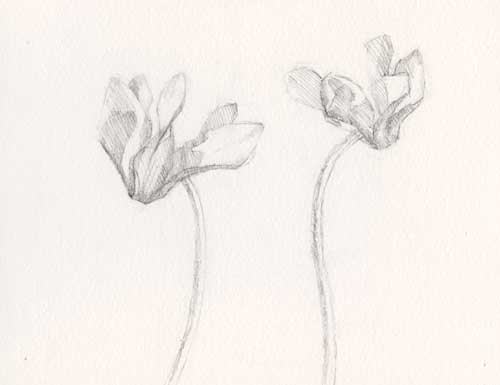
Pencil sketch Arches #300 hot press watercolor paper
I began this painting with a quick drawing, trying to pencil in the shapes and shadows on the flowers before I started painting. This initial drawing took 30 minutes. I’ve also switched back to Arches #300 hot press watercolor paper, as I prefer the way it takes water and pigment (and it doesn’t buckle and curl like lightweight paper).
Watercolor-30 minutes Arches #300 hot press watercolor paper
When I started adding paint, the pencil shading did make it a little easier to figure out what I was doing. The image above is what the painting looked like after 30 minutes of painting.
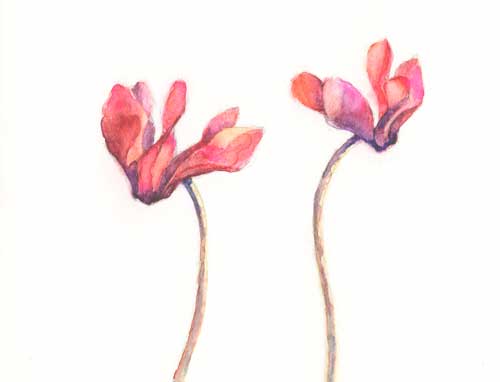
Watercolor-60 minutes Arches #300 hot press watercolor paper
I couldn’t help myself, and when my hour was up, I went back for 30 more minutes to clean up the painting, scrubbing out some messy areas and restating the shadows and highlights. I used Windsor Newton Opera Rose for the brilliant pink, although I realize that’s an extremely fugitive color (Handprint, the blessedly exhaustive web catalog of watercolors disagrees with the fugitive rating of this paint, and says, “I see absolutely no reason to avoid this splendid pigment.”) It’s an awfully pretty color, and really helps with the light-struck areas in the painting, but I would not use it on a painting meant for exhibition until I’ve done a lightfastness test.
All of these flower paintings so far have been done from life, with sunlight as the light source. Since my studio window faces southwest, the sun is constantly moving, which is part of my process to force myself to capture an image quickly.
If you think this blog might be of comfort to someone, please share it








 Mockingbirds at midnight